The Particle 了 (le): Change of State
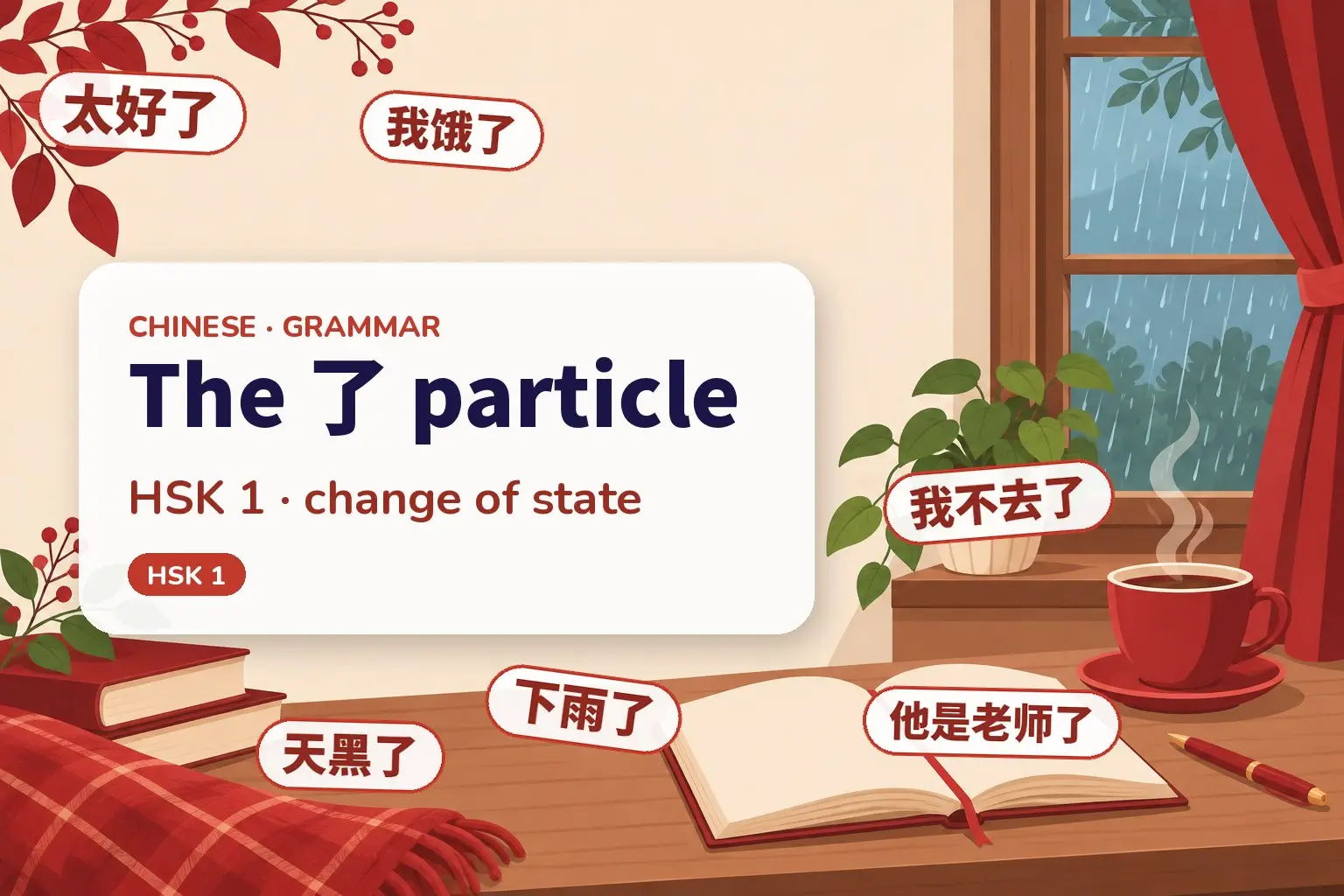
Sentence-final 了 (le) signals a change of state or a new situation, not past tense. 下雨了 (xià yǔ le) means it is raining now, because the rain is new. Put 了 at the end of a sentence to say something is now different from before.
Level: HSK 1. The little word 了 (le) worries learners because it seems to pop up everywhere. The single most useful job it does is this one: placed at the end of a sentence, 了 (le) says a change has happened — things are different now.
The rule
A particle is a small grammar word with no meaning of its own; it tells you how to read the rest of the sentence. Sentence-final le — the 了 (le) sitting at the very end — marks a change of state: a new situation that was not true before.
So 下雨了 (xià yǔ le) is not simply it rains. It is it is raining now — the rain is new. 我饿了 (wǒ è le) is I have got hungry / I am hungry now, not just I am hungry. The le adds the sense of now, of a switch from one state to another.
This is why calling le a past-tense marker is misleading. Chinese has no tense at all — verbs never change for time. Final le marks aspect (how an action sits in time), and a change of state can be in the past, the present, or even the near future: 我要走了 (wǒ yào zǒu le) means I am about to leave — a change that has not happened yet.
The pattern
| Pattern | Pinyin | Meaning |
|---|---|---|
| 下雨 了 | xià yǔ le | it is raining now |
| 我 饿 了 | wǒ è le | I am hungry now |
| 天 黑 了 | tiān hēi le | it has got dark |
| 他 是 老师 了 | tā shì lǎoshī le | he is a teacher now |
| 我 不 去 了 | wǒ bù qù le | I am not going anymore |
The frame is simply [sentence] + le. For not anymore, the frame is 不 (bù) + [verb] + 了 (le).
Example sentences
- 下雨了。Xià yǔ le.It is raining now.new situation
- 我饿了。Wǒ è le.I am hungry now.
- 天黑了。Tiān hēi le.It has got dark.
- 他是老师了。Tā shì lǎoshī le.He is a teacher now.change of role
- 她三岁了。Tā sān suì le.She is three years old now.
- 我们到了。Wǒmen dào le.We have arrived.
- 太贵了。Tài guì le.That is too expensive!tai...le emphasis
- 我懂了。Wǒ dǒng le.I get it now.
- 妈妈回来了。Māma huílái le.Mum is back now.
- 水开了。Shuǐ kāi le.The water has boiled.
- 我要走了。Wǒ yào zǒu le.I am about to leave.imminent change
- 现在几点了?Xiànzài jǐ diǎn le?What time is it now?
- 他累了。Tā lèi le.He has got tired.
- 我不想去了。Wǒ bù xiǎng qù le.I do not want to go anymore.bu...le = not anymore
- 你长高了。Nǐ zhǎng gāo le.You have grown taller.
- 天气冷了。Tiānqì lěng le.The weather has turned cold.
- 我吃饱了。Wǒ chī bǎo le.I am full now.
- 灯亮了。Dēng liàng le.The light has come on.
In every case, le tells you the state has just switched.
Common mistakes
- ❌ 昨天我很累了 (zuótiān wǒ hěn lèi le) → ✅ 昨天我很累 (zuótiān wǒ hěn lèi). With 很 (hěn, very) describing an ongoing state, you do not add le; it would force a change meaning that clashes with very tired all day.
- ❌ treating le as a past tense: using 我是学生了 (wǒ shì xuéshēng le) to mean I was a student → ✅ 我以前是学生 (wǒ yǐqián shì xuéshēng). In fact 我是学生了 (wǒ shì xuéshēng le) means I am a student now — a change into the present.
- ❌ 我不去 (wǒ bù qù) for I am not going anymore → ✅ 我不去了 (wǒ bù qù le). Without the final le it is a plain I am not going; le adds anymore / as of now.
- ❌ 我们到 (wǒmen dào) → ✅ 我们到了 (wǒmen dào le). To announce we have arrived (a change), you need the final le.
- ❌ marking a static fact: using 他是中国人了 (tā shì Zhōngguó rén le) for he is Chinese → ✅ 他是中国人 (tā shì Zhōngguó rén). An unchanging fact takes no le, which would wrongly suggest he just became Chinese.
A short conversation
— 小明 (Xiǎomíng): 下雨了。你带伞了吗? — Xià yǔ le. Nǐ dài sǎn le ma? — It is raining now. Did you bring an umbrella? — 丽丽 (Lìli): 没带。我不出去了。 — Méi dài. Wǒ bù chūqù le. — I did not. I am not going out anymore. — 小明 (Xiǎomíng): 好。天也黑了。 — Hǎo. Tiān yě hēi le. — Okay. It is getting dark too.
Each le marks a fresh change: the rain started, the plan changed, the sky darkened.
Usage notes
- Position matters. Sentence-final le sits at the very end, after everything else. This is different from the le that comes straight after a verb (see below).
- With adjectives. le on an adjective means has become: 贵了 (guì le, got expensive), 大了 (dà le, got bigger), 好了 (hǎo le, all better / ready now).
- The not-anymore frame. 我不喝咖啡了 (wǒ bù hē kāfēi le) is I do not drink coffee anymore — a change away from a habit. Without the final le it is just a present I do not drink coffee.
- The tai…le emphasis frame. 太好了 (tài hǎo le) is great! / wonderful! Here le pairs with 太 (tài, too) and does not mean a literal change.
Compared with the verb-le
There is a second le that sits right after the verb to mark one completed action: 我吃了一个苹果 (wǒ chī le yí ge píngguǒ) means I ate an apple. That verb-le counts a finished event, while the sentence-final le you learned here announces a change of state. Many sentences take only one; some advanced sentences take both. For related verb patterns, see the verb 是 (shì) and describing things with 很 (hěn), or browse the whole Chinese grammar section.
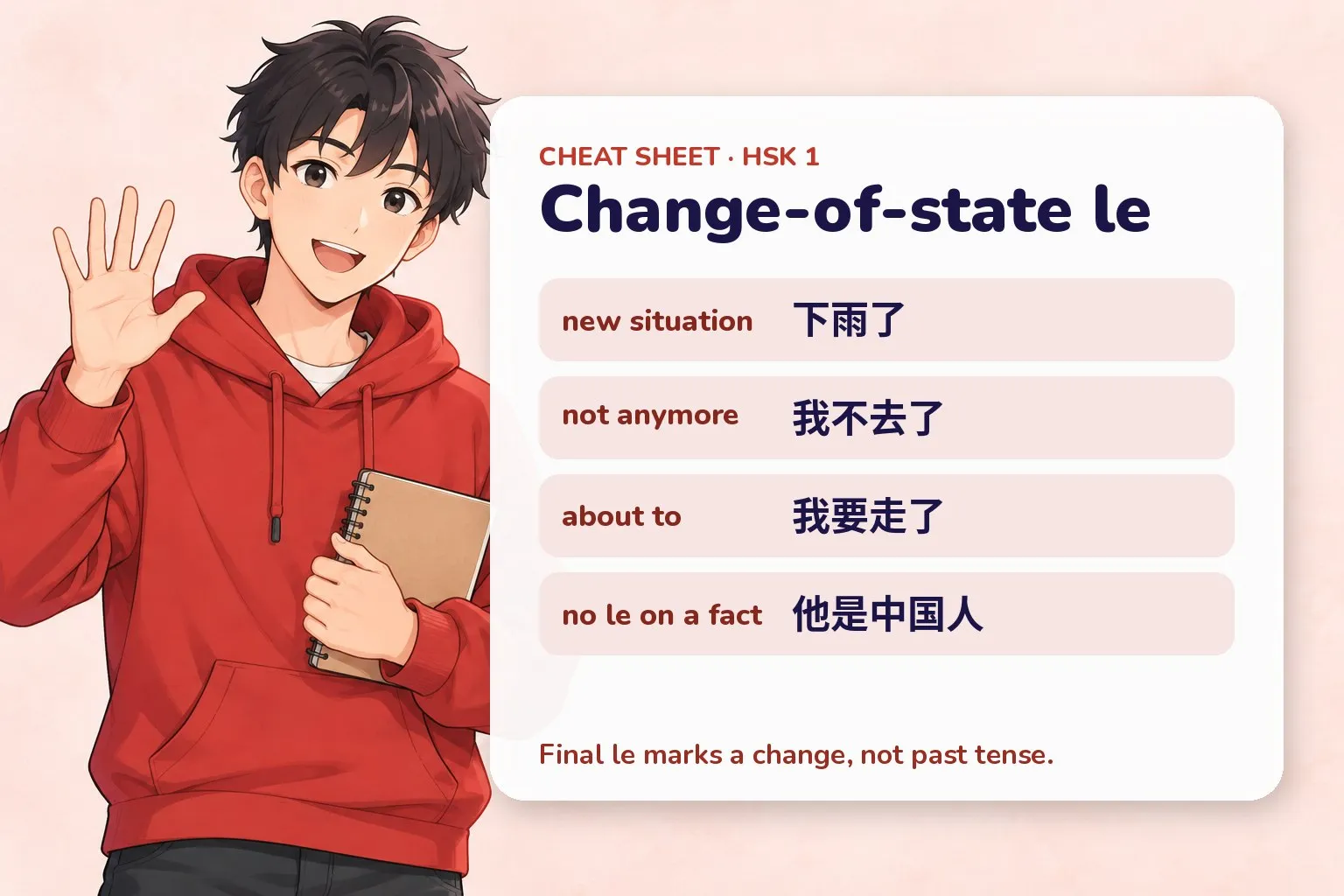
Quick recap before you practise.
Practice
Change-of-state le practice
Try each one, then press Check. No sign-up, nothing is sent anywhere — it all runs in your browser.
Hint: the change-of-state particle
Show answer
了 (le) — 我不去了 (wǒ bù qù le): the bu...le frame means not anymore.
Hint: announce a change
Show answer
了 (le) — 我们到了 (wǒmen dào le): the final le marks arrival as a new situation.
5 Order the words: I am hungry now.
Show answer
我 (wǒ) 饿 (è) 了 (le) — 我饿了 (wǒ è le): subject, then state, then le.
6 Match each sentence to its meaning.
- 天黑了 (tiān hēi le)
- 我懂了 (wǒ dǒng le)
- 太贵了 (tài guì le)
- 我不吃了 (wǒ bù chī le)
Show answer
- 天黑了 (tiān hēi le) → it has got dark
- 我懂了 (wǒ dǒng le) → I get it now
- 太贵了 (tài guì le) → that is too expensive
- 我不吃了 (wǒ bù chī le) → I am not eating anymore
Each le signals a change, or with tai, strong emphasis.
Quiz
Change-of-state le quiz
12 questions · pick an answer and you'll see straight away if it's right.
-
Show answer
a change of state — It shows a new situation, not a tense.
-
Show answer
false — False — Chinese has no tense; le marks aspect, not time on the verb.
-
Show answer
it is raining now — The final le adds the new-situation sense: it is raining now.
-
Show answer
我不去了 (wǒ bù qù le) — The bu...le frame means not anymore.
-
Show answer
at the very end of the sentence — Sentence-final le sits at the end.
-
Show answer
he is a teacher now — The le marks a change into the present: he is a teacher now.
-
Show answer
他是中国人了 (tā shì Zhōngguó rén le) for the plain fact he is Chinese — An unchanging fact takes no le; 他是中国人 (tā shì Zhōngguó rén) is correct.
-
Show answer
about to happen — It marks an imminent change: I am about to leave.
-
Show answer
right after the verb — Verb-le follows the verb: 我吃了饭 (wǒ chī le fàn).
-
Show answer
great! / wonderful! — The tai...le frame is fixed emphasis meaning great or wonderful.
-
Show answer
了 (le) — 天气冷了 (tiānqì lěng le): the adjective plus le means has become cold.
-
Show answer
le marks a change of state, not past time — Past time is shown by time words; le specifically marks a change.
Recap cheat-sheet
| Use | Chinese | Pinyin | Meaning |
|---|---|---|---|
| new situation | 下雨了 | xià yǔ le | it is raining now |
| got (adjective) | 天黑了 | tiān hēi le | it has got dark |
| about to | 我要走了 | wǒ yào zǒu le | I am about to leave |
| not anymore | 我不去了 | wǒ bù qù le | I am not going anymore |
| no le on a fact | 他是中国人 | tā shì Zhōngguó rén | he is Chinese |
Next
- Learn the verb to be: The Verb 是 (shì)
- Back to the Chinese grammar section
- New here? Start with Start Learning Chinese Here
All Chinese grammar topics
Every grammar point in order, from your first sentence to advanced structures. Pick one and go straight to it. New lessons go live every day, so topics marked Coming soon fill in over the next weeks.
Grammar path
HSK 1 15 topics · 12 ready
- 01 The Verb 是 (shì): to be
- 02 Basic Word Order (Subject-Verb-Object)
- 03 Adjectives with 很 (hěn)
- 04 Yes/No Questions with 吗 (ma)
- 05 Question Words (什么 shénme, 谁 shuí, 哪 nǎ, 几 jǐ)
- 06 The Particle 的 (de): Possession & Modification
- 07 Measure Words and 个 (ge)
- 08 Numbers and Counting
- 09 The Verb 有 (yǒu): to have / there is
- 10 The Verb 在 (zài): Location
- 11 Time When (Position in Sentence)
- 12 The Particle 了 (le): Change of State You are here
- 13 Modal Verbs 想 / 要 / 会 / 能 (xiǎng / yào / huì / néng) Coming soon
- 14 The Particle 呢 (ne) Coming soon
- 15 也 (yě) and 都 (dōu) Placement Coming soon
HSK 2 16 topics
- 16 Aspectual 了 (Completed Action) Coming soon
- 17 The Aspect Particle 过 (guò) Coming soon
- 18 Progressive Aspect (在 / 正在 / 呢 zài / zhèngzài / ne) Coming soon
- 19 Comparisons with 比 (bǐ) Coming soon
- 20 A Bit: 一点儿 (yìdiǎnr) vs 有一点儿 (yǒu yìdiǎnr) Coming soon
- 21 Basic Conjunctions (和 hé, 也 yě, 都 dōu, 还 hái) Coming soon
- 22 Because...So (因为 yīnwèi...所以 suǒyǐ) Coming soon
- 23 Coverbs 给 / 跟 / 对 (gěi / gēn / duì) Coming soon
- 24 Duration (Time How Long) Coming soon
- 25 Resultative Complements (看完 kànwán, 听懂 tīngdǒng) Coming soon
- 26 The 把 (bǎ) Construction Coming soon
- 27 The Particle 吧 (ba) Coming soon
- 28 Again: 再 (zài) vs 又 (yòu) Coming soon
- 29 Or: 还是 (háishì) vs 或者 (huòzhě) Coming soon
- 30 Imminent Action (快要 kuàiyào...了 / 要 le / yào...了 le) Coming soon
- 31 Asking Degree with 多 (duō) Coming soon
HSK 3 18 topics
- 32 Directional Complements (出来 chūlái, 回去 huíqù) Coming soon
- 33 Potential Complements (看得懂 kàndedǒng, 做不完 zuòbùwán) Coming soon
- 34 Complement of Degree with 得 (de) Coming soon
- 35 Adverbial Modifier with 地 (de) Coming soon
- 36 The Durative Aspect 着 (zhe) Coming soon
- 37 把 (bǎ) with Complex Results Coming soon
- 38 The 被 (bèi) Passive Coming soon
- 39 Conditionals (如果 rúguǒ...就 / 要是 jiù / yàoshì) Coming soon
- 40 Although...But (虽然 suīrán...但是 dànshì) Coming soon
- 41 Pivotal Sentences (让 ràng, 叫 jiào, 请 qǐng, 使 shǐ) Coming soon
- 42 More and More (越来越 / 越 yuèláiyuè / yuè...越 yuè) Coming soon
- 43 除了 (chúle)...以外 (Besides / Except) Coming soon
- 44 Simultaneous Actions (一边...一边, yìbiān...yìbiān) Coming soon
- 45 Sequence: 先 (xiān)...再/然后 (zài / ránhòu) Coming soon
- 46 Conditional with ...的话 (dehuà) Coming soon
- 47 From...To (从 cóng...到 / 离 dào / lí) Coming soon
- 48 Similarity: 跟 (gēn)...一样 / 像 (yíyàng / xiàng)...一样 (yíyàng) Coming soon
- 49 Both...And (又 yòu...又 / 既 yòu / jì...又 yòu) Coming soon
HSK 4 13 topics
- 50 The 是 (shì)...的 (de) Construction (Emphasis) Coming soon
- 51 The Adverbs 就 (jiù) and 才 (cái) Coming soon
- 52 No Matter (不管 / 无论 bùguǎn / wúlùn...都 dōu) Coming soon
- 53 Even If (即使 / 就算 jíshǐ / jiùsuàn...也 yě) Coming soon
- 54 Verb Reduplication (看看 kànkan, 试一试 shìyishì) Coming soon
- 55 As Soon As (一...就, yī...jiù) Coming soon
- 56 Comparing 把 (bǎ) and 被 (bèi) in Context Coming soon
- 57 Complement of Quantity / Comparison Degree Coming soon
- 58 连 (lián)...都/也 (Even) Coming soon
- 59 Time Sequence (先 xiān...然后 ránhòu, 的时候 deshíhòu, 以后/以前 yǐhòu / yǐqián) Coming soon
- 60 From the Angle Of (对 duì...来说 láishuō) Coming soon
- 61 Only After / Not Until (要 yào...才 / 等 cái / děng...才 cái) Coming soon
- 62 Approximation & 左右/多/来 (zuǒyòu / duō / lái) Coming soon
HSK 5 14 topics
- 63 Mood Adverbs (反正 fǎnzhèng, 居然 jūrán, 竟然 jìngrán, 难道 nándào) Coming soon
- 64 Not Only...But Also (不但 búdàn...而且 érqiě) Coming soon
- 65 Otherwise (否则 / 要不然 fǒuzé / yàobùrán) Coming soon
- 66 Complex Complements & Metaphorical Results Coming soon
- 67 Formal/Written Markers (之 zhī, 其 qí, 者 zhě, 以 yǐ) Coming soon
- 68 Rather...Than (宁愿/宁可 nìngyuàn / nìngkě...也不 yěbù) Coming soon
- 69 与其 (yǔqí)...不如 (Rather Than / Better To) Coming soon
- 70 Only If / Only (只有 zhǐyǒu...才 / 只要 cái / zhǐyào...就 jiù) Coming soon
- 71 Colloquial Passives (让 ràng, 叫 jiào, 给 gěi) Coming soon
- 72 不但不/没 (búdànbù / méi)...反而 (Contrary to Expectation) Coming soon
- 73 一...就 (yī...jiù) vs 一旦 (yídàn): Once / As Soon As Coming soon
- 74 尽管 (jǐnguǎn)...还是 (Even Though) Coming soon
- 75 复合趋向补语 (Compound Directional + Object) Coming soon
- 76 Emphasis with 是 (shì)...的 (de) vs 连 (lián)...都 (dōu) Review Coming soon
HSK 6 7 topics
- 77 Four-Character Idioms (成语 chéngyǔ) in Grammar Coming soon
- 78 Literary Connectives (然而 ránér, 从而 cóngér, 鉴于 jiànyú, 乃至 nǎizhì) Coming soon
- 79 Fixed Frameworks (在 zài...下 xià, 以 yǐ...为 wèi, 对 duì...而言 éryán) Coming soon
- 80 Rhetorical & Emphatic Structures (并 bìng, 可 kě, 正是 zhèngshì) Coming soon
- 81 Nominalisation & Topic Structures (所 suǒ...的 de, 的 de nominaliser) Coming soon
- 82 Long-Sentence Cohesion & Ellipsis Coming soon
- 83 经/予/加以 (Formal Verbal Framing) Coming soon