Aspectual 了 (le): Completed Actions
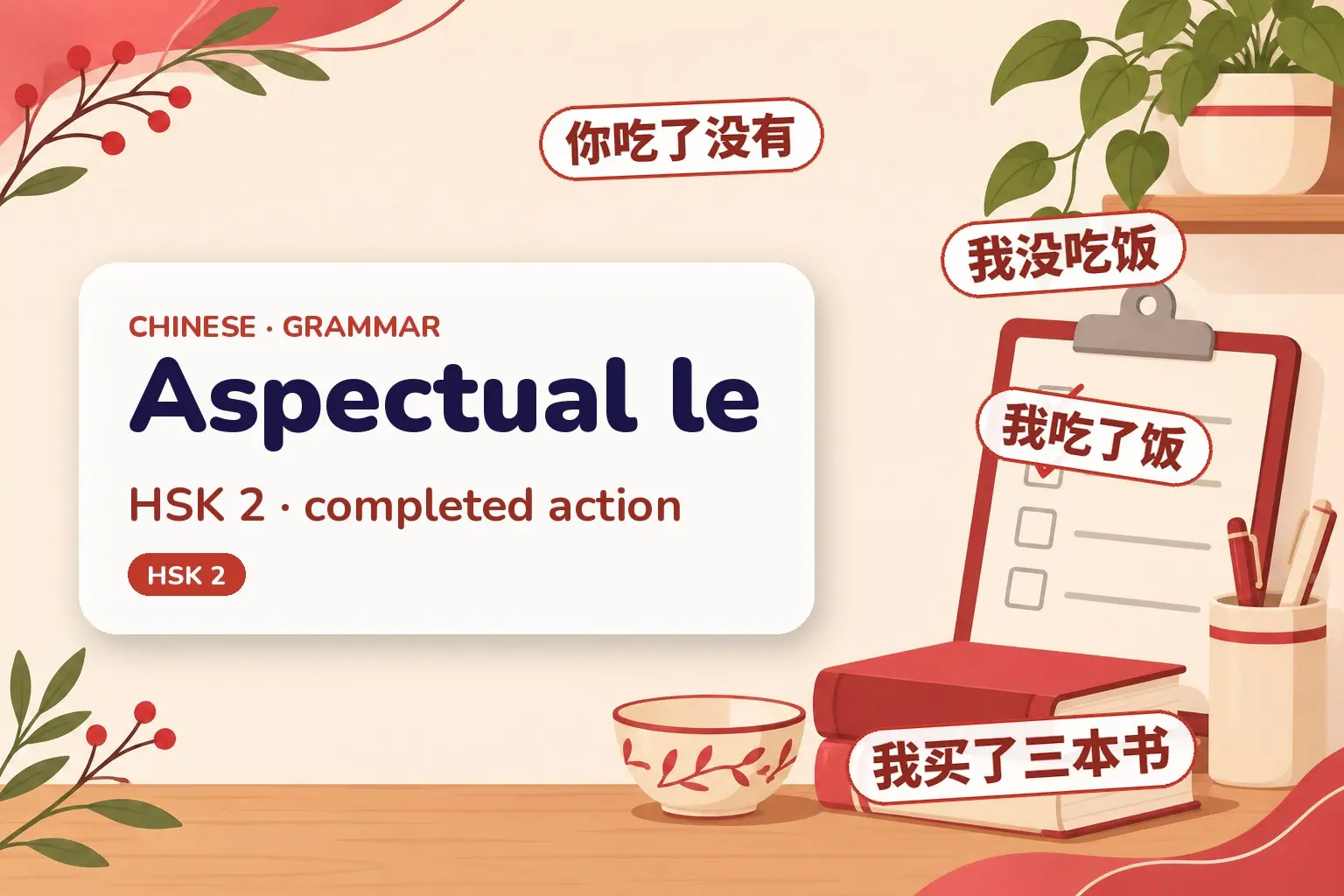
Put 了 (le) straight after the verb to mark the action as completed or realised: 我吃了饭 (wǒ chī le fàn), 'I ate.' To make it negative, use 没有 (méiyǒu) before the verb and drop 了: 我没吃饭 (wǒ méi chī fàn).
Level: HSK 2. The little word 了 (le) is one of the most useful — and most misunderstood — words in Mandarin. Placed directly after the verb, it marks that the action was completed or realised: 我吃了饭 (wǒ chī le fàn, “I ate / I have eaten”). It is not a past-tense ending; it is an aspect marker, and this page shows you exactly when to use it and when to leave it out.
The rule
Aspect is grammar that shows whether an action is finished, ongoing or about to start — separate from tense, which shows the time (past, present, future). Mandarin has no verb tenses at all; it uses aspect markers and time words instead.
The aspect marker 了 (le) sits right after the verb and says the action reached completion: 我看了那部电影 (wǒ kàn le nà bù diànyǐng, “I watched that film”). Because it marks completion rather than time, the “when” comes from a time word if you need it: 昨天我看了那部电影 (zuótiān wǒ kàn le nà bù diànyǐng, “Yesterday I watched that film”).
A completed action is normally about a specific or measured thing, so verb-了 (le) usually comes with a quantified object (a number plus a measure word), a definite object, or a following clause: 我买了三本书 (wǒ mǎi le sān běn shū, “I bought three books”). A bare 我买了书 (wǒ mǎi le shū) sounds unfinished on its own, as if the listener is waiting for the rest.
To make it negative, you do not negate 了 (le). You put 没有 (méiyǒu, “did not”) before the verb and drop the 了 (le): 我没吃饭 (wǒ méi chī fàn, “I didn’t eat”). The negative already tells us the action never happened, so there is no completion to mark.
The pattern
| Purpose | Pattern | Example | Pinyin |
|---|---|---|---|
| Completed action | Subject + Verb + 了 + (quantified) object | 我喝了一杯水 | wǒ hē le yì bēi shuǐ |
| With a time word | Time + Subject + Verb + 了 + object | 昨天他买了车 | zuótiān tā mǎi le chē |
| Negative (drop 了) | Subject + 没有 + Verb + object | 我没喝水 | wǒ méi hē shuǐ |
| Yes/no question | Subject + Verb + 了 + 没有 | 你吃了没有 | nǐ chī le méiyǒu |
| “Once I have…” (future) | Verb + 了 + object + 就 + clause | 我吃了饭就走 | wǒ chī le fàn jiù zǒu |
Example sentences
- 我吃了饭。Wǒ chī le fàn.I ate. / I have eaten.complete as a short answer
- 我买了三本书。Wǒ mǎi le sān běn shū.I bought three books.quantified object
- 他喝了一杯咖啡。Tā hē le yì bēi kāfēi.He drank a cup of coffee.
- 昨天我看了那部电影。Zuótiān wǒ kàn le nà bù diànyǐng.Yesterday I watched that film.time word + 了
- 我写了一封信。Wǒ xiě le yì fēng xìn.I wrote a letter.
- 她做完了作业。Tā zuò wán le zuòyè.She finished the homework.resultative 完 + 了
- 我们到了学校。Wǒmen dào le xuéxiào.We arrived at school.
- 我已经吃了两碗饭。Wǒ yǐjīng chī le liǎng wǎn fàn.I've already eaten two bowls of rice.
- 你吃了没有?Nǐ chī le méiyǒu?Have you eaten (or not)?V了没有 question
- 我没吃饭。Wǒ méi chī fàn.I didn't eat.没 before verb, no 了
- 他没买那本书。Tā méi mǎi nà běn shū.He didn't buy that book.
- 我吃了饭就走。Wǒ chī le fàn jiù zǒu.I'll leave once I've eaten.future completion
- 下了课我们去吃饭。Xià le kè wǒmen qù chī fàn.After class we'll go eat.
- 老师看了我的作业。Lǎoshī kàn le wǒ de zuòyè.The teacher looked at my homework.definite object
- 我买了一个手机。Wǒ mǎi le yí ge shǒujī.I bought a phone.
- 他们回了家。Tāmen huí le jiā.They went home.
- 我喝了水,现在不渴了。Wǒ hē le shuǐ, xiànzài bù kě le.I drank water; I'm not thirsty now.verb-了 then a new-situation 了
Common mistakes
- ❌ 我没吃了饭 (wǒ méi chī le fàn) → ✅ 我没吃饭 (wǒ méi chī fàn). Never use 没有 (méiyǒu) and 了 (le) together; the negative drops the 了 (le).
- ❌ 我不吃了饭 (wǒ bù chī le fàn) for “I didn’t eat” → ✅ 我没吃饭 (wǒ méi chī fàn). Completed actions are negated with 没有 (méiyǒu), not 不 (bù).
- ❌ 我买了书 (wǒ mǎi le shū), left hanging → ✅ 我买了三本书 (wǒ mǎi le sān běn shū) or 我买书了 (wǒ mǎi shū le). A bare verb-了 (le) with a plain object needs a quantifier or a sentence-final 了 (le).
- ❌ 我了吃饭 (wǒ le chī fàn) → ✅ 我吃了饭 (wǒ chī le fàn). 了 (le) goes after the verb, never before it.
- ❌ 昨天我吃饭 (zuótiān wǒ chī fàn) for “yesterday I ate (and finished)” → ✅ 昨天我吃了饭 (zuótiān wǒ chī le fàn) when you mean the action was completed. A time word alone does not mark completion.
A short conversation
— 你昨天做什么了? — Nǐ zuótiān zuò shénme le? — What did you do yesterday? — 我看了一部电影 (wǒ kàn le yí bù diànyǐng), 还买了两本书 (hái mǎi le liǎng běn shū). — I watched a film and bought two books. — 你吃饭了没有? — Nǐ chī fàn le méiyǒu? — Have you eaten? — 还没有 (hái méiyǒu), 我吃了饭就来 (wǒ chī le fàn jiù lái). — Not yet; I’ll come once I’ve eaten.
Usage notes
- Completion, not past. 了 (le) can mark an action completed in the future: 我下了班就给你打电话 (wǒ xià le bān jiù gěi nǐ dǎ diànhuà, “I’ll call you once I’m off work”). The first action finishes before the second.
- Pair with resultative endings. Verbs often take an ending like 完 (wán, “finish”) or 到 (dào, “reach”) plus 了 (le): 做完了 (zuò wán le, “finished doing”), 买到了 (mǎi dào le, “managed to buy”).
- Questions. Ask with 了吗 (le ma) or the verb-了-没有 (le … méiyǒu) pattern: 你到了吗? (nǐ dào le ma?) and 你到了没有? (nǐ dào le méiyǒu?) both mean “Have you arrived?”
- Don’t overuse it. With habitual or ongoing actions you use no 了 (le) at all: 我每天喝咖啡 (wǒ měi tiān hē kāfēi, “I drink coffee every day”) describes a habit, not a single completed act.
Compared with sentence-final 了 (le)
The 了 (le) on this page sits after the verb and marks a completed action. Mandarin has a second 了 (le) that sits at the end of the sentence and signals a new or changed situation — see sentence-final 了 (change of state): 下雨了 (xià yǔ le, “it’s raining now / it has started to rain”) or 我知道了 (wǒ zhīdào le, “oh, now I understand”). One marks that a verb finished; the other marks that things are now different. Build the rest of your sentence with basic Chinese word order and count objects with the measure word 个 (ge).
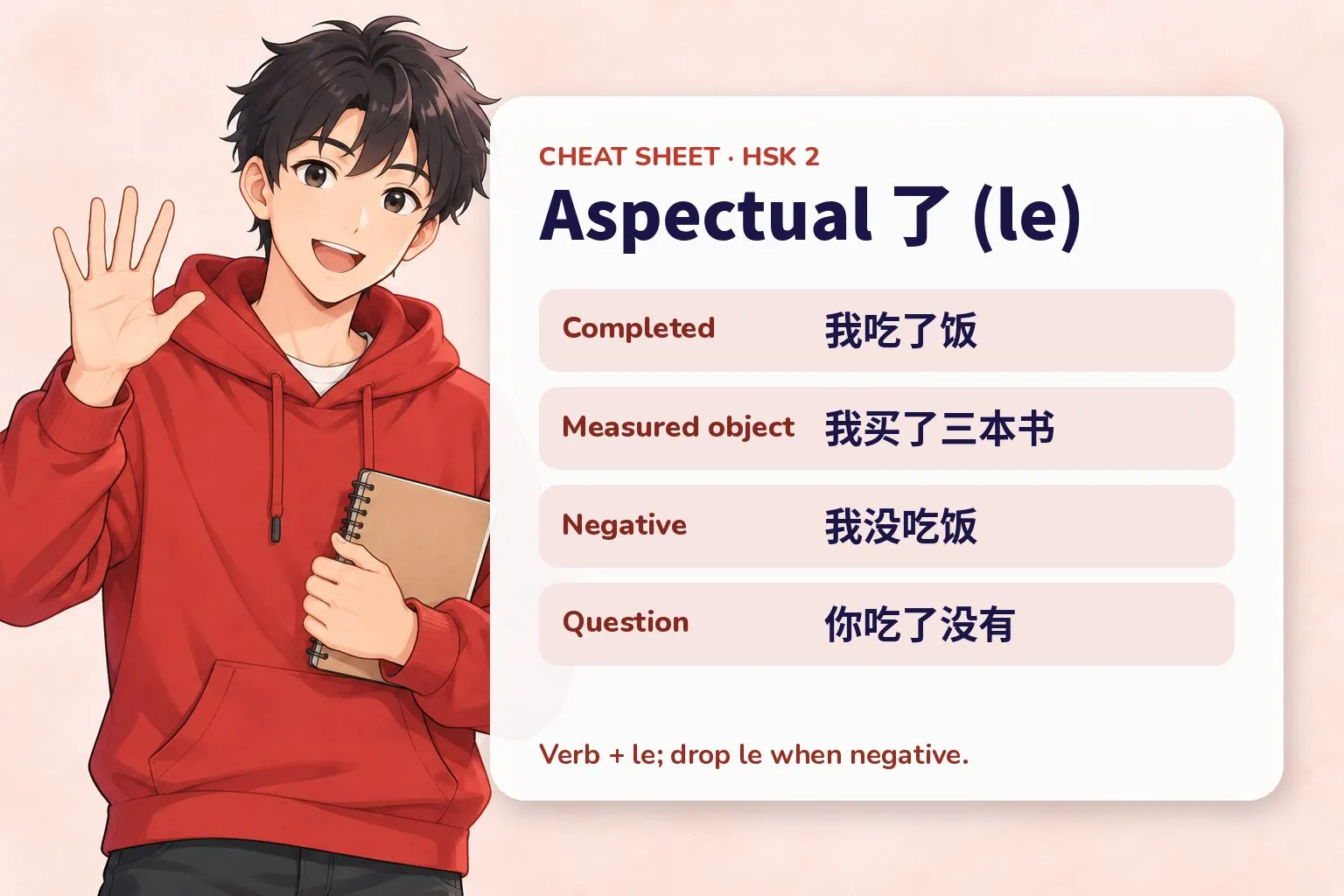
Quick recap before you practise.
Practice
Aspectual 了 (le) practice
Try each one, then press Check. No sign-up, nothing is sent anywhere — it all runs in your browser.
Hint: the completion marker
Show answer
了 (le) — 我买了三本书 (wǒ mǎi le sān běn shū): verb + 了 (le) + quantified object.
4 Build: 'He drank a cup of coffee.'
Show answer
他 (tā) 喝了 (hē le) 一杯咖啡 (yì bēi kāfēi) — 他喝了一杯咖啡 (tā hē le yì bēi kāfēi): subject + verb-了 (le) + measured object.
5 Match each sentence to its meaning.
- 我吃了饭 (wǒ chī le fàn)
- 我没吃饭 (wǒ méi chī fàn)
- 下雨了 (xià yǔ le)
- 我吃了饭就走 (wǒ chī le fàn jiù zǒu)
Show answer
- 我吃了饭 (wǒ chī le fàn) → I ate (completed)
- 我没吃饭 (wǒ méi chī fàn) → I didn't eat
- 下雨了 (xià yǔ le) → it has started raining
- 我吃了饭就走 (wǒ chī le fàn jiù zǒu) → I'll leave once I've eaten
Verb-了 (le) = completion; 没 (méi) = negative; sentence-final 了 (le) = new situation.
Quiz
Aspectual 了 (le) quiz
12 questions · pick an answer and you'll see straight away if it's right.
-
Show answer
completed / realised — Verb-了 (le) marks completion of the action.
-
Show answer
aspect, not tense — Mandarin has no tenses; 了 (le) is an aspect marker.
-
Show answer
我没吃饭 (wǒ méi chī fàn) — 我没吃饭 (wǒ méi chī fàn): 没 (méi) before the verb, no 了 (le).
-
Show answer
没 (méi) and 了 (le) cannot appear together — The negative drops 了 (le): 我没看那部电影 (wǒ méi kàn nà bù diànyǐng).
-
Show answer
quantified or specific object (or a following clause) — 我买了三本书 (wǒ mǎi le sān běn shū): a measured object completes it.
-
Show answer
after the verb — Directly after the verb: 吃了 (chī le).
-
Show answer
I'll leave once I've eaten — 了 (le) can mark future completion: the eating finishes before leaving.
-
Show answer
没有 (méiyǒu) — Use 没有 (méiyǒu) for a completed action that did not happen.
-
Show answer
你到了没有 (nǐ dào le méiyǒu) — 你到了没有 (nǐ dào le méiyǒu) is the V-了-没有 question.
-
Show answer
sentence-final 了 (le) for a new situation — This sentence-final 了 (le) signals a change of state: it has started raining.
-
Show answer
a time word like 昨天 (zuótiān) — 了 (le) marks completion, not time; a time word gives the moment.
-
Show answer
我每天喝咖啡 (wǒ měi tiān hē kāfēi) — 我每天喝咖啡 (wǒ měi tiān hē kāfēi) is habitual — no completion to mark.
Recap cheat-sheet
| Idea | Chinese | Pinyin | Note |
|---|---|---|---|
| Completed action | 我吃了饭 | wǒ chī le fàn | verb + 了 |
| Measured object | 我买了三本书 | wǒ mǎi le sān běn shū | number + measure word |
| Negative (drop 了) | 我没吃饭 | wǒ méi chī fàn | 没有 before verb |
| Question | 你吃了没有 | nǐ chī le méiyǒu | V了没有 |
| Future completion | 我吃了饭就走 | wǒ chī le fàn jiù zǒu | finish then next action |
Next
- Contrast it with change-of-state 了 (le)
- Back to the Chinese grammar section
- New here? Start with Start Learning Chinese Here
All Chinese grammar topics
Every grammar point in order, from your first sentence to advanced structures. Pick one and go straight to it. New lessons go live every day, so topics marked Coming soon fill in over the next weeks.
Grammar path
HSK 1 15 topics · 15 ready
- 01 The Verb 是 (shì): to be
- 02 Basic Word Order (Subject-Verb-Object)
- 03 Adjectives with 很 (hěn)
- 04 Yes/No Questions with 吗 (ma)
- 05 Question Words (什么 shénme, 谁 shuí, 哪 nǎ, 几 jǐ)
- 06 The Particle 的 (de): Possession & Modification
- 07 Measure Words and 个 (ge)
- 08 Numbers and Counting
- 09 The Verb 有 (yǒu): to have / there is
- 10 The Verb 在 (zài): Location
- 11 Time When (Position in Sentence)
- 12 The Particle 了 (le): Change of State
- 13 Modal Verbs 想 / 要 / 会 / 能 (xiǎng / yào / huì / néng)
- 14 The Particle 呢 (ne)
- 15 也 (yě) and 都 (dōu) Placement
HSK 2 14 topics · 6 ready
- 16 Aspectual 了 (Completed Action) You are here
- 17 The Aspect Particle 过 (guò)
- 18 Progressive Aspect (在 / 正在 / 呢 zài / zhèngzài / ne)
- 19 Comparisons with 比 (bǐ)
- 20 A Bit: 一点儿 (yìdiǎnr) vs 有一点儿 (yǒu yìdiǎnr)
- 21 Basic Conjunctions (和 hé, 也 yě, 都 dōu, 还 hái)
- 22 Coverbs 给 / 跟 / 对 (gěi / gēn / duì) Coming soon
- 23 Duration (Time How Long) Coming soon
- 24 Resultative Complements (看完 kànwán, 听懂 tīngdǒng) Coming soon
- 25 The 把 (bǎ) Construction Coming soon
- 26 The Particle 吧 (ba) Coming soon
- 27 Again: 再 (zài) vs 又 (yòu) Coming soon
- 28 Imminent Action (快要 kuàiyào...了 / 要 le / yào...了 le) Coming soon
- 29 Asking Degree with 多 (duō) Coming soon
HSK 3 10 topics
- 30 Directional Complements (出来 chūlái, 回去 huíqù) Coming soon
- 31 Potential Complements (看得懂 kàndedǒng, 做不完 zuòbùwán) Coming soon
- 32 Complement of Degree with 得 (de) Coming soon
- 33 Adverbial Modifier with 地 (de) Coming soon
- 34 The Durative Aspect 着 (zhe) Coming soon
- 35 把 (bǎ) with Complex Results Coming soon
- 36 The 被 (bèi) Passive Coming soon
- 37 Conditionals (如果 rúguǒ...就 / 要是 jiù / yàoshì) Coming soon
- 38 Pivotal Sentences (让 ràng, 叫 jiào, 请 qǐng, 使 shǐ) Coming soon
- 39 Conditional with ...的话 (dehuà) Coming soon
HSK 4 9 topics
- 40 The 是 (shì)...的 (de) Construction (Emphasis) Coming soon
- 41 The Adverbs 就 (jiù) and 才 (cái) Coming soon
- 42 Verb Reduplication (看看 kànkan, 试一试 shìyishì) Coming soon
- 43 As Soon As (一...就, yī...jiù) Coming soon
- 44 Comparing 把 (bǎ) and 被 (bèi) in Context Coming soon
- 45 Complement of Quantity / Comparison Degree Coming soon
- 46 连 (lián)...都/也 (Even) Coming soon
- 47 Time Sequence (先 xiān...然后 ránhòu, 的时候 deshíhòu, 以后/以前 yǐhòu / yǐqián) Coming soon
- 48 Approximation & 左右/多/来 (zuǒyòu / duō / lái) Coming soon
HSK 5 8 topics
- 49 Mood Adverbs (反正 fǎnzhèng, 居然 jūrán, 竟然 jìngrán, 难道 nándào) Coming soon
- 50 Complex Complements & Metaphorical Results Coming soon
- 51 Formal/Written Markers (之 zhī, 其 qí, 者 zhě, 以 yǐ) Coming soon
- 52 Colloquial Passives (让 ràng, 叫 jiào, 给 gěi) Coming soon
- 53 不但不/没 (búdànbù / méi)...反而 (Contrary to Expectation) Coming soon
- 54 一...就 (yī...jiù) vs 一旦 (yídàn): Once / As Soon As Coming soon
- 55 复合趋向补语 (Compound Directional + Object) Coming soon
- 56 Emphasis with 是 (shì)...的 (de) vs 连 (lián)...都 (dōu) Review Coming soon
HSK 6 7 topics
- 57 Four-Character Idioms (成语 chéngyǔ) in Grammar Coming soon
- 58 Literary Connectives (然而 ránér, 从而 cóngér, 鉴于 jiànyú, 乃至 nǎizhì) Coming soon
- 59 Fixed Frameworks (在 zài...下 xià, 以 yǐ...为 wèi, 对 duì...而言 éryán) Coming soon
- 60 Rhetorical & Emphatic Structures (并 bìng, 可 kě, 正是 zhèngshì) Coming soon
- 61 Nominalisation & Topic Structures (所 suǒ...的 de, 的 de nominaliser) Coming soon
- 62 Long-Sentence Cohesion & Ellipsis Coming soon
- 63 经/予/加以 (Formal Verbal Framing) Coming soon