The Aspect Particle 过 (guò) in Chinese

Put 过 (guo) right after a verb to say you have ever done the action at least once. 我去过北京 (wǒ qù guo Běijīng) means I have been to Beijing. To say you never have, use 没 (méi) before the verb: 没去过 (méi qù guo).
Level: HSK 2. When you want to say you have tried, visited, or done something at some point in your life, Chinese uses the particle 过 (guo). You place it straight after the verb, and it turns the sentence into a statement about experience: I have done this before.
The rule
An aspect particle is a small word that shows how an action sits in time — not when it happened, but what kind of event it is. Chinese has no tenses, so these particles do the work instead.
The particle 过 (guo) marks the experiential aspect: it says the subject has done something at least once, at some unspecified time. The pattern is simply:
subject + verb + 过 (guo) + object
So 我去过北京 (wǒ qù guo Běijīng) is I have been to Beijing — it does not say when, only that it has happened in your life. 他吃过日本菜 (tā chī guo Rìběn cài) is he has eaten Japanese food (before).
In this use guo is toneless: you say a light guo, not the full fourth-tone 过 (guò) that means to cross or to pass. The same character, two jobs.
The pattern at a glance
| Sentence type | Pattern | Example | Pinyin |
|---|---|---|---|
| Positive | verb + 过 | 我 看过 这本书 | wǒ kàn guo zhè běn shū |
| Negative | 没 + verb + 过 | 我 没看过 这本书 | wǒ méi kàn guo zhè běn shū |
| Yes/no question | verb + 过 + 吗 | 你 看过 吗 | nǐ kàn guo ma |
| A-not-A question | verb + 过 + 没有 | 你 看过 没有 | nǐ kàn guo méiyǒu |
The negative uses 没 (méi), never 不 (bù): guo is about whether something has ever happened, and 没 (méi) is the negator for things that have not happened.
Example sentences
- 我去过北京。Wǒ qù guo Běijīng.I have been to Beijing.experience, time unspecified
- 你吃过北京烤鸭吗?Nǐ chī guo Běijīng kǎoyā ma?Have you ever eaten Beijing duck?
- 他学过法语。Tā xué guo Fǎyǔ.He has studied French before.
- 我没看过这部电影。Wǒ méi kàn guo zhè bù diànyǐng.I have never seen this film.mei...guo = never
- 她坐过飞机。Tā zuò guo fēijī.She has been on a plane.
- 我们见过面。Wǒmen jiàn guo miàn.We have met before.
- 你去过没有?Nǐ qù guo méiyǒu?Have you been there or not?A-not-A question
- 我喝过中国茶。Wǒ hē guo Zhōngguó chá.I have drunk Chinese tea.
- 他没来过我家。Tā méi lái guo wǒ jiā.He has never come to my home.
- 你读过这本小说吗?Nǐ dú guo zhè běn xiǎoshuō ma?Have you read this novel?
- 我以前住过上海。Wǒ yǐqián zhù guo Shànghǎi.I lived in Shanghai before.
- 她唱过这首歌。Tā chàng guo zhè shǒu gē.She has sung this song before.
- 我试过这个方法。Wǒ shì guo zhège fāngfǎ.I have tried this method.
- 你们爬过长城吗?Nǐmen pá guo Chángchéng ma?Have you climbed the Great Wall?
- 我没学过日语。Wǒ méi xué guo Rìyǔ.I have never studied Japanese.
- 他看过医生了。Tā kàn guo yīshēng le.He has already seen a doctor.
- 我们聊过这件事。Wǒmen liáo guo zhè jiàn shì.We have talked about this matter.
- 你用过这个软件吗?Nǐ yòng guo zhège ruǎnjiàn ma?Have you used this app before?
Each sentence reports an experience — something that has or has not happened at least once.
Common mistakes
- ❌ 我不去过北京 (wǒ bù qù guo Běijīng) → ✅ 我没去过北京 (wǒ méi qù guo Běijīng). Negate guo with 没 (méi), never 不 (bù).
- ❌ 我去过北京了吗 (wǒ qù guo Běijīng le ma) with 了 (le) forced in → ✅ 你去过北京吗 (nǐ qù guo Běijīng ma). The experiential question just adds 吗 (ma) to the verb-guo sentence.
- ❌ 我过去北京 (wǒ guò qù Běijīng) → ✅ 我去过北京 (wǒ qù guo Běijīng). The guo goes after the verb; 过去 (guòqù) is a different word meaning the past.
- ❌ using guo for a one-off action you just finished → ✅ 我吃了饭 (wǒ chī le fàn) is better for I just ate. Reserve guo for have ever experience.
- ❌ 他没看过电影 (tā méi kàn guo diànyǐng) pronounced with a heavy fourth-tone guò → ✅ keep it toneless: méi kàn guo. The aspect guo is light.
A short conversation
— 小李 (Xiǎo Lǐ): 你去过云南吗? — Nǐ qù guo Yúnnán ma? — Have you ever been to Yunnan? — 王明 (Wáng Míng): 没去过。但是我很想去。 — Méi qù guo. Dànshì wǒ hěn xiǎng qù. — I never have, but I really want to go. — 小李 (Xiǎo Lǐ): 我去过两次。很漂亮。 — Wǒ qù guo liǎng cì. Hěn piàoliang. — I have been twice; it is beautiful.
Usage notes
- Add how many times. A frequency phrase comes after the object or the verb: 我去过两次 (wǒ qù guo liǎng cì, I have been twice).
- Verb-object pairs split. The guo attaches to the verb part: 见过面 (jiàn guo miàn, have met), not 见面过 (jiàn miàn guo).
- guo can combine with le. In speech you may hear both: 他看过医生了 (tā kàn guo yīshēng le) stresses that the experience is now complete and relevant. Beginners can safely use guo alone first.
- Time words stay optional. Because guo does not pin down when, you can add 以前 (yǐqián, before) for clarity: 我以前学过 (wǒ yǐqián xué guo, I studied it before).
Compared with the particle 了 (le)
Both 过 (guo) and 了 (le) look back in time, but they answer different questions. 了 (le) reports a specific completed action or a change of state — 我吃了饭 (wǒ chī le fàn, I have eaten / I ate). 过 (guo) reports whether you have ever had the experience — 我吃过日本菜 (wǒ chī guo Rìběn cài, I have eaten Japanese food before). A quick test: if you can add ever in English, use guo. See the full treatment of the particle 了 (le) for change of state, review counting with measure words like 个 (ge), or browse the whole Chinese grammar section.
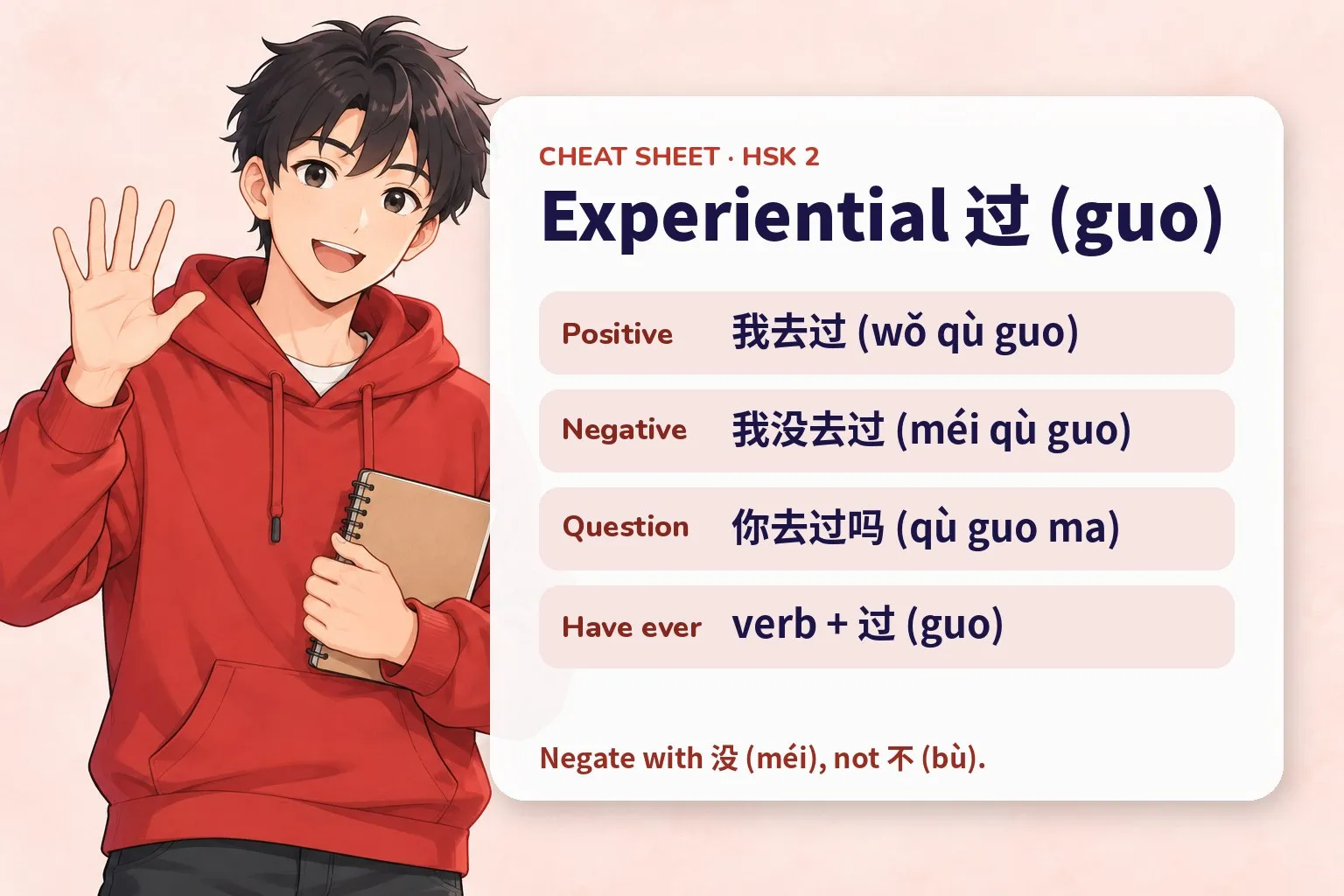
Quick recap before you practise.
Practice
Experiential guo practice
Try each one, then press Check. No sign-up, nothing is sent anywhere — it all runs in your browser.
Hint: not bù
Show answer
没 (méi) — 没去过 (méi qù guo): guo is negated with 没 (méi).
3 Order the words: 'I have eaten Chinese food.'
Show answer
我 (wǒ) 吃过 (chī guo) 中国菜 (Zhōngguó cài) — 我吃过中国菜 (wǒ chī guo Zhōngguó cài): verb + 过 + object.
4 Match each sentence to its meaning.
- 我去过 (wǒ qù guo)
- 我没去过 (wǒ méi qù guo)
- 我去了 (wǒ qù le)
- 你去过吗 (nǐ qù guo ma)
Show answer
- 我去过 (wǒ qù guo) → I have been there
- 我没去过 (wǒ méi qù guo) → I have never been
- 我去了 (wǒ qù le) → I went / have gone
- 你去过吗 (nǐ qù guo ma) → have you ever been?
The guo marks experience; le marks a completed action.
Quiz
Experiential guo quiz
12 questions · pick an answer and you'll see straight away if it's right.
-
Show answer
experiential aspect (have ever done) — It says the action has happened at least once in your life.
-
Show answer
right after the verb — The pattern is verb + guo + object.
-
Show answer
méi + verb + guo — Use 没 (méi): 没去过 (méi qù guo), have never been.
-
Show answer
I have been to Beijing — The guo reports the experience of having been there.
-
Show answer
guo, toneless — The aspect particle is light and toneless: guo.
-
Show answer
to cross / to pass — 过 (guò) as a verb means to cross or pass; the toneless guo is the aspect particle.
-
Show answer
你去过吗 (nǐ qù guo ma) — 你去过吗 (nǐ qù guo ma) uses verb + guo + 吗 (ma).
-
Show answer
没有 (méiyǒu) — 你去过没有 (nǐ qù guo méiyǒu) = have you been or not.
-
Show answer
ever — If you can add ever, guo is the right particle.
-
Show answer
guo is negated with méi, not bù — Experiential 过 takes 没 (méi): 我没去过 (wǒ méi qù guo).
-
Show answer
我去过两次 (wǒ qù guo liǎng cì) — Frequency follows: 我去过两次 (wǒ qù guo liǎng cì).
-
Show answer
用 (yòng) — 你用过这个软件吗 (nǐ yòng guo zhège ruǎnjiàn ma): verb 用 + 过.
Recap cheat-sheet
| Use | Chinese | Pinyin | Meaning |
|---|---|---|---|
| Positive | 我去过 | wǒ qù guo | I have been |
| Negative | 我没去过 | wǒ méi qù guo | I have never been |
| Question | 你去过吗 | nǐ qù guo ma | have you ever been? |
| With count | 我去过两次 | wǒ qù guo liǎng cì | I have been twice |
| Not the verb 过 | 过去 | guòqù | the past |
Next
- Contrast it with the particle 了 (le)
- Back to the Chinese grammar section
- New here? Start with Start Learning Chinese Here
All Chinese grammar topics
Every grammar point in order, from your first sentence to advanced structures. Pick one and go straight to it. New lessons go live every day, so topics marked Coming soon fill in over the next weeks.
Grammar path
HSK 1 15 topics · 15 ready
- 01 The Verb 是 (shì): to be
- 02 Basic Word Order (Subject-Verb-Object)
- 03 Adjectives with 很 (hěn)
- 04 Yes/No Questions with 吗 (ma)
- 05 Question Words (什么 shénme, 谁 shuí, 哪 nǎ, 几 jǐ)
- 06 The Particle 的 (de): Possession & Modification
- 07 Measure Words and 个 (ge)
- 08 Numbers and Counting
- 09 The Verb 有 (yǒu): to have / there is
- 10 The Verb 在 (zài): Location
- 11 Time When (Position in Sentence)
- 12 The Particle 了 (le): Change of State
- 13 Modal Verbs 想 / 要 / 会 / 能 (xiǎng / yào / huì / néng)
- 14 The Particle 呢 (ne)
- 15 也 (yě) and 都 (dōu) Placement
HSK 2 14 topics · 6 ready
- 16 Aspectual 了 (Completed Action)
- 17 The Aspect Particle 过 (guò) You are here
- 18 Progressive Aspect (在 / 正在 / 呢 zài / zhèngzài / ne)
- 19 Comparisons with 比 (bǐ)
- 20 A Bit: 一点儿 (yìdiǎnr) vs 有一点儿 (yǒu yìdiǎnr)
- 21 Basic Conjunctions (和 hé, 也 yě, 都 dōu, 还 hái)
- 22 Coverbs 给 / 跟 / 对 (gěi / gēn / duì) Coming soon
- 23 Duration (Time How Long) Coming soon
- 24 Resultative Complements (看完 kànwán, 听懂 tīngdǒng) Coming soon
- 25 The 把 (bǎ) Construction Coming soon
- 26 The Particle 吧 (ba) Coming soon
- 27 Again: 再 (zài) vs 又 (yòu) Coming soon
- 28 Imminent Action (快要 kuàiyào...了 / 要 le / yào...了 le) Coming soon
- 29 Asking Degree with 多 (duō) Coming soon
HSK 3 10 topics
- 30 Directional Complements (出来 chūlái, 回去 huíqù) Coming soon
- 31 Potential Complements (看得懂 kàndedǒng, 做不完 zuòbùwán) Coming soon
- 32 Complement of Degree with 得 (de) Coming soon
- 33 Adverbial Modifier with 地 (de) Coming soon
- 34 The Durative Aspect 着 (zhe) Coming soon
- 35 把 (bǎ) with Complex Results Coming soon
- 36 The 被 (bèi) Passive Coming soon
- 37 Conditionals (如果 rúguǒ...就 / 要是 jiù / yàoshì) Coming soon
- 38 Pivotal Sentences (让 ràng, 叫 jiào, 请 qǐng, 使 shǐ) Coming soon
- 39 Conditional with ...的话 (dehuà) Coming soon
HSK 4 9 topics
- 40 The 是 (shì)...的 (de) Construction (Emphasis) Coming soon
- 41 The Adverbs 就 (jiù) and 才 (cái) Coming soon
- 42 Verb Reduplication (看看 kànkan, 试一试 shìyishì) Coming soon
- 43 As Soon As (一...就, yī...jiù) Coming soon
- 44 Comparing 把 (bǎ) and 被 (bèi) in Context Coming soon
- 45 Complement of Quantity / Comparison Degree Coming soon
- 46 连 (lián)...都/也 (Even) Coming soon
- 47 Time Sequence (先 xiān...然后 ránhòu, 的时候 deshíhòu, 以后/以前 yǐhòu / yǐqián) Coming soon
- 48 Approximation & 左右/多/来 (zuǒyòu / duō / lái) Coming soon
HSK 5 8 topics
- 49 Mood Adverbs (反正 fǎnzhèng, 居然 jūrán, 竟然 jìngrán, 难道 nándào) Coming soon
- 50 Complex Complements & Metaphorical Results Coming soon
- 51 Formal/Written Markers (之 zhī, 其 qí, 者 zhě, 以 yǐ) Coming soon
- 52 Colloquial Passives (让 ràng, 叫 jiào, 给 gěi) Coming soon
- 53 不但不/没 (búdànbù / méi)...反而 (Contrary to Expectation) Coming soon
- 54 一...就 (yī...jiù) vs 一旦 (yídàn): Once / As Soon As Coming soon
- 55 复合趋向补语 (Compound Directional + Object) Coming soon
- 56 Emphasis with 是 (shì)...的 (de) vs 连 (lián)...都 (dōu) Review Coming soon
HSK 6 7 topics
- 57 Four-Character Idioms (成语 chéngyǔ) in Grammar Coming soon
- 58 Literary Connectives (然而 ránér, 从而 cóngér, 鉴于 jiànyú, 乃至 nǎizhì) Coming soon
- 59 Fixed Frameworks (在 zài...下 xià, 以 yǐ...为 wèi, 对 duì...而言 éryán) Coming soon
- 60 Rhetorical & Emphatic Structures (并 bìng, 可 kě, 正是 zhèngshì) Coming soon
- 61 Nominalisation & Topic Structures (所 suǒ...的 de, 的 de nominaliser) Coming soon
- 62 Long-Sentence Cohesion & Ellipsis Coming soon
- 63 经/予/加以 (Formal Verbal Framing) Coming soon