A Bit: 一点儿 vs 有一点儿
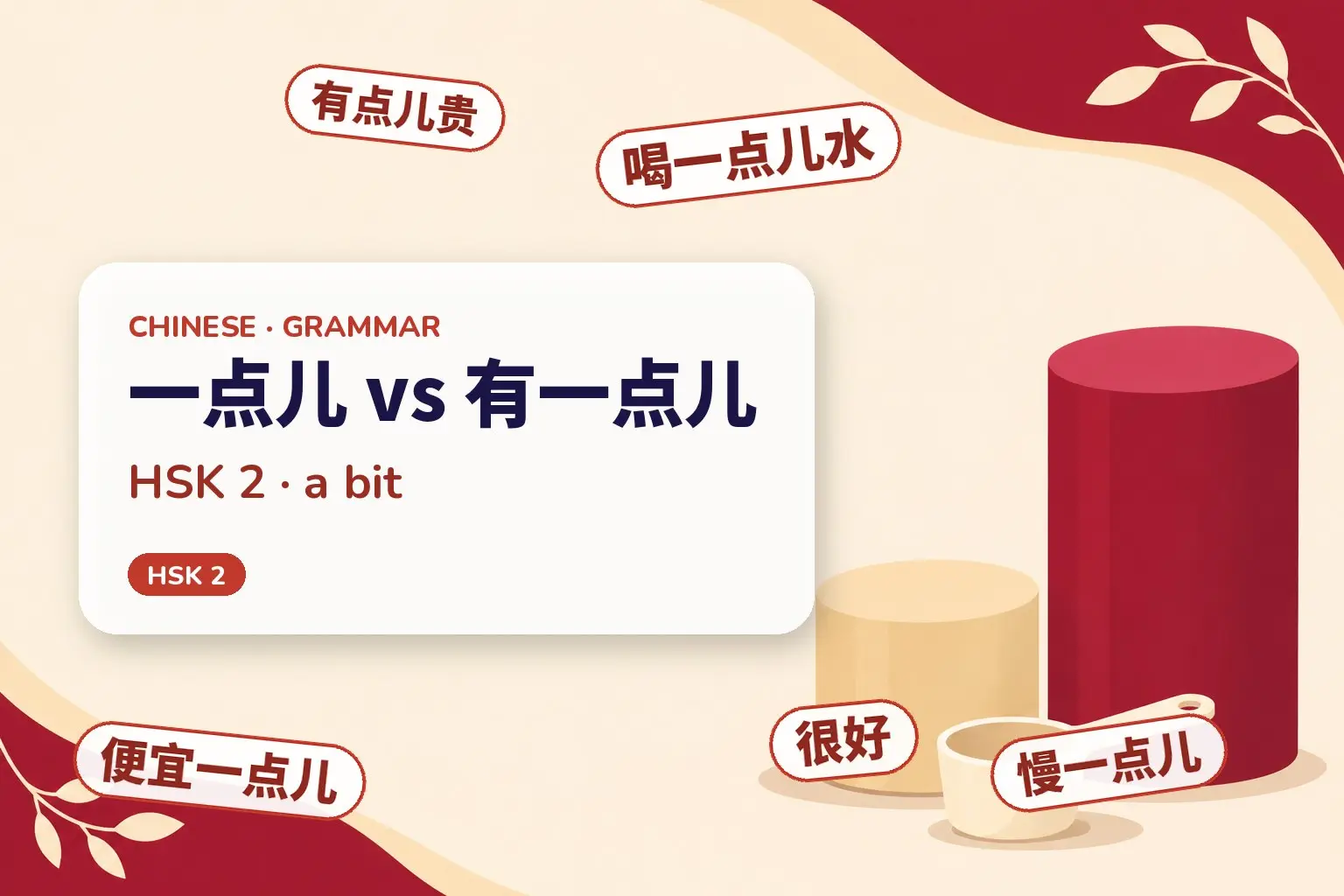
有一点儿 (yǒu yìdiǎnr), often shortened to 有点儿 (yǒudiǎnr), goes before an adjective and carries a mild complaint: 这个有点儿贵 (Zhège yǒudiǎnr guì), 'this is a bit (too) expensive'. 一点儿 (yìdiǎnr) goes after an adjective to mean 'a little more': 便宜一点儿 (piányi yìdiǎnr), 'a bit cheaper'.
Level: HSK 2. Two little phrases both translate as “a bit”, and learners mix them up constantly: 有一点儿 (yǒu yìdiǎnr) and 一点儿 (yìdiǎnr). The difference is where they stand and what they feel like. 有一点儿 (yǒu yìdiǎnr) comes before an adjective and sounds like a complaint — 有点儿贵 (yǒudiǎnr guì), “a bit too expensive”. 一点儿 (yìdiǎnr) comes after an adjective and asks for a change — 便宜一点儿 (piányi yìdiǎnr), “a little cheaper”.
The rule
An adjective is a describing word like 贵 (guì, expensive) or 冷 (lěng, cold). The two “a bit” phrases attach to it from opposite sides.
- 有一点儿 (yǒu yìdiǎnr) + adjective — placed before the adjective. In speech the 一 (yī) is usually dropped, giving 有点儿 (yǒudiǎnr). It means “somewhat / a bit (too)” and nearly always flags something you are not happy about: 今天有点儿冷 (Jīntiān yǒudiǎnr lěng), “it’s a bit cold today”.
- 一点儿 (yìdiǎnr) + after the adjective — placed after the adjective, usually to ask for or state a small change: 大一点儿 (dà yìdiǎnr), “a bit bigger”; 慢一点儿 (màn yìdiǎnr), “a little slower”.
So the same word 贵 (guì) gives 有点儿贵 (yǒudiǎnr guì), “a bit too expensive” (a complaint), but 便宜一点儿 (piányi yìdiǎnr), “a bit cheaper” (a request). Position decides the meaning.
一点儿 (yìdiǎnr) as a small quantity
After a verb, 一点儿 (yìdiǎnr) means a small amount of something, like English “a little” or “some”: 喝一点儿水 (hē yìdiǎnr shuǐ), “drink a little water”; 买一点儿水果 (mǎi yìdiǎnr shuǐguǒ), “buy a little fruit”. Here it works on the noun, not on an adjective, and it can be shortened to 点儿 (diǎnr): 喝点儿水 (hē diǎnr shuǐ).
Forms at a glance
| Meaning | Pattern | Example | Pinyin |
|---|---|---|---|
| a bit (too) … | 有点儿 (yǒudiǎnr) + adj | 有点儿贵。 | yǒudiǎnr guì. |
| a little more … | adj + 一点儿 (yìdiǎnr) | 便宜一点儿。 | piányi yìdiǎnr. |
| a little (of a noun) | verb + 一点儿 (yìdiǎnr) + noun | 喝一点儿水。 | hē yìdiǎnr shuǐ. |
| shortened quantity | verb + 点儿 (diǎnr) + noun | 吃点儿饭。 | chī diǎnr fàn. |
Example sentences
- 这个有点儿贵。Zhège yǒudiǎnr guì.This is a bit (too) expensive.complaint: 有点儿 before the adjective
- 今天有点儿冷。Jīntiān yǒudiǎnr lěng.It's a bit cold today.
- 我有点儿累。Wǒ yǒudiǎnr lèi.I'm a little tired.
- 这件衣服有点儿小。Zhè jiàn yīfu yǒudiǎnr xiǎo.This piece of clothing is a bit too small.
- 能便宜一点儿吗?Néng piányi yìdiǎnr ma?Can it be a little cheaper?request: 一点儿 after the adjective
- 请说慢一点儿。Qǐng shuō màn yìdiǎnr.Please speak a little slower.
- 我想要大一点儿的。Wǒ xiǎng yào dà yìdiǎnr de.I'd like a slightly bigger one.
- 声音大一点儿。Shēngyīn dà yìdiǎnr.Make the sound a bit louder.
- 他比我高一点儿。Tā bǐ wǒ gāo yìdiǎnr.He's a little taller than me.amount after the adjective, with 比
- 喝一点儿水吧。Hē yìdiǎnr shuǐ ba.Have a little water.small quantity after a verb
- 我买了一点儿水果。Wǒ mǎi le yìdiǎnr shuǐguǒ.I bought a little fruit.
- 吃点儿饭吧。Chī diǎnr fàn ba.Have a little food.点儿 = shortened 一点儿
- 这个菜有点儿辣。Zhège cài yǒudiǎnr là.This dish is a bit too spicy.
- 你的房间比我的大一点儿。Nǐ de fángjiān bǐ wǒ de dà yìdiǎnr.Your room is a little bigger than mine.
- 今天有点儿忙。Jīntiān yǒudiǎnr máng.I'm a bit busy today.
- 慢一点儿,别着急。Màn yìdiǎnr, bié zháojí.A bit slower, don't rush.
Common mistakes
- ❌ 贵一点儿 (guì yìdiǎnr) for “too expensive” → ✅ 有点儿贵 (yǒudiǎnr guì). A complaint uses 有点儿 (yǒudiǎnr) before the adjective.
- ❌ 有点儿便宜 (yǒudiǎnr piányi) for “a bit cheaper” → ✅ 便宜一点儿 (piányi yìdiǎnr). A requested change uses 一点儿 (yìdiǎnr) after the adjective.
- ❌ 我很有点儿累 (wǒ hěn yǒudiǎnr lèi) → ✅ 我有点儿累 (wǒ yǒudiǎnr lèi). Don’t add 很 (hěn); 有点儿 (yǒudiǎnr) already means “somewhat”.
- ❌ 有点儿好 (yǒudiǎnr hǎo) for “quite good” → ✅ 很好 (hěn hǎo) or 好一点儿 (hǎo yìdiǎnr). 有点儿 (yǒudiǎnr) wants an unwanted quality, not a plain positive.
- ❌ 喝有点儿水 (hē yǒudiǎnr shuǐ) → ✅ 喝一点儿水 (hē yìdiǎnr shuǐ). A small quantity after a verb is 一点儿 (yìdiǎnr), never 有点儿 (yǒudiǎnr).
A short conversation
顾客 (gùkè, customer): 这件衣服有点儿小。 (Zhè jiàn yīfu yǒudiǎnr xiǎo.) — This piece is a bit too small. 店员 (diànyuán, clerk): 这件大一点儿。您试试。 (Zhè jiàn dà yìdiǎnr. Nín shìshi.) — This one is a bit bigger, try it. 顾客 (gùkè): 好。能便宜一点儿吗? (Hǎo. Néng piányi yìdiǎnr ma?) — Okay. Can it be a little cheaper?
Notice 有点儿小 (yǒudiǎnr xiǎo, “too small”, a complaint) against 大一点儿 (dà yìdiǎnr) and 便宜一点儿 (piányi yìdiǎnr), both requested changes.
Usage notes
- 有点儿 (yǒudiǎnr) comes from 有 (yǒu). It literally reads “there is a bit of”, which is why it describes a state you notice: 有点儿冷 (yǒudiǎnr lěng), “there’s a bit of cold”. The 一 (yī) drops in speech.
- 一点儿 (yìdiǎnr) and 一些 (yìxiē). For a small amount of a noun, 一点儿 (yìdiǎnr) and 一些 (yìxiē) overlap, but only 一点儿 (yìdiǎnr) attaches after an adjective for “a bit more”.
- The 儿 (r) is northern. The 儿 (ér) ending is standard Beijing speech; southern Mandarin and Taiwan often say 一点 (yìdiǎn) and 有点 (yǒudiǎn) without it. The grammar is the same.
- A comparison needs an amount after the adjective. In a 比 (bǐ) sentence the amount sits after the adjective: 高一点儿 (gāo yìdiǎnr), not 一点儿高 (yìdiǎnr gāo).
Compared with…
- 比 (bǐ) comparisons. The “a little more” use of 一点儿 (yìdiǎnr) is exactly the amount that follows a 比 (bǐ) adjective: 他比我高一点儿 (Tā bǐ wǒ gāo yìdiǎnr). See the full pattern in comparisons with 比 (bǐ).
- 很 (hěn) with adjectives. For a plain, non-complaining description you reach for 很 (hěn), not 有点儿 (yǒudiǎnr): 很贵 (hěn guì) states “expensive”, while 有点儿贵 (yǒudiǎnr guì) grumbles “a bit too expensive”. Review adjectives with 很 (hěn).
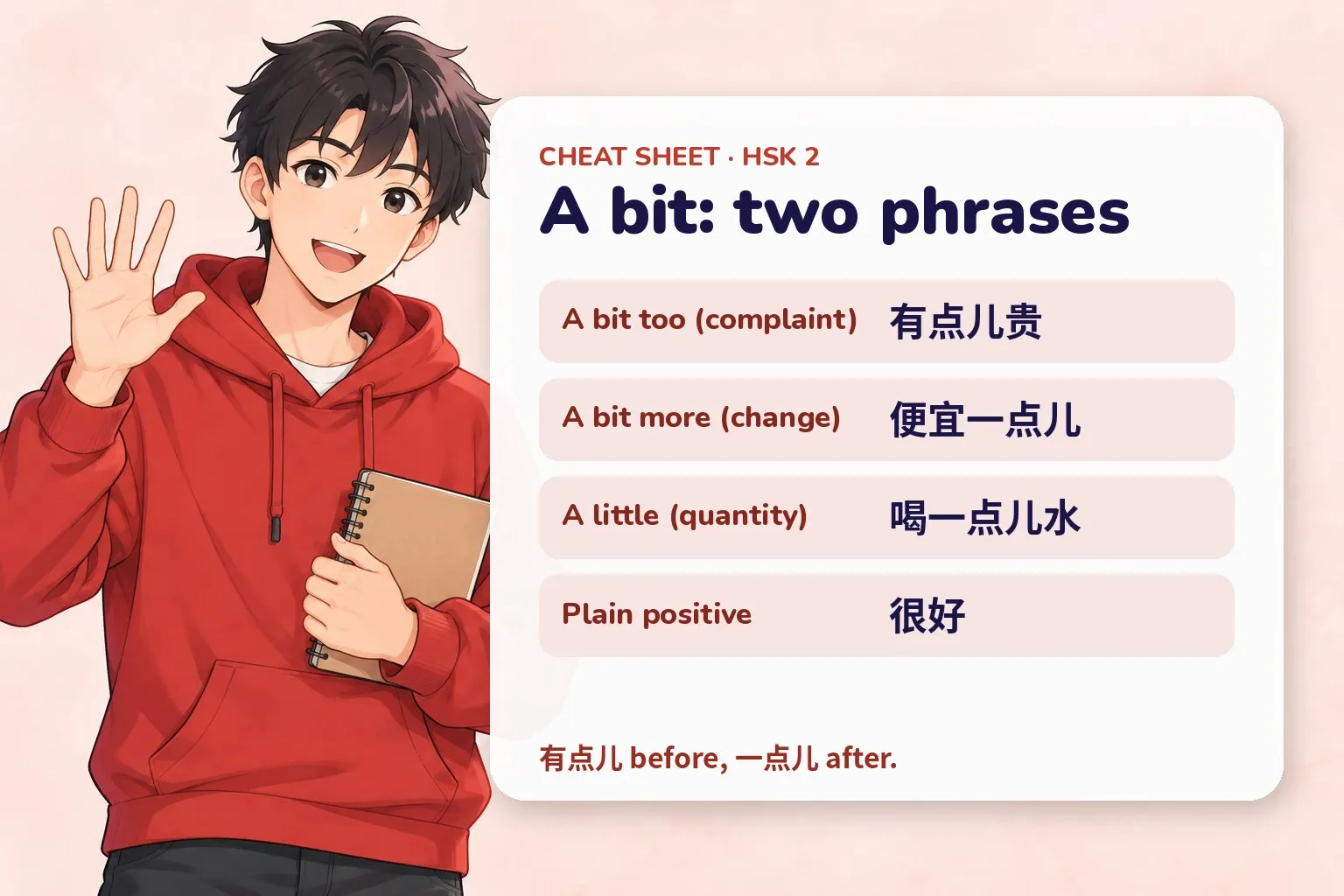
Quick recap before you practise.
Practice
一点儿 (yìdiǎnr) vs 有一点儿 (yǒu yìdiǎnr) practice
Try each one, then press Check. No sign-up, nothing is sent anywhere — it all runs in your browser.
Hint: it goes AFTER the adjective
Show answer
yìdiǎnr — 便宜一点儿 (piányi yìdiǎnr): 一点儿 follows the adjective for a requested change.
3 Put the words in order: 'Please speak a little slower.'
Show answer
请说 (qǐng shuō) 慢 (màn) 一点儿 (yìdiǎnr) — The amount follows the adjective: 请说慢一点儿 (qǐng shuō màn yìdiǎnr).
5 Match each phrase to its meaning.
- 有点儿累 (yǒudiǎnr lèi)
- 大一点儿 (dà yìdiǎnr)
- 一点儿水 (yìdiǎnr shuǐ)
- 很好 (hěn hǎo)
Show answer
- 有点儿累 (yǒudiǎnr lèi) → a bit (too) tired — a complaint
- 大一点儿 (dà yìdiǎnr) → a bit bigger — a change
- 一点儿水 (yìdiǎnr shuǐ) → a little water — a quantity
- 很好 (hěn hǎo) → very good — a plain positive
有点儿 (yǒudiǎnr) before = complaint; 一点儿 (yìdiǎnr) after = change/quantity; 很 (hěn) = plain description.
Quiz
一点儿 (yìdiǎnr) vs 有一点儿 (yǒu yìdiǎnr) quiz
12 questions · pick an answer and you'll see straight away if it's right.
-
Show answer
before the adjective — 有点儿 comes before the adjective: 有点儿贵 (yǒudiǎnr guì).
-
Show answer
after the adjective — It follows the adjective: 大一点儿 (dà yìdiǎnr).
-
Show answer
a complaint / 'too' — 有点儿 flags something unwanted: 有点儿贵 (yǒudiǎnr guì), 'a bit too expensive'.
-
Show answer
便宜一点儿 (piányi yìdiǎnr) — A requested change uses 一点儿 after the adjective: 便宜一点儿 (piányi yìdiǎnr).
-
Show answer
有点儿 (yǒudiǎnr) can't take 很 (hěn) before it — 有点儿 already means 'somewhat'; don't add 很. Say 我有点儿累 (wǒ yǒudiǎnr lèi).
-
Show answer
喝一点儿水 (hē yìdiǎnr shuǐ) — A small quantity after a verb is 一点儿: 喝一点儿水 (hē yìdiǎnr shuǐ).
-
Show answer
有点儿好 (yǒudiǎnr hǎo) — 有点儿 wants an unwanted quality; for 'good' use 很好 (hěn hǎo), not 有点儿好.
-
Show answer
高一点儿 (gāo yìdiǎnr) — The amount follows the adjective: 他比我高一点儿 (tā bǐ wǒ gāo yìdiǎnr).
-
Show answer
点儿 (diǎnr) — 一点儿 can drop to 点儿: 吃点儿饭 (chī diǎnr fàn).
-
Show answer
这个菜有点儿辣 (zhège cài yǒudiǎnr là) — A complaint uses 有点儿 before the adjective: 有点儿辣 (yǒudiǎnr là).
-
Show answer
yǒudiǎnr — 我有点儿累 (wǒ yǒudiǎnr lèi): 有点儿 before the adjective.
-
Show answer
position (before vs after the adjective) — 有点儿 goes before the adjective (complaint); 一点儿 goes after it (change/quantity).
Recap cheat-sheet
| Phrase | Position | Feeling | Example |
|---|---|---|---|
| 有点儿 (yǒudiǎnr) | before adjective | a bit too (complaint) | 有点儿贵 (yǒudiǎnr guì) |
| 一点儿 (yìdiǎnr) | after adjective | a bit more (change) | 便宜一点儿 (piányi yìdiǎnr) |
| 一点儿 (yìdiǎnr) | after verb | a small amount | 喝一点儿水 (hē yìdiǎnr shuǐ) |
| 点儿 (diǎnr) | after verb | shortened amount | 吃点儿饭 (chī diǎnr fàn) |
Next
- See the amount after the adjective in comparisons with 比 (bǐ)
- Review plain description with adjectives with 很 (hěn)
- New here? Start with Start Learning Chinese Here
All Chinese grammar topics
Every grammar point in order, from your first sentence to advanced structures. Pick one and go straight to it. New lessons go live every day, so topics marked Coming soon fill in over the next weeks.
Grammar path
HSK 1 15 topics · 15 ready
- 01 The Verb 是 (shì): to be
- 02 Basic Word Order (Subject-Verb-Object)
- 03 Adjectives with 很 (hěn)
- 04 Yes/No Questions with 吗 (ma)
- 05 Question Words (什么 shénme, 谁 shuí, 哪 nǎ, 几 jǐ)
- 06 The Particle 的 (de): Possession & Modification
- 07 Measure Words and 个 (ge)
- 08 Numbers and Counting
- 09 The Verb 有 (yǒu): to have / there is
- 10 The Verb 在 (zài): Location
- 11 Time When (Position in Sentence)
- 12 The Particle 了 (le): Change of State
- 13 Modal Verbs 想 / 要 / 会 / 能 (xiǎng / yào / huì / néng)
- 14 The Particle 呢 (ne)
- 15 也 (yě) and 都 (dōu) Placement
HSK 2 14 topics · 6 ready
- 16 Aspectual 了 (Completed Action)
- 17 The Aspect Particle 过 (guò)
- 18 Progressive Aspect (在 / 正在 / 呢 zài / zhèngzài / ne)
- 19 Comparisons with 比 (bǐ)
- 20 A Bit: 一点儿 (yìdiǎnr) vs 有一点儿 (yǒu yìdiǎnr) You are here
- 21 Basic Conjunctions (和 hé, 也 yě, 都 dōu, 还 hái)
- 22 Coverbs 给 / 跟 / 对 (gěi / gēn / duì) Coming soon
- 23 Duration (Time How Long) Coming soon
- 24 Resultative Complements (看完 kànwán, 听懂 tīngdǒng) Coming soon
- 25 The 把 (bǎ) Construction Coming soon
- 26 The Particle 吧 (ba) Coming soon
- 27 Again: 再 (zài) vs 又 (yòu) Coming soon
- 28 Imminent Action (快要 kuàiyào...了 / 要 le / yào...了 le) Coming soon
- 29 Asking Degree with 多 (duō) Coming soon
HSK 3 10 topics
- 30 Directional Complements (出来 chūlái, 回去 huíqù) Coming soon
- 31 Potential Complements (看得懂 kàndedǒng, 做不完 zuòbùwán) Coming soon
- 32 Complement of Degree with 得 (de) Coming soon
- 33 Adverbial Modifier with 地 (de) Coming soon
- 34 The Durative Aspect 着 (zhe) Coming soon
- 35 把 (bǎ) with Complex Results Coming soon
- 36 The 被 (bèi) Passive Coming soon
- 37 Conditionals (如果 rúguǒ...就 / 要是 jiù / yàoshì) Coming soon
- 38 Pivotal Sentences (让 ràng, 叫 jiào, 请 qǐng, 使 shǐ) Coming soon
- 39 Conditional with ...的话 (dehuà) Coming soon
HSK 4 9 topics
- 40 The 是 (shì)...的 (de) Construction (Emphasis) Coming soon
- 41 The Adverbs 就 (jiù) and 才 (cái) Coming soon
- 42 Verb Reduplication (看看 kànkan, 试一试 shìyishì) Coming soon
- 43 As Soon As (一...就, yī...jiù) Coming soon
- 44 Comparing 把 (bǎ) and 被 (bèi) in Context Coming soon
- 45 Complement of Quantity / Comparison Degree Coming soon
- 46 连 (lián)...都/也 (Even) Coming soon
- 47 Time Sequence (先 xiān...然后 ránhòu, 的时候 deshíhòu, 以后/以前 yǐhòu / yǐqián) Coming soon
- 48 Approximation & 左右/多/来 (zuǒyòu / duō / lái) Coming soon
HSK 5 8 topics
- 49 Mood Adverbs (反正 fǎnzhèng, 居然 jūrán, 竟然 jìngrán, 难道 nándào) Coming soon
- 50 Complex Complements & Metaphorical Results Coming soon
- 51 Formal/Written Markers (之 zhī, 其 qí, 者 zhě, 以 yǐ) Coming soon
- 52 Colloquial Passives (让 ràng, 叫 jiào, 给 gěi) Coming soon
- 53 不但不/没 (búdànbù / méi)...反而 (Contrary to Expectation) Coming soon
- 54 一...就 (yī...jiù) vs 一旦 (yídàn): Once / As Soon As Coming soon
- 55 复合趋向补语 (Compound Directional + Object) Coming soon
- 56 Emphasis with 是 (shì)...的 (de) vs 连 (lián)...都 (dōu) Review Coming soon
HSK 6 7 topics
- 57 Four-Character Idioms (成语 chéngyǔ) in Grammar Coming soon
- 58 Literary Connectives (然而 ránér, 从而 cóngér, 鉴于 jiànyú, 乃至 nǎizhì) Coming soon
- 59 Fixed Frameworks (在 zài...下 xià, 以 yǐ...为 wèi, 对 duì...而言 éryán) Coming soon
- 60 Rhetorical & Emphatic Structures (并 bìng, 可 kě, 正是 zhèngshì) Coming soon
- 61 Nominalisation & Topic Structures (所 suǒ...的 de, 的 de nominaliser) Coming soon
- 62 Long-Sentence Cohesion & Ellipsis Coming soon
- 63 经/予/加以 (Formal Verbal Framing) Coming soon