Basic Conjunctions (和 hé, 也 yě, 都 dōu, 还 hái)
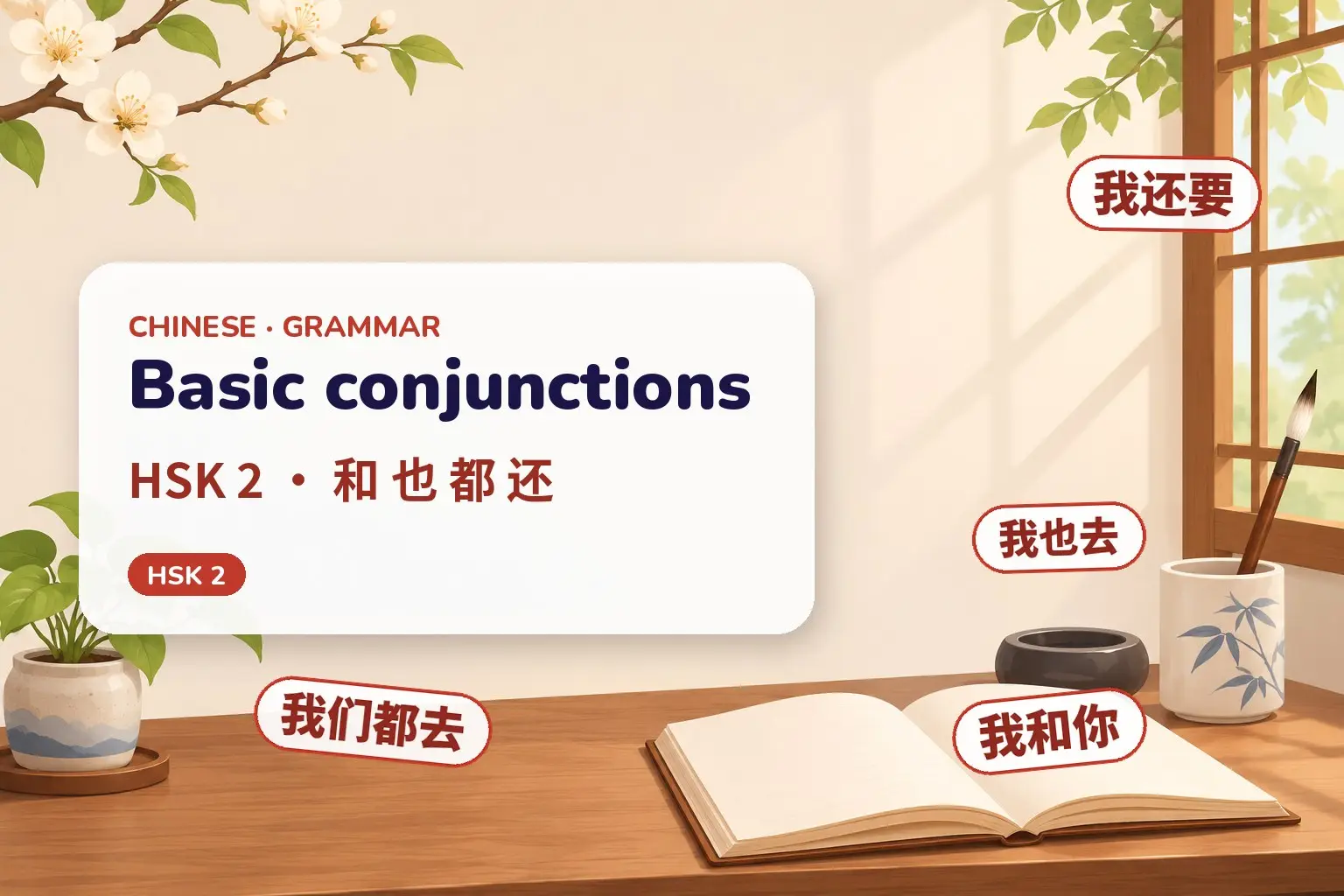
和 (hé) means 'and' and joins nouns only: 茶和咖啡 (chá hé kāfēi), tea and coffee. To add 'also', 'all' or 'still', use the adverbs 也 (yě), 都 (dōu) and 还 (hái) after the subject and before the verb: 我也去 (wǒ yě qù), I'm going too.
Level: HSK 2. English uses “and” for almost everything — “you and I”, “I eat and he sleeps”, “also”, “as well”. Mandarin splits the work. 和 (hé) joins nouns, while the ideas “also”, “all” and “still/in addition” are carried by three adverbs: 也 (yě), 都 (dōu) and 还 (hái). Learn which word does which job and you will stop over-using 和 (hé).
The rule
A conjunction joins two things; an adverb modifies a verb. Mandarin keeps these roles apart.
和 (hé) joins nouns. Put it between two nouns or noun phrases: 我和你 (wǒ hé nǐ), you and I; 茶和咖啡 (chá hé kāfēi), tea and coffee. 和 (hé) does not join two verbs or two sentences. English “I eat and he sleeps” is two clauses, so 和 (hé) is wrong there.
也 (yě), 都 (dōu), 还 (hái) are adverbs. Like all Chinese adverbs they sit after the subject and before the verb:
- 也 (yě) — “also, too”: 我也去 (wǒ yě qù), I’m going too.
- 都 (dōu) — “all, both”: 我们都去 (wǒmen dōu qù), we all go. 都 (dōu) points back to the words on its left, so it needs a plural idea there.
- 还 (hái) — “still, in addition, more”: 他还在睡觉 (tā hái zài shuìjiào), he is still asleep; 我还要一杯茶 (wǒ hái yào yì bēi chá), I want another cup of tea.
Where each word goes
| Word | Reading | Meaning | Position | Example |
|---|---|---|---|---|
| 和 | hé | and | between two nouns | 我和你 (wǒ hé nǐ) |
| 也 | yě | also, too | after subject, before verb | 我也去 (wǒ yě qù) |
| 都 | dōu | all, both | after subject, before verb | 我们都去 (wǒmen dōu qù) |
| 还 | hái | still, in addition | after subject, before verb | 我还要 (wǒ hái yào) |
When several stack up, the order is fixed: you say 也都 (yě dōu), not 都也 (dōu yě): 我们也都是学生 (wǒmen yě dōu shì xuésheng), we are all students too.
Example sentences
- 我和你。Wǒ hé nǐ.You and I.和 joins two nouns
- 茶和咖啡都很好。Chá hé kāfēi dōu hěn hǎo.Tea and coffee are both good.
- 我爸爸和妈妈都是老师。Wǒ bàba hé māma dōu shì lǎoshī.My dad and mom are both teachers.
- 我也喜欢中文。Wǒ yě xǐhuan Zhōngwén.I like Chinese too.也 before the verb
- 他也去北京。Tā yě qù Běijīng.He is going to Beijing too.
- 我们都是学生。Wǒmen dōu shì xuésheng.We are all students.都 looks back at 我们
- 他们都很忙。Tāmen dōu hěn máng.They are all busy.
- 我还要一杯茶。Wǒ hái yào yì bēi chá.I want another cup of tea.还 = in addition
- 他还在睡觉。Tā hái zài shuìjiào.He is still sleeping.还 = still
- 你还想吃吗?Nǐ hái xiǎng chī ma?Do you still want to eat?
- 我和他都不去。Wǒ hé tā dōu bú qù.Neither he nor I are going.都不 = none/neither
- 我们也都来了。Wǒmen yě dōu lái le.We have all come too.fixed order 也都
- 苹果和香蕉我都喜欢。Píngguǒ hé xiāngjiāo wǒ dōu xǐhuan.I like both apples and bananas.
- 老师和学生都在教室里。Lǎoshī hé xuésheng dōu zài jiàoshì lǐ.The teacher and the students are all in the classroom.
- 我喜欢茶,他也喜欢茶。Wǒ xǐhuan chá, tā yě xǐhuan chá.I like tea, and he likes tea too.two clauses: repeat the verb, use 也 — not 和
- 这本书我还没看。Zhè běn shū wǒ hái méi kàn.I haven't read this book yet.
- 你和我都对。Nǐ hé wǒ dōu duì.You and I are both right.
- 她会说中文,还会说法文。Tā huì shuō Zhōngwén, hái huì shuō Fǎwén.She can speak Chinese, and also French.
Every 和 (hé) above sits between nouns; every 也 (yě), 都 (dōu) and 还 (hái) sits in front of a verb.
Common mistakes
- ❌ 我吃饭和他睡觉。 (Wǒ chīfàn hé tā shuìjiào.) → ✅ use two clauses: 我吃饭 (wǒ chīfàn), 他睡觉 (tā shuìjiào). 和 (hé) cannot join two clauses; just use a comma, or add 也 (yě).
- ❌ 我喜欢茶和喜欢咖啡。 (Wǒ xǐhuan chá hé xǐhuan kāfēi.) → ✅ 我喜欢茶和咖啡。 (Wǒ xǐhuan chá hé kāfēi.) Join the nouns, not the repeated verb.
- ❌ 也我去。 (Yě wǒ qù.) → ✅ 我也去。 (Wǒ yě qù.) 也 (yě) is an adverb: it goes after the subject, never at the front.
- ❌ 都我们是学生。 (Dōu wǒmen shì xuésheng.) → ✅ 我们都是学生。 (Wǒmen dōu shì xuésheng.) 都 (dōu) must follow the plural word it sums up.
- ❌ 我和也去。 (Wǒ hé yě qù.) → ✅ 我也去。 (Wǒ yě qù.) Do not mix 和 (hé) with an adverb; pick the right single word.
A short conversation
— 小明 (Xiǎomíng):你喜欢什么? — Nǐ xǐhuan shénme? — What do you like? — 小红 (Xiǎohóng):我喜欢茶和咖啡。 — Wǒ xǐhuan chá hé kāfēi. — I like tea and coffee. — 小明 (Xiǎomíng):我也喜欢。我们都喜欢。 — Wǒ yě xǐhuan. Wǒmen dōu xǐhuan. — I like them too; we both like them. — 小红 (Xiǎohóng):我还喜欢果汁。 — Wǒ hái xǐhuan guǒzhī. — I also like juice.
Notice 和 (hé) joins the two drinks, while 也 (yě), 都 (dōu) and 还 (hái) each sit before a verb.
Usage notes
- 都 (dōu) summarises its left side. Ask “all of what?” — the answer is always to the left of 都 (dōu): 我和他都忙 (wǒ hé tā dōu máng), he and I are both busy.
- 都不 (dōu bù) vs 不都 (bù dōu). 都不 (dōu bù) means “none”: 他们都不去 (tāmen dōu bú qù), none of them go. 不都 (bù dōu) means “not all”: 他们不都去 (tāmen bù dōu qù), not all of them go.
- 还 (hái) has two senses. It can mean “still” (他还在 (tā hái zài), he is still here) and “in addition / more” (还要一个 (hái yào yí ge), want one more). Context decides.
- 和 (hé) is also 跟 (gēn) or 与 (yǔ). In speech many say 跟 (gēn) for “and/with”; 与 (yǔ) is formal and written. All join nouns the same way.
Compared with 也 (yě) / 都 (dōu) placement and paired conjunctions
This page is about which word to choose. For the finer detail of where 也 (yě) and 都 (dōu) sit when they combine, see 也 (yě) and 都 (dōu) placement.
Mandarin also has paired conjunctions that frame two parts together:
- 又…又… (yòu… yòu…) — “both… and…”: 又大又便宜 (yòu dà yòu piányi), both big and cheap.
- 一边…一边… (yìbiān… yìbiān…) — “while doing… do…”: 一边吃一边看 (yìbiān chī yìbiān kàn), eating while watching.
These frame verbs or adjectives, which is exactly the job 和 (hé) cannot do. Browse the whole Chinese grammar section for more.
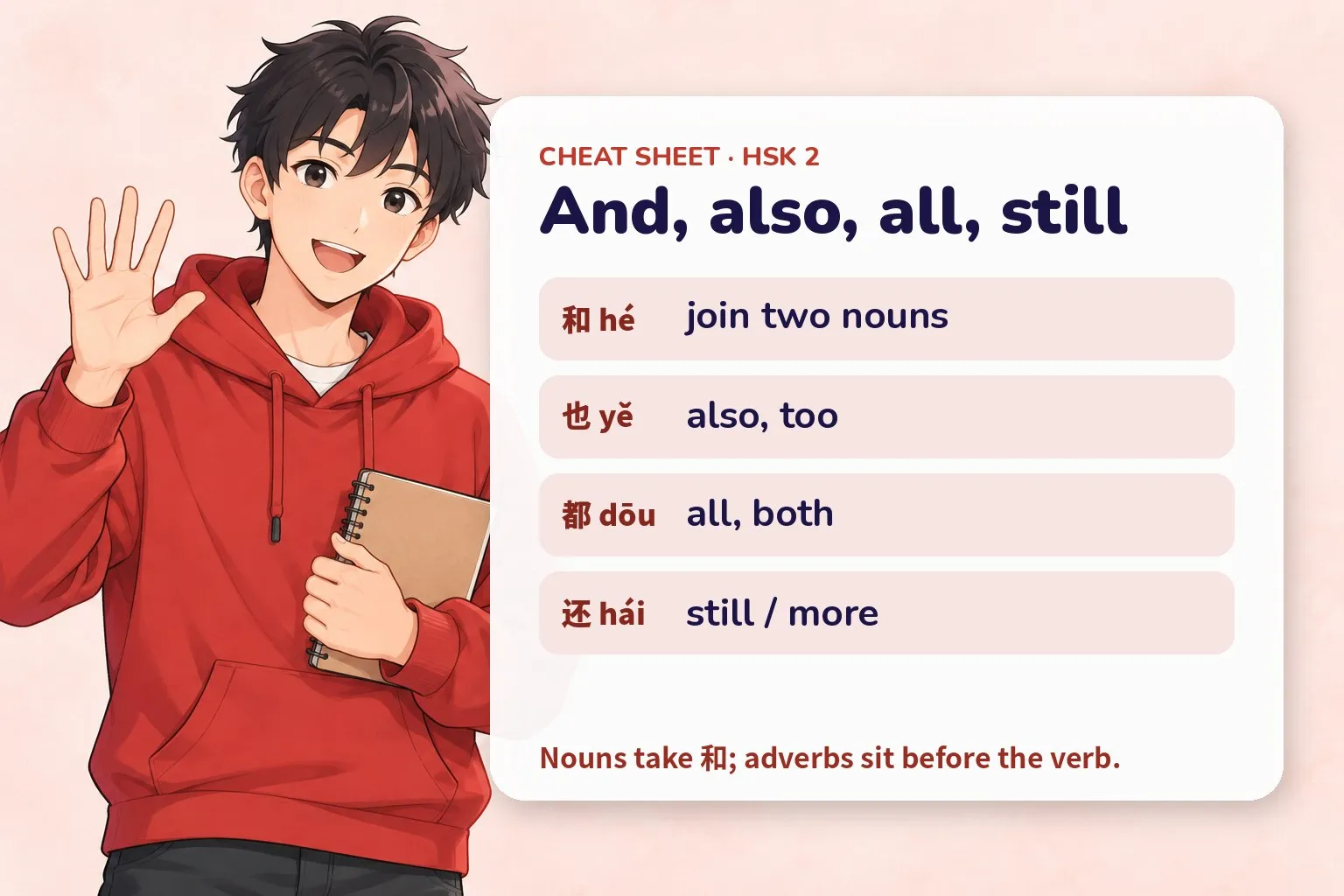
Quick recap before you practise.
Practice
Basic conjunctions practice
Try each one, then press Check. No sign-up, nothing is sent anywhere — it all runs in your browser.
Hint: all/both
Show answer
dōu — 我们都是学生 (wǒmen dōu shì xuésheng): 都 (dōu) sums up 我们 (wǒmen).
Hint: in addition / more
Show answer
hái — 我还要一杯茶 (wǒ hái yào yì bēi chá): 还 (hái) adds 'more'.
5 Order the words: 'They are all busy.'
Show answer
他们 (tāmen) 都 (dōu) 很忙 (hěn máng) — 他们都很忙 (tāmen dōu hěn máng): subject, 都, then the predicate.
6 Match each word to its job.
- 和 (hé)
- 也 (yě)
- 都 (dōu)
- 还 (hái)
Show answer
- 和 (hé) → join nouns
- 也 (yě) → also (adverb)
- 都 (dōu) → all (adverb)
- 还 (hái) → still / more (adverb)
和 (hé) joins nouns; 也 (yě), 都 (dōu) and 还 (hái) are adverbs before the verb.
Quiz
Basic conjunctions quiz
12 questions · pick an answer and you'll see straight away if it's right.
-
Show answer
two nouns — 和 (hé) links nouns or noun phrases only.
-
Show answer
茶和咖啡 (chá hé kāfēi) — Join the two nouns with 和 (hé): 茶和咖啡 (chá hé kāfēi).
-
Show answer
after the subject, before the verb — 也 (yě) is an adverb: 我也去 (wǒ yě qù).
-
Show answer
the words before it (its left) — 都 (dōu) sums up the plural idea on its left: 他们都 (tāmen dōu).
-
Show answer
和 (hé) cannot join two clauses — 和 (hé) joins nouns, not clauses; use a comma or 也 (yě).
-
Show answer
他还在睡觉 (tā hái zài shuìjiào) — 还 (hái) means 'still': 他还在睡觉 (tā hái zài shuìjiào).
-
Show answer
none / neither — 都不 (dōu bù) = 'none': 他们都不去 (tāmen dōu bú qù).
-
Show answer
not all — 不都 (bù dōu) = 'not all': 他们不都去 (tāmen bù dōu qù).
-
Show answer
也都 (yě dōu) — The fixed order is 也都 (yě dōu): 我们也都是学生 (wǒmen yě dōu shì xuésheng).
-
Show answer
也 (yě) — 也 (yě) is the plain word for 'also/too'.
-
Show answer
hé — 和 (hé) joins the two nouns: 爸爸和妈妈 (bàba hé māma).
-
Show answer
和 (hé) — 和 (hé) is a conjunction that joins nouns; the other three are adverbs.
Recap cheat-sheet
| Word | Reading | Job | Example |
|---|---|---|---|
| 和 | hé | joins nouns | 我和你 (wǒ hé nǐ) |
| 也 | yě | also (adverb) | 我也去 (wǒ yě qù) |
| 都 | dōu | all (adverb) | 我们都去 (wǒmen dōu qù) |
| 还 | hái | still / more | 我还要 (wǒ hái yào) |
Next
- Go deeper on placement: 也 (yě) and 都 (dōu) placement
- Back to the Chinese grammar section
- New here? Start with Start Learning Chinese Here
All Chinese grammar topics
Every grammar point in order, from your first sentence to advanced structures. Pick one and go straight to it. New lessons go live every day, so topics marked Coming soon fill in over the next weeks.
Grammar path
HSK 1 15 topics · 15 ready
- 01 The Verb 是 (shì): to be
- 02 Basic Word Order (Subject-Verb-Object)
- 03 Adjectives with 很 (hěn)
- 04 Yes/No Questions with 吗 (ma)
- 05 Question Words (什么 shénme, 谁 shuí, 哪 nǎ, 几 jǐ)
- 06 The Particle 的 (de): Possession & Modification
- 07 Measure Words and 个 (ge)
- 08 Numbers and Counting
- 09 The Verb 有 (yǒu): to have / there is
- 10 The Verb 在 (zài): Location
- 11 Time When (Position in Sentence)
- 12 The Particle 了 (le): Change of State
- 13 Modal Verbs 想 / 要 / 会 / 能 (xiǎng / yào / huì / néng)
- 14 The Particle 呢 (ne)
- 15 也 (yě) and 都 (dōu) Placement
HSK 2 14 topics · 6 ready
- 16 Aspectual 了 (Completed Action)
- 17 The Aspect Particle 过 (guò)
- 18 Progressive Aspect (在 / 正在 / 呢 zài / zhèngzài / ne)
- 19 Comparisons with 比 (bǐ)
- 20 A Bit: 一点儿 (yìdiǎnr) vs 有一点儿 (yǒu yìdiǎnr)
- 21 Basic Conjunctions (和 hé, 也 yě, 都 dōu, 还 hái) You are here
- 22 Coverbs 给 / 跟 / 对 (gěi / gēn / duì) Coming soon
- 23 Duration (Time How Long) Coming soon
- 24 Resultative Complements (看完 kànwán, 听懂 tīngdǒng) Coming soon
- 25 The 把 (bǎ) Construction Coming soon
- 26 The Particle 吧 (ba) Coming soon
- 27 Again: 再 (zài) vs 又 (yòu) Coming soon
- 28 Imminent Action (快要 kuàiyào...了 / 要 le / yào...了 le) Coming soon
- 29 Asking Degree with 多 (duō) Coming soon
HSK 3 10 topics
- 30 Directional Complements (出来 chūlái, 回去 huíqù) Coming soon
- 31 Potential Complements (看得懂 kàndedǒng, 做不完 zuòbùwán) Coming soon
- 32 Complement of Degree with 得 (de) Coming soon
- 33 Adverbial Modifier with 地 (de) Coming soon
- 34 The Durative Aspect 着 (zhe) Coming soon
- 35 把 (bǎ) with Complex Results Coming soon
- 36 The 被 (bèi) Passive Coming soon
- 37 Conditionals (如果 rúguǒ...就 / 要是 jiù / yàoshì) Coming soon
- 38 Pivotal Sentences (让 ràng, 叫 jiào, 请 qǐng, 使 shǐ) Coming soon
- 39 Conditional with ...的话 (dehuà) Coming soon
HSK 4 9 topics
- 40 The 是 (shì)...的 (de) Construction (Emphasis) Coming soon
- 41 The Adverbs 就 (jiù) and 才 (cái) Coming soon
- 42 Verb Reduplication (看看 kànkan, 试一试 shìyishì) Coming soon
- 43 As Soon As (一...就, yī...jiù) Coming soon
- 44 Comparing 把 (bǎ) and 被 (bèi) in Context Coming soon
- 45 Complement of Quantity / Comparison Degree Coming soon
- 46 连 (lián)...都/也 (Even) Coming soon
- 47 Time Sequence (先 xiān...然后 ránhòu, 的时候 deshíhòu, 以后/以前 yǐhòu / yǐqián) Coming soon
- 48 Approximation & 左右/多/来 (zuǒyòu / duō / lái) Coming soon
HSK 5 8 topics
- 49 Mood Adverbs (反正 fǎnzhèng, 居然 jūrán, 竟然 jìngrán, 难道 nándào) Coming soon
- 50 Complex Complements & Metaphorical Results Coming soon
- 51 Formal/Written Markers (之 zhī, 其 qí, 者 zhě, 以 yǐ) Coming soon
- 52 Colloquial Passives (让 ràng, 叫 jiào, 给 gěi) Coming soon
- 53 不但不/没 (búdànbù / méi)...反而 (Contrary to Expectation) Coming soon
- 54 一...就 (yī...jiù) vs 一旦 (yídàn): Once / As Soon As Coming soon
- 55 复合趋向补语 (Compound Directional + Object) Coming soon
- 56 Emphasis with 是 (shì)...的 (de) vs 连 (lián)...都 (dōu) Review Coming soon
HSK 6 7 topics
- 57 Four-Character Idioms (成语 chéngyǔ) in Grammar Coming soon
- 58 Literary Connectives (然而 ránér, 从而 cóngér, 鉴于 jiànyú, 乃至 nǎizhì) Coming soon
- 59 Fixed Frameworks (在 zài...下 xià, 以 yǐ...为 wèi, 对 duì...而言 éryán) Coming soon
- 60 Rhetorical & Emphatic Structures (并 bìng, 可 kě, 正是 zhèngshì) Coming soon
- 61 Nominalisation & Topic Structures (所 suǒ...的 de, 的 de nominaliser) Coming soon
- 62 Long-Sentence Cohesion & Ellipsis Coming soon
- 63 经/予/加以 (Formal Verbal Framing) Coming soon