Chinese Modal Verbs 想, 要, 会, 能 (xiǎng, yào, huì, néng)
Chinese modal verbs go before the main verb: 想 (xiǎng) and 要 (yào) mean want to, 会 (huì) means a learned ability or a likely future, and 能 (néng) means be able to. Negate them all with 不 (bù): 我不会游泳 (wǒ bú huì yóuyǒng), I can't swim.
On this page10 sections · tap to jump
Level: beginner (HSK 1). A modal verb (also called an auxiliary verb) sits in front of a main verb and colours it — want, can, will, must. The four you meet first in Mandarin are 想 (xiǎng), 要 (yào), 会 (huì) and 能 (néng). Get their jobs straight and you can talk about wishes, plans and ability from day one.
The rule
A modal verb goes before the main verb: subject + modal + verb. It never takes a tense ending; time is shown elsewhere in the sentence.
- 我想喝咖啡。 Wǒ xiǎng hē kāfēi. — I want to drink coffee.
- 我会说中文。 Wǒ huì shuō Zhōngwén. — I can speak Chinese.
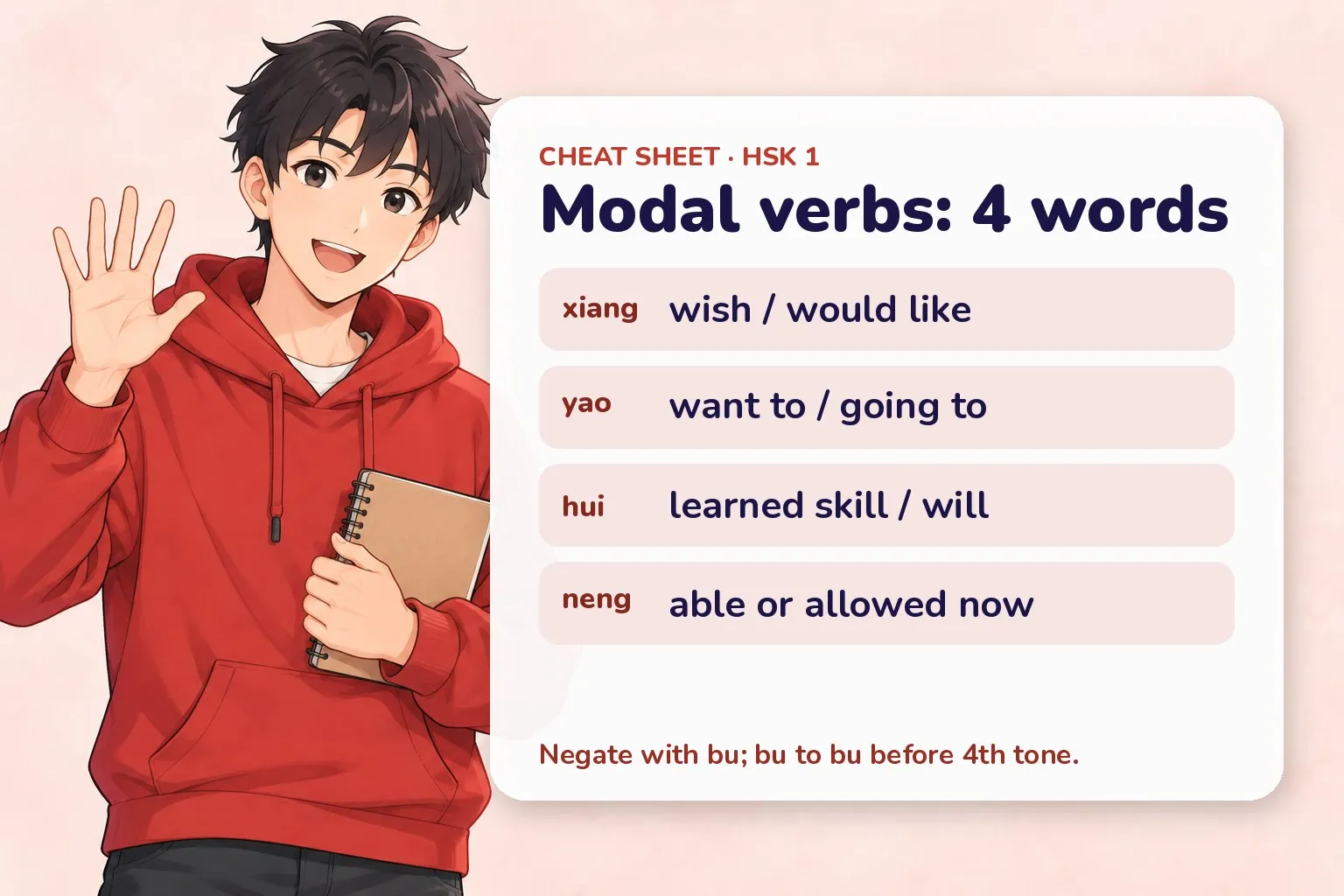
Here is what each one does. 想 (xiǎng) is a soft “would like to”, a wish: 我想休息 (wǒ xiǎng xiūxi), I’d like to rest. 要 (yào) is firmer — “want to”, “intend to” or “going to”: 我要走了 (wǒ yào zǒu le), I’m leaving / about to go. 会 (huì) has two senses: a learned ability — 我会开车 (wǒ huì kāichē), I can drive — and a likely future — 明天会下雨 (míngtiān huì xià yǔ), it will rain tomorrow. 能 (néng) means be able to — the strength, time or permission to do something right now: 我能帮你 (wǒ néng bāng nǐ), I can help you.
To make any of them negative, put 不 (bù) in front: 不想 (bù xiǎng, don’t want to), 不要 (bú yào, don’t / don’t want), 不会 (bú huì, can’t / won’t), 不能 (bù néng, can’t / may not).
Forms at a glance
| Modal | Pinyin | Core meaning | Negative |
|---|---|---|---|
| 想 | xiǎng | would like to (wish) | 不想 bù xiǎng |
| 要 | yào | want to / going to | 不要 bú yào |
| 会 | huì | can (learned skill) / will | 不会 bú huì |
| 能 | néng | be able to / allowed to | 不能 bù néng |
Tone note: 不 (bù) is 4th tone on its own, but before another 4th-tone syllable it rises to bú. Because 要 (yào) and 会 (huì) are 4th tone, 不要 (bú yào) and 不会 (bú huì) are said bú yào and bú huì. Before 想 (xiǎng, 3rd tone) and 能 (néng, 2nd tone) it stays bù.
Example sentences
- 我想喝咖啡。Wǒ xiǎng hē kāfēi.I want to drink coffee.想 = would like to
- 我想休息一下。Wǒ xiǎng xiūxi yíxià.I'd like to rest a bit.
- 你想去哪儿?Nǐ xiǎng qù nǎr?Where do you want to go?
- 我要走了。Wǒ yào zǒu le.I'm leaving (about to go).要 = going to / intend
- 我要一杯茶。Wǒ yào yì bēi chá.I want a cup of tea.要 before a noun = want (to have)
- 你要买什么?Nǐ yào mǎi shénme?What do you want to buy?
- 我会说中文。Wǒ huì shuō Zhōngwén.I can speak Chinese.会 = learned skill
- 她会开车。Tā huì kāichē.She can drive.
- 明天会下雨。Míngtiān huì xià yǔ.It will rain tomorrow.会 = likely future
- 我不会游泳。Wǒ bú huì yóuyǒng.I can't swim.不 rises to bú before 4th-tone 会
- 我能帮你。Wǒ néng bāng nǐ.I can help you.能 = able to right now
- 今天我不能来。Jīntiān wǒ bù néng lái.I can't come today.circumstance, so 能
- 这里能抽烟吗?Zhèlǐ néng chōuyān ma?Can you (is it allowed to) smoke here?能 = permission
- 我不想去。Wǒ bù xiǎng qù.I don't want to go.'don't want to' = 不想
- 不要走!Bú yào zǒu!Don't go!不要 = a command, don't
- 你能听懂吗?Nǐ néng tīngdǒng ma?Can you understand (by listening)?
- 我会帮你的。Wǒ huì bāng nǐ de.I will help you.会 = willingness / future
Common mistakes
- ❌ 我不要去。 (wǒ bú yào qù) for “I don’t want to go” → ✅ 我不想去。 Wǒ bù xiǎng qù. 不要 (bú yào) usually sounds like a command (“don’t go”); use 不想 (bù xiǎng) for “don’t want to”.
- ❌ 我能说中文。 (wǒ néng shuō Zhōngwén) for a skill → ✅ 我会说中文。 Wǒ huì shuō Zhōngwén. A learned language uses 会 (huì), not 能 (néng).
- ❌ 我想中文。 (wǒ xiǎng Zhōngwén) → ✅ 我想学中文。 Wǒ xiǎng xué Zhōngwén. A modal needs a main verb after it, such as 学 (xué), to study.
- ❌ 我会帮你今天。 (wǒ huì bāng nǐ jīntiān) for present ability → ✅ 今天我能帮你。 Jīntiān wǒ néng bāng nǐ. Being able to do something now is 能 (néng).
- ❌ 我不会要茶。 (stacking modals) → ✅ 我不要茶。 Wǒ bú yào chá. Don’t pile two modals together for one idea.
A short conversation
A: 你会游泳吗? (Nǐ huì yóuyǒng ma?) — Can you swim? B: 会。但是今天我不能去。我要工作。 (Huì. Dànshì jīntiān wǒ bù néng qù. Wǒ yào gōngzuò.) — Yes, but I can’t go today. I have to work. A: 那你想周末去吗? (Nà nǐ xiǎng zhōumò qù ma?) — Then would you like to go at the weekend?
Usage notes
- 要 (yào) before a noun means “want (to have)”. 我要一杯茶 (wǒ yào yì bēi chá) is “I want a cup of tea”. Before a verb it means “want to / going to”: 我要走 (wǒ yào zǒu, I’m going to leave).
- 会 (huì) for the future is about likelihood. 明天会下雨 (míngtiān huì xià yǔ) predicts rain; it is not the same as a fixed plan, which often uses 要 (yào).
- 能 (néng) covers three kinds of “can”. Physical ability — 我能跑十公里 (wǒ néng pǎo shí gōnglǐ), I can run 10 km; free time — 今天我不能来 (jīntiān wǒ bù néng lái), I can’t come today; and permission — 这里能停车吗 (zhèlǐ néng tíngchē ma), can one park here?
- Yes/no questions. Add 吗 (ma) at the end, or use the modal in its A-not-A form: 你会不会开车? (nǐ huì bu huì kāichē?, can you drive or not?).
Compared with…
- 会 (huì) vs 能 (néng). 会 (huì) = a skill you have learned and can do in general; 能 (néng) = you are able or allowed to do it this time. “I can swim” as a skill is 我会游泳 (wǒ huì yóuyǒng); “I can’t swim today (my arm hurts)” is 我今天不能游泳 (wǒ jīntiān bù néng yóuyǒng).
- 能 (néng) vs 可以 (kěyǐ). Both can ask permission, but 可以 (kěyǐ) is the everyday “may I”: 我可以进来吗? (wǒ kěyǐ jìnlái ma?, may I come in?). 能 (néng) leans more on ability. You will meet 可以 (kěyǐ) next in the Chinese grammar section.
- The sentence frame here is the basic Chinese word order: subject + (modal) + verb + object.
Quick recap before you practise.
Practice
Chinese modal verbs practice
Try each one, then press Check. No sign-up, nothing is sent anywhere — it all runs in your browser.
Hint: 'don't want to' is not 不要 (bú yào)
Show answer
bù xiǎng — 'Don't want to' is 不想 (bù xiǎng): 我不想去 (wǒ bù xiǎng qù).
3 Put the words in order: 'I can help you.' (able to, right now)
Show answer
我 (wǒ) 能 (néng) 帮你 (bāng nǐ) — Subject + modal + verb: 我能帮你 (wǒ néng bāng nǐ).
5 Match each modal to its core job.
- 想 (xiǎng)
- 要 (yào)
- 会 (huì)
- 能 (néng)
Show answer
- 想 (xiǎng) → wish / would like to
- 要 (yào) → want to / going to
- 会 (huì) → learned skill / will
- 能 (néng) → able or allowed to now
想 (xiǎng) wish, 要 (yào) will, 会 (huì) skill, 能 (néng) able.
Quiz
Chinese modal verbs quiz
12 questions · pick an answer and you'll see straight away if it's right.
-
Show answer
before the main verb — Subject + modal + verb: 我想喝咖啡 (wǒ xiǎng hē kāfēi).
-
Show answer
想 (xiǎng) — 想 (xiǎng) is a wish, a soft 'would like to'.
-
Show answer
会 (huì) — A learned skill uses 会 (huì): 我会开车 (wǒ huì kāichē).
-
Show answer
不能 (bù néng) — A present circumstance uses 能 (néng): 今天我不能来 (jīntiān wǒ bù néng lái).
-
Show answer
我不想去 (wǒ bù xiǎng qù) — 'Don't want to' is 不想 (bù xiǎng); 不要 (bú yào) usually means 'don't' as a command.
-
Show answer
Don't go! — 不要 (bú yào) before a verb is a command: 'Don't go!'
-
Show answer
bú (2nd tone) — 不 (bù) rises to bú before another 4th tone, and 要 (yào) is 4th tone.
-
Show answer
a likely future / prediction — 会 (huì) can mark a likely future: it will rain tomorrow.
-
Show answer
a main verb — A modal needs a main verb: 我想学中文 (wǒ xiǎng xué Zhōngwén), not 我想中文.
-
Show answer
我可以进来吗 (wǒ kěyǐ jìnlái ma) — 可以 (kěyǐ) is the usual word for asking permission: 我可以进来吗 (wǒ kěyǐ jìnlái ma).
-
Show answer
我要一杯茶 (wǒ yào yì bēi chá) — 要 (yào) before a noun means 'want to have': 我要一杯茶 (wǒ yào yì bēi chá).
-
Show answer
huì — 会 (huì) marks a learned skill like swimming.
Recap cheat-sheet
| Modal | Use | Example | Pinyin |
|---|---|---|---|
| 想 | wish / would like | 我想喝咖啡 | Wǒ xiǎng hē kāfēi |
| 要 | want to / going to | 我要走了 | Wǒ yào zǒu le |
| 会 | learned skill / future | 我会说中文 | Wǒ huì shuō Zhōngwén |
| 能 | able / allowed now | 我能帮你 | Wǒ néng bāng nǐ |
Next
- Next grammar point: the basic Chinese word order
- Back to the Chinese grammar section
- New here? Start with Start Learning Chinese Here
All Chinese grammar topics
Every grammar point in order, from your first sentence to advanced structures. Pick one and go straight to it. New lessons go live every day, so topics marked Coming soon fill in over the next weeks.
Grammar path
HSK 1 15 topics · 13 ready
- 01 The Verb 是 (shì): to be
- 02 Basic Word Order (Subject-Verb-Object)
- 03 Adjectives with 很 (hěn)
- 04 Yes/No Questions with 吗 (ma)
- 05 Question Words (什么 shénme, 谁 shuí, 哪 nǎ, 几 jǐ)
- 06 The Particle 的 (de): Possession & Modification
- 07 Measure Words and 个 (ge)
- 08 Numbers and Counting
- 09 The Verb 有 (yǒu): to have / there is
- 10 The Verb 在 (zài): Location
- 11 Time When (Position in Sentence)
- 12 The Particle 了 (le): Change of State
- 13 Modal Verbs 想 / 要 / 会 / 能 (xiǎng / yào / huì / néng) You are here
- 14 The Particle 呢 (ne) Coming soon
- 15 也 (yě) and 都 (dōu) Placement Coming soon
HSK 2 16 topics
- 16 Aspectual 了 (Completed Action) Coming soon
- 17 The Aspect Particle 过 (guò) Coming soon
- 18 Progressive Aspect (在 / 正在 / 呢 zài / zhèngzài / ne) Coming soon
- 19 Comparisons with 比 (bǐ) Coming soon
- 20 A Bit: 一点儿 (yìdiǎnr) vs 有一点儿 (yǒu yìdiǎnr) Coming soon
- 21 Basic Conjunctions (和 hé, 也 yě, 都 dōu, 还 hái) Coming soon
- 22 Because...So (因为 yīnwèi...所以 suǒyǐ) Coming soon
- 23 Coverbs 给 / 跟 / 对 (gěi / gēn / duì) Coming soon
- 24 Duration (Time How Long) Coming soon
- 25 Resultative Complements (看完 kànwán, 听懂 tīngdǒng) Coming soon
- 26 The 把 (bǎ) Construction Coming soon
- 27 The Particle 吧 (ba) Coming soon
- 28 Again: 再 (zài) vs 又 (yòu) Coming soon
- 29 Or: 还是 (háishì) vs 或者 (huòzhě) Coming soon
- 30 Imminent Action (快要 kuàiyào...了 / 要 le / yào...了 le) Coming soon
- 31 Asking Degree with 多 (duō) Coming soon
HSK 3 18 topics
- 32 Directional Complements (出来 chūlái, 回去 huíqù) Coming soon
- 33 Potential Complements (看得懂 kàndedǒng, 做不完 zuòbùwán) Coming soon
- 34 Complement of Degree with 得 (de) Coming soon
- 35 Adverbial Modifier with 地 (de) Coming soon
- 36 The Durative Aspect 着 (zhe) Coming soon
- 37 把 (bǎ) with Complex Results Coming soon
- 38 The 被 (bèi) Passive Coming soon
- 39 Conditionals (如果 rúguǒ...就 / 要是 jiù / yàoshì) Coming soon
- 40 Although...But (虽然 suīrán...但是 dànshì) Coming soon
- 41 Pivotal Sentences (让 ràng, 叫 jiào, 请 qǐng, 使 shǐ) Coming soon
- 42 More and More (越来越 / 越 yuèláiyuè / yuè...越 yuè) Coming soon
- 43 除了 (chúle)...以外 (Besides / Except) Coming soon
- 44 Simultaneous Actions (一边...一边, yìbiān...yìbiān) Coming soon
- 45 Sequence: 先 (xiān)...再/然后 (zài / ránhòu) Coming soon
- 46 Conditional with ...的话 (dehuà) Coming soon
- 47 From...To (从 cóng...到 / 离 dào / lí) Coming soon
- 48 Similarity: 跟 (gēn)...一样 / 像 (yíyàng / xiàng)...一样 (yíyàng) Coming soon
- 49 Both...And (又 yòu...又 / 既 yòu / jì...又 yòu) Coming soon
HSK 4 13 topics
- 50 The 是 (shì)...的 (de) Construction (Emphasis) Coming soon
- 51 The Adverbs 就 (jiù) and 才 (cái) Coming soon
- 52 No Matter (不管 / 无论 bùguǎn / wúlùn...都 dōu) Coming soon
- 53 Even If (即使 / 就算 jíshǐ / jiùsuàn...也 yě) Coming soon
- 54 Verb Reduplication (看看 kànkan, 试一试 shìyishì) Coming soon
- 55 As Soon As (一...就, yī...jiù) Coming soon
- 56 Comparing 把 (bǎ) and 被 (bèi) in Context Coming soon
- 57 Complement of Quantity / Comparison Degree Coming soon
- 58 连 (lián)...都/也 (Even) Coming soon
- 59 Time Sequence (先 xiān...然后 ránhòu, 的时候 deshíhòu, 以后/以前 yǐhòu / yǐqián) Coming soon
- 60 From the Angle Of (对 duì...来说 láishuō) Coming soon
- 61 Only After / Not Until (要 yào...才 / 等 cái / děng...才 cái) Coming soon
- 62 Approximation & 左右/多/来 (zuǒyòu / duō / lái) Coming soon
HSK 5 14 topics
- 63 Mood Adverbs (反正 fǎnzhèng, 居然 jūrán, 竟然 jìngrán, 难道 nándào) Coming soon
- 64 Not Only...But Also (不但 búdàn...而且 érqiě) Coming soon
- 65 Otherwise (否则 / 要不然 fǒuzé / yàobùrán) Coming soon
- 66 Complex Complements & Metaphorical Results Coming soon
- 67 Formal/Written Markers (之 zhī, 其 qí, 者 zhě, 以 yǐ) Coming soon
- 68 Rather...Than (宁愿/宁可 nìngyuàn / nìngkě...也不 yěbù) Coming soon
- 69 与其 (yǔqí)...不如 (Rather Than / Better To) Coming soon
- 70 Only If / Only (只有 zhǐyǒu...才 / 只要 cái / zhǐyào...就 jiù) Coming soon
- 71 Colloquial Passives (让 ràng, 叫 jiào, 给 gěi) Coming soon
- 72 不但不/没 (búdànbù / méi)...反而 (Contrary to Expectation) Coming soon
- 73 一...就 (yī...jiù) vs 一旦 (yídàn): Once / As Soon As Coming soon
- 74 尽管 (jǐnguǎn)...还是 (Even Though) Coming soon
- 75 复合趋向补语 (Compound Directional + Object) Coming soon
- 76 Emphasis with 是 (shì)...的 (de) vs 连 (lián)...都 (dōu) Review Coming soon
HSK 6 7 topics
- 77 Four-Character Idioms (成语 chéngyǔ) in Grammar Coming soon
- 78 Literary Connectives (然而 ránér, 从而 cóngér, 鉴于 jiànyú, 乃至 nǎizhì) Coming soon
- 79 Fixed Frameworks (在 zài...下 xià, 以 yǐ...为 wèi, 对 duì...而言 éryán) Coming soon
- 80 Rhetorical & Emphatic Structures (并 bìng, 可 kě, 正是 zhèngshì) Coming soon
- 81 Nominalisation & Topic Structures (所 suǒ...的 de, 的 de nominaliser) Coming soon
- 82 Long-Sentence Cohesion & Ellipsis Coming soon
- 83 经/予/加以 (Formal Verbal Framing) Coming soon