Comparisons with 比 (bǐ) in Chinese
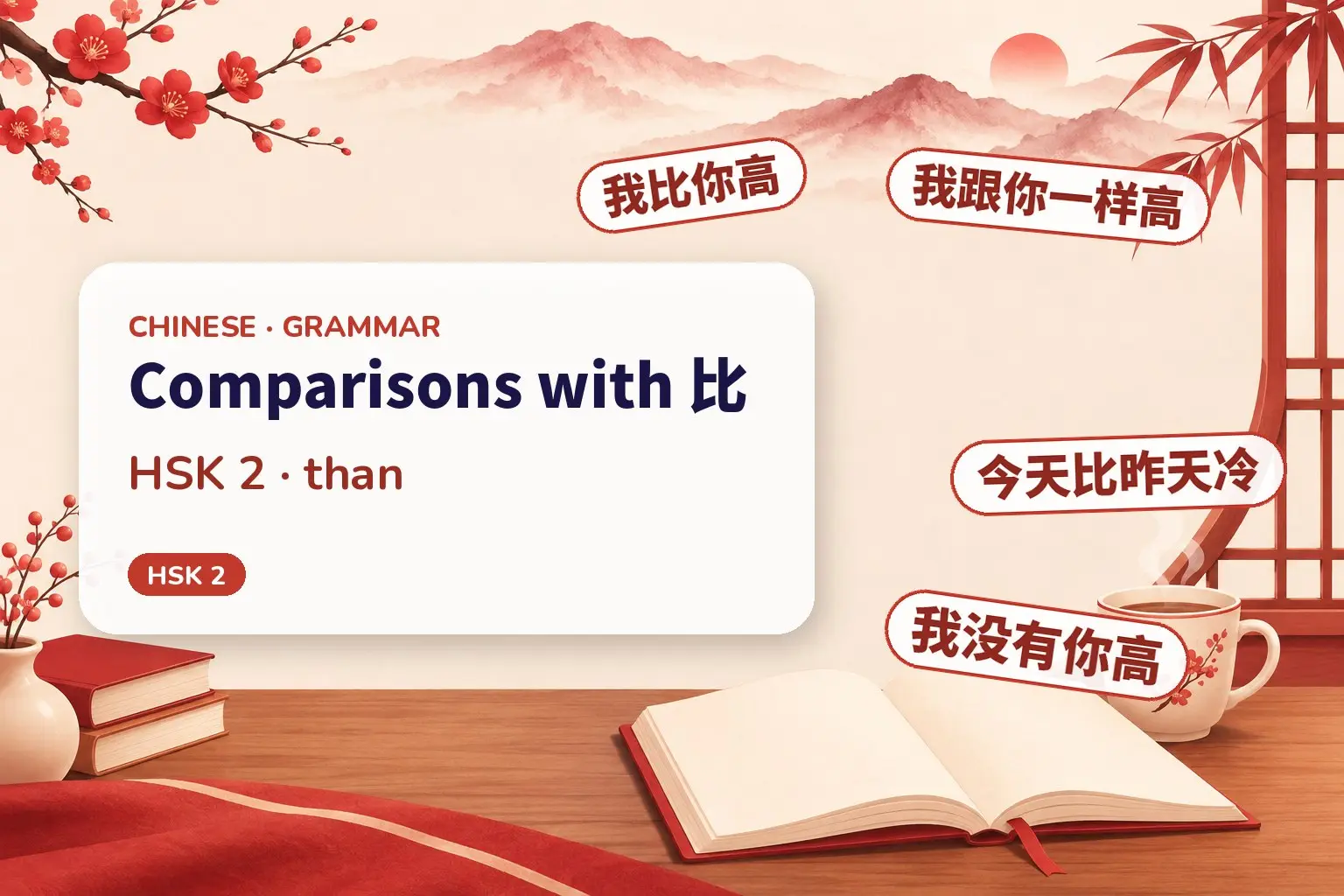
To compare two things in Mandarin use A 比 B + adjective: 我比你高 (Wǒ bǐ nǐ gāo) means 'I'm taller than you'. Never add 很 (hěn) or 非常 (fēicháng) after 比. For 'not as…as', switch to A 没有 B: 我没有你高 (Wǒ méiyǒu nǐ gāo).
Level: HSK 2. The word 比 (bǐ) is how Mandarin says “than”. You line up the two things, put 比 (bǐ) between them, and end with the quality you are comparing: 我比你高 (Wǒ bǐ nǐ gāo), “I’m taller than you”. No word for “more” is needed — the comparison lives in 比 (bǐ).
The rule
The basic pattern is A 比 (bǐ) B + adjective:
- A is the thing you are talking about,
- 比 (bǐ) means “compared with / than”,
- B is what you compare it to,
- the adjective comes last and carries the meaning “more …”.
So 今天比昨天冷 (Jīntiān bǐ zuótiān lěng) is “Today is colder than yesterday” — literally “today than yesterday cold”. You do not add 很 (hěn) or any other everyday intensifier before the adjective.
To say how much more, put an amount after the adjective:
- 一点儿 (yìdiǎnr) / 一些 (yìxiē) — a little: 他比我高一点儿 (Tā bǐ wǒ gāo yìdiǎnr), “a bit taller”.
- 得多 (de duō) / 多了 (duō le) — much more: 这个比那个好得多 (Zhège bǐ nàge hǎo de duō), “much better”.
- a number phrase: 他比我大两岁 (Tā bǐ wǒ dà liǎng suì), “two years older”.
The negative: 没有 (méiyǒu)
To say “not as … as”, Mandarin does not usually negate 比 (bǐ). Instead it uses A 没有 (méiyǒu) B + adjective, optionally with 那么 (nàme):
- 我没有你高 (Wǒ méiyǒu nǐ gāo) — “I’m not as tall as you”.
- 弟弟没有哥哥那么高 (Dìdi méiyǒu gēge nàme gāo) — “The younger brother isn’t as tall as the older one”.
Here 那么 (nàme, “that”) is optional and softens the sentence.
Forms at a glance
| Meaning | Pattern | Example | Pinyin |
|---|---|---|---|
| more than | A 比 B + adj | 我比你高。 | Wǒ bǐ nǐ gāo. |
| a little more | A 比 B + adj + 一点儿 | 他比我高一点儿。 | Tā bǐ wǒ gāo yìdiǎnr. |
| much more | A 比 B + adj + 得多 | 这个比那个好得多。 | Zhège bǐ nàge hǎo de duō. |
| by an amount | A 比 B + adj + number | 他比我大两岁。 | Tā bǐ wǒ dà liǎng suì. |
| even more | A 比 B + 更 + adj | 今天比昨天更热。 | Jīntiān bǐ zuótiān gèng rè. |
| not as … as | A 没有 B + adj | 我没有你高。 | Wǒ méiyǒu nǐ gāo. |
Example sentences
- 我比你高。Wǒ bǐ nǐ gāo.I'm taller than you.
- 他比我大。Tā bǐ wǒ dà.He's older than me.
- 今天比昨天冷。Jīntiān bǐ zuótiān lěng.Today is colder than yesterday.
- 这个比那个贵。Zhège bǐ nàge guì.This one is more expensive than that one.
- 中文比英文难。Zhōngwén bǐ Yīngwén nán.Chinese is harder than English.
- 哥哥比弟弟高一点儿。Gēge bǐ dìdi gāo yìdiǎnr.The older brother is a little taller than the younger one.amount after the adjective
- 这本书比那本书好多了。Zhè běn shū bǐ nà běn shū hǎo duō le.This book is much better than that one.好多了 = much more
- 他比我大两岁。Tā bǐ wǒ dà liǎng suì.He is two years older than me.a specific amount
- 我的房间比你的大。Wǒ de fángjiān bǐ nǐ de dà.My room is bigger than yours.
- 坐飞机比坐火车快。Zuò fēijī bǐ zuò huǒchē kuài.Taking a plane is faster than taking a train.
- 今天比昨天更热。Jīntiān bǐ zuótiān gèng rè.Today is even hotter than yesterday.更 gèng is allowed before the adjective
- 她比我跑得快。Tā bǐ wǒ pǎo de kuài.She runs faster than me.with a verb: 跑得快
- 我没有他高。Wǒ méiyǒu tā gāo.I'm not as tall as he is.negative with 没有
- 这个没有那个贵。Zhège méiyǒu nàge guì.This one isn't as expensive as that one.
- 我跟你一样高。Wǒ gēn nǐ yíyàng gāo.I'm as tall as you.equality: 跟…一样
- 弟弟没有哥哥那么高。Dìdi méiyǒu gēge nàme gāo.The younger brother isn't as tall as the older one.没有…那么
Common mistakes
- ❌ 我比你很高。 (wǒ bǐ nǐ hěn gāo) → ✅ 我比你高。 (wǒ bǐ nǐ gāo) Drop 很 (hěn); 比 (bǐ) already means “more”.
- ❌ 我比你非常高。 (wǒ bǐ nǐ fēicháng gāo) → ✅ 我比你高得多。 (wǒ bǐ nǐ gāo de duō) Use 得多 (de duō) for “much more”, not 非常 (fēicháng).
- ❌ 我不比你高 (wǒ bù bǐ nǐ gāo) for “I’m not as tall as you” → ✅ 我没有你高。 (wǒ méiyǒu nǐ gāo) The normal negative is 没有 (méiyǒu); 不比 (bù bǐ) means “no taller than”, a different nuance.
- ❌ 我比你一点儿高。 (wǒ bǐ nǐ yìdiǎnr gāo) → ✅ 我比你高一点儿。 (wǒ bǐ nǐ gāo yìdiǎnr) The amount follows the adjective.
- ❌ 我比你一样高。 (wǒ bǐ nǐ yíyàng gāo) → ✅ 我跟你一样高。 (wǒ gēn nǐ yíyàng gāo) Equality uses 跟…一样 (gēn…yíyàng), not 比 (bǐ).
A short conversation
A: 你比你弟弟高吗? (Nǐ bǐ nǐ dìdi gāo ma?) — Are you taller than your younger brother? B: 对!我比他高一点儿。 (Duì! Wǒ bǐ tā gāo yìdiǎnr.) — Yes, I’m a little taller than him. A: 他没有你高。可是他跑得比你快。 (Tā méiyǒu nǐ gāo. Kěshì tā pǎo de bǐ nǐ kuài.) — He’s not as tall as you, but he runs faster than you.
Usage notes
- 比 (bǐ) with verbs. When comparing how an action is done, 比 (bǐ) goes with a 得 (de) phrase: 他比我跑得快 (Tā bǐ wǒ pǎo de kuài), “he runs faster than me”, or 他跑得比我快 (Tā pǎo de bǐ wǒ kuài).
- 更 (gèng) and 还 (hái) for emphasis. 更 (gèng) and 还 (hái) can add “even”: 今天比昨天更冷 (Jīntiān bǐ zuótiān gèng lěng), “even colder than yesterday”.
- Comparing possessions. Use 的 (de) to avoid repeating the noun: 我的房间比你的大 (Wǒ de fángjiān bǐ nǐ de dà), “my room is bigger than yours”.
- 一样 (yíyàng) for sameness. The frame 跟 (gēn) or 和 (hé) … 一样 (yíyàng) states equality; its negative is 不一样 (bù yíyàng), “not the same”.
Compared with…
- 没有 (méiyǒu) comparisons say the first thing has less of the quality: 我没有你高 (wǒ méiyǒu nǐ gāo) is the counterpart of 你比我高 (nǐ bǐ wǒ gāo). See how 没有 (méiyǒu) also marks non-existence in 有 (yǒu): there is / to have.
- 一样 (yíyàng) comparisons state equality rather than difference: 我跟你一样高 (wǒ gēn nǐ yíyàng gāo), “as tall as you”. For the plain stative pattern without comparison, review adjectives with 很 (hěn).
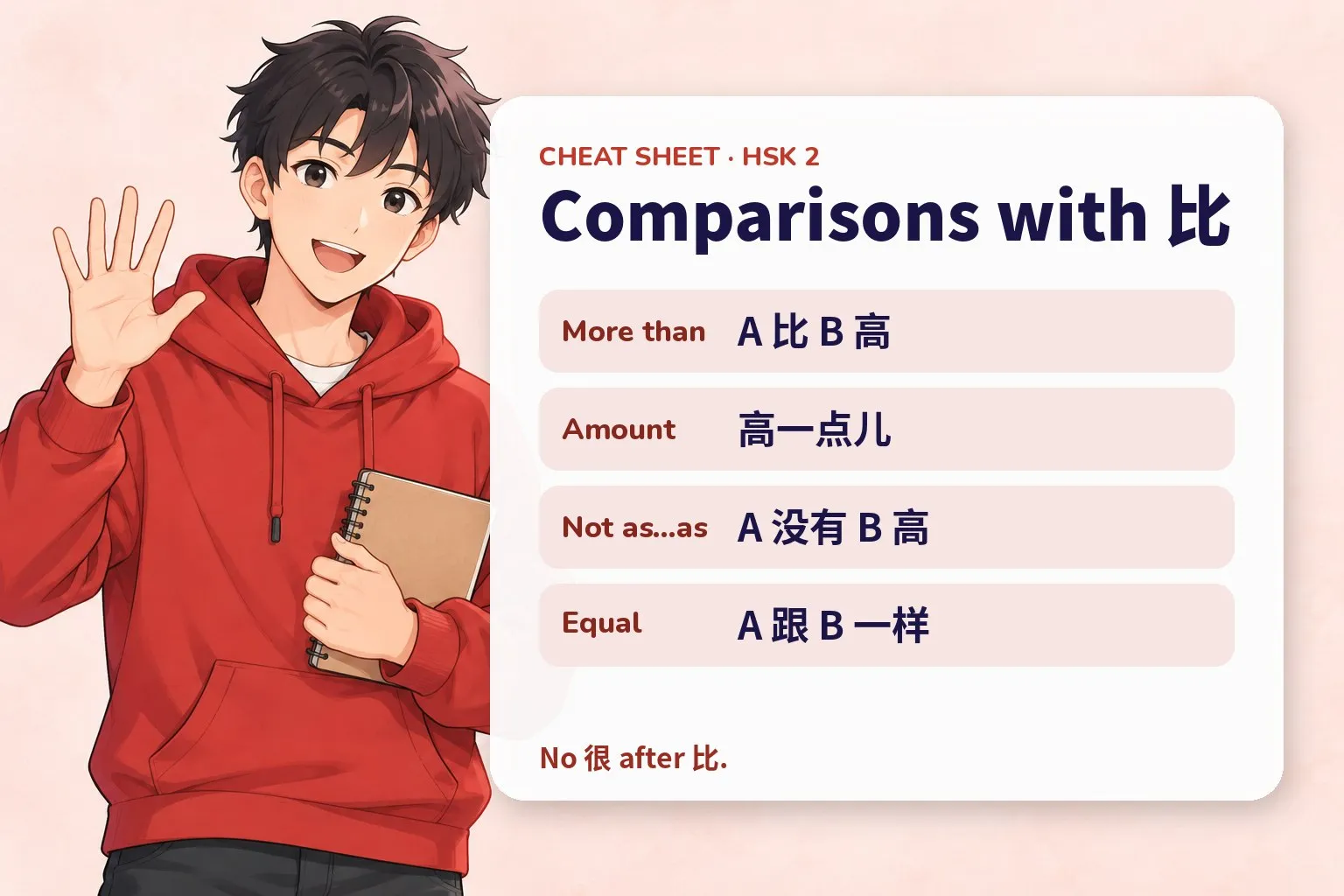
Quick recap before you practise.
Practice
Comparisons with 比 (bǐ) practice
Try each one, then press Check. No sign-up, nothing is sent anywhere — it all runs in your browser.
Hint: the 'not as…as' marker
Show answer
méiyǒu — Use 没有: 我没有你高 (wǒ méiyǒu nǐ gāo).
3 Put the words in order: 'He is two years older than me.'
Show answer
他 (tā) 比我 (bǐ wǒ) 大 (dà) 两岁 (liǎng suì) — A 比 B + adjective + amount: 他比我大两岁 (tā bǐ wǒ dà liǎng suì).
5 Match each frame to its meaning.
- A 比 B 高 (A bǐ B gāo)
- A 没有 B 高 (A méiyǒu B gāo)
- A 跟 B 一样高 (A gēn B yíyàng gāo)
- A 比 B 更高 (A bǐ B gèng gāo)
Show answer
- A 比 B 高 (A bǐ B gāo) → A is taller than B
- A 没有 B 高 (A méiyǒu B gāo) → A is not as tall as B
- A 跟 B 一样高 (A gēn B yíyàng gāo) → A is as tall as B
- A 比 B 更高 (A bǐ B gèng gāo) → A is even taller than B
比 (bǐ) = more, 没有 (méiyǒu) = less, 跟…一样 (gēn…yíyàng) = equal, 更 (gèng) = even more.
Quiz
Comparisons with 比 (bǐ) quiz
12 questions · pick an answer and you'll see straight away if it's right.
-
Show answer
A 比 B + adjective (A bǐ B) — A 比 B + adjective: 我比你高 (wǒ bǐ nǐ gāo).
-
Show answer
很 (hěn) can't follow 比 (bǐ) — An intensifier like 很 (hěn) can't appear after 比 (bǐ); the adjective already means 'more'.
-
Show answer
我没有你高 (wǒ méiyǒu nǐ gāo) — Use A 没有 B: 我没有你高 (wǒ méiyǒu nǐ gāo).
-
Show answer
after the adjective — After the adjective: 高一点儿 (gāo yìdiǎnr).
-
Show answer
更 (gèng) — Only 更 (gèng, even more) is allowed; 很/非常/太 are not.
-
Show answer
他比我大两岁 (tā bǐ wǒ dà liǎng suì) — Adjective then amount: 他比我大两岁 (tā bǐ wǒ dà liǎng suì).
-
Show answer
A 跟 B 一样 + adjective (A gēn B yíyàng) — Equality is A 跟/和 B 一样: 我跟你一样高 (wǒ gēn nǐ yíyàng gāo).
-
Show answer
好得多 (hǎo de duō) — 好得多 (hǎo de duō) or 好多了 (hǎo duō le) means 'much better'.
-
Show answer
这个没有那个贵 (zhège méiyǒu nàge guì) — A 没有 B + adjective: 这个没有那个贵 (zhège méiyǒu nàge guì).
-
Show answer
她比我跑得快 (tā bǐ wǒ pǎo de kuài) — Use a 得 phrase: 她比我跑得快 (tā bǐ wǒ pǎo de kuài).
-
Show answer
gèng — 更 (gèng) means 'even more' and may precede the adjective: 今天比昨天更热。
-
Show answer
我比你一样高 (wǒ bǐ nǐ yíyàng gāo) — 我比你一样高 mixes two frames; equality is 我跟你一样高 (wǒ gēn nǐ yíyàng gāo).
Recap cheat-sheet
| Meaning | Pattern | Example |
|---|---|---|
| more than | A 比 (bǐ) B + adj | 我比你高 (wǒ bǐ nǐ gāo) |
| a bit / much more | + 一点儿 (yìdiǎnr) / 得多 (de duō) | 高一点儿 (gāo yìdiǎnr) / 高得多 (gāo de duō) |
| by an amount | + number | 大两岁 (dà liǎng suì) |
| not as … as | A 没有 (méiyǒu) B + adj | 我没有你高 (wǒ méiyǒu nǐ gāo) |
| the same as | A 跟 (gēn) B 一样 (yíyàng) + adj | 我跟你一样高 (wǒ gēn nǐ yíyàng gāo) |
Next
- Review plain descriptions in adjectives with 很 (hěn)
- Back to the Chinese grammar section
- New here? Start with Start Learning Chinese Here
All Chinese grammar topics
Every grammar point in order, from your first sentence to advanced structures. Pick one and go straight to it. New lessons go live every day, so topics marked Coming soon fill in over the next weeks.
Grammar path
HSK 1 15 topics · 15 ready
- 01 The Verb 是 (shì): to be
- 02 Basic Word Order (Subject-Verb-Object)
- 03 Adjectives with 很 (hěn)
- 04 Yes/No Questions with 吗 (ma)
- 05 Question Words (什么 shénme, 谁 shuí, 哪 nǎ, 几 jǐ)
- 06 The Particle 的 (de): Possession & Modification
- 07 Measure Words and 个 (ge)
- 08 Numbers and Counting
- 09 The Verb 有 (yǒu): to have / there is
- 10 The Verb 在 (zài): Location
- 11 Time When (Position in Sentence)
- 12 The Particle 了 (le): Change of State
- 13 Modal Verbs 想 / 要 / 会 / 能 (xiǎng / yào / huì / néng)
- 14 The Particle 呢 (ne)
- 15 也 (yě) and 都 (dōu) Placement
HSK 2 14 topics · 6 ready
- 16 Aspectual 了 (Completed Action)
- 17 The Aspect Particle 过 (guò)
- 18 Progressive Aspect (在 / 正在 / 呢 zài / zhèngzài / ne)
- 19 Comparisons with 比 (bǐ) You are here
- 20 A Bit: 一点儿 (yìdiǎnr) vs 有一点儿 (yǒu yìdiǎnr)
- 21 Basic Conjunctions (和 hé, 也 yě, 都 dōu, 还 hái)
- 22 Coverbs 给 / 跟 / 对 (gěi / gēn / duì) Coming soon
- 23 Duration (Time How Long) Coming soon
- 24 Resultative Complements (看完 kànwán, 听懂 tīngdǒng) Coming soon
- 25 The 把 (bǎ) Construction Coming soon
- 26 The Particle 吧 (ba) Coming soon
- 27 Again: 再 (zài) vs 又 (yòu) Coming soon
- 28 Imminent Action (快要 kuàiyào...了 / 要 le / yào...了 le) Coming soon
- 29 Asking Degree with 多 (duō) Coming soon
HSK 3 10 topics
- 30 Directional Complements (出来 chūlái, 回去 huíqù) Coming soon
- 31 Potential Complements (看得懂 kàndedǒng, 做不完 zuòbùwán) Coming soon
- 32 Complement of Degree with 得 (de) Coming soon
- 33 Adverbial Modifier with 地 (de) Coming soon
- 34 The Durative Aspect 着 (zhe) Coming soon
- 35 把 (bǎ) with Complex Results Coming soon
- 36 The 被 (bèi) Passive Coming soon
- 37 Conditionals (如果 rúguǒ...就 / 要是 jiù / yàoshì) Coming soon
- 38 Pivotal Sentences (让 ràng, 叫 jiào, 请 qǐng, 使 shǐ) Coming soon
- 39 Conditional with ...的话 (dehuà) Coming soon
HSK 4 9 topics
- 40 The 是 (shì)...的 (de) Construction (Emphasis) Coming soon
- 41 The Adverbs 就 (jiù) and 才 (cái) Coming soon
- 42 Verb Reduplication (看看 kànkan, 试一试 shìyishì) Coming soon
- 43 As Soon As (一...就, yī...jiù) Coming soon
- 44 Comparing 把 (bǎ) and 被 (bèi) in Context Coming soon
- 45 Complement of Quantity / Comparison Degree Coming soon
- 46 连 (lián)...都/也 (Even) Coming soon
- 47 Time Sequence (先 xiān...然后 ránhòu, 的时候 deshíhòu, 以后/以前 yǐhòu / yǐqián) Coming soon
- 48 Approximation & 左右/多/来 (zuǒyòu / duō / lái) Coming soon
HSK 5 8 topics
- 49 Mood Adverbs (反正 fǎnzhèng, 居然 jūrán, 竟然 jìngrán, 难道 nándào) Coming soon
- 50 Complex Complements & Metaphorical Results Coming soon
- 51 Formal/Written Markers (之 zhī, 其 qí, 者 zhě, 以 yǐ) Coming soon
- 52 Colloquial Passives (让 ràng, 叫 jiào, 给 gěi) Coming soon
- 53 不但不/没 (búdànbù / méi)...反而 (Contrary to Expectation) Coming soon
- 54 一...就 (yī...jiù) vs 一旦 (yídàn): Once / As Soon As Coming soon
- 55 复合趋向补语 (Compound Directional + Object) Coming soon
- 56 Emphasis with 是 (shì)...的 (de) vs 连 (lián)...都 (dōu) Review Coming soon
HSK 6 7 topics
- 57 Four-Character Idioms (成语 chéngyǔ) in Grammar Coming soon
- 58 Literary Connectives (然而 ránér, 从而 cóngér, 鉴于 jiànyú, 乃至 nǎizhì) Coming soon
- 59 Fixed Frameworks (在 zài...下 xià, 以 yǐ...为 wèi, 对 duì...而言 éryán) Coming soon
- 60 Rhetorical & Emphatic Structures (并 bìng, 可 kě, 正是 zhèngshì) Coming soon
- 61 Nominalisation & Topic Structures (所 suǒ...的 de, 的 de nominaliser) Coming soon
- 62 Long-Sentence Cohesion & Ellipsis Coming soon
- 63 经/予/加以 (Formal Verbal Framing) Coming soon