也 (yě) and 都 (dōu) Placement in Chinese
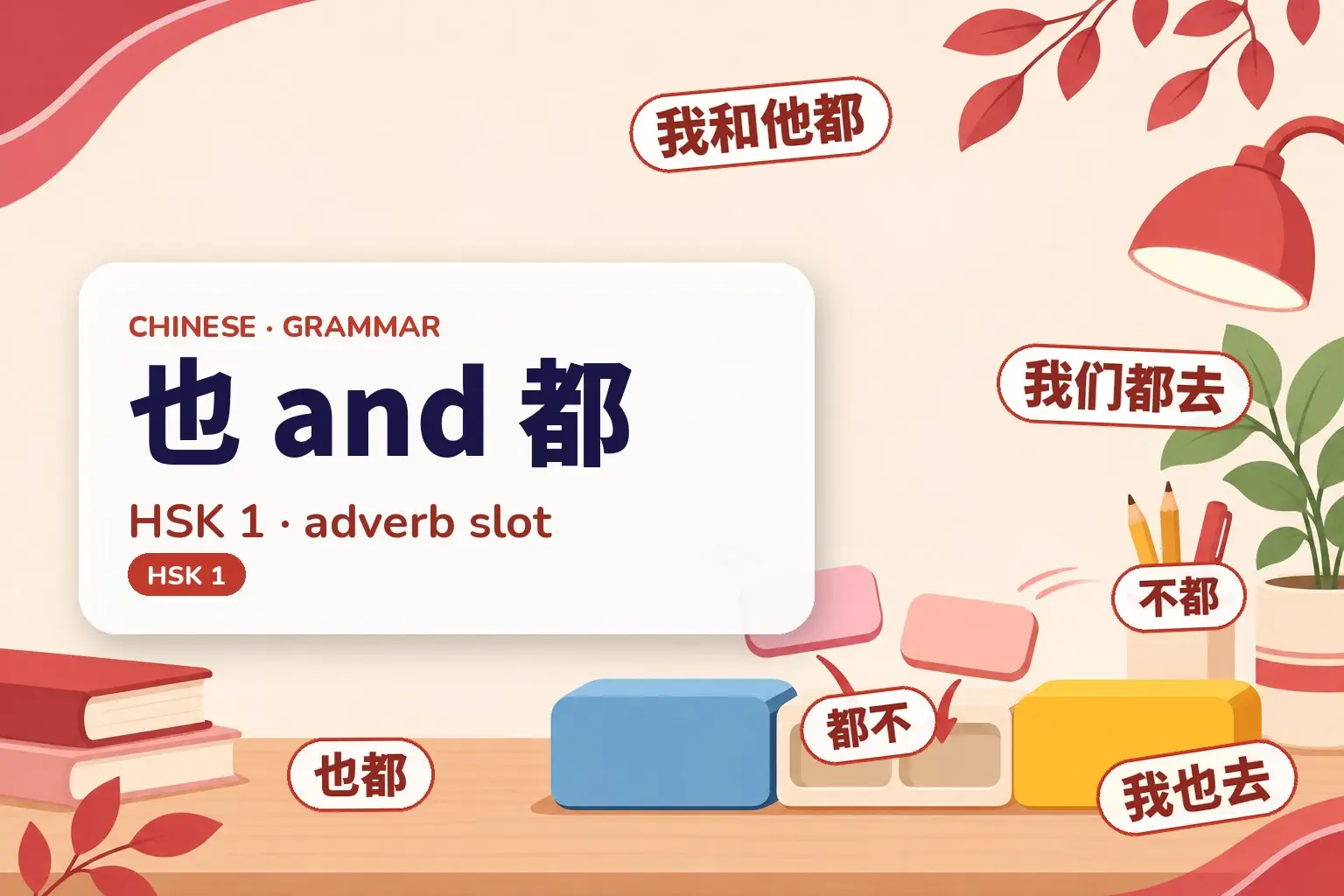
也 (yě, 'also') and 都 (dōu, 'all/both') are adverbs placed after the subject and before the verb or adjective: 我也去 (wǒ yě qù, 'I'm going too'), 我们都去 (wǒmen dōu qù, 'we all go').
Level: HSK 1. In English, “also” and “all” move around quite freely. In Mandarin they do not. 也 (yě, “also/too”) and 都 (dōu, “all/both”) are adverbs, and Chinese adverbs sit in one fixed slot: after the subject and right before the verb or adjective. Learn that slot once and you will place them correctly every time.
The rule
An adverb is a word that modifies a verb or adjective — here, “also” and “all”. The core pattern is:
Subject + 也 (yě) / 都 (dōu) + verb (or adjective)
- 我也去。 Wǒ yě qù. — I am going too.
- 我们都去。 Wǒmen dōu qù. — We all go.
也 (yě) means “also, too, as well”. 都 (dōu) means “all, both”, and it points at a plural idea. The key thing about 都 (dōu) is that it looks backward: it refers to the words that come before it, usually the subject. So 他们都是学生 (tāmen dōu shì xuésheng) means “they are all students” — 都 (dōu) sums up 他们 (tāmen, “they”).
Because they are adverbs, they can never stand at the start of the sentence the way English “Also, …” can, and they never drop to the end. They stay in the slot between the subject and the verb.
The adverb slot
| Pattern | Chinese | Pinyin | Meaning |
|---|---|---|---|
| also | 我也是学生。 | Wǒ yě shì xuésheng. | I am also a student. |
| all/both | 我们都是学生。 | Wǒmen dōu shì xuésheng. | We are all students. |
| also + all | 我们也都是学生。 | Wǒmen yě dōu shì xuésheng. | We are all students too. |
| not … either | 我也不去。 | Wǒ yě bù qù. | I’m not going either. |
| none | 他们都不去。 | Tāmen dōu bù qù. | None of them are going. |
Example sentences
- 我也是学生。Wǒ yě shì xuésheng.I am also a student.也 after the subject
- 他也去。Tā yě qù.He is going too.
- 我们都是学生。Wǒmen dōu shì xuésheng.We are all students.都 refers back to 我们
- 他们都很忙。Tāmen dōu hěn máng.They are all busy.
- 你也喜欢咖啡吗?Nǐ yě xǐhuan kāfēi ma?Do you like coffee too?
- 我也不知道。Wǒ yě bù zhīdào.I don't know either.也 before 不
- 他们都不是老师。Tāmen dōu bú shì lǎoshī.None of them are teachers.都不 = none
- 我和他都喜欢茶。Wǒ hé tā dōu xǐhuan chá.He and I both like tea.
- 这些书都很贵。Zhèxiē shū dōu hěn guì.These books are all expensive.
- 她也会说中文。Tā yě huì shuō Zhōngwén.She can speak Chinese too.
- 我们也都是中国人。Wǒmen yě dōu shì Zhōngguórén.We are all Chinese too.也都 order
- 爸爸和妈妈都在家。Bàba hé māma dōu zài jiā.Dad and Mum are both at home.
- 大家都来了。Dàjiā dōu lái le.Everyone has come.
- 我也想去。Wǒ yě xiǎng qù.I want to go too.
- 他们不都是学生。Tāmen bù dōu shì xuésheng.Not all of them are students.不都 = not all
- 你们都好吗?Nǐmen dōu hǎo ma?Are you all well?
- 我们也都很高兴。Wǒmen yě dōu hěn gāoxìng.We are all glad too.
Common mistakes
- ❌ 也我是学生。 (yě wǒ shì xuésheng) → ✅ 我也是学生。 (wǒ yě shì xuésheng) 也 (yě) goes after the subject, never before it; it is not like English “Also, I…”.
- ❌ 我们是学生都。 (wǒmen shì xuésheng dōu) → ✅ 我们都是学生。 (wǒmen dōu shì xuésheng) 都 (dōu) goes before the verb, never at the end of the sentence.
- ❌ 都我们是学生。 (dōu wǒmen shì xuésheng) → ✅ 我们都是学生。 (wǒmen dōu shì xuésheng) 都 (dōu) must follow the plural word it sums up, so it comes after 我们 (wǒmen).
- ❌ 我都也来了。 (wǒ dōu yě lái le) → ✅ 我也都来了。 (wǒ yě dōu lái le) When both appear, the order is 也都 (yě dōu), not 都也 (dōu yě).
- ❌ 我也和他去。 (wǒ yě hé tā qù, meaning “I also go”) → ✅ 我也去。 (wǒ yě qù) Do not use 和 (hé, “and”) for “also”; 和 (hé) only joins nouns.
A short conversation
A: 你是学生吗? (Nǐ shì xuésheng ma?) — Are you a student? B: 我是学生。你呢? (Wǒ shì xuésheng. Nǐ ne?) — Yes, I’m a student. And you? A: 我也是!我们都是学生。 (Wǒ yě shì! Wǒmen dōu shì xuésheng.) — Me too! We are both students.
Usage notes
- 都 (dōu) needs something plural to sum up. It works with a plural subject 我们 (wǒmen, “we”), a joined subject 我和他 (wǒ hé tā, “he and I”), or a quantity word such as 大家 (dàjiā, “everyone”). A singular “I” alone cannot take 都 (dōu).
- 也 (yě) can echo almost anything. It marks that this subject does the same as a previous one: after someone says 我喜欢茶 (wǒ xǐhuan chá, “I like tea”), you reply 我也喜欢 (wǒ yě xǐhuan, “I like it too”).
- Negation position changes the meaning with 都 (dōu). 都不 (dōu bù) puts “all” before “not” and means “none”; 不都 (bù dōu) puts “not” before “all” and means “not all”. With 也 (yě), the order is always 也不 (yě bù), “not … either”.
- Both come before 很 (hěn) and other adverbs too. 我们都很忙 (wǒmen dōu hěn máng, “we are all busy”): 都 (dōu) sits before the adjective phrase 很忙 (hěn máng).
Compared with 和 (hé)
Learners often reach for 和 (hé, “and”) to translate “also” or “all”, but 和 (hé) is a conjunction that only joins nouns: 我和他 (wǒ hé tā, “he and I”). It cannot mean “too” and it cannot mean “all”. For “too” use 也 (yě); for “all” use 都 (dōu). You will often see them together: 我和他都去 (wǒ hé tā dōu qù, “he and I both go”). Browse more patterns in the Chinese grammar section.
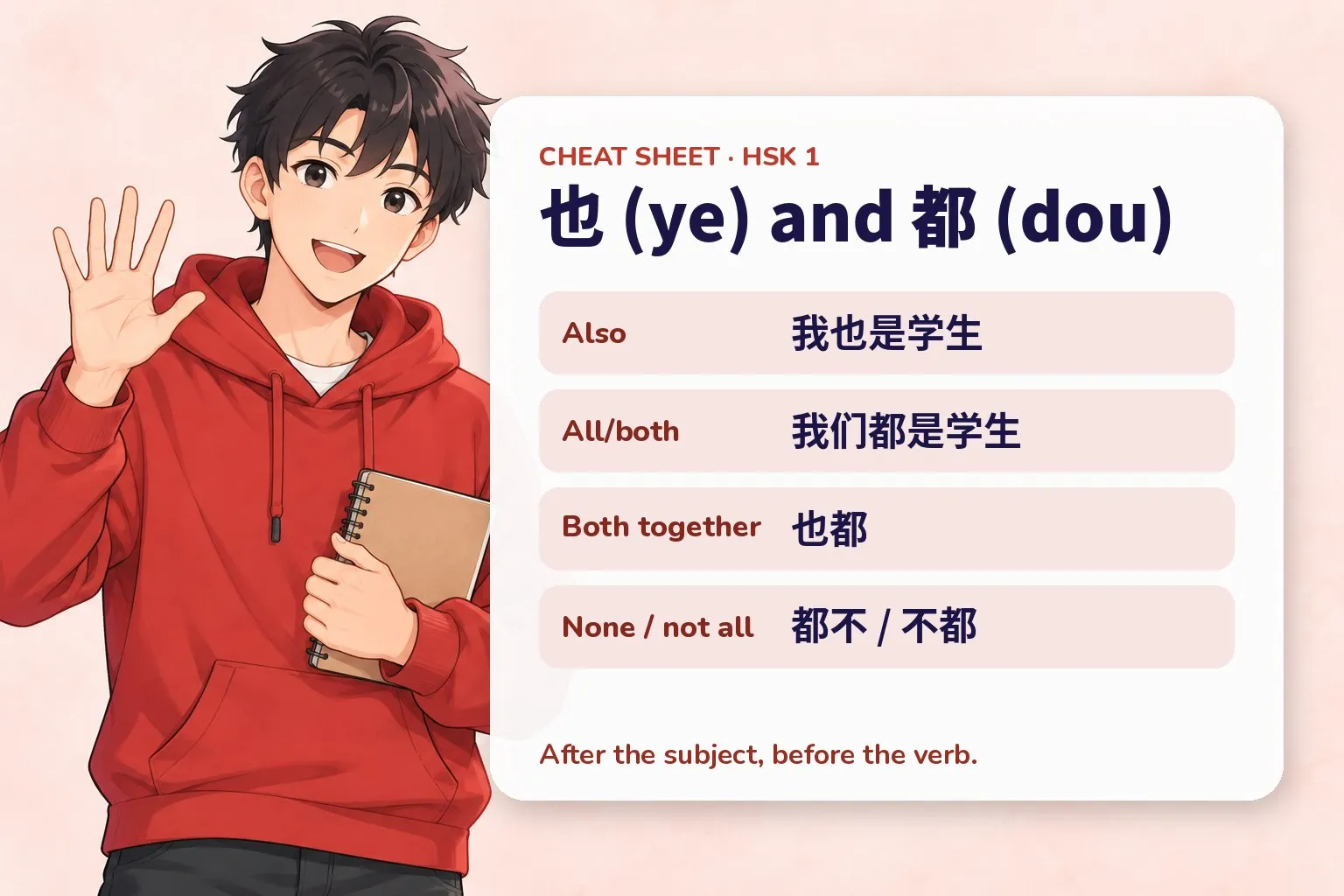
Quick recap before you practise.
Practice
也 (yě) and 都 (dōu) practice
Try each one, then press Check. No sign-up, nothing is sent anywhere — it all runs in your browser.
Hint: it goes after the subject
Show answer
yě — 我也是学生 (wǒ yě shì xuésheng): 也 (yě) sits after the subject.
4 Put the words in order: 'He and I both like tea.'
Show answer
我和他 (wǒ hé tā) 都 (dōu) 喜欢茶 (xǐhuan chá) — 都 (dōu) sums up 我和他 (wǒ hé tā) and comes before the verb: 我和他都喜欢茶 (wǒ hé tā dōu xǐhuan chá).
5 Match each form to its meaning.
- 也 (yě)
- 都 (dōu)
- 都不 (dōu bù)
- 不都 (bù dōu)
Show answer
- 也 (yě) → also / too
- 都 (dōu) → all / both
- 都不 (dōu bù) → none
- 不都 (bù dōu) → not all
也 (yě) also; 都 (dōu) all; 都不 (dōu bù) none; 不都 (bù dōu) not all.
Quiz
也 (yě) and 都 (dōu) placement quiz
12 questions · pick an answer and you'll see straight away if it's right.
-
Show answer
adverbs — They are adverbs, so they sit between the subject and the verb.
-
Show answer
after the subject, before the verb — Subject + 也 (yě) + verb: 我也去 (wǒ yě qù).
-
Show answer
the words before it — 都 (dōu) looks backward and sums up the words to its left, usually the subject.
-
Show answer
我们都是学生 (wǒmen dōu shì xuésheng) — 都 (dōu) follows 我们 (wǒmen) and precedes the verb 是 (shì).
-
Show answer
也都 (yě dōu) — The fixed order is 也都 (yě dōu): 我们也都来了 (wǒmen yě dōu lái le).
-
Show answer
none of them are teachers — 都不 (dōu bù) means 'none' — all of them are not teachers.
-
Show answer
not all of them are students — 不都 (bù dōu) means 'not all' — the reversed order flips the meaning.
-
Show answer
也我去 (yě wǒ qù) — 也 (yě) cannot come before the subject; say 我也去 (wǒ yě qù).
-
Show answer
我也不知道 (wǒ yě bù zhīdào) — The order is 也不 (yě bù): 我也不知道 (wǒ yě bù zhīdào).
-
Show answer
no — it needs a plural idea to sum up — 都 (dōu) needs a plural subject or joined nouns to its left.
-
Show answer
和 (hé) — 和 (hé) is a conjunction that joins nouns; it never means 'also' or 'all'.
-
Show answer
dōu — 都 (dōu) sums up 我们 (wǒmen) and precedes the verb.
Recap cheat-sheet
| Point | Chinese | Pinyin |
|---|---|---|
| Also | 我也是学生 | Wǒ yě shì xuésheng |
| All/both | 我们都是学生 | Wǒmen dōu shì xuésheng |
| Both together | 也都 | yě dōu |
| None | 都不 | dōu bù |
| Not all | 不都 | bù dōu |
Next
- Next grammar point: 是 (shì): ‘to be’
- Back to the Chinese grammar section
- New here? Start with Start Learning Chinese Here
All Chinese grammar topics
Every grammar point in order, from your first sentence to advanced structures. Pick one and go straight to it. New lessons go live every day, so topics marked Coming soon fill in over the next weeks.
Grammar path
HSK 1 15 topics · 15 ready
- 01 The Verb 是 (shì): to be
- 02 Basic Word Order (Subject-Verb-Object)
- 03 Adjectives with 很 (hěn)
- 04 Yes/No Questions with 吗 (ma)
- 05 Question Words (什么 shénme, 谁 shuí, 哪 nǎ, 几 jǐ)
- 06 The Particle 的 (de): Possession & Modification
- 07 Measure Words and 个 (ge)
- 08 Numbers and Counting
- 09 The Verb 有 (yǒu): to have / there is
- 10 The Verb 在 (zài): Location
- 11 Time When (Position in Sentence)
- 12 The Particle 了 (le): Change of State
- 13 Modal Verbs 想 / 要 / 会 / 能 (xiǎng / yào / huì / néng)
- 14 The Particle 呢 (ne)
- 15 也 (yě) and 都 (dōu) Placement You are here
HSK 2 14 topics · 6 ready
- 16 Aspectual 了 (Completed Action)
- 17 The Aspect Particle 过 (guò)
- 18 Progressive Aspect (在 / 正在 / 呢 zài / zhèngzài / ne)
- 19 Comparisons with 比 (bǐ)
- 20 A Bit: 一点儿 (yìdiǎnr) vs 有一点儿 (yǒu yìdiǎnr)
- 21 Basic Conjunctions (和 hé, 也 yě, 都 dōu, 还 hái)
- 22 Coverbs 给 / 跟 / 对 (gěi / gēn / duì) Coming soon
- 23 Duration (Time How Long) Coming soon
- 24 Resultative Complements (看完 kànwán, 听懂 tīngdǒng) Coming soon
- 25 The 把 (bǎ) Construction Coming soon
- 26 The Particle 吧 (ba) Coming soon
- 27 Again: 再 (zài) vs 又 (yòu) Coming soon
- 28 Imminent Action (快要 kuàiyào...了 / 要 le / yào...了 le) Coming soon
- 29 Asking Degree with 多 (duō) Coming soon
HSK 3 10 topics
- 30 Directional Complements (出来 chūlái, 回去 huíqù) Coming soon
- 31 Potential Complements (看得懂 kàndedǒng, 做不完 zuòbùwán) Coming soon
- 32 Complement of Degree with 得 (de) Coming soon
- 33 Adverbial Modifier with 地 (de) Coming soon
- 34 The Durative Aspect 着 (zhe) Coming soon
- 35 把 (bǎ) with Complex Results Coming soon
- 36 The 被 (bèi) Passive Coming soon
- 37 Conditionals (如果 rúguǒ...就 / 要是 jiù / yàoshì) Coming soon
- 38 Pivotal Sentences (让 ràng, 叫 jiào, 请 qǐng, 使 shǐ) Coming soon
- 39 Conditional with ...的话 (dehuà) Coming soon
HSK 4 9 topics
- 40 The 是 (shì)...的 (de) Construction (Emphasis) Coming soon
- 41 The Adverbs 就 (jiù) and 才 (cái) Coming soon
- 42 Verb Reduplication (看看 kànkan, 试一试 shìyishì) Coming soon
- 43 As Soon As (一...就, yī...jiù) Coming soon
- 44 Comparing 把 (bǎ) and 被 (bèi) in Context Coming soon
- 45 Complement of Quantity / Comparison Degree Coming soon
- 46 连 (lián)...都/也 (Even) Coming soon
- 47 Time Sequence (先 xiān...然后 ránhòu, 的时候 deshíhòu, 以后/以前 yǐhòu / yǐqián) Coming soon
- 48 Approximation & 左右/多/来 (zuǒyòu / duō / lái) Coming soon
HSK 5 8 topics
- 49 Mood Adverbs (反正 fǎnzhèng, 居然 jūrán, 竟然 jìngrán, 难道 nándào) Coming soon
- 50 Complex Complements & Metaphorical Results Coming soon
- 51 Formal/Written Markers (之 zhī, 其 qí, 者 zhě, 以 yǐ) Coming soon
- 52 Colloquial Passives (让 ràng, 叫 jiào, 给 gěi) Coming soon
- 53 不但不/没 (búdànbù / méi)...反而 (Contrary to Expectation) Coming soon
- 54 一...就 (yī...jiù) vs 一旦 (yídàn): Once / As Soon As Coming soon
- 55 复合趋向补语 (Compound Directional + Object) Coming soon
- 56 Emphasis with 是 (shì)...的 (de) vs 连 (lián)...都 (dōu) Review Coming soon
HSK 6 7 topics
- 57 Four-Character Idioms (成语 chéngyǔ) in Grammar Coming soon
- 58 Literary Connectives (然而 ránér, 从而 cóngér, 鉴于 jiànyú, 乃至 nǎizhì) Coming soon
- 59 Fixed Frameworks (在 zài...下 xià, 以 yǐ...为 wèi, 对 duì...而言 éryán) Coming soon
- 60 Rhetorical & Emphatic Structures (并 bìng, 可 kě, 正是 zhèngshì) Coming soon
- 61 Nominalisation & Topic Structures (所 suǒ...的 de, 的 de nominaliser) Coming soon
- 62 Long-Sentence Cohesion & Ellipsis Coming soon
- 63 经/予/加以 (Formal Verbal Framing) Coming soon