The Chinese Particle 呢 (ne) Explained
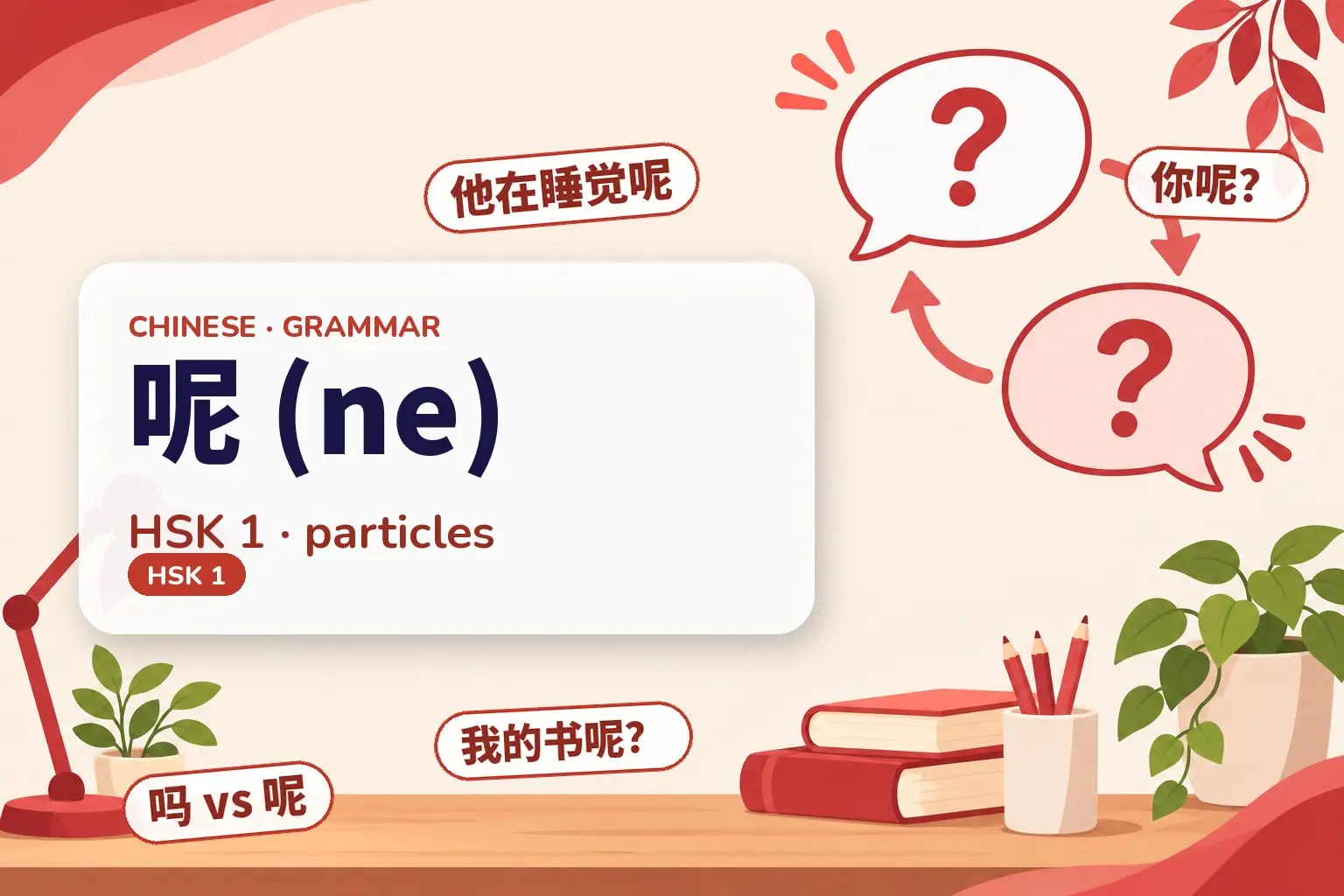
呢 (ne) is a neutral-tone particle at the end of a sentence. Its most common job is to bounce a question back: 我很好,你呢? (wǒ hěn hǎo, nǐ ne?) means 'I'm fine, and you?'. It also asks 'where is…?' and softens a statement, but it never forms a yes/no question.
Level: beginner (HSK 1). 呢 (ne) is a tiny word with no meaning of its own that sits at the end of a sentence. Its star use is the quick comeback: say something about yourself, then add 你呢? (nǐ ne?) to turn the same question back on the other person — “and you?”.
The rule
A particle is a short function word that shapes a sentence without adding its own meaning. 呢 (ne) goes at the very end and does three jobs for a beginner:
- Bounce a question back (the follow-up). After a statement or an answer, put a noun or pronoun plus 呢 (ne) to ask the same thing about someone or something else: 我很好 (wǒ hěn hǎo),你呢? (nǐ ne?) — “I’m fine, and you?”. 我喜欢茶 (wǒ xǐhuan chá),你呢? (nǐ ne?) — “I like tea, and you?”.
- Ask “where is…?” from context. When everyone knows what you are talking about, noun + 呢 (ne) asks where it is: 我的手机呢? (wǒ de shǒujī ne?) — “Where’s my phone?”. No verb is needed.
- Soften or mark “right now”. Added to a statement, especially with 在 (zài, marking an action in progress), 呢 (ne) gives a relaxed, “it’s happening” feel: 他在看书呢 (tā zài kàn shū ne) — “He’s reading (right now)”.
The one thing 呢 (ne) does not do is make a yes/no question. For “Are you a student?” you need 吗 (ma): 你是学生吗? (nǐ shì xuéshēng ma?). 呢 (ne) is always said in the neutral (light) tone, so it is written without a tone mark.
Forms at a glance
| Use | Chinese | Pinyin | Meaning |
|---|---|---|---|
| follow-up question | 你呢? | Nǐ ne? | And you? |
| follow-up with a noun | 你的妈妈呢? | Nǐ de māma ne? | And your mother? |
| where is…? | 我的书呢? | Wǒ de shū ne? | Where’s my book? |
| action in progress | 他在睡觉呢。 | Tā zài shuìjiào ne. | He’s sleeping (right now). |
| yes/no question (NOT 呢) | 你好吗? | Nǐ hǎo ma? | Are you well? |
Example sentences
- 我很好,你呢?Wǒ hěn hǎo, nǐ ne?I'm fine, and you?the classic follow-up
- 我喜欢咖啡,你呢?Wǒ xǐhuan kāfēi, nǐ ne?I like coffee, and you?
- 我是学生,他呢?Wǒ shì xuéshēng, tā ne?I'm a student, and him?
- 你的书呢?Nǐ de shū ne?Where's your book?where-is use, no verb
- 我的手机呢?Wǒ de shǒujī ne?Where's my phone?
- 妈妈呢?Māma ne?Where's mum?
- 他在睡觉呢。Tā zài shuìjiào ne.He's sleeping (right now).在…呢 marks an action in progress
- 我在吃饭呢。Wǒ zài chī fàn ne.I'm eating right now.
- 你们在做什么呢?Nǐmen zài zuò shénme ne?What are you (all) doing right now?
- 我要茶,你呢?Wǒ yào chá, nǐ ne?I want tea, and you?
- 这个很贵,那个呢?Zhège hěn guì, nàge ne?This one is expensive, and that one?
- 我住在北京,你呢?Wǒ zhù zài Běijīng, nǐ ne?I live in Beijing, and you?
- 老师呢?Lǎoshī ne?Where's the teacher?
- 我不去,你呢?Wǒ bú qù, nǐ ne?I'm not going, and you?
- 你的爸爸妈妈呢?Nǐ de bàba māma ne?And your parents?
- 外面在下雨呢。Wàimiàn zài xià yǔ ne.It's raining outside (right now).
- 我们在等你呢。Wǒmen zài děng nǐ ne.We're waiting for you.
Common mistakes
- ❌ 你是学生呢? (nǐ shì xuéshēng ne) → ✅ 你是学生吗? (nǐ shì xuéshēng ma) — a yes/no question needs 吗 (ma), not 呢 (ne).
- ❌ 你好呢? (nǐ hǎo ne) → ✅ 你好吗? (nǐ hǎo ma) — the greeting “how are you?” uses 吗 (ma).
- ❌ 呢你? (ne nǐ) → ✅ 你呢? (nǐ ne) — 呢 (ne) goes at the end, after the noun or pronoun.
- ❌ 你呢? (nǐ ne) with nothing said first → ✅ say something first, then 你呢? (nǐ ne) — the follow-up needs an earlier topic.
- ❌ 我的书在哪里呢吗? (wǒ de shū zài nǎlǐ ne ma) → ✅ 我的书呢? (wǒ de shū ne) or 我的书在哪里? (wǒ de shū zài nǎlǐ) — don’t stack particles.
A short conversation
A: 你好!你最近好吗? (Nǐ hǎo! Nǐ zuìjìn hǎo ma?) — Hi! Have you been well lately? B: 很好 (hěn hǎo),谢谢 (xièxie)。你呢? (nǐ ne?) — Very well, thanks. And you? A: 我也很好。你的工作呢? (Wǒ yě hěn hǎo. Nǐ de gōngzuò ne?) — I’m good too. And your job? B: 还不错。 (Hái búcuò.) — Not bad.
Notice the opening question uses 吗 (ma), but each “and you / and your…” follow-up uses 呢 (ne).
Usage notes
- 呢 (ne) sits last, always. Whatever the sentence, the particle is the final word: 你的朋友呢? (nǐ de péngyou ne?), not 呢你的朋友 (ne nǐ de péngyou).
- No verb needed for “where”. 钥匙呢? (yàoshi ne?) is a complete “Where are the keys?” — context supplies the rest.
- 在…呢 (zài…ne) go together for “right now”. The marker 在 (zài) before the verb and 呢 (ne) at the end frame an action in progress: 我在学习呢 (wǒ zài xuéxí ne), “I’m studying right now”.
- It is friendly and informal. 呢 (ne) keeps a sentence light and conversational; it is common in everyday speech and fine in the HSK 1–2 range.
Compared with 吗 (ma)
The two particles are easy to mix up, so hold them apart. 吗 (ma) turns a statement into a yes/no question: 你是老师吗? (nǐ shì lǎoshī ma?) — “Are you a teacher?”, answered 是 (shì) or 不是 (bú shì). 呢 (ne) does not ask yes/no; it bounces a topic back with 你呢? (nǐ ne?), asks “where is…?” with 书呢? (shū ne?) or softens an ongoing action. Rule of thumb: if the answer is “yes/no”, use 吗 (ma); if you are saying “and what about…?”, use 呢 (ne). See the full pattern on Yes/No Questions with 吗 (ma), and the question words that need neither on Question Words in Chinese.
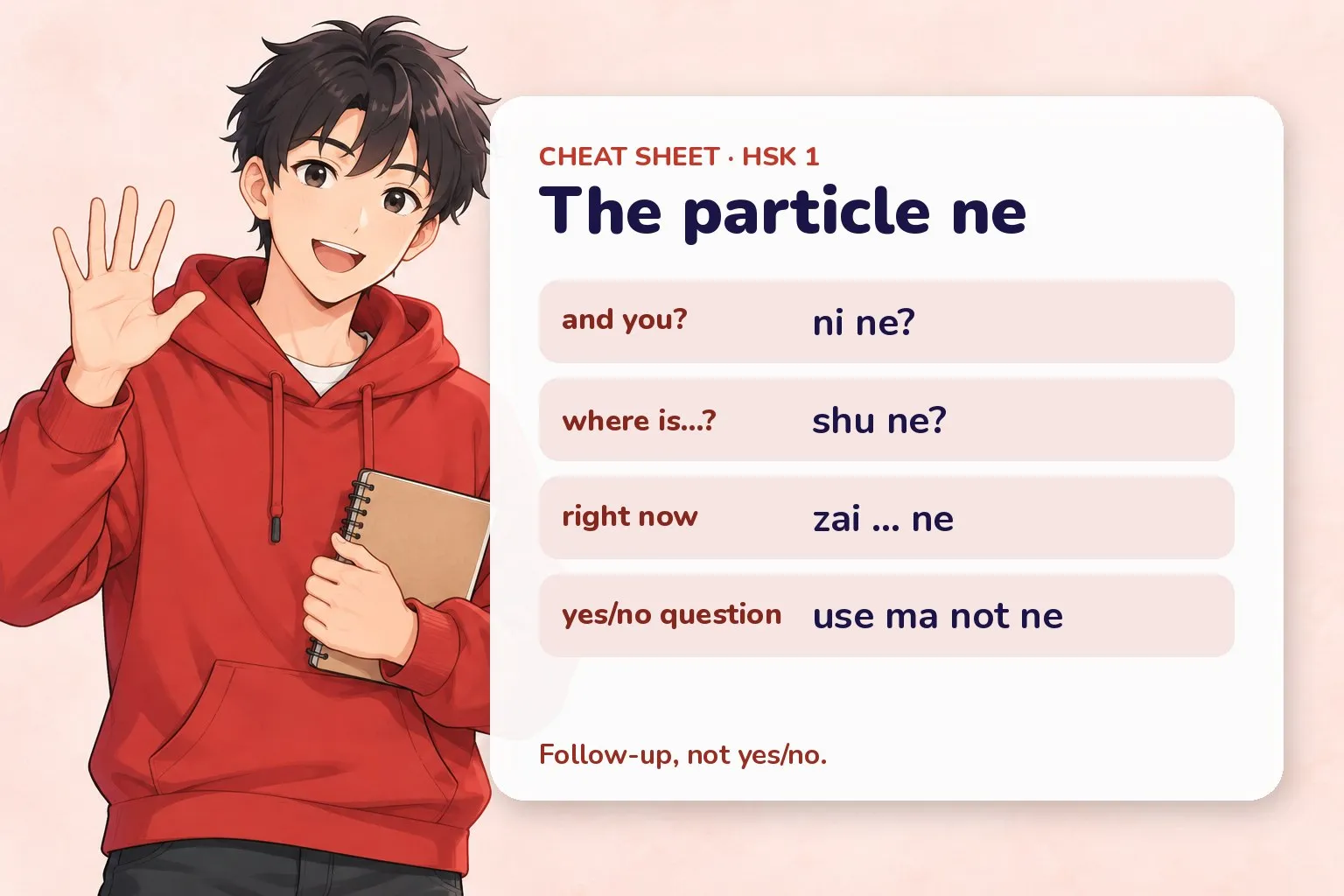
Quick recap before the quiz.
Practice
呢 (ne) practice
Try each one, then press Check. No sign-up, nothing is sent anywhere — it all runs in your browser.
Hint: the follow-up particle
Show answer
ne — 你呢? (nǐ ne?) — 呢 (ne) makes the follow-up.
4 Build 'Where's my phone?'
Show answer
我的 (wǒ de) 手机 (shǒujī) 呢 (ne) — Noun + 呢: 我的手机呢? (wǒ de shǒujī ne?).
5 Match each particle or phrase to its job.
- 呢 (ne)
- 吗 (ma)
- 在…呢 (zài…ne)
- 不是 (bú shì)
Show answer
- 呢 (ne) → and you? / where is…?
- 吗 (ma) → makes a yes/no question
- 在…呢 (zài…ne) → action happening right now
- 不是 (bú shì) → answers 'no'
呢 (ne) follows up, 吗 (ma) asks yes/no, 在…呢 marks 'right now'.
Quiz
The particle 呢 (ne)
12 questions · pick an answer and you'll see straight away if it's right.
-
Show answer
at the very end — 呢 (ne) is a sentence-final particle.
-
Show answer
I'm fine, and you? — 你呢? (nǐ ne?) bounces the question back: 'and you?'.
-
Show answer
neutral (no tone mark) — 呢 (ne) is always neutral-tone, so no tone mark.
-
Show answer
Where's my book? — Noun + 呢 (ne) can ask 'where is it?' from context.
-
Show answer
吗 (ma) — 吗 (ma) makes yes/no questions, not 呢 (ne).
-
Show answer
你好吗? (nǐ hǎo ma) — The greeting uses 吗 (ma): 你好吗? (nǐ hǎo ma).
-
Show answer
happening right now — 在…呢 (zài…ne) frames an action in progress.
-
Show answer
no — the follow-up needs an earlier topic — A follow-up 呢 (ne) needs a topic already on the table.
-
Show answer
呢 (ne) — 'And you?' uses 呢 (ne): 你呢? (nǐ ne?).
-
Show answer
妈妈呢? (māma ne) — Noun + 呢: 妈妈呢? (māma ne?).
-
Show answer
吗 (ma) asks yes/no; 呢 (ne) follows up or asks 'where is…?' — 吗 (ma) = yes/no; 呢 (ne) = follow-up, 'where is…?', or 'right now'.
-
Show answer
ne — 他呢? (tā ne?) — 呢 (ne) for the follow-up.
Recap cheat-sheet
| Use | Example | Pinyin |
|---|---|---|
| and you? | 你呢? | Nǐ ne? |
| and your…? | 你的工作呢? | Nǐ de gōngzuò ne? |
| where is…? | 我的书呢? | Wǒ de shū ne? |
| right now | 他在睡觉呢。 | Tā zài shuìjiào ne. |
| yes/no (use 吗) | 你好吗? | Nǐ hǎo ma? |
Next
- Compare it with Yes/No Questions with 吗 (ma)
- Back to the Chinese grammar section
- New here? Start with Start Learning Chinese Here
All Chinese grammar topics
Every grammar point in order, from your first sentence to advanced structures. Pick one and go straight to it. New lessons go live every day, so topics marked Coming soon fill in over the next weeks.
Grammar path
HSK 1 15 topics · 14 ready
- 01 The Verb 是 (shì): to be
- 02 Basic Word Order (Subject-Verb-Object)
- 03 Adjectives with 很 (hěn)
- 04 Yes/No Questions with 吗 (ma)
- 05 Question Words (什么 shénme, 谁 shuí, 哪 nǎ, 几 jǐ)
- 06 The Particle 的 (de): Possession & Modification
- 07 Measure Words and 个 (ge)
- 08 Numbers and Counting
- 09 The Verb 有 (yǒu): to have / there is
- 10 The Verb 在 (zài): Location
- 11 Time When (Position in Sentence)
- 12 The Particle 了 (le): Change of State
- 13 Modal Verbs 想 / 要 / 会 / 能 (xiǎng / yào / huì / néng)
- 14 The Particle 呢 (ne) You are here
- 15 也 (yě) and 都 (dōu) Placement Coming soon
HSK 2 16 topics
- 16 Aspectual 了 (Completed Action) Coming soon
- 17 The Aspect Particle 过 (guò) Coming soon
- 18 Progressive Aspect (在 / 正在 / 呢 zài / zhèngzài / ne) Coming soon
- 19 Comparisons with 比 (bǐ) Coming soon
- 20 A Bit: 一点儿 (yìdiǎnr) vs 有一点儿 (yǒu yìdiǎnr) Coming soon
- 21 Basic Conjunctions (和 hé, 也 yě, 都 dōu, 还 hái) Coming soon
- 22 Because...So (因为 yīnwèi...所以 suǒyǐ) Coming soon
- 23 Coverbs 给 / 跟 / 对 (gěi / gēn / duì) Coming soon
- 24 Duration (Time How Long) Coming soon
- 25 Resultative Complements (看完 kànwán, 听懂 tīngdǒng) Coming soon
- 26 The 把 (bǎ) Construction Coming soon
- 27 The Particle 吧 (ba) Coming soon
- 28 Again: 再 (zài) vs 又 (yòu) Coming soon
- 29 Or: 还是 (háishì) vs 或者 (huòzhě) Coming soon
- 30 Imminent Action (快要 kuàiyào...了 / 要 le / yào...了 le) Coming soon
- 31 Asking Degree with 多 (duō) Coming soon
HSK 3 18 topics
- 32 Directional Complements (出来 chūlái, 回去 huíqù) Coming soon
- 33 Potential Complements (看得懂 kàndedǒng, 做不完 zuòbùwán) Coming soon
- 34 Complement of Degree with 得 (de) Coming soon
- 35 Adverbial Modifier with 地 (de) Coming soon
- 36 The Durative Aspect 着 (zhe) Coming soon
- 37 把 (bǎ) with Complex Results Coming soon
- 38 The 被 (bèi) Passive Coming soon
- 39 Conditionals (如果 rúguǒ...就 / 要是 jiù / yàoshì) Coming soon
- 40 Although...But (虽然 suīrán...但是 dànshì) Coming soon
- 41 Pivotal Sentences (让 ràng, 叫 jiào, 请 qǐng, 使 shǐ) Coming soon
- 42 More and More (越来越 / 越 yuèláiyuè / yuè...越 yuè) Coming soon
- 43 除了 (chúle)...以外 (Besides / Except) Coming soon
- 44 Simultaneous Actions (一边...一边, yìbiān...yìbiān) Coming soon
- 45 Sequence: 先 (xiān)...再/然后 (zài / ránhòu) Coming soon
- 46 Conditional with ...的话 (dehuà) Coming soon
- 47 From...To (从 cóng...到 / 离 dào / lí) Coming soon
- 48 Similarity: 跟 (gēn)...一样 / 像 (yíyàng / xiàng)...一样 (yíyàng) Coming soon
- 49 Both...And (又 yòu...又 / 既 yòu / jì...又 yòu) Coming soon
HSK 4 13 topics
- 50 The 是 (shì)...的 (de) Construction (Emphasis) Coming soon
- 51 The Adverbs 就 (jiù) and 才 (cái) Coming soon
- 52 No Matter (不管 / 无论 bùguǎn / wúlùn...都 dōu) Coming soon
- 53 Even If (即使 / 就算 jíshǐ / jiùsuàn...也 yě) Coming soon
- 54 Verb Reduplication (看看 kànkan, 试一试 shìyishì) Coming soon
- 55 As Soon As (一...就, yī...jiù) Coming soon
- 56 Comparing 把 (bǎ) and 被 (bèi) in Context Coming soon
- 57 Complement of Quantity / Comparison Degree Coming soon
- 58 连 (lián)...都/也 (Even) Coming soon
- 59 Time Sequence (先 xiān...然后 ránhòu, 的时候 deshíhòu, 以后/以前 yǐhòu / yǐqián) Coming soon
- 60 From the Angle Of (对 duì...来说 láishuō) Coming soon
- 61 Only After / Not Until (要 yào...才 / 等 cái / děng...才 cái) Coming soon
- 62 Approximation & 左右/多/来 (zuǒyòu / duō / lái) Coming soon
HSK 5 14 topics
- 63 Mood Adverbs (反正 fǎnzhèng, 居然 jūrán, 竟然 jìngrán, 难道 nándào) Coming soon
- 64 Not Only...But Also (不但 búdàn...而且 érqiě) Coming soon
- 65 Otherwise (否则 / 要不然 fǒuzé / yàobùrán) Coming soon
- 66 Complex Complements & Metaphorical Results Coming soon
- 67 Formal/Written Markers (之 zhī, 其 qí, 者 zhě, 以 yǐ) Coming soon
- 68 Rather...Than (宁愿/宁可 nìngyuàn / nìngkě...也不 yěbù) Coming soon
- 69 与其 (yǔqí)...不如 (Rather Than / Better To) Coming soon
- 70 Only If / Only (只有 zhǐyǒu...才 / 只要 cái / zhǐyào...就 jiù) Coming soon
- 71 Colloquial Passives (让 ràng, 叫 jiào, 给 gěi) Coming soon
- 72 不但不/没 (búdànbù / méi)...反而 (Contrary to Expectation) Coming soon
- 73 一...就 (yī...jiù) vs 一旦 (yídàn): Once / As Soon As Coming soon
- 74 尽管 (jǐnguǎn)...还是 (Even Though) Coming soon
- 75 复合趋向补语 (Compound Directional + Object) Coming soon
- 76 Emphasis with 是 (shì)...的 (de) vs 连 (lián)...都 (dōu) Review Coming soon
HSK 6 7 topics
- 77 Four-Character Idioms (成语 chéngyǔ) in Grammar Coming soon
- 78 Literary Connectives (然而 ránér, 从而 cóngér, 鉴于 jiànyú, 乃至 nǎizhì) Coming soon
- 79 Fixed Frameworks (在 zài...下 xià, 以 yǐ...为 wèi, 对 duì...而言 éryán) Coming soon
- 80 Rhetorical & Emphatic Structures (并 bìng, 可 kě, 正是 zhèngshì) Coming soon
- 81 Nominalisation & Topic Structures (所 suǒ...的 de, 的 de nominaliser) Coming soon
- 82 Long-Sentence Cohesion & Ellipsis Coming soon
- 83 经/予/加以 (Formal Verbal Framing) Coming soon