Coverbs 给 / 跟 / 对 (gěi / gēn / duì)
给 (gěi), 跟 (gēn) and 对 (duì) work like prepositions but behave like verbs: the phrase they introduce comes before the main verb. 我给他打电话 (wǒ gěi tā dǎ diànhuà) — I called him.
Level: HSK 2. Mandarin has no class of words that are only prepositions. The words that translate “for”, “with” and “towards” are verbs doing a second job — coverbs — and they keep the verb’s habit of standing before its object. Learn the position first and the meanings sort themselves out.
The rule
A coverb is a verb used in front of another verb. Chinese builds sentences by stringing verb phrases together — serial verb constructions — and the first verb in the chain often loses its full verbal force and starts acting like English “with” or “for”. Grammarians still call these words coverbs because they cover the verb that follows.
The word order is the point:
Subject + coverb + object + main verb + object
我给他打电话 (wǒ gěi tā dǎ diànhuà) — I to-him make phone-call — “I called him”. English moves the prepositional phrase to the end; Chinese keeps it in the middle, glued to the front of the main verb. Nothing may come between the coverb and the verb except its own object.
The three coverbs in this lesson differ by the role of that object:
- 给 (gěi) marks the recipient — who receives the action or the thing. 给我做饭 (gěi wǒ zuò fàn) — cook for me.
- 跟 (gēn) marks the companion — who does the action along with you. 跟我来 (gēn wǒ lái) — come with me.
- 对 (duì) marks the target — who or what the action or attitude points at. 对我笑 (duì wǒ xiào) — smile at me.
The three coverbs at a glance
| Coverb | Pinyin | Meaning | Pattern | Example |
|---|---|---|---|---|
| 给 | gěi | to, for (recipient) | 给 + person + verb | 我给他打电话 (wǒ gěi tā dǎ diànhuà) |
| 跟 | gēn | with (companion) | 跟 + person + verb | 我跟朋友吃饭 (wǒ gēn péngyou chīfàn) |
| 对 | duì | to, towards, about (target) | 对 + person or thing + verb | 他对我说谢谢 (tā duì wǒ shuō xièxie) |
Each of the three also lives a second life. 给 (gěi) is the ordinary verb “to give”: 我给你一本书 (wǒ gěi nǐ yì běn shū, I give you a book). 跟 (gēn) joins two nouns like “and”: 我跟他是同事 (wǒ gēn tā shì tóngshì, he and I are colleagues). 对 (duì) is the adjective “correct”: 你说得对 (nǐ shuō de duì, you are right).
Where the phrase sits
| Slot | What goes there | Example |
|---|---|---|
| 1 | time word (optional) | 昨天 (zuótiān) |
| 2 | subject | 我 (wǒ) |
| 3 | coverb + object | 给妈妈 (gěi māma) |
| 4 | main verb + object | 打了电话 (dǎ le diànhuà) |
Put together: 昨天我给妈妈打了电话 (zuótiān wǒ gěi māma dǎ le diànhuà) — yesterday I to-mum made a phone call — “I called my mother yesterday”.
The same skeleton holds for the other two: 明天我跟老板见面 (míngtiān wǒ gēn lǎobǎn jiànmiàn, tomorrow I meet with the boss), 他一直对我很好 (tā yìzhí duì wǒ hěn hǎo, he has always been good to me).
Example sentences
Each sentence was written for this lesson. Watch the coverb phrase stay in front of the verb.
- 我给他打电话。Wǒ gěi tā dǎ diànhuà.I called him.给 (gěi) + person + verb
- 妈妈给我做饭。Māma gěi wǒ zuò fàn.Mum cooks for me.
- 请给我看一下。Qǐng gěi wǒ kàn yíxià.Please show me.给 (gěi) marks the beneficiary
- 他给我买了一本书。Tā gěi wǒ mǎi le yì běn shū.He bought me a book.
- 老师给学生解释这个词。Lǎoshī gěi xuésheng jiěshì zhège cí.The teacher explains this word to the students.
- 我跟朋友吃饭。Wǒ gēn péngyou chīfàn.I'm eating with a friend.跟 (gēn) = together with
- 我跟他说了。Wǒ gēn tā shuō le.I told him.
- 你跟我来。Nǐ gēn wǒ lái.Come with me.
- 我跟他是同事。Wǒ gēn tā shì tóngshì.He and I are colleagues.跟 (gēn) joins two nouns
- 我跟你一样高。Wǒ gēn nǐ yíyàng gāo.I'm as tall as you.跟 … 一样 comparison
- 他对我说谢谢。Tā duì wǒ shuō xièxie.He said thank you to me.对 (duì) = direction of speech
- 我对汉语感兴趣。Wǒ duì Hànyǔ gǎn xìngqù.I'm interested in Chinese.
- 跑步对身体有好处。Pǎobù duì shēntǐ yǒu hǎochù.Running is good for your health.
- 别对我生气。Bié duì wǒ shēngqì.Don't be angry with me.
- 他对我很好。Tā duì wǒ hěn hǎo.He is very good to me.
- 我送给他一本书。Wǒ sòng gěi tā yì běn shū.I gave him a book.transfer verb + 给 (gěi)
- 这个字你写对了。Zhège zì nǐ xiě duì le.You wrote this character correctly.对 (duì) as a result complement
- 昨天我给妈妈打了电话。Zuótiān wǒ gěi māma dǎ le diànhuà.Yesterday I called my mother.
Common mistakes
- ❌ 我打电话给他 (wǒ dǎ diànhuà gěi tā) → ✅ 我给他打电话 (wǒ gěi tā dǎ diànhuà). The coverb phrase belongs before the verb.
- ❌ 我打电话跟我朋友 (wǒ dǎ diànhuà gēn wǒ péngyou) → ✅ 我跟我朋友打电话 (wǒ gēn wǒ péngyou dǎ diànhuà). 跟 (gēn) also stands in front.
- ❌ using 跟 (gēn) to mean “to” when you speak at someone → ✅ use 对 (duì) for the direction of speech: 他对我说 (tā duì wǒ shuō), not 他跟他说 (tā gēn tā shuō) if you mean “he said to him”.
- ❌ splitting the coverb from its verb with a time word, as in 我给昨天妈妈打电话 (wǒ gěi zuótiān māma dǎ diànhuà) → ✅ time first: 昨天我给妈妈打电话 (zuótiān wǒ gěi māma dǎ diànhuà).
- ❌ dropping 给 (gěi) after a transfer verb → ✅ 送给他 (sòng gěi tā), 卖给我 (mài gěi wǒ), 寄给他 (jì gěi tā) all need it.
A short conversation
— 你昨天给谁打电话了? — Nǐ zuótiān gěi shéi dǎ diànhuà le? — Who did you call yesterday? — 给我妈妈。我跟她聊了半个小时。 — Gěi wǒ māma. Wǒ gēn tā liáo le bàn gè xiǎoshí. — My mother. I chatted with her for half an hour. — 她对你说了什么? — Tā duì nǐ shuō le shénme? — What did she say to you? — 她让我多穿衣服。 — Tā ràng wǒ duō chuān yīfu. — She told me to wear more clothes.
Three coverbs in four lines: 给 (gěi) picks the person you call, 跟 (gēn) the person you chat with, 对 (duì) the person the words are aimed at.
Usage notes
- 给 (gěi) as a complement. Verbs of transfer — 送 (sòng, give), 卖 (mài, sell), 寄 (jì, post), 借 (jiè, lend) — take 给 (gěi) after them: 我借给他十块钱 (wǒ jiè gěi tā shí kuài qián, I lent him ten yuan). With 打电话 (dǎ diànhuà) that is wrong, because a phone call is not an object being handed over.
- 跟 (gēn) for comparisons. 跟 … 一样 (gēn … yíyàng) means “the same as”: 这个跟那个一样 (zhège gēn nàge yíyàng, this one is the same as that one). The pattern takes the coverb before the thing compared against, and 一样 (yíyàng) after it.
- 对 (duì) with feelings and judgements. 对 … 感兴趣 (gǎn xìngqù), 对 … 有好处 (yǒu hǎochù), 对 … 生气 (shēngqì) and 对 … 好 (hǎo) are fixed frames worth memorising as chunks.
- Negation goes before the coverb. 我不给他打电话 (wǒ bù gěi tā dǎ diànhuà, I’m not calling him) puts 不 (bù) first. 别 (bié) works the same way: 别对他说 (bié duì tā shuō, don’t tell him).
- 跟 (gēn) vs 和 (hé). Both join nouns, and 和 (hé) is the more formal choice in writing; 跟 (gēn) is common in speech.
Compared with…
- 把 (bǎ) and 被 (bèi). All three sit before the main verb, but they mark different things: 给 (gěi) marks a recipient, 把 (bǎ) marks a definite object being handled — 我把书给他了 (wǒ bǎ shū gěi tā le, I gave him the book) — and 被 (bèi) marks the doer in a passive — 书被弟弟拿走了 (shū bèi dìdi ná zǒu le, the book was taken by my little brother).
- Plain word order. Without a coverb a Mandarin sentence is subject–verb–object: 我买书 (wǒ mǎi shū, I buy books). The coverb phrase slots in between subject and verb and does not change that backbone. See basic Chinese word order.
Quick recap before the quiz.
Practice
Chinese coverbs practice
Try each one, then press Check. No sign-up, nothing is sent anywhere — it all runs in your browser.
Hint: the noun in 感兴趣 (gǎn xìngqù)
Show answer
xìngqù — 感兴趣 (gǎn xìngqù) is the fixed phrase for 'be interested in'.
4 Match each coverb to its job.
- 给 (gěi)
- 跟 (gēn)
- 对 (duì)
Show answer
- 给 (gěi) → recipient, for
- 跟 (gēn) → companion, with
- 对 (duì) → target, towards
The coverb tells you what role its object plays.
5 Build the sentence: Yesterday I called my mother.
Show answer
昨天 (zuótiān) 我 (wǒ) 给 (gěi) 妈妈 (māma) 打电话 (dǎ diànhuà) — Time, subject, coverb phrase, then the main verb.
Quiz
Chinese coverbs gei, gen, dui
12 questions · pick an answer and you'll see straight away if it's right.
-
Show answer
a verb used in front of another verb — Coverbs are verbs pressed into preposition-like service.
-
Show answer
between the subject and the main verb — Subject + coverb + object + main verb is the fixed frame.
-
Show answer
跟 (gēn) — 跟 (gēn) means 'with', as in 跟朋友吃饭 (gēn péngyou chīfàn).
-
Show answer
I buy a book for him — 给 (gěi) marks the beneficiary of the buying.
-
Show answer
他对我说 (tā duì wǒ shuō) — 对 (duì) marks the target of what is said.
-
Show answer
a complement after the verb — With transfer verbs 给 (gěi) follows the verb: 送给他 (sòng gěi tā).
-
Show answer
你说得对 (nǐ shuō de duì) — As an adjective 对 (duì) means 'right, correct'.
-
Show answer
before the coverb — 我不给他打电话 (wǒ bù gěi tā dǎ diànhuà) — negation goes first.
-
Show answer
跟你一样高 (gēn nǐ yíyàng gāo) — 跟 … 一样 (gēn … yíyàng) marks equality.
-
Show answer
跟 (gēn) — 我跟他是同事 (wǒ gēn tā shì tóngshì) — he and I are colleagues.
-
Show answer
duì — 对 (duì) marks the thing a benefit applies to.
-
Show answer
我打电话给他 (wǒ dǎ diànhuà gěi tā) — 打电话 (dǎ diànhuà) does not transfer an object, so 给 (gěi) must come before the verb.
Recap cheat-sheet
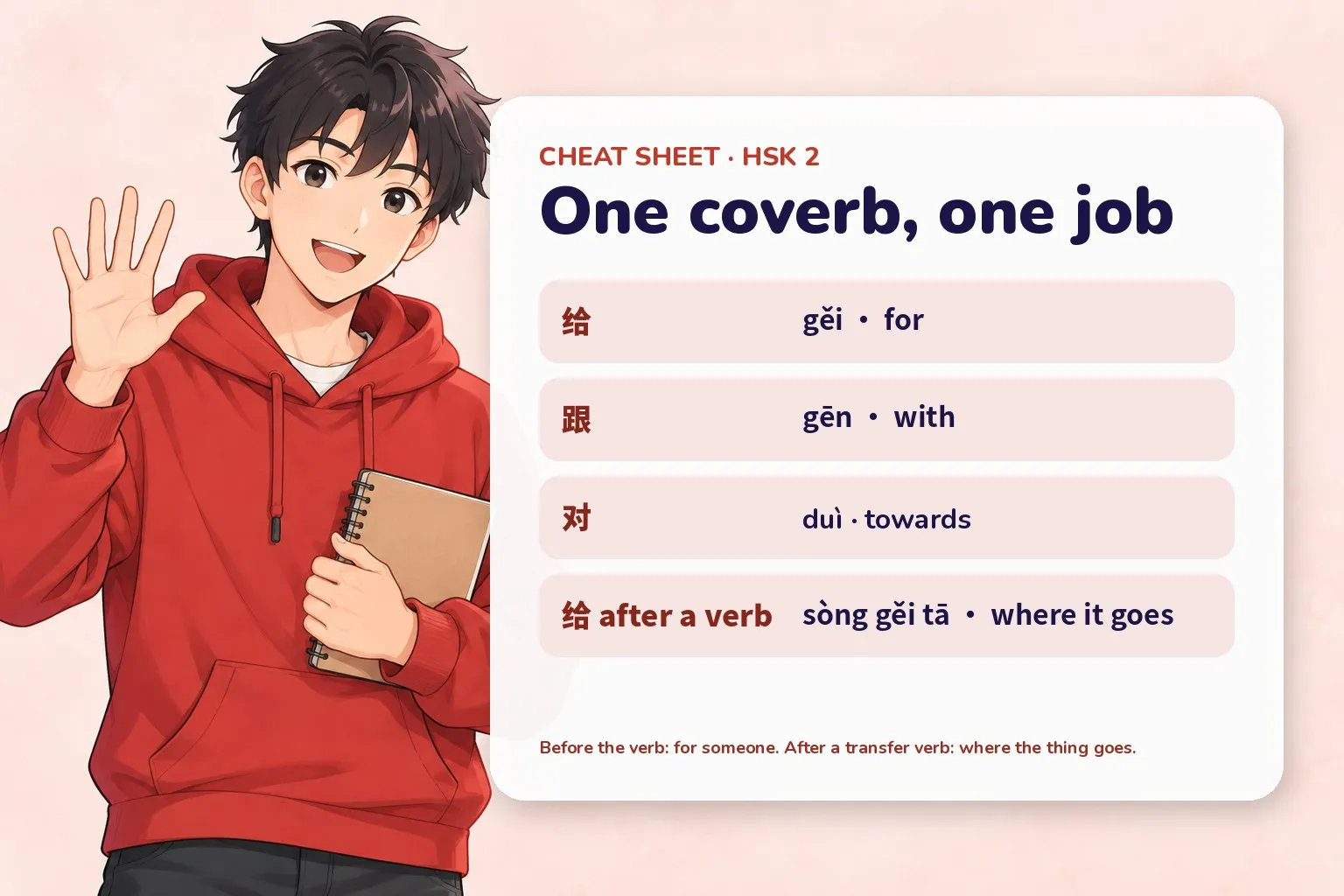
| Coverb | Pinyin | Role | Example |
|---|---|---|---|
| 给 | gěi | recipient, “for / to” | 给他打电话 (gěi tā dǎ diànhuà) |
| 跟 | gēn | companion, “with” | 跟他吃饭 (gēn tā chīfàn) |
| 对 | duì | target, “towards” | 对他说 (duì tā shuō) |
| 给 after a verb | gěi | where a thing goes | 送给他 (sòng gěi tā) |
Next
- The backbone the coverb slots into: basic Chinese word order
- Comparison with 比 (bǐ): the 比 (bǐ) comparison
- Counting the nouns you hand over: measure words with 个 (gè)
- Back to the Chinese grammar section
All Chinese grammar topics
Every grammar point in order, from your first sentence to advanced structures. Pick one and go straight to it. New lessons go live every day, so topics marked Coming soon fill in over the next weeks.
Grammar path
HSK 1 15 topics · 15 ready
- 01 The Verb 是 (shì): to be
- 02 Basic Word Order (Subject-Verb-Object)
- 03 Adjectives with 很 (hěn)
- 04 Yes/No Questions with 吗 (ma)
- 05 Question Words (什么 shénme, 谁 shuí, 哪 nǎ, 几 jǐ)
- 06 The Particle 的 (de): Possession & Modification
- 07 Measure Words and 个 (ge)
- 08 Numbers and Counting
- 09 The Verb 有 (yǒu): to have / there is
- 10 The Verb 在 (zài): Location
- 11 Time When (Position in Sentence)
- 12 The Particle 了 (le): Change of State
- 13 Modal Verbs 想 / 要 / 会 / 能 (xiǎng / yào / huì / néng)
- 14 The Particle 呢 (ne)
- 15 也 (yě) and 都 (dōu) Placement
HSK 2 14 topics · 7 ready
- 16 Aspectual 了 (Completed Action)
- 17 The Aspect Particle 过 (guò)
- 18 Progressive Aspect (在 / 正在 / 呢 zài / zhèngzài / ne)
- 19 Comparisons with 比 (bǐ)
- 20 A Bit: 一点儿 (yìdiǎnr) vs 有一点儿 (yǒu yìdiǎnr)
- 21 Basic Conjunctions (和 hé, 也 yě, 都 dōu, 还 hái)
- 22 Coverbs 给 / 跟 / 对 (gěi / gēn / duì) You are here
- 23 Duration (Time How Long) Coming soon
- 24 Resultative Complements (看完 kànwán, 听懂 tīngdǒng) Coming soon
- 25 The 把 (bǎ) Construction Coming soon
- 26 The Particle 吧 (ba) Coming soon
- 27 Again: 再 (zài) vs 又 (yòu) Coming soon
- 28 Imminent Action (快要 kuàiyào...了 / 要 le / yào...了 le) Coming soon
- 29 Asking Degree with 多 (duō) Coming soon
HSK 3 10 topics
- 30 Directional Complements (出来 chūlái, 回去 huíqù) Coming soon
- 31 Potential Complements (看得懂 kàndedǒng, 做不完 zuòbùwán) Coming soon
- 32 Complement of Degree with 得 (de) Coming soon
- 33 Adverbial Modifier with 地 (de) Coming soon
- 34 The Durative Aspect 着 (zhe) Coming soon
- 35 把 (bǎ) with Complex Results Coming soon
- 36 The 被 (bèi) Passive Coming soon
- 37 Conditionals (如果 rúguǒ...就 / 要是 jiù / yàoshì) Coming soon
- 38 Pivotal Sentences (让 ràng, 叫 jiào, 请 qǐng, 使 shǐ) Coming soon
- 39 Conditional with ...的话 (dehuà) Coming soon
HSK 4 9 topics
- 40 The 是 (shì)...的 (de) Construction (Emphasis) Coming soon
- 41 The Adverbs 就 (jiù) and 才 (cái) Coming soon
- 42 Verb Reduplication (看看 kànkan, 试一试 shìyishì) Coming soon
- 43 As Soon As (一...就, yī...jiù) Coming soon
- 44 Comparing 把 (bǎ) and 被 (bèi) in Context Coming soon
- 45 Complement of Quantity / Comparison Degree Coming soon
- 46 连 (lián)...都/也 (Even) Coming soon
- 47 Time Sequence (先 xiān...然后 ránhòu, 的时候 deshíhòu, 以后/以前 yǐhòu / yǐqián) Coming soon
- 48 Approximation & 左右/多/来 (zuǒyòu / duō / lái) Coming soon
HSK 5 8 topics
- 49 Mood Adverbs (反正 fǎnzhèng, 居然 jūrán, 竟然 jìngrán, 难道 nándào) Coming soon
- 50 Complex Complements & Metaphorical Results Coming soon
- 51 Formal/Written Markers (之 zhī, 其 qí, 者 zhě, 以 yǐ) Coming soon
- 52 Colloquial Passives (让 ràng, 叫 jiào, 给 gěi) Coming soon
- 53 不但不/没 (búdànbù / méi)...反而 (Contrary to Expectation) Coming soon
- 54 一...就 (yī...jiù) vs 一旦 (yídàn): Once / As Soon As Coming soon
- 55 复合趋向补语 (Compound Directional + Object) Coming soon
- 56 Emphasis with 是 (shì)...的 (de) vs 连 (lián)...都 (dōu) Review Coming soon
HSK 6 7 topics
- 57 Four-Character Idioms (成语 chéngyǔ) in Grammar Coming soon
- 58 Literary Connectives (然而 ránér, 从而 cóngér, 鉴于 jiànyú, 乃至 nǎizhì) Coming soon
- 59 Fixed Frameworks (在 zài...下 xià, 以 yǐ...为 wèi, 对 duì...而言 éryán) Coming soon
- 60 Rhetorical & Emphatic Structures (并 bìng, 可 kě, 正是 zhèngshì) Coming soon
- 61 Nominalisation & Topic Structures (所 suǒ...的 de, 的 de nominaliser) Coming soon
- 62 Long-Sentence Cohesion & Ellipsis Coming soon
- 63 经/予/加以 (Formal Verbal Framing) Coming soon