Italian Reflexive Verbs (alzarsi, lavarsi)
Italian reflexive verbs add a pronoun that points back to the subject — mi, ti, si, ci, vi, si — placed before the verb: mi alzo, ti lavi, si veste. In the passato prossimo they take essere, and the participle agrees with the subject: mi sono alzato, mi sono alzata.
Level: A2. A whole family of everyday Italian verbs — getting up, washing, dressing, sitting down, having fun — carries an extra little word in front: mi alzo, ti lavi, si veste. That word is the whole topic, and once you see what it points at, the family stops looking irregular.
The rule
A verb is reflexive when the person doing the action and the person receiving it are the same. Treccani puts it simply: in reflexive verbs the action carried out by the subject falls back, in most cases, on the subject itself. English can do this with myself (I wash myself), but mostly it just drops the object — I wash, I get up, I sit down. Italian keeps a marker.
The marker is a reflexive pronoun that matches the subject and stands before the verb:
| Subject | Pronoun | Example | English |
|---|---|---|---|
| io | mi | mi alzo | I get up |
| tu | ti | ti lavi | you wash |
| lui / lei | si | si veste | he / she dresses |
| noi | ci | ci alziamo | we get up |
| voi | vi | vi preparate | you (plural) get ready |
| loro | si | si svegliano | they wake up |
Two things are worth noticing at once. The pronoun changes with the subject, never with the verb’s tense — mi alzo today, mi sono alzato yesterday, mi alzerò tomorrow. And the third person uses si for both singular and plural, so the verb ending is what tells you whether it is one person or several.
Treccani divides reflexives into three kinds, and the division is useful because the three behave slightly differently:
| Type | What happens | Example |
|---|---|---|
| diretti | subject and object coincide | Giuseppe si veste. Claudia si lava. |
| indiretti | the action benefits the subject rather than landing on it | Mi chiedo come mai. Federica si pulisce le mani. |
| reciproci | two or more subjects act on each other | Luca e Simonetta si sposano. |
The indiretti type is where body parts appear, and it explains an idiom you will meet constantly: mi lavo le mani — “I wash my hands”, with the definite article, not a possessive.
The forms
Here is the present tense of three reflexives you will use every day. The pattern is regular: pronoun plus the normal present form.
| Person | alzarsi (to get up) | lavarsi (to wash) | vestirsi (to dress) |
|---|---|---|---|
| io | mi alzo | mi lavo | mi vesto |
| tu | ti alzi | ti lavi | ti vesti |
| lui / lei | si alza | si lava | si veste |
| noi | ci alziamo | ci laviamo | ci vestiamo |
| voi | vi alzate | vi lavate | vi vestite |
| loro | si alzano | si lavano | si vestono |
The infinitive itself carries the pronoun glued to the end: alzarsi, lavarsi, vestirsi. That is why dictionaries list the verb in that form — it tells you the verb is reflexive before you use it.
| Person | Pronoun before a verb | Pronoun on the infinitive |
|---|---|---|
| io | mi alzo | alzarmi |
| tu | ti alzi | alzarti |
| lui / lei | si alza | alzarsi |
| noi | ci alziamo | alzarci |
| voi | vi alzate | alzarvi |
| loro | si alzano | alzarsi |
The right-hand column matters the moment a second verb appears: voglio alzarmi, devo lavarmi, preferisci vestirti.
The past tense
Reflexive verbs build the passato prossimo with essere, never avere, and the participle agrees with the subject in gender and number. Treccani’s ausiliari entry states it directly for direct reflexives, and it is the reason mi sono alzato has a masculine -o while mi sono alzata has a feminine -a.
| Person | alzarsi | English |
|---|---|---|
| io | mi sono alzato / alzata | I got up |
| tu | ti sei alzato / alzata | you got up |
| lui / lei | si è alzato / alzata | he / she got up |
| noi | ci siamo alzati / alzate | we got up |
| voi | vi siete alzati / alzate | you got up |
| loro | si sono alzati / alzate | they got up |
The agreement follows the subject even when the subject is not stated: a woman writes mi sono alzata tardi. The full agreement system for essere verbs, with the movement verbs that share it, is on passato prossimo with essere.
Example sentences
- Mi alzo alle sette.I get up at seven.mi + alzo
- Ti alzi presto anche tu?Do you get up early too?ti + alzi
- Si veste in fretta.He gets dressed in a hurry.si + veste
- Ci alziamo alle sei durante la settimana.We get up at six during the week.ci + alziamo
- Vi preparate per la cena?Are you getting ready for dinner?vi + preparate
- Si svegliano sempre tardi.They always wake up late.loro also takes si
- Mi lavo le mani.I wash my hands.body part with the article
- Mi sono alzato tardi.I got up late. (man speaking)essere + -o
- Mi sono alzata tardi.I got up late. (woman speaking)essere + -a
- Si è vestita bene.She dressed well.participle agrees with lei
- Ci siamo divertiti molto.We had a lot of fun.divertirsi, plural -i
- Si sono seduti vicino alla finestra.They sat down by the window.sedersi
- Ti sei ricordato di chiamare?Did you remember to call?ricordarsi
- Mi sento bene oggi.I feel well today.sentirsi + adverb
- Mi chiamo Anna.My name is Anna.chiamarsi, literally 'I call myself'
- Ci vediamo domani!See you tomorrow!reciprocal: we see each other
- Si sposano a giugno.They're getting married in June.reciprocal si
- Non mi alzo mai prima delle otto.I never get up before eight.non goes before the pronoun
- Devo alzarmi presto domani.I have to get up early tomorrow.pronoun on the infinitive
- Mi devo alzare presto domani.I have to get up early tomorrow.same meaning, pronoun before the modal
Common mistakes
- ❌ Alzo alle sette. → ✅ Mi alzo alle sette. Without the pronoun the verb means “I raise”, and it is missing its object.
- ❌ Io mi alzo in every sentence → ✅ Mi alzo on its own. The subject pronoun is redundant; keep io only for contrast.
- ❌ Ho alzato alle sette. → ✅ Mi sono alzato alle sette. Reflexives take essere, and the participle agrees.
- ❌ Mi sono alzato said by a woman → ✅ Mi sono alzata. The participle follows the speaker’s gender.
- ❌ Mi non alzo. → ✅ Non mi alzo. Non stands before the pronoun, not between pronoun and verb.
- ❌ Mi lavo le mie mani. → ✅ Mi lavo le mani. With a reflexive and a body part, Italian uses the definite article.
- ❌ Ti lava for “you wash” → ✅ Ti lavi. The pronoun and the ending must agree: ti goes with the tu form.
A short conversation
Una mattina in famiglia: — A che ora ti sei alzato? (What time did you get up?) — Mi sono alzato alle sei, ma non mi sono ancora lavato. (I got up at six, but I haven’t washed yet.) — Allora sbrigati! Ci vediamo giù tra dieci minuti. (Then hurry up! See you downstairs in ten minutes.) — Va bene. Mi vesto e arrivo. (Fine. I’ll get dressed and come.)
Usage notes
- Reciprocal si. With a plural subject, the same pronoun can mean “each other”: ci vediamo (“we see each other”), si sposano, si scrivono ogni giorno. Ci vediamo is also the standard way to say “see you”, so you will hear it as a goodbye formula.
- Two homes with a modal. When a modal verb is present, the pronoun can sit before the modal (mi devo alzare) or attach to the infinitive (devo alzarmi). Both are correct and common; pick one and stay consistent within a sentence.
- Impersonal si looks the same. Si vende (“for sale”), si parla italiano (“Italian is spoken”) use si with a third-person verb and no reflexive meaning at all. Context separates them: a reciprocal or reflexive si has a subject that acts, an impersonal si has none.
- A few verbs are only reflexive. Accorgersi (to notice), lamentarsi (to complain) and pentirsi (to regret) have no useful non-reflexive twin, so learn them with the pronoun from the start.
Compared with normal verbs
The contrast is easiest to see with pairs that share a root.
| Normal verb | Meaning | Reflexive | Meaning |
|---|---|---|---|
| alzare | to raise (something) | alzarsi | to get up |
| lavare | to wash (something) | lavarsi | to wash oneself |
| vestire | to dress (someone) | vestirsi | to get dressed |
| chiamare | to call (someone) | chiamarsi | to be called, to call oneself |
| svegliare | to wake (someone) | svegliarsi | to wake up |
| sentire | to hear, to feel (something) | sentirsi | to feel (a state) |
With the normal verb, the object is someone or something else: lavo la macchina (“I wash the car”), chiamo mia madre (“I call my mother”). With the reflexive, the object is the subject: mi lavo, mi chiamo Anna. And in the past the normal verb takes avere (ho lavato la macchina) while the reflexive takes essere (mi sono lavato) — the contrast that trips learners most often.
Verbs that are reflexive in Italian but not in English
Several frequent verbs carry the pronoun in Italian and nothing at all in English. Learn these with mi attached to the infinitive, or you will look for an object that is not there.
| Italian | English | Example |
|---|---|---|
| ricordarsi | to remember | Mi ricordo bene. |
| dimenticarsi | to forget | Si è dimenticato le chiavi. |
| accorgersi | to notice | Non me ne sono accorto. |
| arrabbiarsi | to get angry | Non ti arrabbiare! |
| annoiarsi | to get bored | Ci annoiamo presto. |
| divertirsi | to have fun | Vi siete divertiti? |
| sbrigarsi | to hurry up | Sbrigati, è tardi! |
| fermarsi | to stop | Mi fermo qui. |
| sedersi | to sit down | Si sono seduti. |
| sposarsi | to get married | Si sposano in estate. |
Accorgersi and dimenticarsi also take ne or a direct object in many sentences (me ne sono accorto, si è dimenticato le chiavi), which is why they read as advanced at first. Recognise them early; produce them once the plain reflexives are automatic.
How to say it
| Point | How to say it |
|---|---|
| z | “ts” as in cats: alzo = “AL-tso”, pranzo = “PRAN-tso”. Never a buzzing “z”. |
| gl | like the “lli” in million: svegliarsi = “zveh-LYAR-si”, luglio = “LOO-lyo”. |
| double consonants | held longer: addormentarsi has a long “dd”, arrabbiarsi a long “rr” and “bb”. |
| s between vowels | voiced, like English “z”: chiesa = “KYEH-za”. In sono it stays sharp. |
Practice
Italian reflexive verbs practice
Try each one, then press Check. No sign-up, nothing is sent anywhere — it all runs in your browser.
Hint: third person plural
Show answer
si — loro takes si, same pronoun as lui/lei; the ending -ano marks the plural.
Hint: reflexives take essere
Show answer
sono — mi sono alzato: essere plus agreeing participle.
5 Build: 'We get up early during the week.'
Show answer
Ci alziamo presto durante la settimana — The reflexive pronoun opens the clause, then the verb.
6 Match each reflexive to its meaning.
- alzarsi
- lavarsi
- vestirsi
- divertirsi
Show answer
- alzarsi → to get up
- lavarsi → to wash oneself
- vestirsi → to get dressed
- divertirsi → to have fun
All four are everyday routine verbs that need the pronoun.
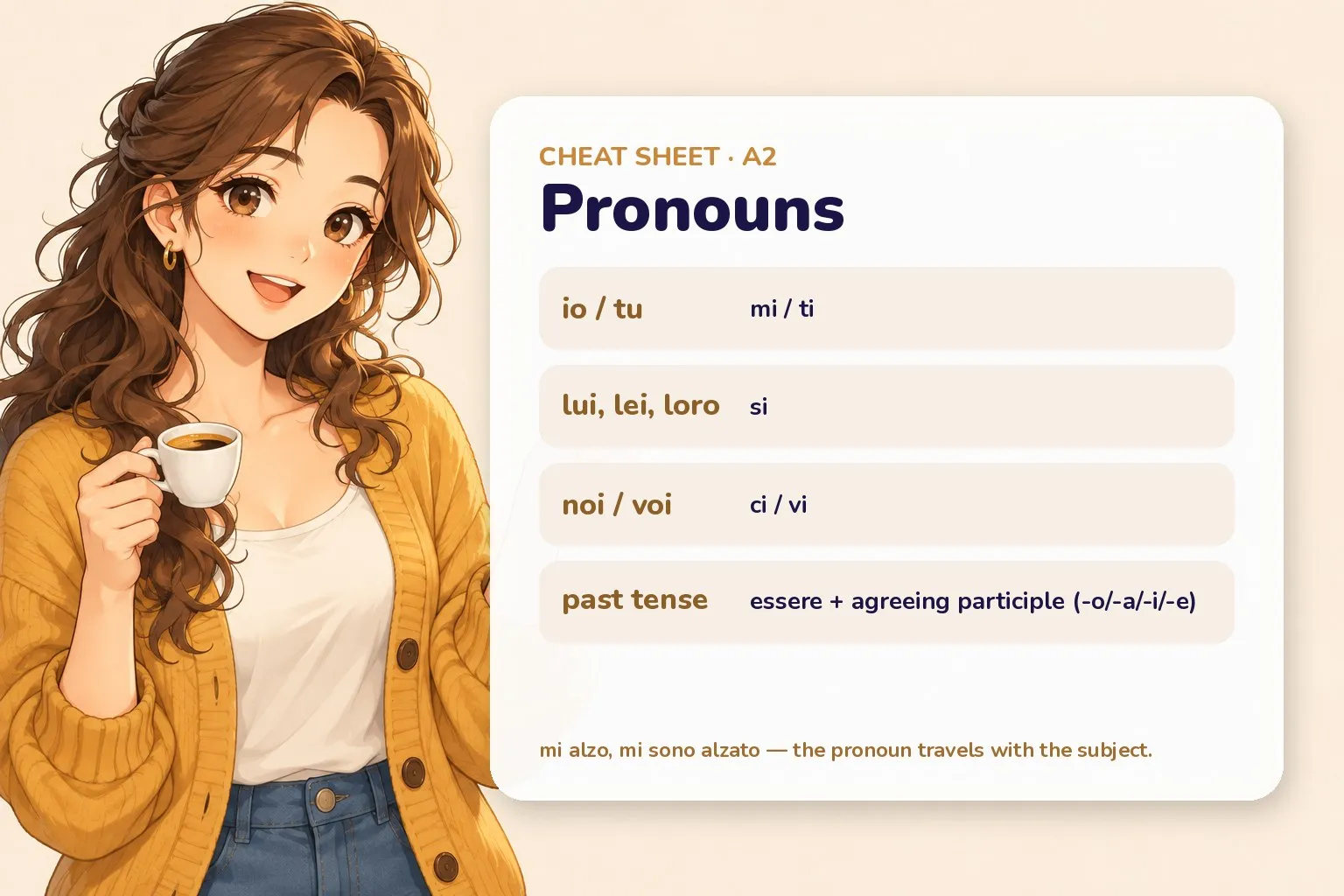
Quick recap before the quiz.
Quiz
Italian reflexive verbs
12 questions · pick an answer and you'll see straight away if it's right.
-
Show answer
the action falls back on the subject — Treccani: the action carried out by the subject falls back on the subject.
-
Show answer
mi — io takes mi: mi alzo.
-
Show answer
si — Both lui/lei and loro take si.
-
Show answer
to get up — The reflexive alzarsi is 'to get up'; alzare alone is 'to raise'.
-
Show answer
essere — Reflexives build compound tenses with essere.
-
Show answer
mi sono alzata tardi — The participle agrees with the subject's gender: alzata.
-
Show answer
before the verb — mi alzo, ti lavi — the pronoun precedes the verb.
-
Show answer
both mi devo alzare and devo alzarmi — The pronoun may precede the modal or attach to the infinitive.
-
Show answer
body parts take the definite article with reflexives — Italian says mi lavo le mani, not le mie mani.
-
Show answer
for sale — That si is impersonal, not reflexive.
-
Show answer
Non mi alzo. — Non stands before the pronoun: non mi alzo.
-
Show answer
alzarmi — With a modal, the pronoun attaches to the infinitive: alzarmi.
Recap cheat-sheet
| Person | Pronoun | Present | Past (m / f) |
|---|---|---|---|
| io | mi | mi alzo | mi sono alzato / alzata |
| tu | ti | ti alzi | ti sei alzato / alzata |
| lui / lei | si | si alza | si è alzato / alzata |
| noi | ci | ci alziamo | ci siamo alzati / alzate |
| voi | vi | vi alzate | vi siete alzati / alzate |
| loro | si | si alzano | si sono alzati / alzate |
| Point | Rule |
|---|---|
| Infinitive | pronoun glued on: alzarsi, lavarsi |
| Past auxiliary | essere + agreeing participle |
| Body parts | definite article: mi lavo le mani |
| Reciprocal | plural si: ci vediamo, si sposano |
| Negative | non before the pronoun |
| With a modal | mi devo alzare / devo alzarmi |
Next
- The past tense these verbs share with movement verbs: passato prossimo with essere
- The other auxiliary, for normal verbs: passato prossimo with avere
- The present tense they are built on: Italian -are verbs
- Participles that do not follow the -ato / -uto pattern: irregular past participles
- Back to the Italian grammar section, or start at Start Learning Italian Here
All Italian grammar topics
Every grammar point in order, from your first sentence to advanced structures. Pick one and go straight to it. New lessons go live every day, so topics marked Coming soon fill in over the next weeks.
Grammar path
A1 18 topics · 18 ready
- 01 Italian Definite Articles (il, la, i, le)
- 02 Italian Indefinite Articles (un, una)
- 03 Noun Gender and Number
- 04 The Verb Essere (to be)
- 05 The Verb Avere (to have)
- 06 Subject Pronouns (io, tu, lui, lei)
- 07 Present Tense: -are Verbs
- 08 Present Tense: -ere Verbs
- 09 Present Tense: -ire Verbs (and -isc-)
- 10 Plural of Nouns and Adjectives
- 11 Adjective Agreement and Position
- 12 C'è and Ci sono (there is/are)
- 13 Question Words (chi, che, dove, quando)
- 14 Numbers, Time and Dates
- 15 Possessive Adjectives (il mio, la mia)
- 16 Negation with non
- 17 The Verb Piacere (to like)
- 18 Quantity Adjectives/Adverbs (molto, troppo, poco)
A2 23 topics · 4 ready
- 19 Passato Prossimo with Avere
- 20 Passato Prossimo with Essere
- 21 Irregular Past Participles
- 22 Reflexive Verbs (alzarsi, lavarsi) You are here
- 23 Modal Verbs (potere, dovere, volere) Coming soon
- 24 Direct Object Pronouns (lo, la, li, le) Coming soon
- 25 Indirect Object Pronouns (gli, le) Coming soon
- 26 Simple Prepositions (di, a, da, in) Coming soon
- 27 Articulated Prepositions (del, nella, sul) Coming soon
- 28 The Imperfect Tense (Imperfetto) Coming soon
- 29 The Simple Future (Futuro Semplice) Coming soon
- 30 Comparatives (più, meno, come) Coming soon
- 31 Superlatives (il più, -issimo) Coming soon
- 32 The Imperative (tu, noi, voi) Coming soon
- 33 The Particles ci and ne Coming soon
- 34 Stare + Gerund (Present Progressive) Coming soon
- 35 C'è bisogno / Ci vuole (Need & Take Time) Coming soon
- 36 The Partitive (del, dei = some) Coming soon
- 37 Pre-Noun Forms: bello, buono, quello Coming soon
- 38 Stare per + Infinitive (About To) Coming soon
- 39 Forming Adverbs with -mente Coming soon
- 40 Time: da (since/for) and fa (ago) Coming soon
- 41 Double Negatives (non...niente, nessuno) Coming soon
B1 18 topics
- 42 Passato Prossimo vs Imperfetto Coming soon
- 43 Combined Pronouns (glielo, me lo) Coming soon
- 44 The Present Conditional (Condizionale) Coming soon
- 45 Impersonal and Passivante si Coming soon
- 46 Relative Pronouns (che, cui) Coming soon
- 47 The Future Perfect (Futuro Anteriore) Coming soon
- 48 The Past Perfect (Trapassato Prossimo) Coming soon
- 49 Formal Imperative (Lei) & with Pronouns Coming soon
- 50 The Gerund: Uses and Past Gerund Coming soon
- 51 The Past Conditional (Condizionale Passato) Coming soon
- 52 Pronoun Placement with Infinitive/Imperative Coming soon
- 53 Comparative & Superlative Irregulars Coming soon
- 54 Impersonal Verbs (bisogna, basta, sembra) Coming soon
- 55 Future of Probability (Suppositional) Coming soon
- 56 Altered Words (-ino, -one, -accio) Coming soon
- 57 Relative chi and quello che Coming soon
- 58 Ne with Quantities and Participle Agreement Coming soon
- 59 Adverb Position (già, ancora, più, mai) Coming soon
B2 14 topics
- 60 The Present Subjunctive (Congiuntivo) Coming soon
- 61 The Imperfect Subjunctive Coming soon
- 62 Perfect & Pluperfect Subjunctive Coming soon
- 63 The Three Hypothetical Periods (periodo ipotetico) Coming soon
- 64 Sequence of Tenses with the Subjunctive Coming soon
- 65 Passive Voice (essere / venire / andare) Coming soon
- 66 Conjunctions Requiring the Subjunctive Coming soon
- 67 Advanced Relatives (il quale, cui possessive) Coming soon
- 68 Reported Speech (Discorso Indiretto) Coming soon
- 69 The Remote Past (Passato Remoto) Coming soon
- 70 Causative Construction (fare + infinitive) Coming soon
- 71 Indefinite Adjectives & Pronouns Coming soon
- 72 Concession: anche se vs benché Coming soon
- 73 Gerund vs Infinitive as Subject/Complement Coming soon
C1 8 topics
- 74 Independent & Optative Subjunctive Coming soon
- 75 Advanced Sequence of Tenses Coming soon
- 76 Nominalisation & Formal Register Coming soon
- 77 Advanced Connectives & Cohesion Coming soon
- 78 Absolute Participle & Implicit Clauses Coming soon
- 79 Pronominal Verbs (farcela, andarsene) Coming soon
- 80 Dislocation & Emphasis Coming soon
- 81 Register, Style and Bureaucratic Italian Coming soon