The Italian Verb Piacere (to Like) Explained
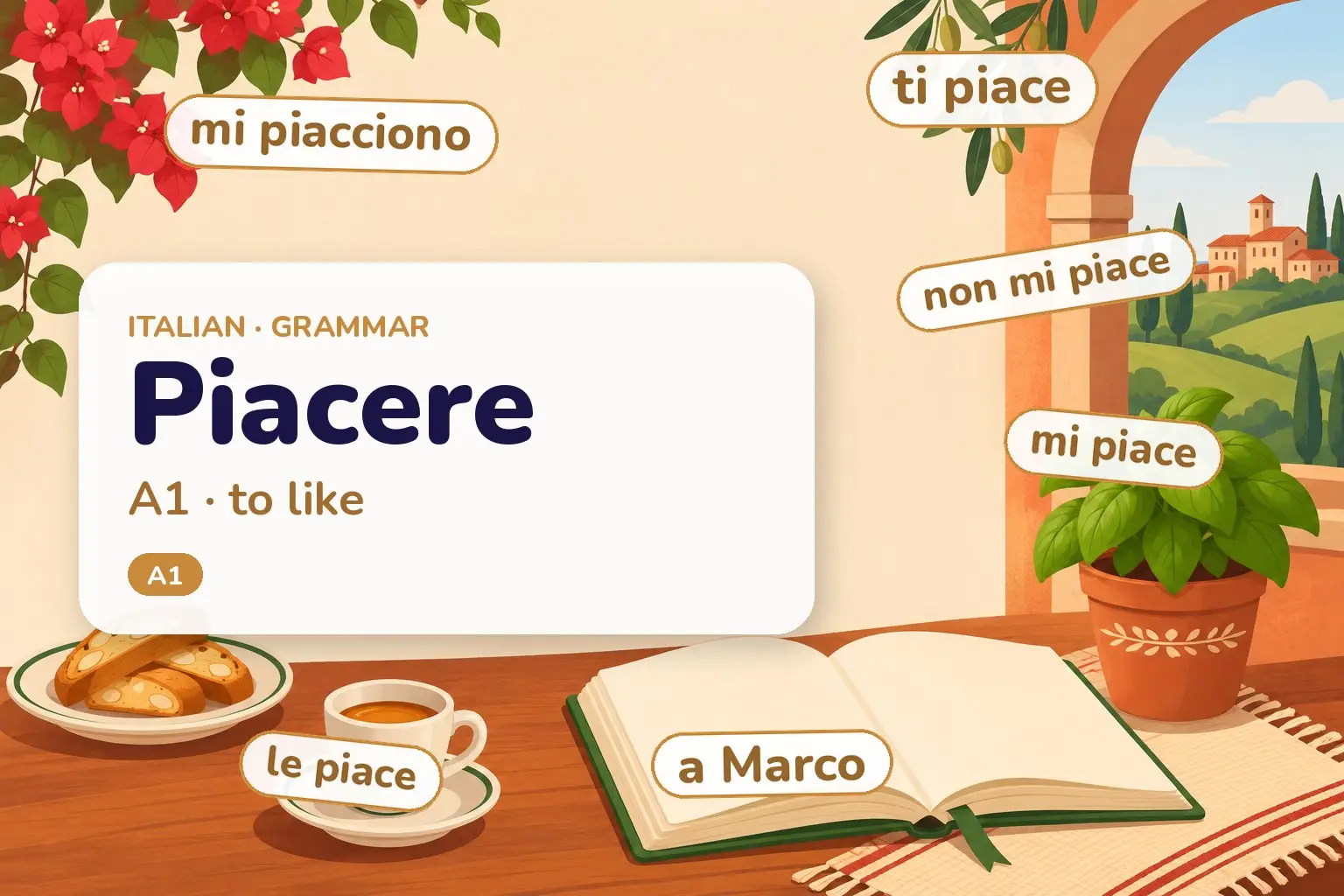
Italian piacere works backwards from English 'to like': it means 'to be pleasing to', so the thing liked is the subject and the person is an indirect object. Mi piace la pizza = 'I like pizza'. Use piace for one thing, piacciono for several.
Level: A1. Piacere is the verb Italians use for “to like”, and it is the one that confuses almost every beginner — because it is built the opposite way round from English. Once you see the real pattern, though, it is simple and never changes.
The rule
English says “I like pizza”: the person is the subject, pizza is the object. Italian flips this. Piacere literally means “to be pleasing to”, so the thing liked is the subject and the person is an indirect object — the one it is pleasing to.
Mi piace la pizza word for word is “to-me is-pleasing the pizza” = “I like pizza”. Because la pizza is the real subject, the verb agrees with it, not with you.
That gives you two forms to choose from in the present tense:
- piace — when the thing liked is singular (or is an action): Mi piace il caffè (“I like coffee”).
- piacciono — when the things liked are plural: Mi piacciono i gatti (“I like cats”).
The pronouns and the two verb forms
The little word in front is an indirect object pronoun (“to me”, “to you”, and so on). Swap it to change who likes something; keep piace / piacciono tied to the thing:
| To whom | Pronoun | One thing (piace) | Many things (piacciono) |
|---|---|---|---|
| to me | mi | Mi piace il tè | Mi piacciono i libri |
| to you (informal) | ti | Ti piace il tè | Ti piacciono i libri |
| to him | gli | Gli piace il tè | Gli piacciono i libri |
| to her | le | Le piace il tè | Le piacciono i libri |
| to us | ci | Ci piace il tè | Ci piacciono i libri |
| to you (plural) | vi | Vi piace il tè | Vi piacciono i libri |
| to them | gli (or loro) | Gli piace il tè | Gli piacciono i libri |
To say the person’s name instead of using a pronoun, put a in front: A Marco piace il calcio (“Marco likes football”), A Maria piacciono i fiori (“Maria likes flowers”).
Example sentences
- Mi piace la pizza.I like pizza.one thing: piace
- Mi piacciono i gatti.I like cats.plural: piacciono
- Ti piace il caffè?Do you like coffee?ti = to you
- Ti piacciono i film italiani?Do you like Italian films?plural: piacciono
- Le piace la musica.She likes music.le = to her
- Gli piace il calcio.He likes football.gli = to him
- Ci piace viaggiare.We like travelling.infinitive: always piace
- Vi piacciono i dolci?Do you (all) like sweets?vi = to you plural
- Mi piace leggere.I like reading.action: piace
- Non mi piace il freddo.I don't like the cold.non before the pronoun
- A Marco piace il gelato.Marco likes ice cream.a + name
- A Maria piacciono i fiori.Maria likes flowers.a + name, plural thing
- Ti piace questa canzone?Do you like this song?singular: piace
- Mi piacciono le tue scarpe.I like your shoes.plural: piacciono
- Non ci piacciono le zanzare.We don't like mosquitoes.negative + plural
- Vi piace l'Italia?Do you like Italy?singular thing
- Mi piace molto questo libro.I like this book a lot.molto = a lot
- A loro piace ballare.They like dancing.a loro + infinitive
Common mistakes
- ❌ Io piaccio la pizza. → ✅ Mi piace la pizza. You are not the subject; the pizza is. Io piaccio would mean “I am pleasing / likeable”, not “I like”.
- ❌ Mi piaccio i gatti. → ✅ Mi piacciono i gatti. The things liked are plural, so the verb is piacciono, agreeing with i gatti.
- ❌ Mi piacciono la pizza. → ✅ Mi piace la pizza. One thing takes the singular piace.
- ❌ Mi piacciono leggere. → ✅ Mi piace leggere. An action (infinitive) always takes the singular piace.
- ❌ Marco piace il calcio. → ✅ A Marco piace il calcio. When you name the person, you need a in front: “to Marco”.
A short conversation
— Ti piace la cucina italiana? (Do you like Italian food?) — Sì, mi piace molto! Soprattutto mi piacciono i dolci. (Yes, I like it a lot! Especially I like the desserts.) — Anche a me. Ma non mi piace il caffè amaro. (Me too. But I don’t like bitter coffee.) — Davvero? A Luca invece piacciono tutti i caffè. (Really? Luca, on the other hand, likes all coffees.)
Notice mi piace la cucina (singular) against mi piacciono i dolci (plural), non mi piace for “I don’t like”, and a Luca piacciono with the name marked by a.
Usage notes
- “Me too / me neither.” Agreeing uses the stressed pronoun: Anche a me (“Me too”), Neanche a me (“Me neither”). You are literally saying “also to me”.
- Adverbs of degree. Add molto (“a lot”), tanto (“so much”) or poco (“not much”) after the verb: Mi piace molto, Mi piacciono poco.
- The past tense. In the passato prossimo, piacere takes essere and the participle agrees with the thing liked: la pizza è piaciuta, i film sono piaciuti, le canzoni sono piaciute.
- Other verbs work the same way. mancare (“to miss / be lacking”), servire (“to be needed”) and sembrare (“to seem”) use the identical pattern: Mi manca Roma (“I miss Rome”).
Compared with…
- Indirect object pronouns: the words mi, ti, gli, le, ci, vi in front of piacere are the ordinary Italian indirect object pronouns (“to me”, “to you”…), the same ones you use with verbs like dare (“to give”) and scrivere (“to write”). Learning them as a set unlocks piacere and much more. For the people doing or receiving the action, compare the ordinary Italian subject pronouns.
- Agreement with the subject: piace vs piacciono is really just subject–verb agreement, the same idea that drives essere in the present and noun–adjective matching in Italian adjective agreement. The twist is only that the “subject” is the thing liked. To pair piacere with having and wanting, see avere in the present.
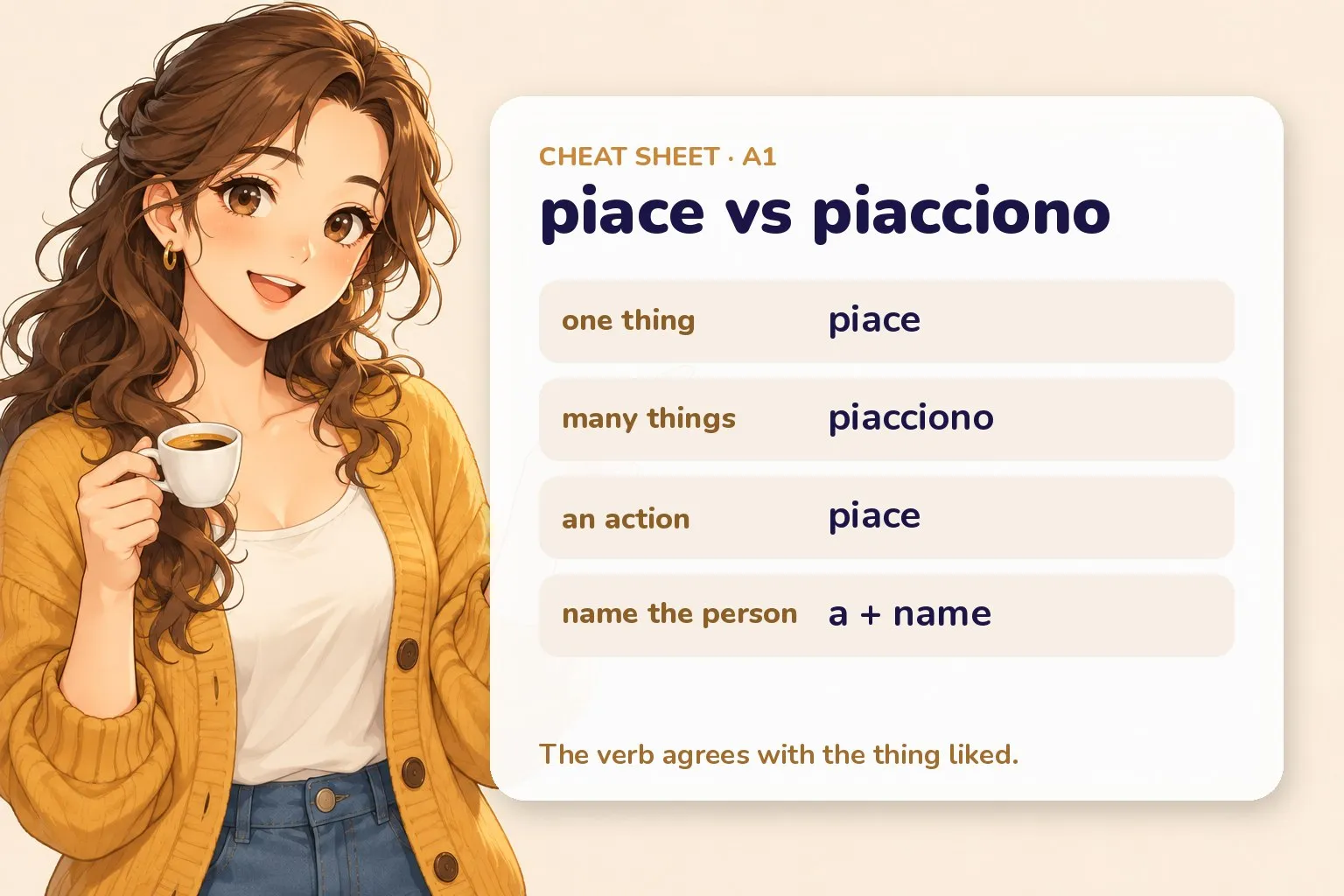
Quick recap before the quiz — the verb agrees with the thing liked.
Practice
Piacere practice
Try each one, then press Check. No sign-up, nothing is sent anywhere — it all runs in your browser.
Hint: infinitive is always singular
Show answer
piace — An infinitive always takes the singular piace.
4 Build: 'Marco likes ice cream.'
Show answer
A Marco piace il gelato — Name with a + Marco, then piace (one thing), then il gelato.
5 Match each pronoun to its meaning.
- mi
- ti
- le
- ci
Show answer
- mi → to me
- ti → to you
- le → to her
- ci → to us
mi = to me, ti = to you, le = to her, ci = to us.
Quiz
The Italian verb piacere
12 questions · pick an answer and you'll see straight away if it's right.
-
Show answer
to be pleasing to — Piacere = 'to be pleasing to', so it works backwards from English 'to like'.
-
Show answer
la pizza — La pizza is the subject; mi is 'to me'.
-
Show answer
piace — One thing: singular piace.
-
Show answer
piacciono — Plural things: piacciono.
-
Show answer
piace — An action always takes the singular piace: Mi piace viaggiare.
-
Show answer
A Marco piace il calcio — Name the person with a: A Marco piace il calcio.
-
Show answer
le — le = to her; gli = to him.
-
Show answer
Maria likes me — Literally 'I am pleasing to Maria' = 'Maria likes me'.
-
Show answer
Non ci piacciono le zanzare — Non before the pronoun, and plural things take piacciono.
-
Show answer
essere, with agreement — It takes essere and the participle agrees: la pizza è piaciuta.
-
Show answer
piace — One thing (questa canzone) takes piace.
-
Show answer
Anche a me — Because the pronoun is indirect, you say Anche a me ('also to me').
Recap cheat-sheet
| Situation | Form | Example |
|---|---|---|
| One thing liked | piace | Mi piace il caffè |
| Several things liked | piacciono | Mi piacciono i libri |
| An action (infinitive) | piace | Mi piace leggere |
| Name the person | a + name | A Marco piace il calcio |
| Past tense | essere + agreement | La pizza è piaciuta |
Next
- The pronouns in full: Italian subject pronouns
- Subject–verb agreement: essere in the present
- Making words match: Italian adjective agreement
- Back to the Italian grammar section
All Italian grammar topics
Every grammar point in order, from your first sentence to advanced structures. Pick one and go straight to it. New lessons go live every day, so topics marked Coming soon fill in over the next weeks.
Grammar path
A1 18 topics · 18 ready
- 01 Italian Definite Articles (il, la, i, le)
- 02 Italian Indefinite Articles (un, una)
- 03 Noun Gender and Number
- 04 The Verb Essere (to be)
- 05 The Verb Avere (to have)
- 06 Subject Pronouns (io, tu, lui, lei)
- 07 Present Tense: -are Verbs
- 08 Present Tense: -ere Verbs
- 09 Present Tense: -ire Verbs (and -isc-)
- 10 Plural of Nouns and Adjectives
- 11 Adjective Agreement and Position
- 12 C'è and Ci sono (there is/are)
- 13 Question Words (chi, che, dove, quando)
- 14 Numbers, Time and Dates
- 15 Possessive Adjectives (il mio, la mia)
- 16 Negation with non
- 17 The Verb Piacere (to like) You are here
- 18 Quantity Adjectives/Adverbs (molto, troppo, poco)
A2 23 topics · 3 ready
- 19 Passato Prossimo with Avere
- 20 Passato Prossimo with Essere
- 21 Irregular Past Participles
- 22 Reflexive Verbs (alzarsi, lavarsi) Coming soon
- 23 Modal Verbs (potere, dovere, volere) Coming soon
- 24 Direct Object Pronouns (lo, la, li, le) Coming soon
- 25 Indirect Object Pronouns (gli, le) Coming soon
- 26 Simple Prepositions (di, a, da, in) Coming soon
- 27 Articulated Prepositions (del, nella, sul) Coming soon
- 28 The Imperfect Tense (Imperfetto) Coming soon
- 29 The Simple Future (Futuro Semplice) Coming soon
- 30 Comparatives (più, meno, come) Coming soon
- 31 Superlatives (il più, -issimo) Coming soon
- 32 The Imperative (tu, noi, voi) Coming soon
- 33 The Particles ci and ne Coming soon
- 34 Stare + Gerund (Present Progressive) Coming soon
- 35 C'è bisogno / Ci vuole (Need & Take Time) Coming soon
- 36 The Partitive (del, dei = some) Coming soon
- 37 Pre-Noun Forms: bello, buono, quello Coming soon
- 38 Stare per + Infinitive (About To) Coming soon
- 39 Forming Adverbs with -mente Coming soon
- 40 Time: da (since/for) and fa (ago) Coming soon
- 41 Double Negatives (non...niente, nessuno) Coming soon
B1 18 topics
- 42 Passato Prossimo vs Imperfetto Coming soon
- 43 Combined Pronouns (glielo, me lo) Coming soon
- 44 The Present Conditional (Condizionale) Coming soon
- 45 Impersonal and Passivante si Coming soon
- 46 Relative Pronouns (che, cui) Coming soon
- 47 The Future Perfect (Futuro Anteriore) Coming soon
- 48 The Past Perfect (Trapassato Prossimo) Coming soon
- 49 Formal Imperative (Lei) & with Pronouns Coming soon
- 50 The Gerund: Uses and Past Gerund Coming soon
- 51 The Past Conditional (Condizionale Passato) Coming soon
- 52 Pronoun Placement with Infinitive/Imperative Coming soon
- 53 Comparative & Superlative Irregulars Coming soon
- 54 Impersonal Verbs (bisogna, basta, sembra) Coming soon
- 55 Future of Probability (Suppositional) Coming soon
- 56 Altered Words (-ino, -one, -accio) Coming soon
- 57 Relative chi and quello che Coming soon
- 58 Ne with Quantities and Participle Agreement Coming soon
- 59 Adverb Position (già, ancora, più, mai) Coming soon
B2 14 topics
- 60 The Present Subjunctive (Congiuntivo) Coming soon
- 61 The Imperfect Subjunctive Coming soon
- 62 Perfect & Pluperfect Subjunctive Coming soon
- 63 The Three Hypothetical Periods (periodo ipotetico) Coming soon
- 64 Sequence of Tenses with the Subjunctive Coming soon
- 65 Passive Voice (essere / venire / andare) Coming soon
- 66 Conjunctions Requiring the Subjunctive Coming soon
- 67 Advanced Relatives (il quale, cui possessive) Coming soon
- 68 Reported Speech (Discorso Indiretto) Coming soon
- 69 The Remote Past (Passato Remoto) Coming soon
- 70 Causative Construction (fare + infinitive) Coming soon
- 71 Indefinite Adjectives & Pronouns Coming soon
- 72 Concession: anche se vs benché Coming soon
- 73 Gerund vs Infinitive as Subject/Complement Coming soon
C1 8 topics
- 74 Independent & Optative Subjunctive Coming soon
- 75 Advanced Sequence of Tenses Coming soon
- 76 Nominalisation & Formal Register Coming soon
- 77 Advanced Connectives & Cohesion Coming soon
- 78 Absolute Participle & Implicit Clauses Coming soon
- 79 Pronominal Verbs (farcela, andarsene) Coming soon
- 80 Dislocation & Emphasis Coming soon
- 81 Register, Style and Bureaucratic Italian Coming soon