Noun Gender and Number
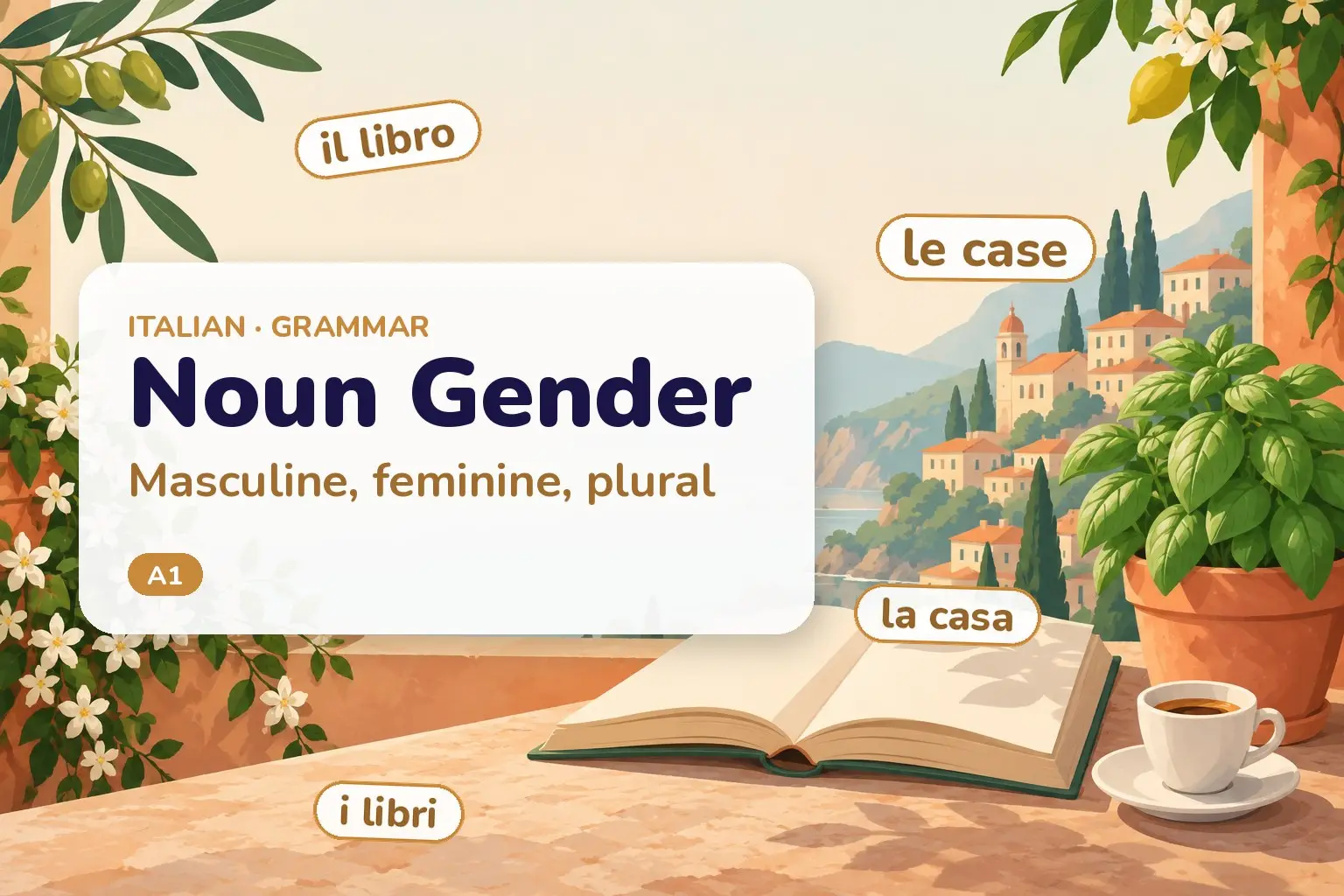
Italian nouns are masculine or feminine. Most -o nouns are masculine (il libro → i libri), most -a are feminine (la casa → le case), and -e nouns are either gender and take -i in the plural (il cane → i cani, la chiave → le chiavi).
Level: A1. Every Italian noun has a gender (masculine or feminine) and a number (singular or plural). You cannot avoid the choice: the article and most adjectives must agree with the noun, so the and new change shape to match it.
The rule
Gender is whether a noun is treated as masculine or feminine — it is a grammar label, not about real-world sex. Number is singular (one) or plural (more than one). The ending of the noun usually tells you both:
- Nouns ending in -o are usually masculine, and the plural ends in -i: libro → libri.
- Nouns ending in -a are usually feminine, and the plural ends in -e: casa → case.
- Nouns ending in -e can be either gender, and the plural ends in -i: cane (m) → cani, chiave (f) → chiavi.
Because an -e noun does not show its gender, you have to learn each one with its article: il cane (the dog, masculine), la chiave (the key, feminine).
Forms
| Singular ending | Usual gender | Plural ending | Example |
|---|---|---|---|
| -o | masculine | -i | il libro → i libri |
| -a | feminine | -e | la casa → le case |
| -e | masculine or feminine | -i | il cane → i cani; la chiave → le chiavi |
| -à / -ù (accented) | either | unchanged | la città → le città |
| shortened (-o from a longer word) | feminine | unchanged | la foto → le foto |
Some common nouns break the -o/-a pattern and simply have to be memorised: la mano (the hand) is feminine though it ends in -o, with plural le mani; il problema, il tema, il programma and il sistema are masculine though they end in -a, with plurals i problemi, i temi, and so on.
Example sentences
- Il libro è nuovo.The book is new.-o masculine singular
- I libri sono nuovi.The books are new.-o → -i plural
- La casa è grande.The house is big.-a feminine singular
- Le case sono grandi.The houses are big.-a → -e plural
- Il cane dorme.The dog is sleeping.-e noun, masculine
- I cani dormono.The dogs are sleeping.-e → -i plural
- La chiave è sul tavolo.The key is on the table.-e noun, feminine
- Le chiavi sono qui.The keys are here.-e → -i plural
- Lo studente studia molto.The student studies a lot.
- Gli studenti studiano molto.The students study a lot.
- La mano destra è fredda.The right hand is cold.exception: -o but feminine
- Le mani sono fredde.The hands are cold.
- Il problema è difficile.The problem is difficult.exception: -a but masculine
- I problemi sono difficili.The problems are difficult.
- La città è bella.The city is beautiful.accented -à: no change in plural
- Le città italiane sono antiche.The Italian cities are ancient.
- La foto è bella.The photo is nice.shortened word, invariable
- Le foto sono belle.The photos are nice.
Common mistakes
- ❌ le casa → ✅ le case. The plural of a feminine -a noun is -e, not -a.
- ❌ le chiave → ✅ le chiavi. An -e noun takes -i in the plural, whatever its gender.
- ❌ la mani → ✅ le mani. La mano is feminine; its plural mani takes the feminine plural article le.
- ❌ i problema → ✅ i problemi. Problema is masculine and pluralises to problemi.
- ❌ le cittàe → ✅ le città. Nouns ending in an accented vowel never change in the plural.
A short conversation
— Scusa, dove sono le chiavi? (Excuse me, where are the keys?) — La chiave di casa è qui; le chiavi della macchina sono sul tavolo. (The house key is here; the car keys are on the table.) — E i libri? Sono ancora nello zaino? (And the books? Are they still in the backpack?) — Sì, ma ho solo due mani: ho portato troppe borse! (Yes, but I only have two hands: I carried too many bags!)
Notice how each noun drags its article and ending along: la chiave → le chiavi (an -e noun, feminine), il libro → i libri (-o → -i), la mano → le mani (the -o-but-feminine trap), la borsa → le borse (-a → -e).
Usage notes
- The ending is a guide, not a guarantee. Most -o nouns are masculine and most -a feminine, but learn every noun with its article, because the common exceptions (la mano, il problema, la radio, il cinema) never announce themselves.
- -e nouns hide their gender. Since -e can be either, store each one as a pair: il fiore (the flower, masculine), la notte (the night, feminine). Both pluralise to -i — i fiori, le notti — so only the article tells them apart.
- Some nouns never change in the plural. Words ending in a stressed vowel (la città → le città, il caffè → i caffè), shortened words (la foto → le foto, la moto, l’auto) and foreign borrowings (il bar → i bar, il film → i film) keep one form; only the article shows the number.
- Nouns for people often pair up. Many swap -o/-a to match the person: il ragazzo / la ragazza, il maestro / la maestra. Nouns in -ista keep one word for both and let the article do the work: il turista / la turista, i turisti / le turiste.
Compared with…
- Definite articles (il, lo, la, i, gli, le) change with the noun’s gender and number — read Italian Definite Articles to pick the right one.
- Indefinite articles (un, uno, una, un’) follow the same gender logic; see the Italian grammar section.
How to say it
Italian reads almost exactly as it is written. These are the sounds English speakers get wrong in this lesson’s words:
| Sound | How to say it |
|---|---|
| c / g before e/i | c = “ch” (cane is hard “k”, but città = “cheet-TAH”); g before e/i = “j”. |
| ch / gh | Always hard “k” / “g”: chiave = “KYAH-veh”, amiche = “ah-MEE-keh”. |
| z | “ts” or “dz”: città keeps a crisp t, zaino = “DZEYE-no”. |
| Double consonants | Held longer: problema has a clear single m, but say doubled letters long elsewhere (palla, mano vs manno is wrong). |
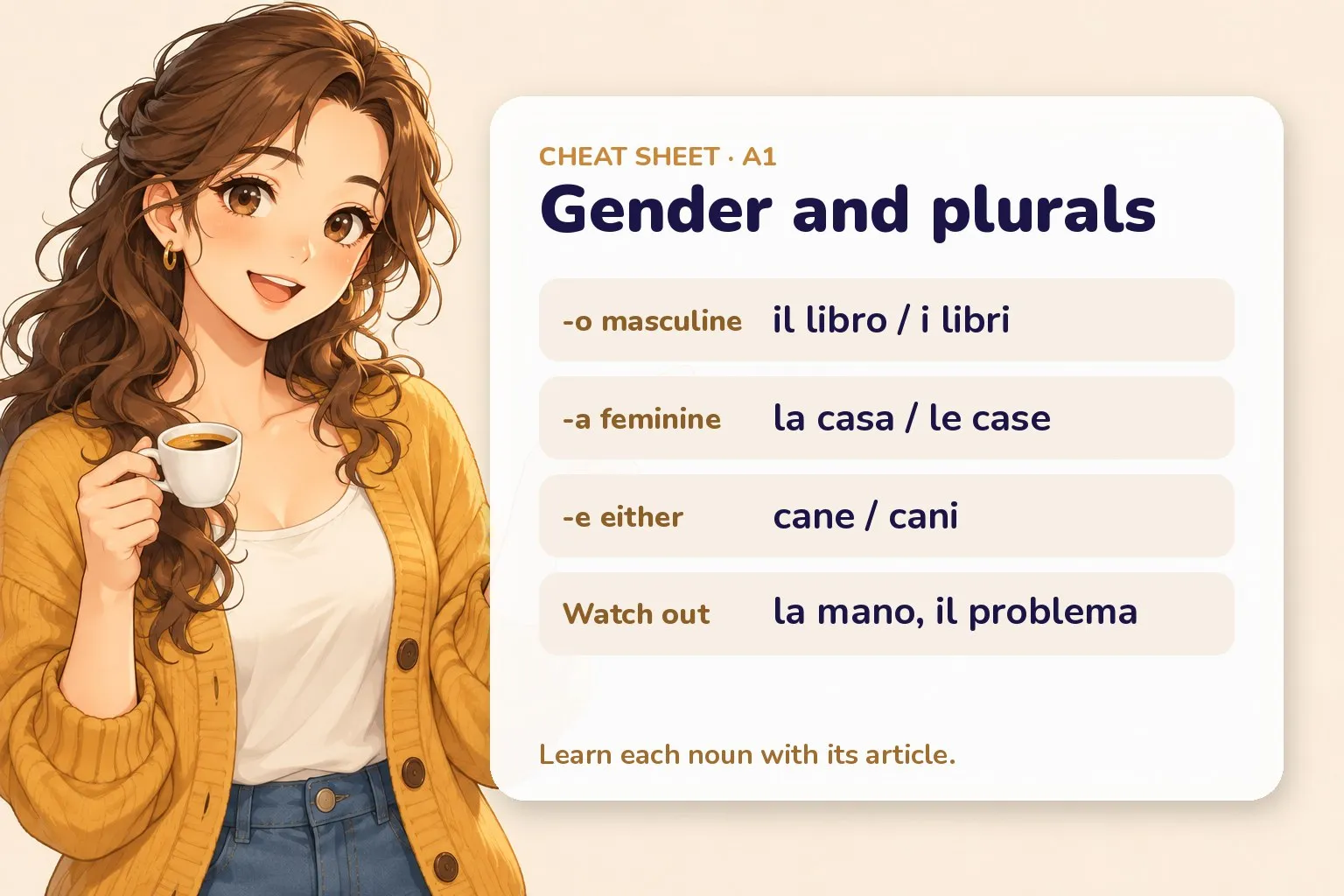
Quick recap before the quiz.
Practice
Gender and number practice
Try each one, then press Check. No sign-up, nothing is sent anywhere — it all runs in your browser.
Hint: -e nouns take -i.
Show answer
chiavi — An -e noun takes -i in the plural, so le chiavi.
3 Build: 'The books are new.'
Show answer
i libri sono nuovi — i libri sono nuovi — article, noun, verb, adjective all masculine plural.
4 Match each singular with its plural.
- il libro
- la casa
- il cane
- la mano
Show answer
- il libro → i libri
- la casa → le case
- il cane → i cani
- la mano → le mani
-o/-e → -i; -a → -e; la mano is an -o feminine exception.
Quiz
Noun gender and number
13 questions · pick an answer and you'll see straight away if it's right.
-
Show answer
masculine — Most -o nouns are masculine: il libro.
-
Show answer
le case — Feminine -a → -e: le case.
-
Show answer
i libri — Masculine -o → -i: i libri.
-
Show answer
-i — -e nouns take -i: cane → cani, chiave → chiavi.
-
Show answer
feminine — La mano is feminine despite the -o; plural le mani.
-
Show answer
i problemi — Problema is masculine: i problemi.
-
Show answer
le città — Accented-vowel nouns do not change: le città.
-
Show answer
chiavi — -e nouns take -i: le chiavi.
-
Show answer
To know its gender — The -e ending hides the gender, so il/la tells you.
-
Show answer
agree with the noun's gender and number — Agreement: il libro nuovo → i libri nuovi.
-
Show answer
le chiavi — Chiave is feminine -e, plural le chiavi.
-
Show answer
foto — Shortened words like foto are invariable: le foto.
-
Show answer
i fiori — Fiore is an -e noun (masculine): i fiori.
Recap cheat-sheet
| Singular | Plural | Note |
|---|---|---|
| il libro | i libri | -o → -i (m) |
| la casa | le case | -a → -e (f) |
| il cane / la chiave | i cani / le chiavi | -e → -i |
| la mano / la città | le mani / le città | exceptions |
Next
- Back to the Italian grammar section
- Related: Italian Definite Articles
- New here? Start with Start Learning Italian Here
All Italian grammar topics
Every grammar point in order, from your first sentence to advanced structures. Pick one and go straight to it. New lessons go live every day, so topics marked Coming soon fill in over the next weeks.
Grammar path
A1 18 topics · 12 ready
- 01 Italian Definite Articles (il, la, i, le)
- 02 Italian Indefinite Articles (un, una)
- 03 Noun Gender and Number You are here
- 04 The Verb Essere (to be)
- 05 The Verb Avere (to have)
- 06 Subject Pronouns (io, tu, lui, lei)
- 07 Present Tense: -are Verbs
- 08 Present Tense: -ere Verbs
- 09 Present Tense: -ire Verbs (and -isc-)
- 10 Plural of Nouns and Adjectives
- 11 Adjective Agreement and Position
- 12 C'è and Ci sono (there is/are)
- 13 Question Words (chi, che, dove, quando) Coming soon
- 14 Numbers, Time and Dates Coming soon
- 15 Possessive Adjectives (il mio, la mia) Coming soon
- 16 Negation with non Coming soon
- 17 The Verb Piacere (to like) Coming soon
- 18 Quantity Adjectives/Adverbs (molto, troppo, poco) Coming soon
A2 23 topics
- 19 Passato Prossimo with Avere Coming soon
- 20 Passato Prossimo with Essere Coming soon
- 21 Irregular Past Participles Coming soon
- 22 Reflexive Verbs (alzarsi, lavarsi) Coming soon
- 23 Modal Verbs (potere, dovere, volere) Coming soon
- 24 Direct Object Pronouns (lo, la, li, le) Coming soon
- 25 Indirect Object Pronouns (gli, le) Coming soon
- 26 Simple Prepositions (di, a, da, in) Coming soon
- 27 Articulated Prepositions (del, nella, sul) Coming soon
- 28 The Imperfect Tense (Imperfetto) Coming soon
- 29 The Simple Future (Futuro Semplice) Coming soon
- 30 Comparatives (più, meno, come) Coming soon
- 31 Superlatives (il più, -issimo) Coming soon
- 32 The Imperative (tu, noi, voi) Coming soon
- 33 The Particles ci and ne Coming soon
- 34 Stare + Gerund (Present Progressive) Coming soon
- 35 C'è bisogno / Ci vuole (Need & Take Time) Coming soon
- 36 The Partitive (del, dei = some) Coming soon
- 37 Pre-Noun Forms: bello, buono, quello Coming soon
- 38 Stare per + Infinitive (About To) Coming soon
- 39 Forming Adverbs with -mente Coming soon
- 40 Time: da (since/for) and fa (ago) Coming soon
- 41 Double Negatives (non...niente, nessuno) Coming soon
B1 18 topics
- 42 Passato Prossimo vs Imperfetto Coming soon
- 43 Combined Pronouns (glielo, me lo) Coming soon
- 44 The Present Conditional (Condizionale) Coming soon
- 45 Impersonal and Passivante si Coming soon
- 46 Relative Pronouns (che, cui) Coming soon
- 47 The Future Perfect (Futuro Anteriore) Coming soon
- 48 The Past Perfect (Trapassato Prossimo) Coming soon
- 49 Formal Imperative (Lei) & with Pronouns Coming soon
- 50 The Gerund: Uses and Past Gerund Coming soon
- 51 The Past Conditional (Condizionale Passato) Coming soon
- 52 Pronoun Placement with Infinitive/Imperative Coming soon
- 53 Comparative & Superlative Irregulars Coming soon
- 54 Impersonal Verbs (bisogna, basta, sembra) Coming soon
- 55 Future of Probability (Suppositional) Coming soon
- 56 Altered Words (-ino, -one, -accio) Coming soon
- 57 Relative chi and quello che Coming soon
- 58 Ne with Quantities and Participle Agreement Coming soon
- 59 Adverb Position (già, ancora, più, mai) Coming soon
B2 14 topics
- 60 The Present Subjunctive (Congiuntivo) Coming soon
- 61 The Imperfect Subjunctive Coming soon
- 62 Perfect & Pluperfect Subjunctive Coming soon
- 63 The Three Hypothetical Periods (periodo ipotetico) Coming soon
- 64 Sequence of Tenses with the Subjunctive Coming soon
- 65 Passive Voice (essere / venire / andare) Coming soon
- 66 Conjunctions Requiring the Subjunctive Coming soon
- 67 Advanced Relatives (il quale, cui possessive) Coming soon
- 68 Reported Speech (Discorso Indiretto) Coming soon
- 69 The Remote Past (Passato Remoto) Coming soon
- 70 Causative Construction (fare + infinitive) Coming soon
- 71 Indefinite Adjectives & Pronouns Coming soon
- 72 Concession: anche se vs benché Coming soon
- 73 Gerund vs Infinitive as Subject/Complement Coming soon
C1 8 topics
- 74 Independent & Optative Subjunctive Coming soon
- 75 Advanced Sequence of Tenses Coming soon
- 76 Nominalisation & Formal Register Coming soon
- 77 Advanced Connectives & Cohesion Coming soon
- 78 Absolute Participle & Implicit Clauses Coming soon
- 79 Pronominal Verbs (farcela, andarsene) Coming soon
- 80 Dislocation & Emphasis Coming soon
- 81 Register, Style and Bureaucratic Italian Coming soon