Present Tense: -ire Verbs (and -isc-)
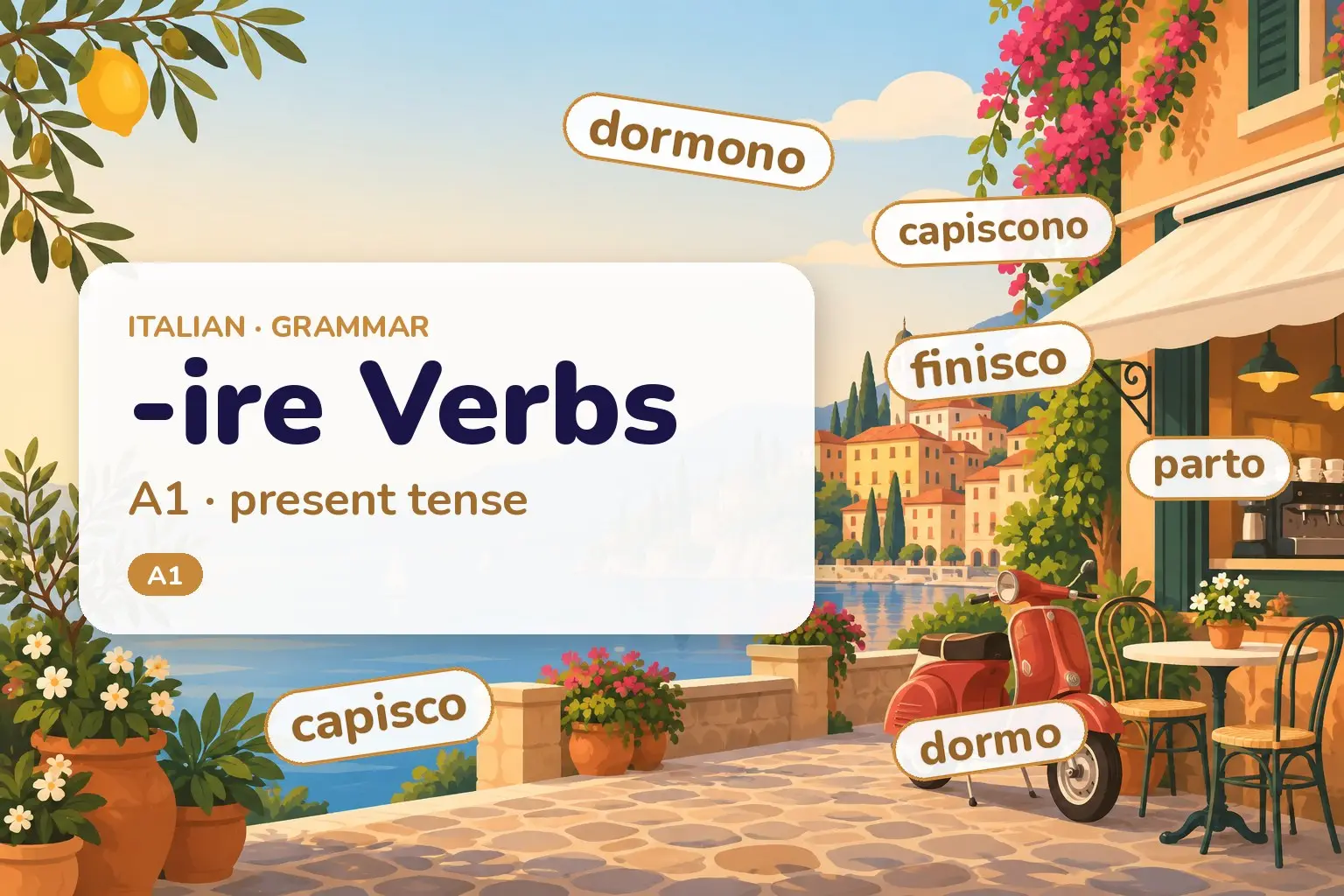
Regular Italian -ire verbs take -o, -i, -e, -iamo, -ite, -ono, so dormire gives dormo, dormi, dorme, dormiamo, dormite, dormono. A large group inserts -isc- in every form except noi and voi: capire becomes capisco, capisci, capisce, capiamo, capite, capiscono.
Level: A1. The third Italian verb group ends in -ire (dormire, partire, capire). It has one twist the first two groups do not: a large set of verbs slips -isc- into most forms. Learn the two patterns side by side and the whole group falls into place.
The rule
An infinitive is the dictionary form of a verb, like dormire (“to sleep”). Remove the -ire to find the stem (dorm-), then add the ending that matches the subject.
The six present-tense endings for -ire verbs are:
- -o (io) — dormo — I sleep
- -i (tu) — dormi — you sleep (informal)
- -e (lui / lei) — dorme — he / she sleeps
- -iamo (noi) — dormiamo — we sleep
- -ite (voi) — dormite — you (all) sleep
- -ono (loro) — dormono — they sleep
That is the plain pattern, used by verbs like dormire, partire, sentire, aprire, offrire, seguire. As with every Italian verb, the ending shows who acts, so the subject pronoun is usually dropped: Dormo bene is a full sentence — “I sleep well.”
The -isc- group
Most -ire verbs belong to a second, larger set that adds -isc- between the stem and the ending — but only in the four forms where the stress would fall on the stem: io, tu, lui/lei and loro. The noi and voi forms stay plain:
- capire (“to understand”) → capisco, capisci, capisce, capiamo, capite, capiscono.
- finire (“to finish”) → finisco, finisci, finisce, finiamo, finite, finiscono.
So capiamo and capite have no -isc-, while the other four forms do.
Forms
| Subject | Ending | dormire (plain) | capire (-isc-) |
|---|---|---|---|
| io | -o | dormo | capisco |
| tu | -i | dormi | capisci |
| lui / lei | -e | dorme | capisce |
| noi | -iamo | dormiamo | capiamo |
| voi | -ite | dormite | capite |
| loro | -ono | dormono | capiscono |
Common plain -ire verbs: dormire, partire, sentire, aprire, offrire, seguire, servire, soffrire. Common -isc- verbs: capire, finire, preferire, pulire, spedire, costruire, suggerire, restituire, guarire.
How to say it
Italian is read as written; watch these in -ire verbs:
- -sc- before o or a is a hard “sk”: capisco ≈ “ka-PEES-ko”, finiscono ≈ “fee-NEES-ko-no”.
- -sc- before i or e is a soft “sh”: capisci ≈ “ka-PEE-shee”, capisce ≈ “ka-PEE-sheh”.
- Stress the loro form early: dòrmono ≈ “DOR-mo-no”, capìscono ≈ “ka-PEES-ko-no”, never on the last -o.
- Final -e is pronounced: dorme ≈ “DOR-meh”, parte ≈ “PAR-teh”.
Example sentences
- Dormo otto ore ogni notte.I sleep eight hours every night.io, plain -ire
- A che ora parti domani?What time do you leave tomorrow?tu, partire
- Il treno parte alle nove.The train leaves at nine.lui/lei form
- Sentiamo la musica dalla strada.We hear the music from the street.noi, sentire
- Aprite le finestre, per favore.Open the windows, please.voi, aprire
- I bambini dormono già.The children are already asleep.loro, dormono
- Offro io il caffè oggi.I'm buying the coffee today.offrire
- Seguo un corso di italiano.I'm taking an Italian course.seguire
- Capisco l'italiano abbastanza bene.I understand Italian quite well.io, -isc-
- Capisci la domanda?Do you understand the question?tu, -isc- (soft sc)
- Lei non capisce il problema.She doesn't understand the problem.lui/lei, -isc-
- Capiamo la situazione.We understand the situation.noi, NO -isc-
- Voi capite tutto subito.You (all) understand everything at once.voi, NO -isc-
- Loro capiscono il francese.They understand French.loro, -isc-
- Finisco il lavoro alle sei.I finish work at six.finire, -isc-
- Finiamo la lezione adesso.We finish the lesson now.noi, NO -isc-
- Preferisco il tè al caffè.I prefer tea to coffee.preferire, -isc-
- Pulisci la cucina stasera?Are you cleaning the kitchen tonight?pulire, -isc-
- Spediscono il pacco domani.They are sending the parcel tomorrow.spedire, loro -isc-
- Costruiamo una casa nuova.We are building a new house.costruire, noi NO -isc-
Common mistakes
- ❌ Io capo l’italiano. → ✅ Capisco l’italiano. capire is an -isc- verb: the io form is capisco, not capo.
- ❌ Noi capisciamo. → ✅ Capiamo. The noi form never takes -isc-: just capiamo.
- ❌ Voi capiscite. → ✅ Capite. The voi form stays plain and uses -ite: capite.
- ❌ Voi dormete. → ✅ Dormite. The -ire voi ending is -ite, not the -ete of -ere verbs.
- ❌ Loro finono. → ✅ Finiscono. finire keeps -isc- in the loro form: finiscono.
A short conversation
— A che ora parti domani? — Parto presto, alle sette. E tu, capisci gli orari dei treni? — Sì, capisco. Prima finisco la colazione e poi dormo ancora un’ora. — Va bene. Apriamo la finestra? Fa caldo.
Usage notes
- io, tu, noi echo the other groups. -o, -i, -iamo are shared with -are and -ere, so only voi (-ite) and the -isc- insert are really new.
- The present covers the near future: Domani parto (“Tomorrow I’m leaving”) is normal with a time word.
- No rule predicts the -isc- group. Dictionaries and courses mark it; high-frequency capire, finire, preferire, pulire all take it, while dormire, partire, sentire, aprire do not.
- A few -ire verbs are irregular — venire, uscire, dire, salire. Learn those one by one; the two patterns here cover the regular ones.
Compared with -are and -ere verbs
Italian has three verb groups. The present endings differ only in lui/lei, voi and loro:
- -are (parlare): parlo, parli, parla, parliamo, parlate, parlano.
- -ere (prendere): prendo, prendi, prende, prendiamo, prendete, prendono.
- -ire (dormire): dormo, dormi, dorme, dormiamo, dormite, dormono.
So -ere and -ire share lui/lei (-e) and loro (-ono); they split only at voi (-ete vs -ite) — and -ire adds the optional -isc-. Review the first two groups in Present tense: -are verbs and Present tense: -ere verbs, plus the key irregulars essere and avere.
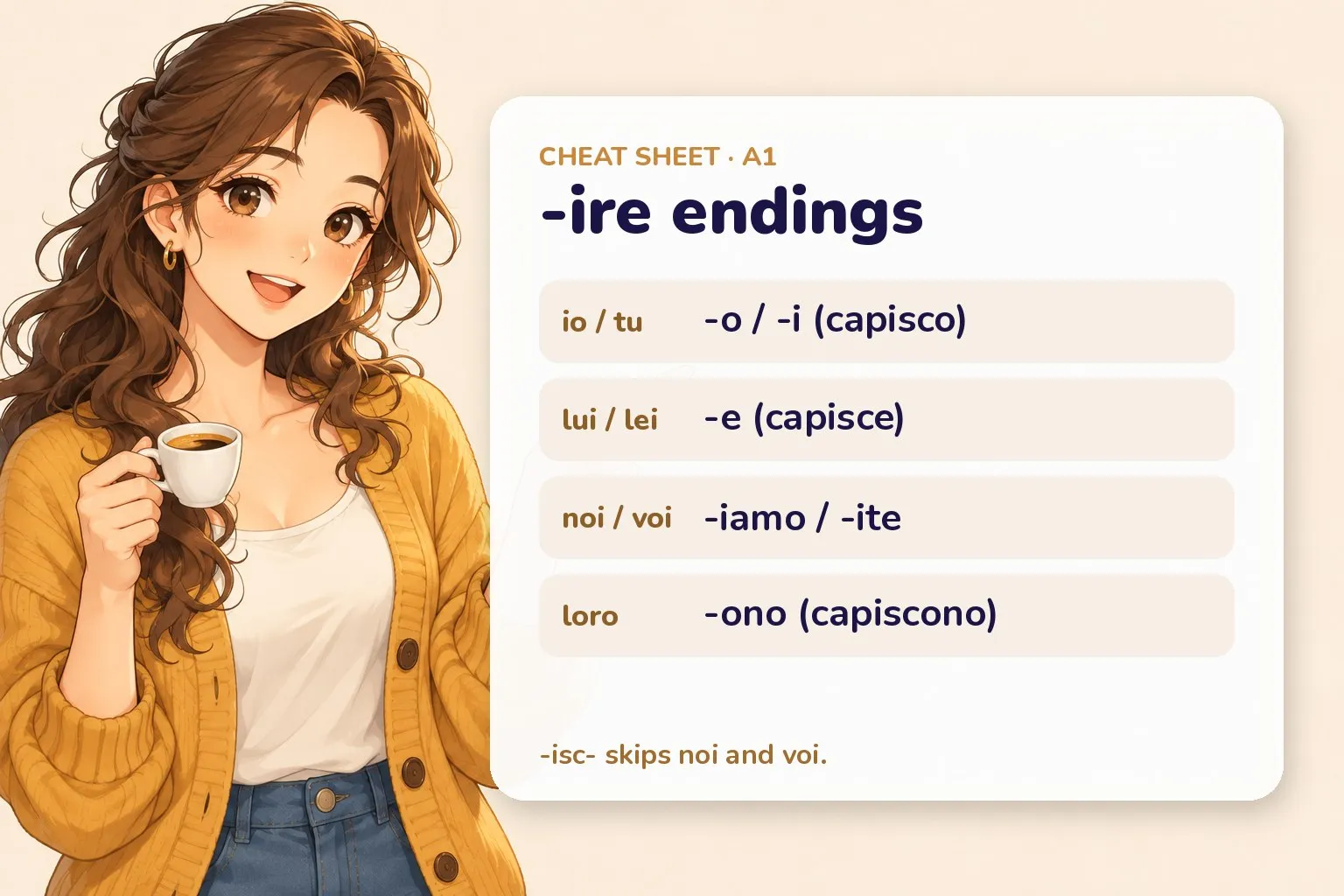
Quick recap before the quiz.
Practice
-ire verbs practice
Try each one, then press Check. No sign-up, nothing is sent anywhere — it all runs in your browser.
Hint: noi never takes -isc-
Show answer
capiamo — The noi form stays plain: capiamo.
3 Build: 'The train leaves at nine.'
Show answer
Il treno parte alle nove — lui/lei form of partire (plain -ire): parte.
4 Match each subject to the capire form.
- io
- noi
- voi
- loro
Show answer
- io → capisco
- noi → capiamo
- voi → capite
- loro → capiscono
io/loro take -isc- (capisco, capiscono); noi/voi stay plain (capiamo, capite).
Quiz
Italian -ire verbs quiz
12 questions · pick an answer and you'll see straight away if it's right.
-
Show answer
-o — io takes -o: dormo, parto, capisco.
-
Show answer
dormi — tu takes -i: dormi.
-
Show answer
dormite — The -ire voi ending is -ite: dormite.
-
Show answer
io, tu, lui/lei and loro — -isc- appears in io, tu, lui/lei and loro; noi and voi stay plain.
-
Show answer
capiamo — noi never takes -isc-: capiamo.
-
Show answer
finiscono — loro keeps -isc-: finiscono.
-
Show answer
Voi capite. — voi stays plain with -ite: capite.
-
Show answer
parte — lui/lei takes -e: parte.
-
Show answer
sc is soft before i/e and hard before o/a — sc is soft before i or e, hard before o or a.
-
Show answer
preferisco — preferire is an -isc- verb: io preferisco.
-
Show answer
the voi form (-ite vs -ete) — They split only at voi: -ire -ite vs -ere -ete.
-
Show answer
capiscono — loro takes -isc-: capiscono.
Recap cheat-sheet
| Subject | Plain (dormire) | -isc- (capire) |
|---|---|---|
| io / tu | dormo / dormi | capisco / capisci |
| lui / lei | dorme | capisce |
| noi | dormiamo | capiamo (no -isc-) |
| voi | dormite | capite (no -isc-) |
| loro | dormono | capiscono |
Next
- The second group: Present tense: -ere verbs
- Practise reading these verbs: Italian Reading Practice: Intermediate (B1)
- New here? Start with Start Learning Italian Here
All Italian grammar topics
Every grammar point in order, from your first sentence to advanced structures. Pick one and go straight to it. New lessons go live every day, so topics marked Coming soon fill in over the next weeks.
Grammar path
A1 18 topics · 12 ready
- 01 Italian Definite Articles (il, la, i, le)
- 02 Italian Indefinite Articles (un, una)
- 03 Noun Gender and Number
- 04 The Verb Essere (to be)
- 05 The Verb Avere (to have)
- 06 Subject Pronouns (io, tu, lui, lei)
- 07 Present Tense: -are Verbs
- 08 Present Tense: -ere Verbs
- 09 Present Tense: -ire Verbs (and -isc-) You are here
- 10 Plural of Nouns and Adjectives
- 11 Adjective Agreement and Position
- 12 C'è and Ci sono (there is/are)
- 13 Question Words (chi, che, dove, quando) Coming soon
- 14 Numbers, Time and Dates Coming soon
- 15 Possessive Adjectives (il mio, la mia) Coming soon
- 16 Negation with non Coming soon
- 17 The Verb Piacere (to like) Coming soon
- 18 Quantity Adjectives/Adverbs (molto, troppo, poco) Coming soon
A2 23 topics
- 19 Passato Prossimo with Avere Coming soon
- 20 Passato Prossimo with Essere Coming soon
- 21 Irregular Past Participles Coming soon
- 22 Reflexive Verbs (alzarsi, lavarsi) Coming soon
- 23 Modal Verbs (potere, dovere, volere) Coming soon
- 24 Direct Object Pronouns (lo, la, li, le) Coming soon
- 25 Indirect Object Pronouns (gli, le) Coming soon
- 26 Simple Prepositions (di, a, da, in) Coming soon
- 27 Articulated Prepositions (del, nella, sul) Coming soon
- 28 The Imperfect Tense (Imperfetto) Coming soon
- 29 The Simple Future (Futuro Semplice) Coming soon
- 30 Comparatives (più, meno, come) Coming soon
- 31 Superlatives (il più, -issimo) Coming soon
- 32 The Imperative (tu, noi, voi) Coming soon
- 33 The Particles ci and ne Coming soon
- 34 Stare + Gerund (Present Progressive) Coming soon
- 35 C'è bisogno / Ci vuole (Need & Take Time) Coming soon
- 36 The Partitive (del, dei = some) Coming soon
- 37 Pre-Noun Forms: bello, buono, quello Coming soon
- 38 Stare per + Infinitive (About To) Coming soon
- 39 Forming Adverbs with -mente Coming soon
- 40 Time: da (since/for) and fa (ago) Coming soon
- 41 Double Negatives (non...niente, nessuno) Coming soon
B1 18 topics
- 42 Passato Prossimo vs Imperfetto Coming soon
- 43 Combined Pronouns (glielo, me lo) Coming soon
- 44 The Present Conditional (Condizionale) Coming soon
- 45 Impersonal and Passivante si Coming soon
- 46 Relative Pronouns (che, cui) Coming soon
- 47 The Future Perfect (Futuro Anteriore) Coming soon
- 48 The Past Perfect (Trapassato Prossimo) Coming soon
- 49 Formal Imperative (Lei) & with Pronouns Coming soon
- 50 The Gerund: Uses and Past Gerund Coming soon
- 51 The Past Conditional (Condizionale Passato) Coming soon
- 52 Pronoun Placement with Infinitive/Imperative Coming soon
- 53 Comparative & Superlative Irregulars Coming soon
- 54 Impersonal Verbs (bisogna, basta, sembra) Coming soon
- 55 Future of Probability (Suppositional) Coming soon
- 56 Altered Words (-ino, -one, -accio) Coming soon
- 57 Relative chi and quello che Coming soon
- 58 Ne with Quantities and Participle Agreement Coming soon
- 59 Adverb Position (già, ancora, più, mai) Coming soon
B2 14 topics
- 60 The Present Subjunctive (Congiuntivo) Coming soon
- 61 The Imperfect Subjunctive Coming soon
- 62 Perfect & Pluperfect Subjunctive Coming soon
- 63 The Three Hypothetical Periods (periodo ipotetico) Coming soon
- 64 Sequence of Tenses with the Subjunctive Coming soon
- 65 Passive Voice (essere / venire / andare) Coming soon
- 66 Conjunctions Requiring the Subjunctive Coming soon
- 67 Advanced Relatives (il quale, cui possessive) Coming soon
- 68 Reported Speech (Discorso Indiretto) Coming soon
- 69 The Remote Past (Passato Remoto) Coming soon
- 70 Causative Construction (fare + infinitive) Coming soon
- 71 Indefinite Adjectives & Pronouns Coming soon
- 72 Concession: anche se vs benché Coming soon
- 73 Gerund vs Infinitive as Subject/Complement Coming soon
C1 8 topics
- 74 Independent & Optative Subjunctive Coming soon
- 75 Advanced Sequence of Tenses Coming soon
- 76 Nominalisation & Formal Register Coming soon
- 77 Advanced Connectives & Cohesion Coming soon
- 78 Absolute Participle & Implicit Clauses Coming soon
- 79 Pronominal Verbs (farcela, andarsene) Coming soon
- 80 Dislocation & Emphasis Coming soon
- 81 Register, Style and Bureaucratic Italian Coming soon