Italian Reading Practice: Intermediate
This page gives you two short, original Italian texts at intermediate (B1) level, each with the new words glossed and comprehension questions. Read first for the gist, then again slowly, checking the word list only when a sentence will not click.
Level: B1 (intermediate). At B1 the texts tell real stories with opinions, reasons and a little unreal past. Below are two original passages written for intermediate learners, with the harder words explained and questions to check what you understood.
By the end of this page you can…
…read two B1 Italian texts that use connectors and the unreal past, work out new words from context, and answer comprehension questions.
How to use this page
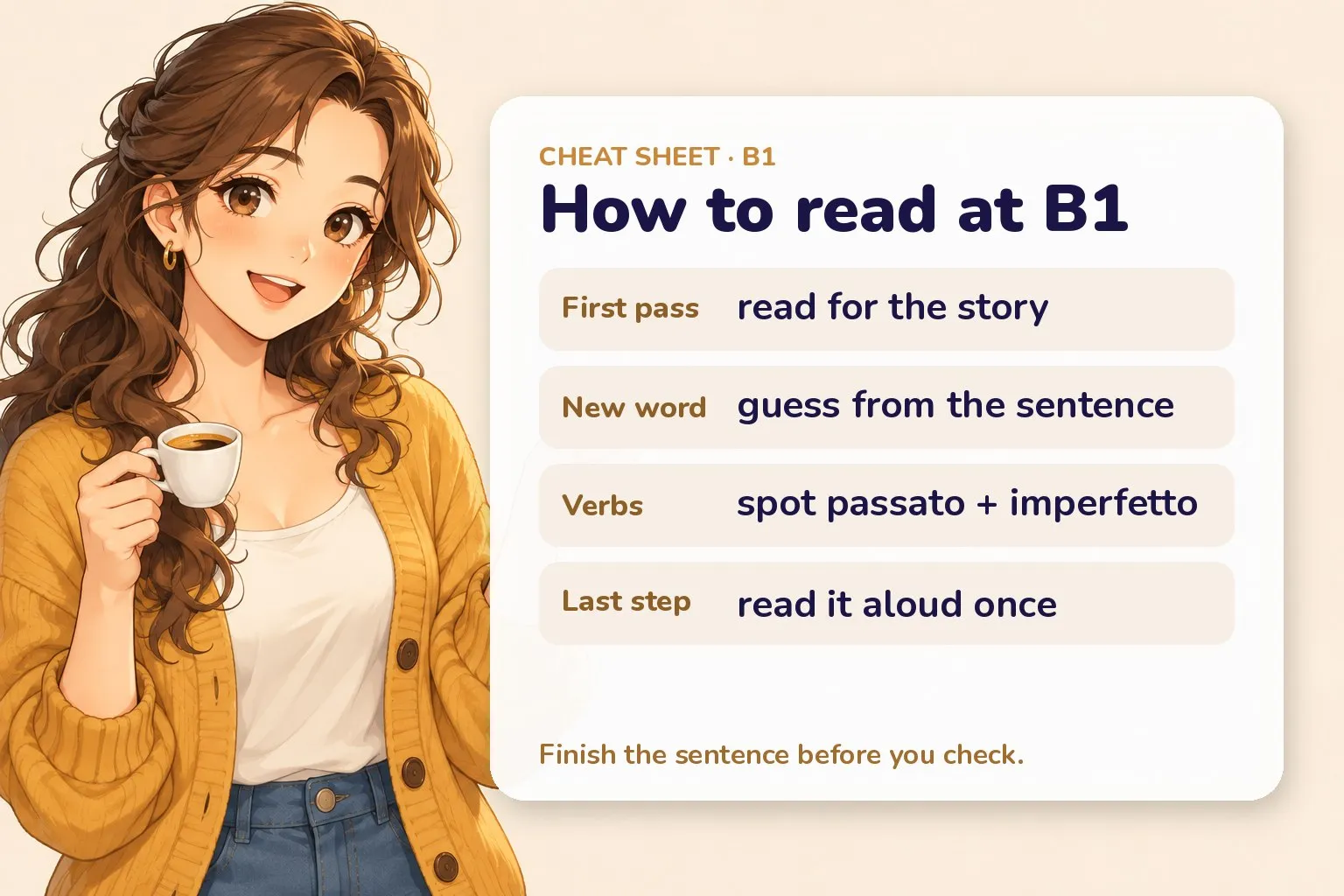
- Read once for the gist. Do not stop at every word. What happens, and how does the person feel about it?
- Read again, slowly. Follow the connectors (perché, anche se, comunque) to see how ideas link.
- Check the word list under each text — only for words you could not guess.
- Read it aloud once, or play the audio sentences, so you hear the rhythm too.
- Answer the questions at the bottom without looking back, then check.
Reading 1: Un nuovo lavoro a Bologna
Tre mesi fa Giulia si è trasferita a Bologna per un nuovo lavoro. All’inizio non conosceva nessuno e la città le sembrava enorme. Anche se parlava italiano abbastanza bene, aveva paura di sbagliare al telefono con i clienti.
Una collega, che si chiama Sara, l’ha aiutata molto. Le ha mostrato i posti migliori per mangiare e l’ha invitata a cena. “Se hai bisogno di qualcosa, chiamami pure”, le ha detto Sara.
Poco a poco tutto è diventato più facile. Giulia ha trovato un corso serale e ha conosciuto altre persone. Oggi dice: “Rifarei la stessa scelta. All’inizio è stato difficile, ma adesso mi sento a casa.” L’anno prossimo vorrebbe affittare un appartamento più grande, perché sua sorella vuole venire a trovarla.
New words (Reading 1)
| Word | Meaning | Example from the text |
|---|---|---|
| trasferirsi | to move, relocate | Giulia si è trasferita a Bologna. |
| non conoscere nessuno | to know no one | All’inizio non conosceva nessuno. |
| anche se | even though | Anche se parlava bene, aveva paura. |
| la collega | (female) colleague | Una collega l’ha aiutata. |
| rifare la stessa scelta | to make the same choice again | Rifarei la stessa scelta. |
| affittare | to rent | …vorrebbe affittare un appartamento. |
| venire a trovare | to come and visit (a person) | Sua sorella vuole venire a trovarla. |
Reading 2: Una mail su un weekend
Ciao Luca,
devo assolutamente raccontarti il mio weekend! Sabato volevo andare a Firenze in treno, ma il treno era in ritardo di due ore. All’inizio ero molto arrabbiata, perché volevo incontrare la mia amica alla stazione.
Per fortuna lei mi ha aspettata. Anche se avevamo meno tempo, abbiamo visto comunque tante cose. Abbiamo camminato per il centro e abbiamo mangiato una bistecca buonissima. Se il tempo fosse stato migliore, avremmo fatto anche una passeggiata lungo il fiume.
Domenica sono tornata presto, perché lunedì dovevo lavorare. La prossima volta prenderei un treno diretto. Hai voglia di venire anche tu? Potremmo organizzare un weekend insieme.
Un abbraccio, Elena
New words (Reading 2)
| Word | Meaning | Example from the text |
|---|---|---|
| in ritardo | late | Il treno era in ritardo di due ore. |
| arrabbiato / arrabbiata | angry | Ero molto arrabbiata. |
| comunque | anyway, nevertheless | Abbiamo visto comunque tante cose. |
| la bistecca | steak | Abbiamo mangiato una bistecca. |
| avremmo fatto | we would have done (unreal past) | …avremmo fatto una passeggiata. |
| tornare | to return, go back | Domenica sono tornata presto. |
| avere voglia di | to feel like (doing) | Hai voglia di venire? |
How to say it
A few sounds still trip English speakers at B1:
- c / g before e or i are soft: centro ≈ “CHEN-tro”, cena ≈ “CHE-na”.
- gl in migliore, famiglia sounds like the “lli” in “million”: migliore ≈ “mi-LYOH-reh”.
- z is “ts” or “dz”: stazione ≈ “sta-TSYOH-neh”.
- Double consonants are held: bistecca ≈ “bi-STEK-ka”, abbraccio ≈ “ab-BRAT-cho”.
Example sentences
Listen to key sentences from the texts, then read them aloud.
- Tre mesi fa Giulia si è trasferita a Bologna.Three months ago Giulia moved to Bologna.passato prossimo, reflexive
- All'inizio non conosceva nessuno.At first she knew no one.imperfetto
- Anche se parlava bene, aveva paura di sbagliare.Even though she spoke well, she was afraid of making mistakes.
- Una collega, che si chiama Sara, l'ha aiutata molto.A colleague called Sara helped her a lot.relative clause
- Rifarei la stessa scelta.I would make the same choice.condizionale
- Il treno era in ritardo di due ore.The train was two hours late.
- Anche se avevamo meno tempo, abbiamo visto comunque tante cose.Even though we had less time, we still saw a lot.
- Se il tempo fosse stato migliore, avremmo fatto una passeggiata.If the weather had been better, we would have taken a walk.unreal past
- Hai voglia di venire anche tu?Do you feel like coming too?
Quick recap before you answer the questions.
Comprehension practice
Reading comprehension practice
Try each one, then press Check. No sign-up, nothing is sent anywhere — it all runs in your browser.
Hint: past participle of mostrare
Show answer
mostrato — Sara le ha mostrato i posti migliori — she showed her the best places.
Hint: a cut of meat
Show answer
bistecca — They ate a very good steak.
5 Match each connector to its meaning.
- perché
- anche se
- comunque
- quindi
Show answer
- perché → because
- anche se → even though
- comunque → anyway
- quindi → so / therefore
These connectors carry the logic of a B1 text.
6 Put Giulia's story in order.
Show answer
si è trasferita a Bologna ha conosciuto una collega ha trovato un corso serale non rimpiange la scelta — Move, meet a colleague, take a course, be glad she decided this.
Quiz
Intermediate Italian reading quiz
8 questions · pick an answer and you'll see straight away if it's right.
-
Show answer
tre mesi — She moved to Bologna three months ago.
-
Show answer
una collega di nome Sara — A colleague called Sara helped her a lot.
-
Show answer
affittare un appartamento più grande — She would like to rent a bigger flat because her sister wants to visit.
-
Show answer
Il treno era in ritardo — The train was two hours late while she wanted to meet her friend.
-
Show answer
Non hanno fatto la passeggiata — The unreal past means it did not happen — the weather was not good enough.
-
Show answer
anyway / nevertheless — comunque signals a result despite something: anyway, nevertheless.
-
Show answer
leggere una volta per l'idea — Read for the gist first; look up only blocking words.
-
Show answer
Do you feel like coming? — avere voglia di = to feel like (doing) something.
Next
- Build the grammar: Italian -ere verbs in the present
- Easier first: Italian Reading Practice: Elementary (A2)
- New here? Start with Start Learning Italian Here
All Italian practice topics
Vocabulary, pronunciation, phrases, practice and exam help, ordered by level. Pick a topic and go straight to it. New lessons go live every day, so topics marked Coming soon fill in over the next weeks.
Practice
A1 1 topics · 1 ready
A2 4 topics · 2 ready
- 02 How to Practise Italian Listening
- 03 Italian Reading Practice: Elementary
- 04 Essere vs Avere Practice Set Coming soon
- 05 Italian Preposition+Article Practice Coming soon
B1 4 topics · 2 ready
- 06 Shadowing to Improve Italian Speaking
- 07 Italian Reading Practice: Intermediate You are here
- 08 How to Practise Italian Writing Coming soon
- 09 Passato Prossimo vs Imperfetto Practice Coming soon
B2 3 topics · 1 ready
- 10 Italian Reading Practice: Upper-Intermediate
- 11 Italian Subjunctive (Congiuntivo) Practice Coming soon
- 12 Italian Combined Pronouns Practice Coming soon