Italian Reading Practice: Elementary (A2)
This page gives you two short, original Italian texts at elementary (A2) level, with the new words glossed and comprehension questions. Read each text first for the general idea, then again slowly, and check the word list only when you are stuck.
Level: A2 (elementary). At A2 the texts get a little longer and start talking about the past. Below are two short passages written for elementary learners, with the new words explained and questions to check what you understood.
By the end of this page you can…
…read two short A2 Italian texts that mix present and past, work out the new words, and answer comprehension questions.
How to use this page
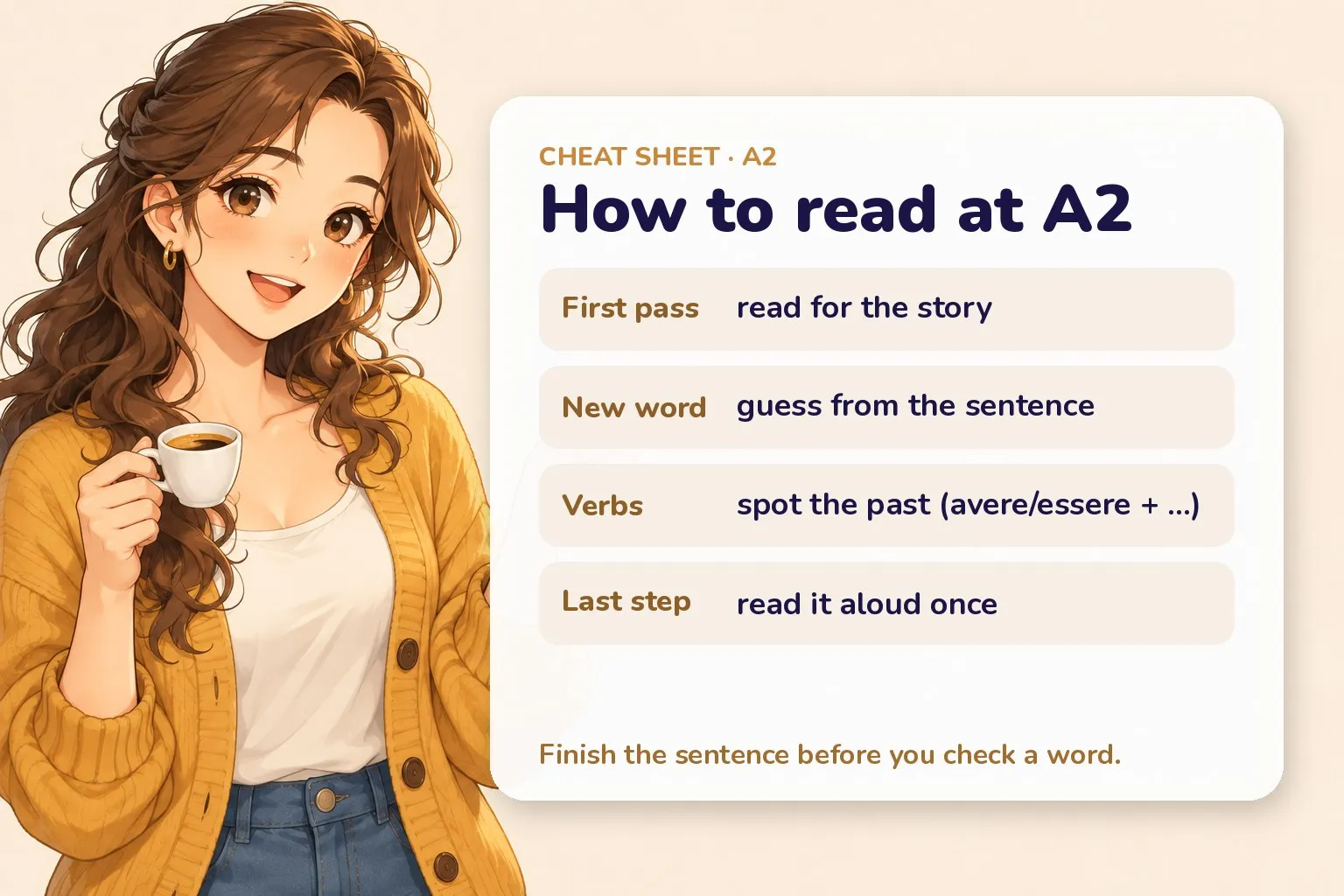
- Read once for the gist. Do not stop at every word. What happens? Who is in it?
- Read again, slowly. Guess new words from the sentence around them.
- Check the word list under each text — only for the words you could not guess.
- Read it aloud once, or play the audio sentences, so you hear the words too.
- Answer the questions at the bottom without looking back, then check.
Reading 1: Il fine settimana di Giulia
Il fine settimana scorso Giulia è andata a Firenze. Ha visitato una sua amica, Sara. Sabato mattina hanno fatto colazione insieme e poi sono uscite in centro.
Il tempo non era bello. Ha piovuto, quindi sono entrate in un museo. Lì hanno visto molti quadri famosi. Dopo hanno mangiato un gelato, anche se faceva freddo.
Domenica Giulia è tornata a casa in treno. Era un po’ stanca, ma molto contenta. “La prossima volta resto più a lungo”, ha detto.
New words (Reading 1)
| Word | Meaning | Example from the text |
|---|---|---|
| il fine settimana scorso | last weekend | Il fine settimana scorso Giulia è andata a Firenze. |
| è andata | she went (andare, past) | Giulia è andata a Firenze. |
| ha visitato | visited (visitare, past) | Ha visitato una sua amica. |
| sono uscite | they went out (uscire, past, fem. pl.) | Sono uscite in centro. |
| ha piovuto | it rained | Ha piovuto. |
| quindi | so, therefore | Quindi sono entrate in un museo. |
| la prossima volta | next time | La prossima volta resto più a lungo. |
Reading 2: Un messaggio a un amico
Ciao Luca,
come stai? Io sto bene. Ho trovato un nuovo appartamento, perché il mio vecchio appartamento era troppo piccolo. Il nuovo è più grande e ha un balcone.
La settimana scorsa ho portato tanti scatoloni. È stato faticoso! Mia sorella mi ha aiutato, quindi è andata più veloce. La sera abbiamo ordinato una pizza.
Vuoi venire a trovarmi presto? Puoi venire nel fine settimana. Possiamo cucinare insieme e guardare un film. Scrivimi, per favore!
Un abbraccio, Marco
New words (Reading 2)
| Word | Meaning | Example from the text |
|---|---|---|
| ho trovato | I found (trovare, past) | Ho trovato un nuovo appartamento. |
| perché | because / why | …perché era troppo piccolo. |
| il balcone | the balcony | Il nuovo ha un balcone. |
| faticoso | tiring, exhausting | È stato faticoso! |
| mi ha aiutato | helped me (aiutare, past) | Mia sorella mi ha aiutato. |
| ordinare | to order | Abbiamo ordinato una pizza. |
| venire a trovarmi | to come and visit me | Vuoi venire a trovarmi? |
How to say it
A few sounds in these texts need care:
- c / g before e or i are soft: centro ≈ “CHEN-tro”, gelato ≈ “je-LAH-to”.
- ch / gh keep a hard sound: perché ≈ “per-KEH”.
- gli is a soft “lli” as in “million”: famosi is easy, but watch figli ≈ “FEE-lyee”.
- Double consonants are held longer: appartamento, scatoloni — linger on the doubled letter.
Example sentences
Listen to key sentences from the texts, then read them aloud.
- Il fine settimana scorso Giulia è andata a Firenze.Last weekend Giulia went to Florence.past with essere; andata agrees
- Ha visitato una sua amica.She visited a friend of hers.past with avere
- Ha piovuto, quindi sono entrate in un museo.It rained, so they went into a museum.
- Dopo hanno mangiato un gelato.Afterwards they ate an ice cream.
- Ho trovato un nuovo appartamento.I found a new flat.
- Il mio vecchio appartamento era troppo piccolo.My old flat was too small.
- Mia sorella mi ha aiutato.My sister helped me.
- Vuoi venire a trovarmi presto?Do you want to come and visit me soon?
- Possiamo cucinare insieme.We can cook together.
Quick recap before you answer the questions.
Comprehension practice
Reading comprehension practice
Try each one, then press Check. No sign-up, nothing is sent anywhere — it all runs in your browser.
Hint: a ___ = home
Show answer
casa — On Sunday Giulia returned home by train: a casa.
Hint: a round Italian dish
Show answer
pizza — In the evening they ordered a pizza.
5 Match each helper verb to its participle from the texts.
- è
- ha
- hanno
- sono
Show answer
- è → andata
- ha → visitato
- hanno → mangiato
- sono → uscite
Movement verbs take essere (è andata, sono uscite); most others take avere.
6 Put Giulia's weekend in order.
Show answer
è andata a Firenze ha visitato Sara sono entrate in un museo è tornata a casa — To Florence, visit Sara, the museum, then home on Sunday.
Quiz
Elementary Italian reading quiz
8 questions · pick an answer and you'll see straight away if it's right.
-
Show answer
la sua amica Sara — She visited her friend Sara.
-
Show answer
un gelato — Afterwards they ate an ice cream, even though it was cold.
-
Show answer
non bello, ha piovuto — The weather was not nice; it rained.
-
Show answer
un balcone — The new flat is bigger and has a balcony.
-
Show answer
sua sorella — His sister helped him, so it went faster.
-
Show answer
so / therefore — quindi links a cause to a result: so, therefore.
-
Show answer
essere — Movement verbs form the past with essere: è andata.
-
Show answer
leggere una volta per l'idea — Read for the gist first; check only the words you cannot guess.
Next
- Build the grammar: Present Tense: -are Verbs
- Easier first: Italian Reading Practice: Beginner (A1)
- Practise hearing it: How to Practise Italian Listening
All Italian practice topics
Vocabulary, pronunciation, phrases, practice and exam help, ordered by level. Pick a topic and go straight to it. New lessons go live every day, so topics marked Coming soon fill in over the next weeks.
Practice
A1 1 topics · 1 ready
A2 4 topics · 2 ready
- 02 How to Practise Italian Listening
- 03 Italian Reading Practice: Elementary You are here
- 04 Essere vs Avere Practice Set Coming soon
- 05 Italian Preposition+Article Practice Coming soon
B1 4 topics · 2 ready
- 06 Shadowing to Improve Italian Speaking
- 07 Italian Reading Practice: Intermediate
- 08 How to Practise Italian Writing Coming soon
- 09 Passato Prossimo vs Imperfetto Practice Coming soon
B2 3 topics · 1 ready
- 10 Italian Reading Practice: Upper-Intermediate
- 11 Italian Subjunctive (Congiuntivo) Practice Coming soon
- 12 Italian Combined Pronouns Practice Coming soon