Italian Reading Practice: Upper-Intermediate
This page gives you two original Italian texts at upper-intermediate (B2) level — an opinion piece and a personal email — each with the harder words glossed and comprehension questions. Read first for the main argument, then again slowly, checking the word list only when a sentence will not click.
Level: B2 (upper-intermediate). At B2 Italian texts argue a point: they weigh two sides and use the subjunctive and conditional for ideas that are not (yet) real. Below are two original passages — an opinion piece and a personal email — with the harder words explained and questions to check what you understood.
By the end of this page you can…
…read two B2 Italian texts that argue both sides of an issue, recognise the congiuntivo and condizionale, work out new words from context, and answer comprehension questions.
How to use this page
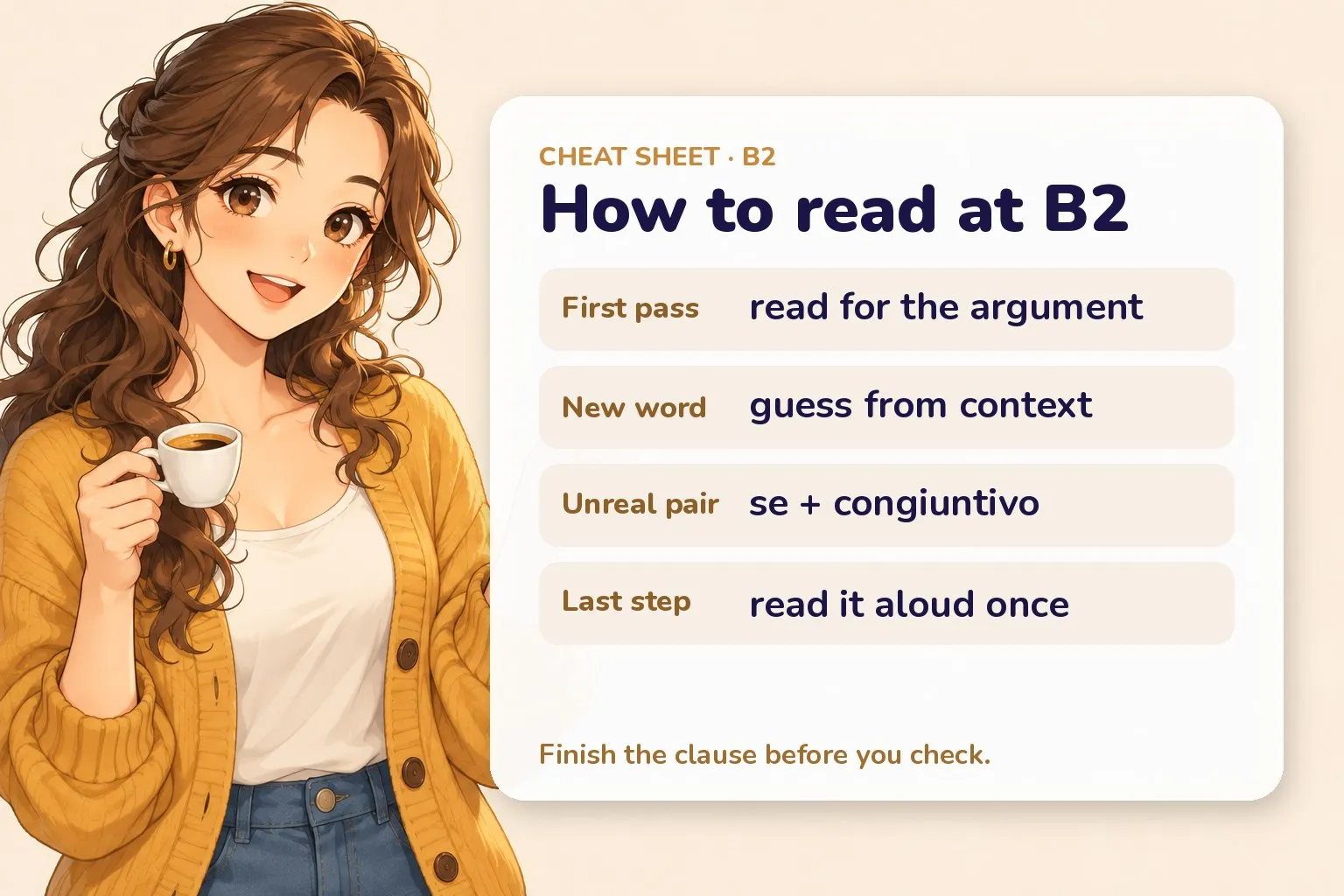
- Read once for the argument. What is the issue, and what does the writer think about it?
- Read again, slowly. Follow the signposts (da un lato … dall’altro lato, quindi, invece) to see how the argument is built.
- Check the word list under each text — only for words you could not guess.
- Read it aloud once, or play the audio sentences, so you hear the rhythm too.
- Answer the questions at the bottom without looking back, then check.
Reading 1: Il turismo di massa
Negli ultimi anni molte città italiane sono diventate mete turistiche sempre più affollate. Da un lato, il turismo porta lavoro e ricchezza: ristoranti, negozi e musei vivono grazie ai visitatori che arrivano da tutto il mondo. Dall’altro lato, però, gli abitanti dei centri storici si lamentano sempre più spesso.
Gli affitti brevi per i turisti, infatti, hanno fatto aumentare i prezzi delle case, e molte famiglie non possono più permettersi di vivere in centro. Alcuni sindaci hanno quindi deciso di limitare il numero di nuovi alloggi turistici, anche se non tutti sono d’accordo.
Secondo me, servirebbe un equilibrio. Se le città riuscissero a gestire meglio i flussi, il turismo resterebbe una risorsa invece di diventare un problema. Sarebbe utile, per esempio, promuovere anche i piccoli borghi, in modo che i visitatori non si concentrino soltanto nelle solite quattro o cinque città.
New words (Reading 1)
| Word | Meaning | Example from the text |
|---|---|---|
| affollato | crowded | …mete turistiche sempre più affollate. |
| lamentarsi | to complain | Gli abitanti si lamentano. |
| l’affitto breve | short-term rental | Gli affitti brevi per i turisti… |
| permettersi | to afford | …non possono più permettersi di vivere in centro. |
| il sindaco | mayor | Alcuni sindaci hanno deciso… |
| l’equilibrio | balance | Servirebbe un equilibrio. |
| il borgo | small village | …promuovere anche i piccoli borghi. |
Reading 2: Una mail sull’Erasmus
Cara Giulia,
ti scrivo per raccontarti come sta andando il mio Erasmus a Lisbona. All’inizio ero un po’ spaventata, perché non conoscevo nessuno e il mio portoghese era quasi inesistente. Adesso, dopo tre mesi, mi sembra di essere un’altra persona.
La cosa più difficile non è stata la lingua, ma imparare a gestire tutto da sola: l’affitto, la spesa, la burocrazia dell’università. Se avessi saputo quanto tempo serve per questi documenti, mi sarei organizzata prima. Comunque, ne è valsa la pena.
Ho conosciuto studenti da tutta Europa e ho imparato molto più di quanto immaginassi. Quando tornerò, mi mancheranno le serate con loro. Perché non vieni a trovarmi prima che finisca il semestre?
Un abbraccio, Sofia
New words (Reading 2)
| Word | Meaning | Example from the text |
|---|---|---|
| spaventato / spaventata | scared | All’inizio ero un po’ spaventata. |
| inesistente | non-existent | Il mio portoghese era quasi inesistente. |
| gestire | to manage, handle | …imparare a gestire tutto da sola. |
| la burocrazia | bureaucracy, paperwork | …la burocrazia dell’università. |
| valerne la pena | to be worth it | Ne è valsa la pena. |
| mancare (a qualcuno) | to be missed (by someone) | Mi mancheranno le serate. |
| il semestre | semester, term | …prima che finisca il semestre. |
How to say it
A few sounds still trip English speakers at B2:
- c / g before e or i are soft: centro ≈ “CHEN-tro”, gestire ≈ “jes-TEE-reh”.
- gli sounds like the “lli” in “million”: famiglia ≈ “fa-MEE-lya”, biglietto ≈ “bee-LYET-to”.
- sc before e/i is “sh”: conoscevo ≈ “ko-no-SHEH-vo”; before a/o/u it is “sk”: scuola ≈ “SKWOH-la”.
- Double consonants are held: affitto ≈ “af-FEET-to”, abbraccio ≈ “ab-BRAT-cho”.
Example sentences
Listen to key sentences from the texts, then read them aloud.
- Da un lato, il turismo porta lavoro e ricchezza.On one hand, tourism brings work and wealth.
- Dall'altro lato, gli abitanti si lamentano sempre più spesso.On the other hand, residents complain more and more often.
- Gli affitti brevi hanno fatto aumentare i prezzi delle case.Short-term rentals have driven up house prices.
- Molte famiglie non possono più permettersi di vivere in centro.Many families can no longer afford to live in the centre.
- Se le città riuscissero a gestire i flussi, il turismo resterebbe una risorsa.If cities managed the flows, tourism would stay a resource.congiuntivo + condizionale
- All'inizio ero un po' spaventata, perché non conoscevo nessuno.At first I was a bit scared, because I knew no one.
- Se avessi saputo quanto tempo serve, mi sarei organizzata prima.If I had known how long it takes, I would have organised myself sooner.unreal past
- Ho imparato molto più di quanto immaginassi.I learned far more than I imagined.congiuntivo imperfetto
- Perché non vieni a trovarmi prima che finisca il semestre?Why don't you come and visit me before the term ends?
Quick recap before you answer the questions.
Comprehension practice
Reading comprehension practice
Try each one, then press Check. No sign-up, nothing is sent anywhere — it all runs in your browser.
Hint: verb for 'to afford'
Show answer
permettersi — permettersi di = to afford to.
Hint: to handle / manage
Show answer
gestire — imparare a gestire tutto da sola — to manage everything on her own.
5 Match each connector to its meaning.
- da un lato
- invece
- quindi
- anche se
Show answer
- da un lato → on one hand
- invece → instead
- quindi → so / therefore
- anche se → even though
These connectors carry the logic of a B2 argument.
6 Build the hypothesis: 'If cities managed the flows, …'
Show answer
Se le città riuscissero a gestire i flussi il turismo resterebbe una risorsa — se + congiuntivo (riuscissero) with the condizionale (resterebbe).
Quiz
Upper-intermediate Italian reading quiz
8 questions · pick an answer and you'll see straight away if it's right.
-
Show answer
del turismo di massa — The first text is about mass tourism in Italian cities.
-
Show answer
porta lavoro e ricchezza — Tourism brings work and wealth to restaurants, shops and museums.
-
Show answer
limitare i nuovi alloggi turistici — Some mayors decided to limit the number of new tourist rentals.
-
Show answer
gestire tutto da sola — Not the language, but managing rent, shopping and bureaucracy alone.
-
Show answer
Non lo sapeva in tempo (pensiero sul passato) — The unreal past means she did not know in time.
-
Show answer
to afford — permettersi (di) = to afford to do something.
-
Show answer
leggere una volta per l'argomento — Read for the argument first; look up only blocking words.
-
Show answer
It was worth it — valerne la pena = to be worth it.
Next
- Build the grammar: Present Tense: -ire Verbs (and -isc-)
- Easier first: Italian Reading Practice: Intermediate (B1)
- New here? Start with Start Learning Italian Here
All Italian practice topics
Vocabulary, pronunciation, phrases, practice and exam help, ordered by level. Pick a topic and go straight to it. New lessons go live every day, so topics marked Coming soon fill in over the next weeks.
Practice
A1 1 topics · 1 ready
A2 4 topics · 2 ready
- 02 How to Practise Italian Listening
- 03 Italian Reading Practice: Elementary
- 04 Essere vs Avere Practice Set Coming soon
- 05 Italian Preposition+Article Practice Coming soon
B1 4 topics · 2 ready
- 06 Shadowing to Improve Italian Speaking
- 07 Italian Reading Practice: Intermediate
- 08 How to Practise Italian Writing Coming soon
- 09 Passato Prossimo vs Imperfetto Practice Coming soon
B2 3 topics · 1 ready
- 10 Italian Reading Practice: Upper-Intermediate You are here
- 11 Italian Subjunctive (Congiuntivo) Practice Coming soon
- 12 Italian Combined Pronouns Practice Coming soon