How to Practise Italian Listening
To practise Italian listening, pick audio at or just below your level and play the same short clip several times: first for the gist, then for detail, then with the transcript. Mix top-down guessing from context with bottom-up decoding of the actual sounds.
Level: A2. Listening is the skill most learners neglect and then panic about in a real conversation. The fix is not more hours of hard audio — it is the right audio, repeated the right way. This page gives you a routine you can run on any short Italian clip.
By the end of this page you can…
…choose listening material at your level, run a repeatable listening routine, handle the sounds that make Italian hard to catch, and find free audio to practise with.
What listening practice is
Listening practice is not background noise while you cook. It is active: you choose a short clip, set yourself a question, and listen with full attention to answer it. Two processes work together.
- Top-down listening uses what you already know — the topic, the situation, the words you expect — to predict and fill gaps. At a café you know a number is probably a price.
- Bottom-up listening decodes the actual sounds and words as they arrive, without guessing. This is what catches the detail top-down skips: the exact time, the negative non, the right name.
Good listeners switch between the two. Beginners lean too hard on one: all guessing (you miss non and reverse the meaning) or all decoding (you freeze on one unknown word and lose the sentence).
Graded listening: pick the right level
The material should be comprehensible: you follow most of it and stretch for the rest. Audio far above your level teaches you only that Italian is fast. Choose clips where you catch perhaps 70–90% unaided, then work on the gaps.
A listening routine, step by step
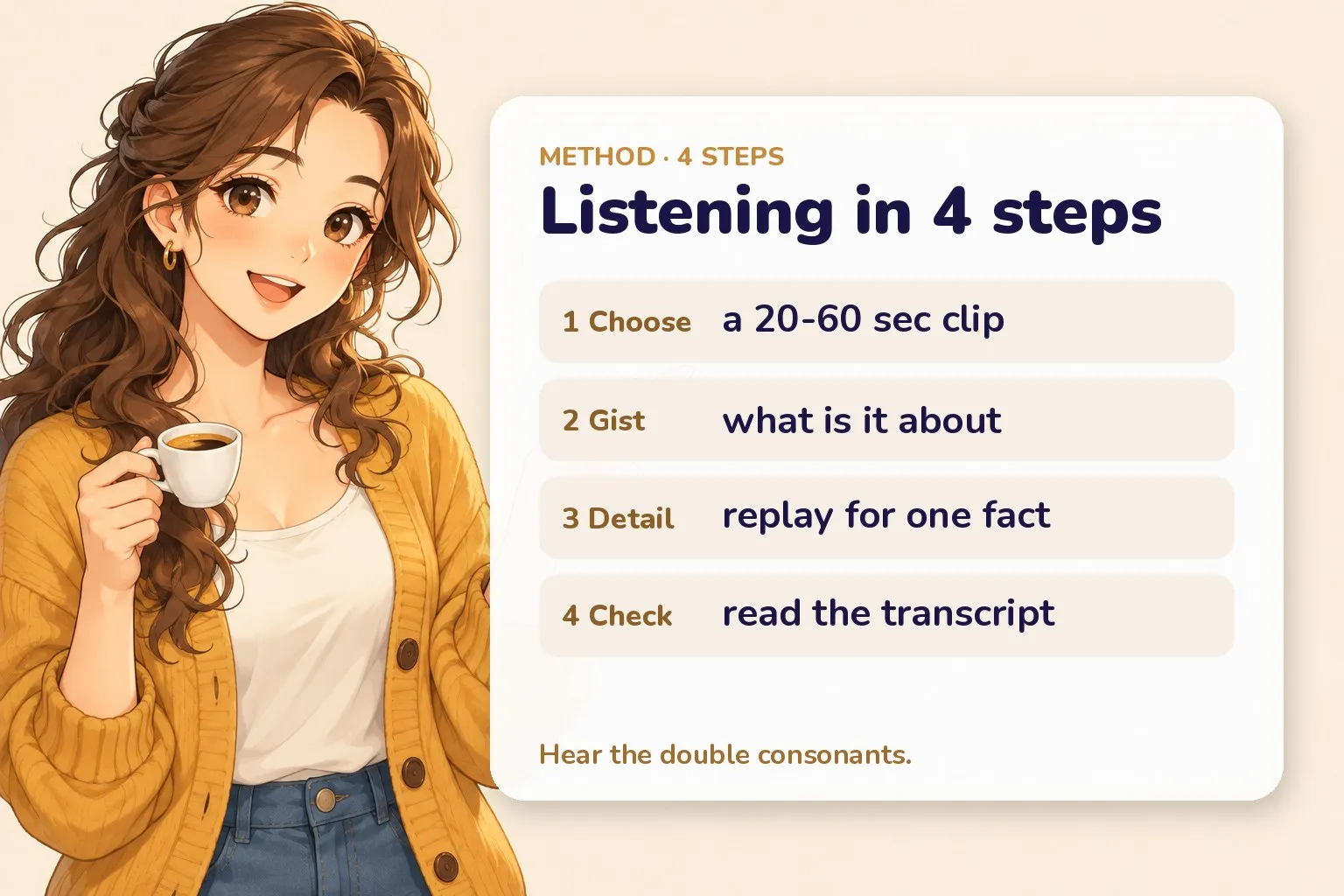
- Pick a short clip, 20–60 seconds. A news headline, a dialogue, or the audio on this site is plenty.
- Listen once for the gist. What is it about? Who is speaking? Do not read anything yet.
- Listen again for one detail. Set a question first: a number, a time, a name, a yes/no. Replay only the part you need.
- Do a mini-dictation. Play a sentence, pause, and write what you heard. Gaps show you exactly which sounds you are missing.
- Open the transcript. Compare it with what you wrote. Mark the words you heard wrong, not just the ones you did not know.
- Listen one last time while reading, then once more with the text hidden. The second hearing should feel noticeably clearer.
What makes Italian hard to hear
- Double consonants change the word. A held consonant is a different word: nonno (grandfather) vs nono (ninth), sette (seven) vs sete (thirst). Train your ear for the length.
- Vowel-final words run together. Italian words mostly end in a vowel and link straight into the next, so non è ancora sounds like one flow, not three words.
- Elisions drop a vowel. lo amico becomes l’amico, dove è becomes dov’è — a syllable disappears in speech.
- Stress is usually not written. Only final-stressed words carry an accent (città, perché); for the rest you learn where the stress falls by ear.
How to say it
Hearing these sounds clearly is what you are training; it helps to be able to produce them too:
- c and g before e/i. c becomes “ch” (ciao = “chow”, cena = “CHEH-na”); g becomes “j” (gelato = “jeh-LAH-to”).
- ch and gh. Always a hard “k” / “g”: che = “kay”, spaghetti = “spa-GHET-tee”.
- gli and gn. gli ≈ “lyee” (famiglia); gn ≈ “ny” (gnocchi, signore).
- Double consonants. Held clearly longer: pizza, bello, nonno — the extra length is part of the word.
Example sentences
Play each line, then replay it with your eyes off the text and write what you hear:
- Che ore sono?What time is it?listen for the time that follows
- Sono le nove e mezza.It is half past nine.time and the number
- Quanto costa?How much does it cost?
- Costa tre euro e cinquanta.It costs three euros fifty.price
- Non ho capito, può ripetere?I didn't understand, can you repeat?listen for non
- Dov'è la stazione?Where is the station?elision: dove è → dov'è
- Mio nonno ha ottant'anni.My grandfather is eighty.nonno, double n
- Vorrei un tavolo per due.I'd like a table for two.
- Il treno parte alle otto.The train leaves at eight.
- Può parlare più lentamente?Can you speak more slowly?
- Ci vediamo domani alle tre.See you tomorrow at three.listen for the day and time
- L'amico di Marco è arrivato.Marco's friend has arrived.elision: lo amico → l'amico
Quick recap before you practise.
Where to find audio
- Graded news: slowly read Italian news bulletins give you real content at a learner’s pace.
- Exam listening: CILS sample listening papers from the Università per Stranieri di Siena are mapped to CEFR levels, so you can match a clip to your own.
- This site’s audio: every example above plays through your browser’s built-in voice — use it for mini-dictation.
- High-frequency words first: the FrequencyWords lists tell you which words to expect most, so learning them makes any clip easier to decode.
Practice
Listening-strategy practice
Try each one, then press Check. No sign-up, nothing is sent anywhere — it all runs in your browser.
Hint: write exactly what you hear
Show answer
dictation — Dictation shows you precisely which sounds you are missing.
4 Put the listening routine in order.
Show answer
pick a short clip listen for the gist listen for one detail check the transcript — Choose, gist, detail, then confirm with the transcript.
5 Match each Italian listening trap to what it means.
- nonno vs nono
- dov'è
- vowel-final words
- città, perché
Show answer
- nonno vs nono → a double consonant changes the word
- dov'è → an elision drops a vowel
- vowel-final words → they run into the next word
- città, perché → final stress is marked with an accent
Each is a feature of spoken Italian that trips new listeners.
Quiz
Italian listening quiz
8 questions · pick an answer and you'll see straight away if it's right.
-
Show answer
audio you can mostly follow, with a little stretch — You learn most from audio you largely understand.
-
Show answer
using context and expectations to predict — Top-down uses what you already know to fill gaps.
-
Show answer
decoding the actual sounds and words — Bottom-up catches the exact detail that guessing skips.
-
Show answer
each pass you catch a little more — Repetition on one clip is where the gains come from.
-
Show answer
length changes the word: nonno vs nono — nonno (grandfather) and nono (ninth) differ only in the held consonant.
-
Show answer
an elision, where a vowel is dropped — dove è contracts to dov'è, dropping a vowel in speech.
-
Show answer
get the gist and note the gaps — Gist first; detail and exact words come on later passes.
-
Show answer
many clips on the same topic — Staying on one topic recycles the same vocabulary until it sticks.
Next
- Build the words you will hear in the Italian grammar section
- New here? Start with Start Learning Italian Here
All Italian practice topics
Vocabulary, pronunciation, phrases, practice and exam help, ordered by level. Pick a topic and go straight to it. New lessons go live every day, so topics marked Coming soon fill in over the next weeks.
Practice
A1 1 topics · 1 ready
A2 4 topics · 2 ready
- 02 How to Practise Italian Listening You are here
- 03 Italian Reading Practice: Elementary
- 04 Essere vs Avere Practice Set Coming soon
- 05 Italian Preposition+Article Practice Coming soon
B1 4 topics · 2 ready
- 06 Shadowing to Improve Italian Speaking
- 07 Italian Reading Practice: Intermediate
- 08 How to Practise Italian Writing Coming soon
- 09 Passato Prossimo vs Imperfetto Practice Coming soon
B2 3 topics · 1 ready
- 10 Italian Reading Practice: Upper-Intermediate
- 11 Italian Subjunctive (Congiuntivo) Practice Coming soon
- 12 Italian Combined Pronouns Practice Coming soon