Italian Adjective Agreement and Position
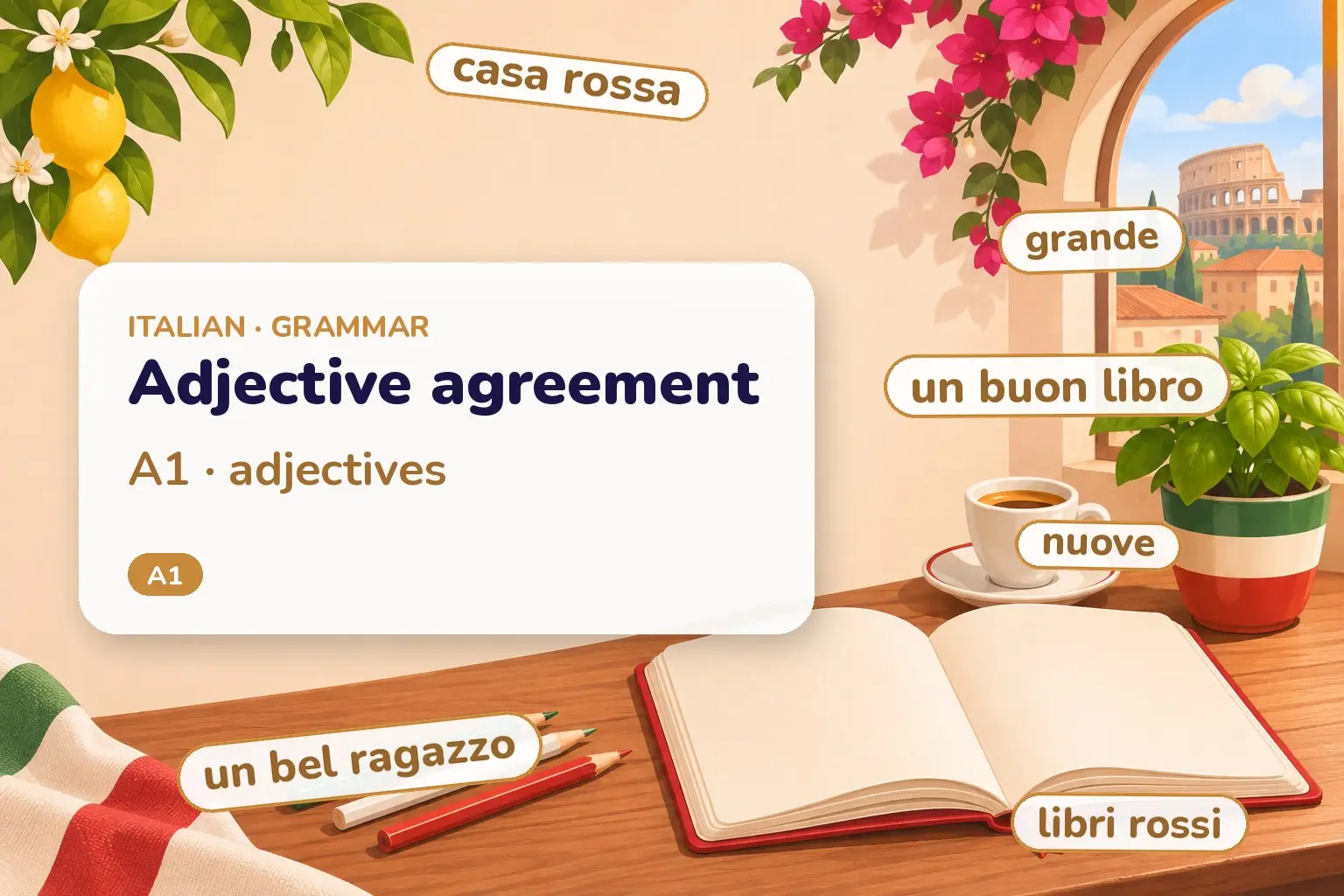
Italian adjectives agree in gender and number with their noun and usually follow it: una casa rossa, due case rosse. A small set (bello, buono, grande, nuovo) normally comes before the noun and can change its meaning.
Level: A1. In Italian an adjective must match its noun — in gender (masculine/feminine) and number (singular/plural) — and it usually comes after the noun. Learn the two ending patterns and a short list of adjectives that go in front.
The rule
An adjective describes a noun (red, big, new). To agree means the adjective changes its ending to match the noun’s gender and number. There are two classes.
Class 1 — adjectives ending in -o. These have four forms: masculine singular -o, feminine singular -a, masculine plural -i, feminine plural -e. So rosso (red) gives rosso / rossa / rossi / rosse.
Class 2 — adjectives ending in -e. These have only two forms: -e for both genders in the singular, -i for both genders in the plural. So grande (big) gives grande / grande / grandi / grandi. The singular looks the same for a man or a woman; only the plural changes.
Most adjectives follow the noun: una casa rossa (a red house), un libro interessante (an interesting book). But a small group of very common adjectives usually comes before the noun — bello, buono, bravo, grande, piccolo, nuovo, vecchio, giovane, brutto — and some of these can change the article-like shape or even the meaning.
The endings at a glance
| Class | masc. sing. | fem. sing. | masc. pl. | fem. pl. |
|---|---|---|---|---|
| -o type (rosso) | rosso | rossa | rossi | rosse |
| -e type (grande) | grande | grande | grandi | grandi |
And the two front-position shape-shifters, before the noun:
| Adjective | before the noun |
|---|---|
| bello | bel, bello, bella, bei, begli, belle |
| buono (sing.) | buon, buono, buona |
How to say it
A few Italian sounds decide how these endings are read:
- Double consonants are held longer: rosso (“ROHS-so”), bello (“BEHL-lo”) — don’t shorten them to a single sound.
- c / g before e or i are soft: c = “ch” (piacere), g = “j” (giovane = “JOH-vah-neh”); before a/o/u they are hard (grande = hard “g”).
- ch / gh keep the hard sound before e/i: bianche = “bee-AN-keh”.
- gli is a soft “lly” sound: begli ≈ “BEH-lyee”.
- every final vowel is pronounced: rosse is two syllables, “ROHS-seh”.
Example sentences
- Una casa rossa.A red house.feminine singular → rossa, after the noun
- Un libro rosso.A red book.masculine singular → rosso
- Due case rosse.Two red houses.feminine plural → rosse
- I libri rossi.The red books.masculine plural → rossi
- Una ragazza alta.A tall girl.
- Dei ragazzi alti.Some tall boys.
- Un libro interessante.An interesting book.-e type, same for m/f
- Una lezione interessante.An interesting lesson.-e type unchanged in the feminine
- Due libri interessanti.Two interesting books.-e type plural → -i
- Una grande città.A big / great city.grande can precede the noun
- Un bel ragazzo.A good-looking boy.bello → bel before the noun
- Una bella casa.A beautiful house.
- Dei begli amici.Some fine friends.bello → begli before a vowel/plural
- Un buon libro.A good book.buono → buon before a masculine noun
- Una buona idea.A good idea.
- Un uomo grande.A big man.after the noun: physical size
- Un grande uomo.A great man.before the noun: a change of meaning
- Le macchine nuove.The new cars.
Common mistakes
- ❌ una casa rosso → ✅ una casa rossa. Casa is feminine singular, so the -o adjective takes -a.
- ❌ due case rossi → ✅ due case rosse. Feminine plural of an -o adjective is -e, not -i.
- ❌ una lezione interessanta → ✅ una lezione interessante. An -e adjective does not switch to -a in the feminine; it stays -e.
- ❌ un bello ragazzo → ✅ un bel ragazzo. Before most masculine nouns bello shortens to bel.
- ❌ un buono libro → ✅ un buon libro. Before a masculine noun buono drops to buon.
- ❌ una rossa casa → ✅ una casa rossa. A colour adjective follows the noun; don’t put it in front like in English.
A short conversation
Al mercato (at the market): — Che bella borsa! È nuova? — Sì, è una borsa italiana, molto comoda. — E quelle scarpe rosse? — Sono vecchie, ma buone. Un buon affare!
Usage notes
- Position and meaning. Many adjectives mean something different before vs after the noun: un grande uomo (a great man) vs un uomo grande (a big man); un vecchio amico (a long-time friend) vs un amico vecchio (an elderly friend).
- bello and buono before the noun. bello follows the pattern of the definite article (bel like il, bello like lo, begli like gli). buono in the singular follows the indefinite article (buon like un, buono like uno, buona like una). After the noun they are regular: un ragazzo bello, un libro buono.
- Nouns ending in -e. Because an -e noun hides its gender, you must learn the gender to choose the adjective: il fiore is masculine (un fiore rosso), la neve is feminine (la neve bianca).
- molto as an adverb doesn’t agree. molto meaning “very” never changes: una casa molto grande, ragazze molto alte.
Compared with…
- Noun gender — the adjective can only agree once you know the noun’s gender, so start there: see Italian Noun Gender.
- Plural of nouns and adjectives — the same -i / -e / -a plural endings run through both: compare Plurals of Nouns and Adjectives.
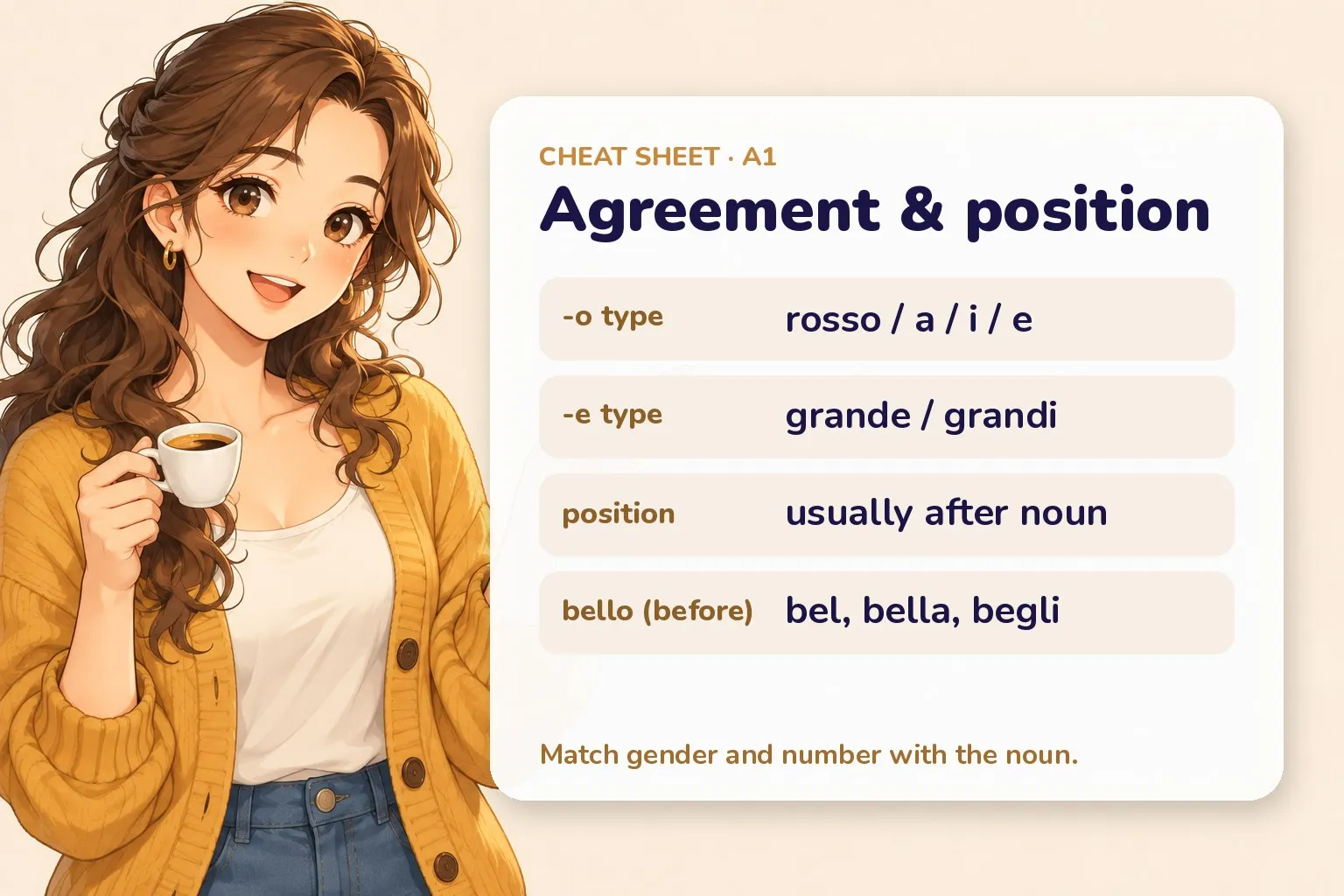
Quick recap before the quiz.
Practice
Adjective agreement practice
Try each one, then press Check. No sign-up, nothing is sent anywhere — it all runs in your browser.
Hint: -o type, feminine plural
Show answer
rosse — Feminine plural of rosso is rosse.
Hint: bello before a masculine noun
Show answer
bel — bello shortens to bel before most masculine nouns.
5 Order the words: 'a tall girl'.
Show answer
una ragazza alta — Descriptive adjectives follow the noun.
6 Match each noun to the right form of 'nuovo' (new).
- un libro
- una casa
- due libri
- due case
Show answer
- un libro → nuovo
- una casa → nuova
- due libri → nuovi
- due case → nuove
-o adjectives: -o/-a/-i/-e by gender and number.
Quiz
Italian adjective agreement
12 questions · pick an answer and you'll see straight away if it's right.
-
Show answer
rossa — Feminine singular → rossa.
-
Show answer
rosse — Feminine plural of an -o adjective → rosse.
-
Show answer
interessante — An -e adjective is the same for m/f singular: interessante.
-
Show answer
interessante — -e adjectives do not become -a in the feminine.
-
Show answer
interessanti — -e adjective plural → -i.
-
Show answer
un bel ragazzo — bello → bel before most masculine nouns.
-
Show answer
un buon libro — buono → buon before a masculine noun.
-
Show answer
un grande uomo — Before the noun grande means 'great'; after it, 'big'.
-
Show answer
after the noun — Descriptive adjectives like colours follow the noun: una casa rossa.
-
Show answer
two — Just two: -e (singular, both genders) and -i (plural).
-
Show answer
nuove — Feminine plural of nuovo is nuove.
-
Show answer
never changes — As an adverb, molto is invariable: ragazze molto alte.
Recap cheat-sheet
| Noun | -o adjective | -e adjective |
|---|---|---|
| masc. sing. | rosso | grande |
| fem. sing. | rossa | grande |
| masc. pl. | rossi | grandi |
| fem. pl. | rosse | grandi |
Next
- Back to the Italian grammar section
- New here? Start with Start Learning Italian Here
All Italian grammar topics
Every grammar point in order, from your first sentence to advanced structures. Pick one and go straight to it. New lessons go live every day, so topics marked Coming soon fill in over the next weeks.
Grammar path
A1 18 topics · 12 ready
- 01 Italian Definite Articles (il, la, i, le)
- 02 Italian Indefinite Articles (un, una)
- 03 Noun Gender and Number
- 04 The Verb Essere (to be)
- 05 The Verb Avere (to have)
- 06 Subject Pronouns (io, tu, lui, lei)
- 07 Present Tense: -are Verbs
- 08 Present Tense: -ere Verbs
- 09 Present Tense: -ire Verbs (and -isc-)
- 10 Plural of Nouns and Adjectives
- 11 Adjective Agreement and Position You are here
- 12 C'è and Ci sono (there is/are)
- 13 Question Words (chi, che, dove, quando) Coming soon
- 14 Numbers, Time and Dates Coming soon
- 15 Possessive Adjectives (il mio, la mia) Coming soon
- 16 Negation with non Coming soon
- 17 The Verb Piacere (to like) Coming soon
- 18 Quantity Adjectives/Adverbs (molto, troppo, poco) Coming soon
A2 23 topics
- 19 Passato Prossimo with Avere Coming soon
- 20 Passato Prossimo with Essere Coming soon
- 21 Irregular Past Participles Coming soon
- 22 Reflexive Verbs (alzarsi, lavarsi) Coming soon
- 23 Modal Verbs (potere, dovere, volere) Coming soon
- 24 Direct Object Pronouns (lo, la, li, le) Coming soon
- 25 Indirect Object Pronouns (gli, le) Coming soon
- 26 Simple Prepositions (di, a, da, in) Coming soon
- 27 Articulated Prepositions (del, nella, sul) Coming soon
- 28 The Imperfect Tense (Imperfetto) Coming soon
- 29 The Simple Future (Futuro Semplice) Coming soon
- 30 Comparatives (più, meno, come) Coming soon
- 31 Superlatives (il più, -issimo) Coming soon
- 32 The Imperative (tu, noi, voi) Coming soon
- 33 The Particles ci and ne Coming soon
- 34 Stare + Gerund (Present Progressive) Coming soon
- 35 C'è bisogno / Ci vuole (Need & Take Time) Coming soon
- 36 The Partitive (del, dei = some) Coming soon
- 37 Pre-Noun Forms: bello, buono, quello Coming soon
- 38 Stare per + Infinitive (About To) Coming soon
- 39 Forming Adverbs with -mente Coming soon
- 40 Time: da (since/for) and fa (ago) Coming soon
- 41 Double Negatives (non...niente, nessuno) Coming soon
B1 18 topics
- 42 Passato Prossimo vs Imperfetto Coming soon
- 43 Combined Pronouns (glielo, me lo) Coming soon
- 44 The Present Conditional (Condizionale) Coming soon
- 45 Impersonal and Passivante si Coming soon
- 46 Relative Pronouns (che, cui) Coming soon
- 47 The Future Perfect (Futuro Anteriore) Coming soon
- 48 The Past Perfect (Trapassato Prossimo) Coming soon
- 49 Formal Imperative (Lei) & with Pronouns Coming soon
- 50 The Gerund: Uses and Past Gerund Coming soon
- 51 The Past Conditional (Condizionale Passato) Coming soon
- 52 Pronoun Placement with Infinitive/Imperative Coming soon
- 53 Comparative & Superlative Irregulars Coming soon
- 54 Impersonal Verbs (bisogna, basta, sembra) Coming soon
- 55 Future of Probability (Suppositional) Coming soon
- 56 Altered Words (-ino, -one, -accio) Coming soon
- 57 Relative chi and quello che Coming soon
- 58 Ne with Quantities and Participle Agreement Coming soon
- 59 Adverb Position (già, ancora, più, mai) Coming soon
B2 14 topics
- 60 The Present Subjunctive (Congiuntivo) Coming soon
- 61 The Imperfect Subjunctive Coming soon
- 62 Perfect & Pluperfect Subjunctive Coming soon
- 63 The Three Hypothetical Periods (periodo ipotetico) Coming soon
- 64 Sequence of Tenses with the Subjunctive Coming soon
- 65 Passive Voice (essere / venire / andare) Coming soon
- 66 Conjunctions Requiring the Subjunctive Coming soon
- 67 Advanced Relatives (il quale, cui possessive) Coming soon
- 68 Reported Speech (Discorso Indiretto) Coming soon
- 69 The Remote Past (Passato Remoto) Coming soon
- 70 Causative Construction (fare + infinitive) Coming soon
- 71 Indefinite Adjectives & Pronouns Coming soon
- 72 Concession: anche se vs benché Coming soon
- 73 Gerund vs Infinitive as Subject/Complement Coming soon
C1 8 topics
- 74 Independent & Optative Subjunctive Coming soon
- 75 Advanced Sequence of Tenses Coming soon
- 76 Nominalisation & Formal Register Coming soon
- 77 Advanced Connectives & Cohesion Coming soon
- 78 Absolute Participle & Implicit Clauses Coming soon
- 79 Pronominal Verbs (farcela, andarsene) Coming soon
- 80 Dislocation & Emphasis Coming soon
- 81 Register, Style and Bureaucratic Italian Coming soon