Italian Subject Pronouns: io, tu, lui, lei (A1)
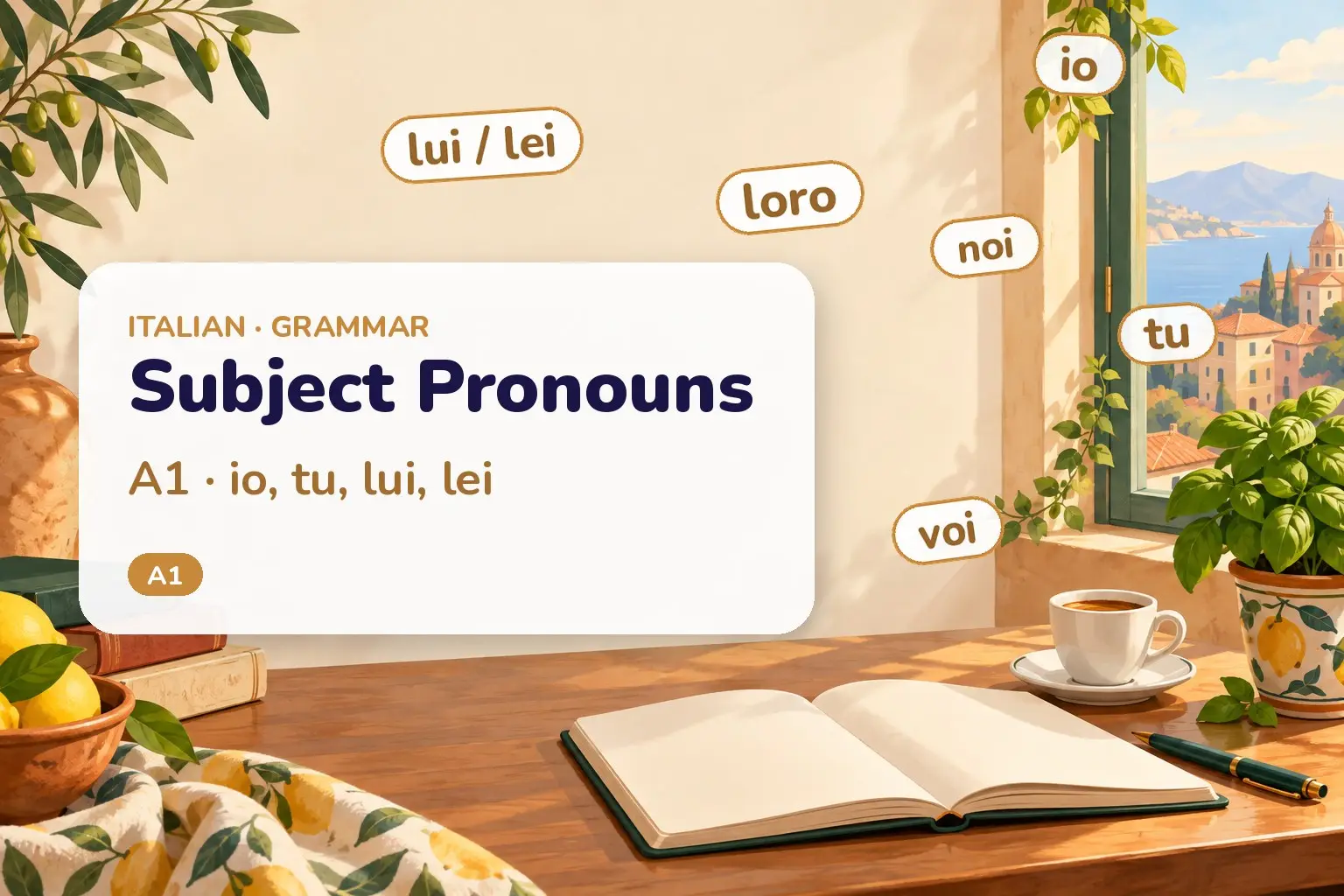
Italian subject pronouns are io (I), tu (you), lui (he), lei (she), noi (we), voi (you all) and loro (they), plus formal Lei. The verb ending already shows the subject, so Italian usually drops them: parlo means I speak.
Level: A1. Subject pronouns are the words for I, you, he, she, we, they when they do the action. Italian has them — but here is the twist most courses bury: Italian usually leaves them out, because the verb ending already says who you mean.
The rule
A subject pronoun names who does the verb. In Italian the verb ending changes for each person, so the pronoun is often redundant: parlo can only mean “I speak”, so you rarely add io. Italian is a pro-drop language — it drops the subject pronoun by default.
You bring the pronoun back for three reasons:
- Emphasis or contrast: Io pago, tu aspetti. (“I pay, you wait.”)
- Clarity when the verb form is shared: lui and lei both take è, so you add the pronoun if the person is not clear.
- After certain words like anche (also): Anche lui viene. (“He is coming too.”)
The politeness system matters too. Informal “you” is tu; formal “you” is Lei, written with a capital L and taking the same verb as lei (she) — Lei è gentile (“You are kind”, formal).
The pronoun forms
| Person | Pronoun | Meaning | essere (to be) |
|---|---|---|---|
| 1st singular | io | I | io sono |
| 2nd singular (informal) | tu | you | tu sei |
| 3rd singular | lui / lei | he / she | lui/lei è |
| formal “you” | Lei | you (polite) | Lei è |
| 1st plural | noi | we | noi siamo |
| 2nd plural | voi | you (all) | voi siete |
| 3rd plural | loro | they | loro sono |
How to say it
Italian is read as it is written, but these sounds need care:
- io ≈ “EE-oh”; lui ≈ “LOO-ee”; lei / Lei ≈ “lay”; loro ≈ “LO-ro”.
- c and g are soft before e/i: gentile ≈ “jen-TEE-leh”, voci ≈ “VO-chee”.
- Double consonants are held longer: sonno (sleep) vs sono (I am) — the double n is clearly longer.
- Stress usually falls on the second-to-last syllable: i-TA-lia-no, si-A-mo.
Example sentences
- Sono italiano.I am Italian.no io needed — ending -o shows I
- Io pago, tu aspetti.I pay, you wait.pronouns kept for contrast
- Tu sei molto gentile.You are very kind.tu = informal you
- Lui abita a Roma.He lives in Rome.
- Lei lavora in banca.She works at a bank.
- Lei è il signor Rossi?Are you Mr Rossi? (formal)capital Lei = formal you
- Noi studiamo italiano.We study Italian.
- Voi siete pronti?Are you (all) ready?
- Loro sono miei amici.They are my friends.
- Anche lui viene alla festa.He is coming to the party too.pronoun after anche
- Parlo un po' di italiano.I speak a little Italian.subject dropped
- Dove abiti?Where do you live?tu dropped, ending -i shows you
- Siamo in ritardo.We are late.
- Piove oggi.It is raining today.no word for it
- Io sono Anna, e tu?I am Anna, and you?pronouns for introductions/contrast
- Lei capisce l'inglese?Do you understand English? (formal)
- Loro arrivano domani.They arrive tomorrow.
- Voi venite con noi?Are you (all) coming with us?
Common mistakes
- ❌ Io sono italiano in every sentence → ✅ Sono italiano. Drop io unless you are emphasising it.
- ❌ lei è gentile to a stranger → ✅ Lei è gentile with a capital L for the formal “you”.
- ❌ using tu with someone you just met formally → ✅ start with Lei until invited to switch to tu (darsi del tu).
- ❌ Esso piove / Lui piove for “it rains” → ✅ Piove. Weather and “it” verbs take no subject.
- ❌ egli / ella in everyday speech → ✅ lui / lei. The older forms are literary.
A short conversation
A una riunione: — Buongiorno, Lei è la signora Bruni? — Sì, sono io. E Lei? — Io sono Marco. Noi lavoriamo insieme da oggi. — Bene! Loro arrivano più tardi?
Usage notes
- The verb ending is the real subject. Learn each ending with its person: parlo, parli, parla, parliamo, parlate, parlano. The pronoun just adds stress.
- voi is the normal plural “you”. Standard Italian uses voi for a group, informal or formal. Very formal Loro for “you all” is rare today.
- lui/lei for people, not objects. For “it” as a thing, Italian normally drops the subject or recasts the sentence; it does not use lui/lei for ordinary objects.
- Introductions keep the pronoun. Io sono… and e tu? are natural in introductions because you are contrasting speakers.
Compared with the verb endings
Because every verb ending is different, Italian can tell parlo (I speak) from parli (you speak) from parla (he/she speaks) with no pronoun at all. That is exactly why the pronoun is optional. If the endings feel shaky, study them first: essere (to be) in the present and avere (to have) in the present. Once the endings are solid, you will drop the pronouns naturally.
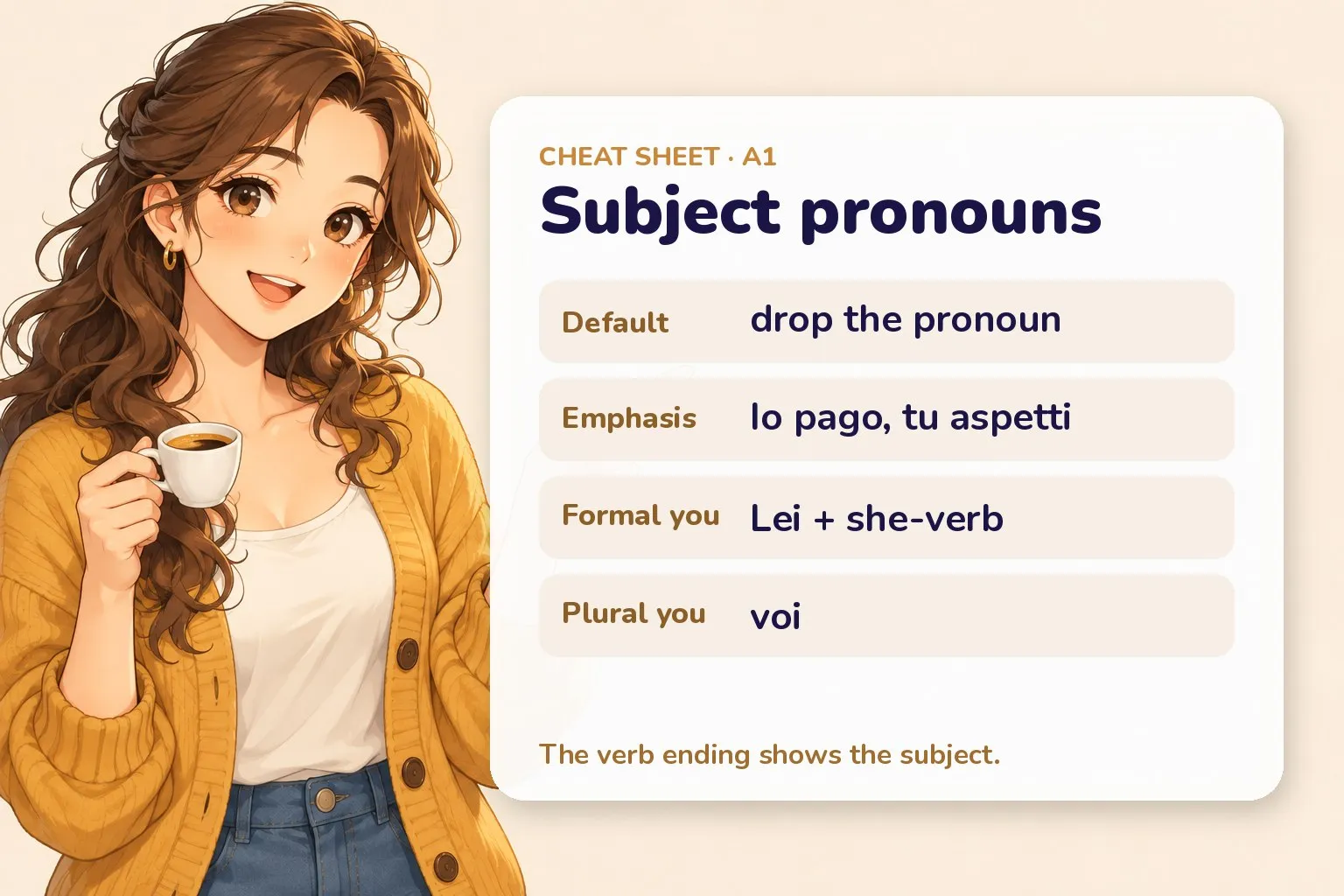
Quick recap before the quiz.
Practice
Subject pronouns practice
Try each one, then press Check. No sign-up, nothing is sent anywhere — it all runs in your browser.
Hint: capital L, formal you
Show answer
Lei — Formal you is Lei, capitalised, with the she-verb è.
3 Order the words: 'We study Italian.'
Show answer
Noi studiamo italiano — Noi (we) + studiamo + italiano; here noi adds emphasis.
4 Match each pronoun to its meaning.
- io
- voi
- lui
- loro
Show answer
- io → I
- voi → you (all)
- lui → he
- loro → they
io = I, voi = you all, lui = he, loro = they.
Quiz
Italian subject pronouns quiz
12 questions · pick an answer and you'll see straight away if it's right.
-
Show answer
io — io = I.
-
Show answer
the verb ending already shows the subject — Italian is pro-drop: the ending tells you the person.
-
Show answer
Lei — Formal singular you is Lei, with a capital L.
-
Show answer
è — Lei uses the she-form è: Lei è gentile.
-
Show answer
voi — voi is the standard plural you, informal or formal.
-
Show answer
Io pago, tu aspetti. — Pronouns are kept to contrast the two subjects.
-
Show answer
Piove. — Weather verbs take no subject: Piove.
-
Show answer
Lei — Use formal Lei until invited to switch to tu.
-
Show answer
they — loro = they (and very formally 'you all').
-
Show answer
Abito a Roma. — Drop io; the ending -o shows I.
-
Show answer
Voi — voi = you all, with the verb siete.
-
Show answer
literary, older forms of lui/lei — egli/ella are literary; use lui/lei in speech.
Recap cheat-sheet
| Pronoun | Meaning | Note |
|---|---|---|
| io / tu | I / you (informal) | usually dropped |
| lui / lei | he / she | kept for clarity |
| Lei | you (formal) | capital L, she-verb |
| noi / voi / loro | we / you all / they | voi = normal plural you |
Next
- Back to the Italian grammar section
- New here? Start with Start Learning Italian Here
All Italian grammar topics
Every grammar point in order, from your first sentence to advanced structures. Pick one and go straight to it. New lessons go live every day, so topics marked Coming soon fill in over the next weeks.
Grammar path
A1 18 topics · 12 ready
- 01 Italian Definite Articles (il, la, i, le)
- 02 Italian Indefinite Articles (un, una)
- 03 Noun Gender and Number
- 04 The Verb Essere (to be)
- 05 The Verb Avere (to have)
- 06 Subject Pronouns (io, tu, lui, lei) You are here
- 07 Present Tense: -are Verbs
- 08 Present Tense: -ere Verbs
- 09 Present Tense: -ire Verbs (and -isc-)
- 10 Plural of Nouns and Adjectives
- 11 Adjective Agreement and Position
- 12 C'è and Ci sono (there is/are)
- 13 Question Words (chi, che, dove, quando) Coming soon
- 14 Numbers, Time and Dates Coming soon
- 15 Possessive Adjectives (il mio, la mia) Coming soon
- 16 Negation with non Coming soon
- 17 The Verb Piacere (to like) Coming soon
- 18 Quantity Adjectives/Adverbs (molto, troppo, poco) Coming soon
A2 23 topics
- 19 Passato Prossimo with Avere Coming soon
- 20 Passato Prossimo with Essere Coming soon
- 21 Irregular Past Participles Coming soon
- 22 Reflexive Verbs (alzarsi, lavarsi) Coming soon
- 23 Modal Verbs (potere, dovere, volere) Coming soon
- 24 Direct Object Pronouns (lo, la, li, le) Coming soon
- 25 Indirect Object Pronouns (gli, le) Coming soon
- 26 Simple Prepositions (di, a, da, in) Coming soon
- 27 Articulated Prepositions (del, nella, sul) Coming soon
- 28 The Imperfect Tense (Imperfetto) Coming soon
- 29 The Simple Future (Futuro Semplice) Coming soon
- 30 Comparatives (più, meno, come) Coming soon
- 31 Superlatives (il più, -issimo) Coming soon
- 32 The Imperative (tu, noi, voi) Coming soon
- 33 The Particles ci and ne Coming soon
- 34 Stare + Gerund (Present Progressive) Coming soon
- 35 C'è bisogno / Ci vuole (Need & Take Time) Coming soon
- 36 The Partitive (del, dei = some) Coming soon
- 37 Pre-Noun Forms: bello, buono, quello Coming soon
- 38 Stare per + Infinitive (About To) Coming soon
- 39 Forming Adverbs with -mente Coming soon
- 40 Time: da (since/for) and fa (ago) Coming soon
- 41 Double Negatives (non...niente, nessuno) Coming soon
B1 18 topics
- 42 Passato Prossimo vs Imperfetto Coming soon
- 43 Combined Pronouns (glielo, me lo) Coming soon
- 44 The Present Conditional (Condizionale) Coming soon
- 45 Impersonal and Passivante si Coming soon
- 46 Relative Pronouns (che, cui) Coming soon
- 47 The Future Perfect (Futuro Anteriore) Coming soon
- 48 The Past Perfect (Trapassato Prossimo) Coming soon
- 49 Formal Imperative (Lei) & with Pronouns Coming soon
- 50 The Gerund: Uses and Past Gerund Coming soon
- 51 The Past Conditional (Condizionale Passato) Coming soon
- 52 Pronoun Placement with Infinitive/Imperative Coming soon
- 53 Comparative & Superlative Irregulars Coming soon
- 54 Impersonal Verbs (bisogna, basta, sembra) Coming soon
- 55 Future of Probability (Suppositional) Coming soon
- 56 Altered Words (-ino, -one, -accio) Coming soon
- 57 Relative chi and quello che Coming soon
- 58 Ne with Quantities and Participle Agreement Coming soon
- 59 Adverb Position (già, ancora, più, mai) Coming soon
B2 14 topics
- 60 The Present Subjunctive (Congiuntivo) Coming soon
- 61 The Imperfect Subjunctive Coming soon
- 62 Perfect & Pluperfect Subjunctive Coming soon
- 63 The Three Hypothetical Periods (periodo ipotetico) Coming soon
- 64 Sequence of Tenses with the Subjunctive Coming soon
- 65 Passive Voice (essere / venire / andare) Coming soon
- 66 Conjunctions Requiring the Subjunctive Coming soon
- 67 Advanced Relatives (il quale, cui possessive) Coming soon
- 68 Reported Speech (Discorso Indiretto) Coming soon
- 69 The Remote Past (Passato Remoto) Coming soon
- 70 Causative Construction (fare + infinitive) Coming soon
- 71 Indefinite Adjectives & Pronouns Coming soon
- 72 Concession: anche se vs benché Coming soon
- 73 Gerund vs Infinitive as Subject/Complement Coming soon
C1 8 topics
- 74 Independent & Optative Subjunctive Coming soon
- 75 Advanced Sequence of Tenses Coming soon
- 76 Nominalisation & Formal Register Coming soon
- 77 Advanced Connectives & Cohesion Coming soon
- 78 Absolute Participle & Implicit Clauses Coming soon
- 79 Pronominal Verbs (farcela, andarsene) Coming soon
- 80 Dislocation & Emphasis Coming soon
- 81 Register, Style and Bureaucratic Italian Coming soon