C'è and Ci sono: there is and there are in Italian
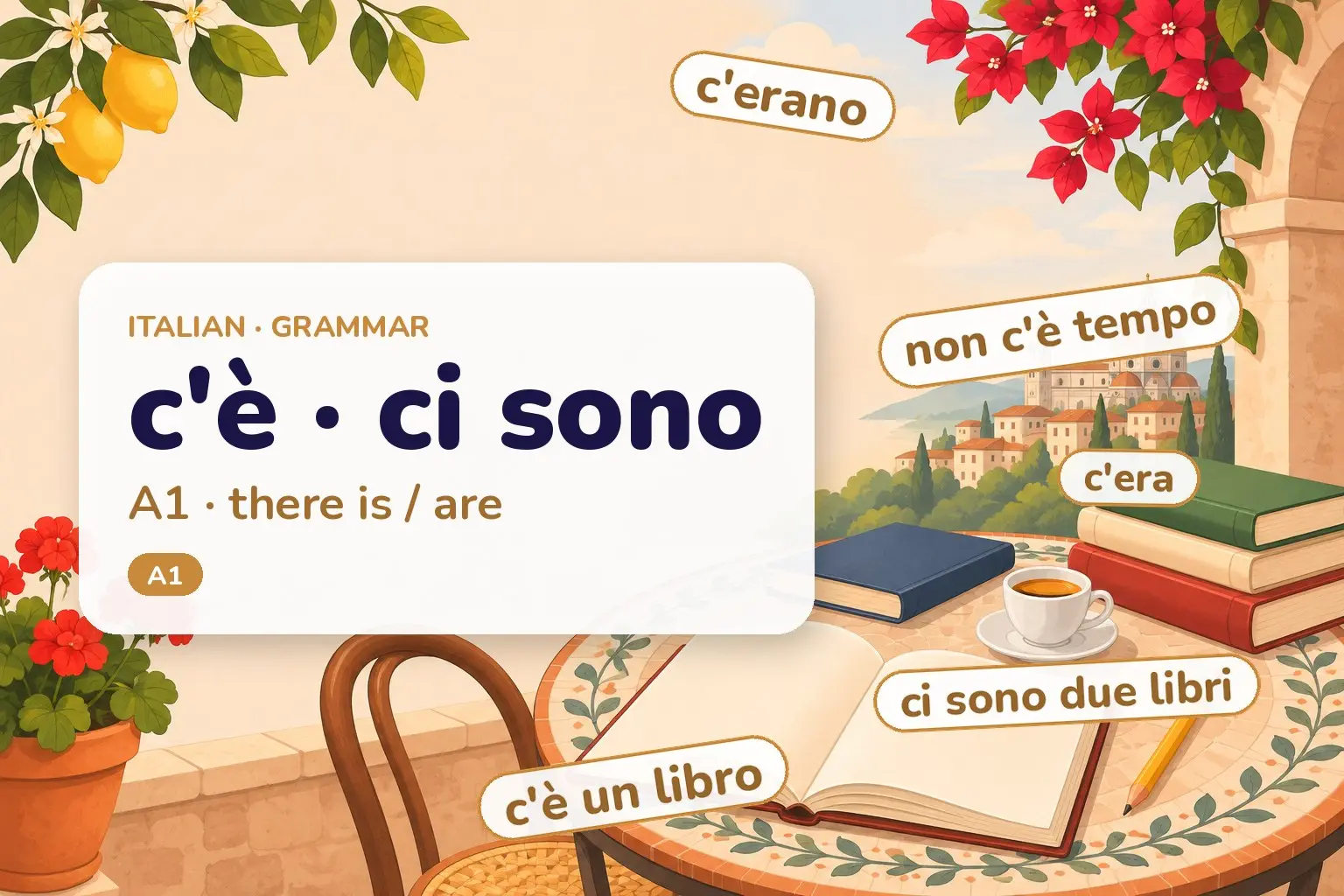
Use c'è for there is (one thing) and ci sono for there are (more than one). C'è un libro means there is a book; ci sono due libri means there are two books. Both come from the verb essere.
Level: A1. To say something exists or is present — there is a book, there are two chairs — Italian uses two short set phrases: c’è and ci sono. Which one you pick depends only on how many things there are.
The rule
Both phrases are built from ci (here/there) plus the verb essere (to be):
- c’è = ci + è (“there is”) — for one thing or an uncountable idea.
- ci sono = ci + sono (“there are”) — for two or more things.
The apostrophe in c’è simply shows that ci has dropped its i before the vowel è. The accent on è matters: è (with accent) is the verb “is”; e (no accent) means “and”.
You choose based on the noun that follows, not on the English wording. English often says “there’s” even for plurals in speech (“there’s two left”), but Italian always switches to ci sono for more than one.
The forms at a glance
| Use | Affirmative | Negative | Question |
|---|---|---|---|
| one thing (there is) | c’è | non c’è | C’è…? |
| more than one (there are) | ci sono | non ci sono | Ci sono…? |
| past: one thing (there was) | c’era | non c’era | C’era…? |
| past: several (there were) | c’erano | non c’erano | C’erano…? |
Example sentences
- C'è un libro sul tavolo.There is a book on the table.one book → c'è
- Ci sono due libri sul tavolo.There are two books on the table.two books → ci sono
- C'è un problema.There is a problem.
- Ci sono molti turisti.There are many tourists.
- C'è una farmacia qui vicino?Is there a pharmacy near here?question
- Ci sono bagni al primo piano?Are there toilets on the first floor?
- Non c'è tempo.There is no time.negative with non
- Non ci sono problemi.There are no problems.
- C'è molta gente oggi.There are a lot of people today.gente is singular in Italian → c'è
- In frigo c'è del latte.There is some milk in the fridge.uncountable → c'è
- Ci sono tre camere nell'appartamento.There are three bedrooms in the flat.
- C'è posto per me?Is there room for me?
- Quante persone ci sono?How many people are there?
- C'era un gatto in giardino.There was a cat in the garden.past singular → c'era
- C'erano molte macchine.There were many cars.past plural → c'erano
- Scusi, c'è il wifi?Excuse me, is there wifi?
- Non c'è nessuno.There is no one.
- Ci sono novità?Is there any news?novità is plural in form → ci sono
- Nel menù c'è il pesce?Is there fish on the menu?
- Ci sono sconti oggi?Are there discounts today?
Common mistakes
- ❌ C’è due libri → ✅ Ci sono due libri. Two or more things need ci sono.
- ❌ Ci sono un problema → ✅ C’è un problema. One thing needs c’è.
- ❌ Ce un libro → ✅ C’è un libro. Keep the apostrophe and the accent: c’è.
- ❌ Non c’è non problemi → ✅ Non ci sono problemi. One non is enough, and plural takes ci sono.
- ❌ C’è molta gente → ci sono (thinking “people” is plural) → ✅ C’è molta gente. Gente is grammatically singular in Italian.
A short conversation
In albergo: — Buongiorno, c’è una camera libera? — Sì, ci sono due camere al secondo piano. — Perfetto. C’è il wifi? — Certo, e non c’è nessun supplemento.
Usage notes
- c’è with uncountables: water, time, bread and similar take c’è because they are treated as one mass: c’è acqua, c’è pane.
- Tricky nouns: gente (people) is singular → c’è; novità (news) is plural in form → ci sono. Learn these with the right phrase.
- Not the same as “it is”: c’è states that something exists or is present; to describe what something is (it is big), use plain essere: è grande.
A worked example
Imagine you walk into a café and want to describe what you see. One counter, so c’è un bancone. Three free tables, so ci sono tre tavoli liberi. No menu in English, so non c’è un menù in inglese. Notice how every phrase is decided purely by counting the Italian noun: singular or mass nouns pull c’è, while anything you could count past one pulls ci sono. Say the whole scene aloud and the switch becomes automatic.
Compared with…
- essere (to be) — c’è and ci sono are made from è and sono, two forms of essere. For the full present tense and how to say what something is, see the verb essere in the present.
- Articles — the noun after c’è/ci sono usually carries an article; review definite articles and indefinite articles to get il/la and un/una right.
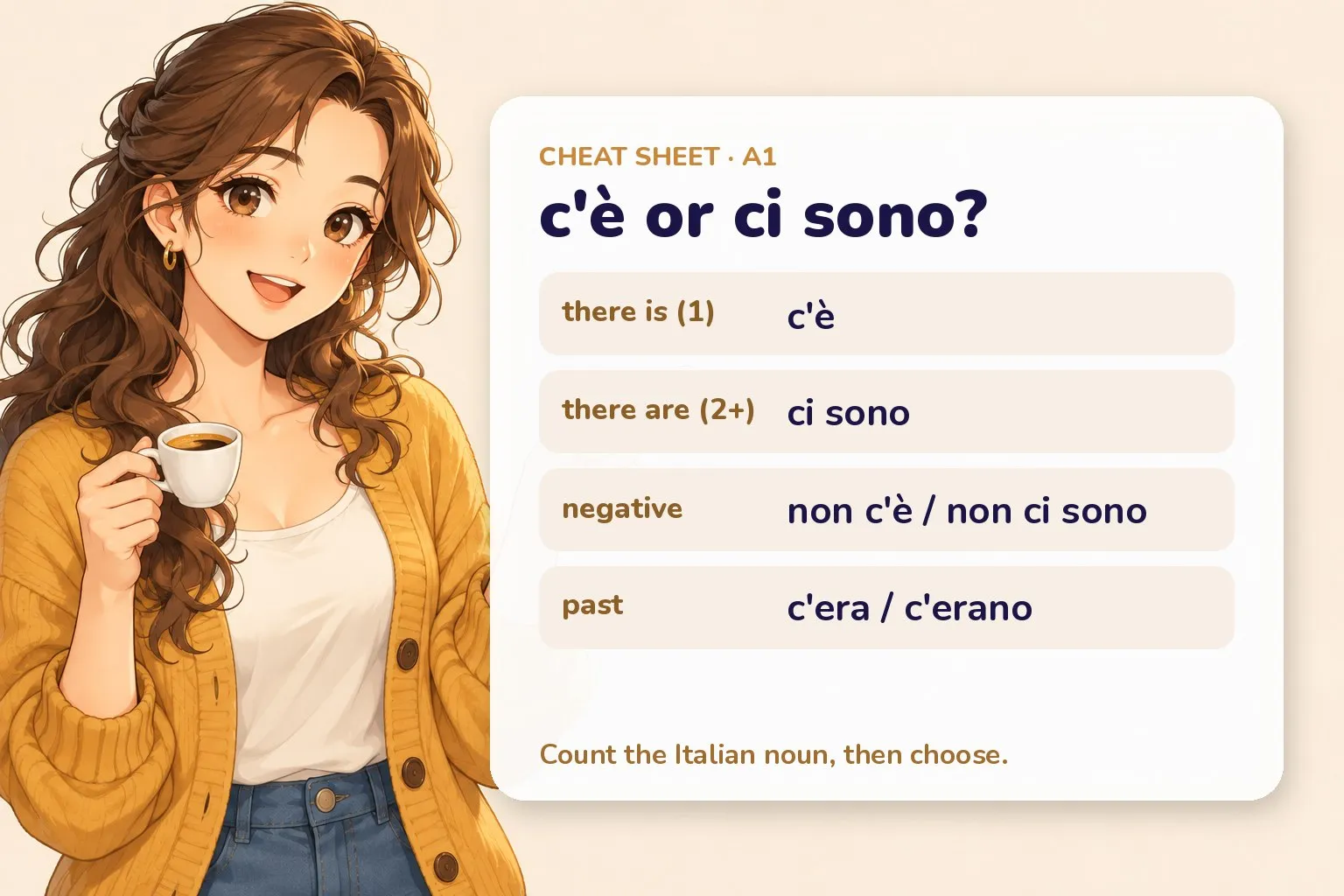
Quick recap before the quiz.
Practice
c'è / ci sono practice
Try each one, then press Check. No sign-up, nothing is sent anywhere — it all runs in your browser.
Show answer
C'è — One bar → c'è; it works as a question too.
Show answer
non c'è — Put non in front of c'è.
4 Order the words: 'There are many tourists.'
Show answer
Ci sono molti turisti — Plural → ci sono + noun.
5 Match each phrase to its use.
- c'è
- ci sono
- c'era
- c'erano
Show answer
- c'è → one thing, present
- ci sono → several, present
- c'era → one thing, past
- c'erano → several, past
Number and tense decide the form.
Quiz
Italian c'è and ci sono
11 questions · pick an answer and you'll see straight away if it's right.
-
Show answer
C'è — One book → c'è.
-
Show answer
Ci sono — Two books → ci sono.
-
Show answer
è — c'è = ci + è (the verb 'is').
-
Show answer
non c'è — Put non in front: non c'è.
-
Show answer
Ci sono — Plural noun → Ci sono.
-
Show answer
C'è molta gente oggi — gente is singular in Italian → c'è.
-
Show answer
the verb 'is' — è (accented) = 'is'; e (no accent) = 'and'.
-
Show answer
c'era — Past, one thing → c'era.
-
Show answer
c'erano — Past, plural → c'erano.
-
Show answer
C'è — One thing (posto) → c'è.
-
Show answer
the Italian noun's number — The number of the following Italian noun decides it.
Recap cheat-sheet
| Meaning | Present | Negative |
|---|---|---|
| there is (1) | c’è | non c’è |
| there are (2+) | ci sono | non ci sono |
| there was (1) | c’era | non c’era |
| there were (2+) | c’erano | non c’erano |
Next
- Previous topic: adjective agreement and position
- Back to the Italian grammar section
- New here? Start with Start Learning Italian Here
All Italian grammar topics
Every grammar point in order, from your first sentence to advanced structures. Pick one and go straight to it. New lessons go live every day, so topics marked Coming soon fill in over the next weeks.
Grammar path
A1 18 topics · 12 ready
- 01 Italian Definite Articles (il, la, i, le)
- 02 Italian Indefinite Articles (un, una)
- 03 Noun Gender and Number
- 04 The Verb Essere (to be)
- 05 The Verb Avere (to have)
- 06 Subject Pronouns (io, tu, lui, lei)
- 07 Present Tense: -are Verbs
- 08 Present Tense: -ere Verbs
- 09 Present Tense: -ire Verbs (and -isc-)
- 10 Plural of Nouns and Adjectives
- 11 Adjective Agreement and Position
- 12 C'è and Ci sono (there is/are) You are here
- 13 Question Words (chi, che, dove, quando) Coming soon
- 14 Numbers, Time and Dates Coming soon
- 15 Possessive Adjectives (il mio, la mia) Coming soon
- 16 Negation with non Coming soon
- 17 The Verb Piacere (to like) Coming soon
- 18 Quantity Adjectives/Adverbs (molto, troppo, poco) Coming soon
A2 23 topics
- 19 Passato Prossimo with Avere Coming soon
- 20 Passato Prossimo with Essere Coming soon
- 21 Irregular Past Participles Coming soon
- 22 Reflexive Verbs (alzarsi, lavarsi) Coming soon
- 23 Modal Verbs (potere, dovere, volere) Coming soon
- 24 Direct Object Pronouns (lo, la, li, le) Coming soon
- 25 Indirect Object Pronouns (gli, le) Coming soon
- 26 Simple Prepositions (di, a, da, in) Coming soon
- 27 Articulated Prepositions (del, nella, sul) Coming soon
- 28 The Imperfect Tense (Imperfetto) Coming soon
- 29 The Simple Future (Futuro Semplice) Coming soon
- 30 Comparatives (più, meno, come) Coming soon
- 31 Superlatives (il più, -issimo) Coming soon
- 32 The Imperative (tu, noi, voi) Coming soon
- 33 The Particles ci and ne Coming soon
- 34 Stare + Gerund (Present Progressive) Coming soon
- 35 C'è bisogno / Ci vuole (Need & Take Time) Coming soon
- 36 The Partitive (del, dei = some) Coming soon
- 37 Pre-Noun Forms: bello, buono, quello Coming soon
- 38 Stare per + Infinitive (About To) Coming soon
- 39 Forming Adverbs with -mente Coming soon
- 40 Time: da (since/for) and fa (ago) Coming soon
- 41 Double Negatives (non...niente, nessuno) Coming soon
B1 18 topics
- 42 Passato Prossimo vs Imperfetto Coming soon
- 43 Combined Pronouns (glielo, me lo) Coming soon
- 44 The Present Conditional (Condizionale) Coming soon
- 45 Impersonal and Passivante si Coming soon
- 46 Relative Pronouns (che, cui) Coming soon
- 47 The Future Perfect (Futuro Anteriore) Coming soon
- 48 The Past Perfect (Trapassato Prossimo) Coming soon
- 49 Formal Imperative (Lei) & with Pronouns Coming soon
- 50 The Gerund: Uses and Past Gerund Coming soon
- 51 The Past Conditional (Condizionale Passato) Coming soon
- 52 Pronoun Placement with Infinitive/Imperative Coming soon
- 53 Comparative & Superlative Irregulars Coming soon
- 54 Impersonal Verbs (bisogna, basta, sembra) Coming soon
- 55 Future of Probability (Suppositional) Coming soon
- 56 Altered Words (-ino, -one, -accio) Coming soon
- 57 Relative chi and quello che Coming soon
- 58 Ne with Quantities and Participle Agreement Coming soon
- 59 Adverb Position (già, ancora, più, mai) Coming soon
B2 14 topics
- 60 The Present Subjunctive (Congiuntivo) Coming soon
- 61 The Imperfect Subjunctive Coming soon
- 62 Perfect & Pluperfect Subjunctive Coming soon
- 63 The Three Hypothetical Periods (periodo ipotetico) Coming soon
- 64 Sequence of Tenses with the Subjunctive Coming soon
- 65 Passive Voice (essere / venire / andare) Coming soon
- 66 Conjunctions Requiring the Subjunctive Coming soon
- 67 Advanced Relatives (il quale, cui possessive) Coming soon
- 68 Reported Speech (Discorso Indiretto) Coming soon
- 69 The Remote Past (Passato Remoto) Coming soon
- 70 Causative Construction (fare + infinitive) Coming soon
- 71 Indefinite Adjectives & Pronouns Coming soon
- 72 Concession: anche se vs benché Coming soon
- 73 Gerund vs Infinitive as Subject/Complement Coming soon
C1 8 topics
- 74 Independent & Optative Subjunctive Coming soon
- 75 Advanced Sequence of Tenses Coming soon
- 76 Nominalisation & Formal Register Coming soon
- 77 Advanced Connectives & Cohesion Coming soon
- 78 Absolute Participle & Implicit Clauses Coming soon
- 79 Pronominal Verbs (farcela, andarsene) Coming soon
- 80 Dislocation & Emphasis Coming soon
- 81 Register, Style and Bureaucratic Italian Coming soon