The Verb Avere (to have)
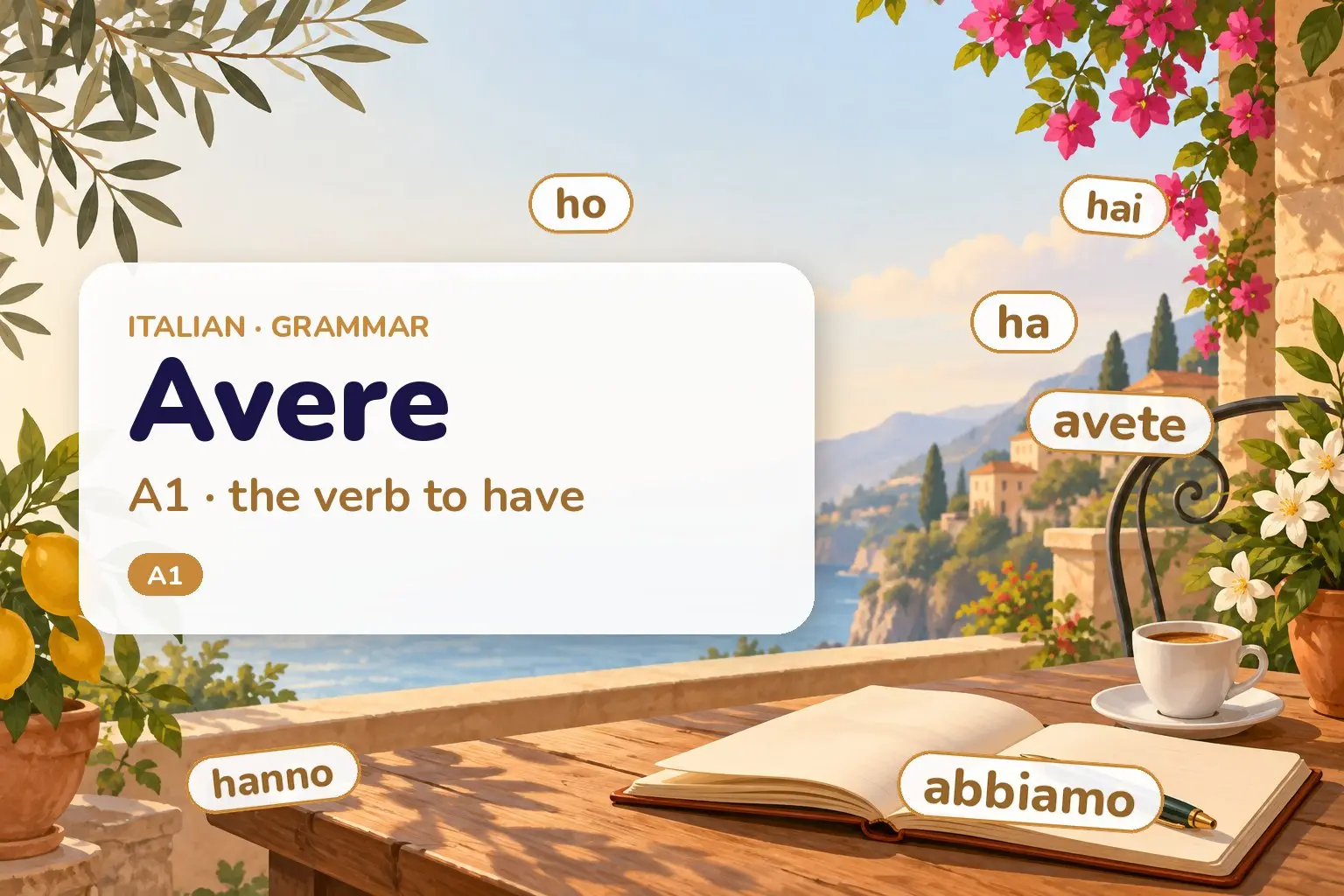
Avere means to have and is irregular: io ho, tu hai, lui/lei ha, noi abbiamo, voi avete, loro hanno. The silent h keeps ho, ha and hanno apart from o, a and anno. Use avere for possession, age (ho vent'anni) and feelings (ho fame).
Level: A1. Avere means to have, and you will use it constantly — for what you own, how old you are and how you feel. It is irregular, so there is no ending rule to apply; you memorise its six present-tense forms, and you learn one small spelling habit: the silent h.
The rule
A verb is a word for an action or a state. Avere is the verb for having. The forms it takes for each subject are its conjugation, and because avere is irregular, those forms do not come from the regular stem-plus-ending pattern — you learn them:
- io ho — I have
- tu hai — you have (one person, informal)
- lui / lei ha — he / she has
- noi abbiamo — we have
- voi avete — you have (plural)
- loro hanno — they have
Four of these forms begin with a silent h: ho, hai, ha, hanno. You never pronounce it. Its only job is to keep these verb forms apart in writing from words that sound identical: o (or), ai (to the), a (to / at) and anno (year).
Italian normally drops the subject pronoun, because the verb ending already shows who is meant. Ho una macchina is a full sentence — “I have a car” — with no io needed. Add the pronoun back only for emphasis or contrast.
Forms
| Subject | avere | Meaning |
|---|---|---|
| io | ho | I have |
| tu | hai | you have (informal sg) |
| lui / lei | ha | he / she has |
| noi | abbiamo | we have |
| voi | avete | you have (pl) |
| loro | hanno | they have |
How to say it
The spelling looks tricky, but the sounds are simple once you ignore the h:
| Form | How to say it |
|---|---|
| ho | Just “o”: a clear, open “oh”. |
| hai | One syllable, “eye” with no h. |
| ha | Just “ah”. |
| abbiamo | Double b held: “ab-BYAH-mo”. |
| avete | “ah-VEH-teh”, every vowel clear. |
| hanno | Double n held: “AN-no”, longer than one n. |
Example sentences
- Ho una macchina.I have a car.possession, pronoun dropped
- Hai un momento?Do you have a moment?tu hai, informal
- Lei ha due figli.She has two children.ha with silent h
- Noi abbiamo una casa a Roma.We have a house in Rome.
- Voi avete ragione.You (all) are right.avere ragione = to be right
- Loro hanno un cane.They have a dog.hanno, not anno
- Ho vent'anni.I am twenty years old.age uses avere
- Quanti anni hai?How old are you?literally: how many years do you have
- Ho fame.I am hungry.literally: I have hunger
- Hai sete?Are you thirsty?
- Ha sonno.He/She is sleepy.
- Abbiamo freddo.We are cold.
- Ho una domanda.I have a question.
- Non ho tempo oggi.I don't have time today.negative with non
- Hanno paura del buio.They are afraid of the dark.
- Lui ha una bella voce.He has a lovely voice.
- Avete una prenotazione?Do you (all) have a reservation?
- Ho caldo, apro la finestra.I'm hot, I'll open the window.
Common mistakes
- ❌ O una macchina → ✅ Ho una macchina. Without the h, o means “or”; the verb “I have” is ho.
- ❌ Tu ai un cane → ✅ Tu hai un cane. The tu form is hai; ai without the h means “to the”.
- ❌ Lei a fame → ✅ Lei ha fame. ha (with h) is the verb; a alone means “to / at”.
- ❌ Loro anno un cane → ✅ Loro hanno un cane. hanno is “they have”; anno (no h) means “year”.
- ❌ Sono vent’anni → ✅ Ho vent’anni. Age uses avere, not essere: you “have” years in Italian.
- ❌ Sono fame → ✅ Ho fame. Hunger, thirst, sleep, heat and fear all take avere.
A short conversation
— Ciao! Hai un momento? — Certo. Che cosa c’è? — Ho una domanda. Quanti anni ha tua sorella? — Ha diciotto anni. E abbiamo anche un fratello più piccolo.
Usage notes
- Avere shows possession. What you own or hold: ho una macchina, hanno un cane, avete una prenotazione.
- Age uses avere, with anni. Quanti anni hai? — Ho vent’anni. You literally “have” years; never use essere for age.
- Physical and emotional states use avere. ho fame (hungry), ho sete (thirsty), ho sonno (sleepy), ho caldo / freddo (hot / cold), ho paura (afraid), ho ragione (right).
- Avere is the main past-tense helper. The passato prossimo of most verbs uses it: ho mangiato (I have eaten), hai visto (you have seen). The forms here come straight back.
Compared with…
- Essere (to be): sono, sei, è, siamo, siete, sono. Use essere for who or what someone is and where they are (sono italiano, è a casa); use avere for what they have, their age and feelings. Do not mix them: it is ho fame, not sono fame.
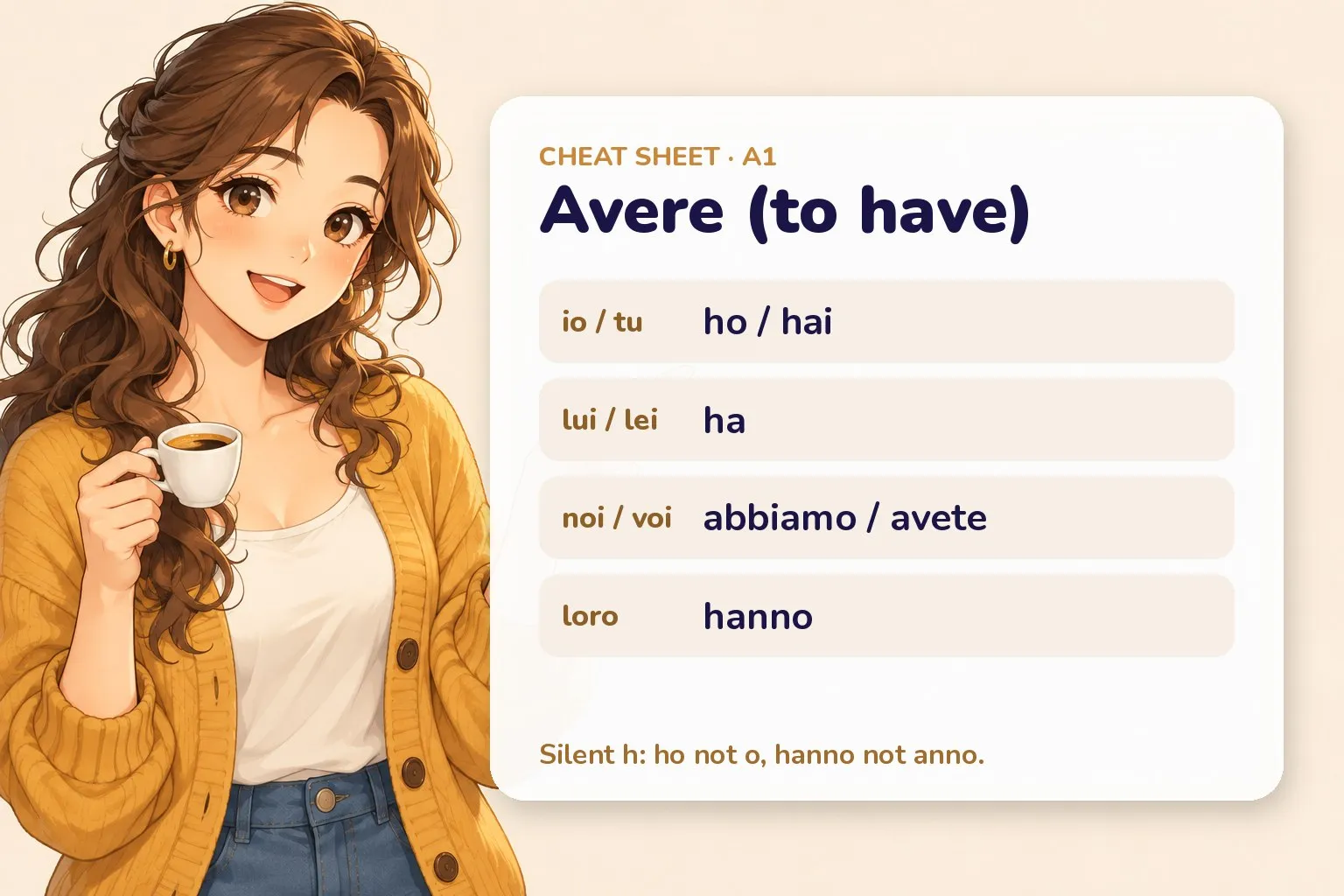
Quick recap before the quiz.
Practice
Avere practice
Try each one, then press Check. No sign-up, nothing is sent anywhere — it all runs in your browser.
Hint: sounds like eye, but keep the h
Show answer
hai — tu hai; ai without the h means to the.
3 Build: 'We have a house.'
Show answer
Noi abbiamo una casa — noi abbiamo una casa.
4 Match each subject to its form of avere.
- io
- tu
- lui/lei
- loro
Show answer
- io → ho
- tu → hai
- lui/lei → ha
- loro → hanno
io ho, tu hai, lui/lei ha, loro hanno.
Hint: with h, not anno
Show answer
hanno — loro hanno; anno without the h means year.
Quiz
The verb avere
12 questions · pick an answer and you'll see straight away if it's right.
-
Show answer
ho — io ho.
-
Show answer
hai — tu hai.
-
Show answer
ha — lui/lei ha.
-
Show answer
abbiamo — noi abbiamo.
-
Show answer
avete — voi avete.
-
Show answer
hanno — loro hanno.
-
Show answer
to tell it apart from o (or) — The silent h separates ho from o (or) in writing.
-
Show answer
Ho fame. — Hunger takes avere: Ho fame (literally I have hunger).
-
Show answer
ha — lei ha — with h; a alone means to/at.
-
Show answer
how old are you — Literally how many years do you have — your age.
-
Show answer
Loro anno un cane. — It should be hanno; anno (no h) means year.
-
Show answer
ho — io ho, kept even in the negative: non ho tempo.
Recap cheat-sheet
| Subject | avere | Note |
|---|---|---|
| io | ho | silent h: not o (or) |
| tu | hai | not ai (to the) |
| lui / lei | ha | not a (to / at) |
| noi / voi | abbiamo / avete | we / you all |
| loro | hanno | not anno (year) |
Next
- Back to the Italian grammar section
- New here? Start with Start Learning Italian Here
All Italian grammar topics
Every grammar point in order, from your first sentence to advanced structures. Pick one and go straight to it. New lessons go live every day, so topics marked Coming soon fill in over the next weeks.
Grammar path
A1 18 topics · 12 ready
- 01 Italian Definite Articles (il, la, i, le)
- 02 Italian Indefinite Articles (un, una)
- 03 Noun Gender and Number
- 04 The Verb Essere (to be)
- 05 The Verb Avere (to have) You are here
- 06 Subject Pronouns (io, tu, lui, lei)
- 07 Present Tense: -are Verbs
- 08 Present Tense: -ere Verbs
- 09 Present Tense: -ire Verbs (and -isc-)
- 10 Plural of Nouns and Adjectives
- 11 Adjective Agreement and Position
- 12 C'è and Ci sono (there is/are)
- 13 Question Words (chi, che, dove, quando) Coming soon
- 14 Numbers, Time and Dates Coming soon
- 15 Possessive Adjectives (il mio, la mia) Coming soon
- 16 Negation with non Coming soon
- 17 The Verb Piacere (to like) Coming soon
- 18 Quantity Adjectives/Adverbs (molto, troppo, poco) Coming soon
A2 23 topics
- 19 Passato Prossimo with Avere Coming soon
- 20 Passato Prossimo with Essere Coming soon
- 21 Irregular Past Participles Coming soon
- 22 Reflexive Verbs (alzarsi, lavarsi) Coming soon
- 23 Modal Verbs (potere, dovere, volere) Coming soon
- 24 Direct Object Pronouns (lo, la, li, le) Coming soon
- 25 Indirect Object Pronouns (gli, le) Coming soon
- 26 Simple Prepositions (di, a, da, in) Coming soon
- 27 Articulated Prepositions (del, nella, sul) Coming soon
- 28 The Imperfect Tense (Imperfetto) Coming soon
- 29 The Simple Future (Futuro Semplice) Coming soon
- 30 Comparatives (più, meno, come) Coming soon
- 31 Superlatives (il più, -issimo) Coming soon
- 32 The Imperative (tu, noi, voi) Coming soon
- 33 The Particles ci and ne Coming soon
- 34 Stare + Gerund (Present Progressive) Coming soon
- 35 C'è bisogno / Ci vuole (Need & Take Time) Coming soon
- 36 The Partitive (del, dei = some) Coming soon
- 37 Pre-Noun Forms: bello, buono, quello Coming soon
- 38 Stare per + Infinitive (About To) Coming soon
- 39 Forming Adverbs with -mente Coming soon
- 40 Time: da (since/for) and fa (ago) Coming soon
- 41 Double Negatives (non...niente, nessuno) Coming soon
B1 18 topics
- 42 Passato Prossimo vs Imperfetto Coming soon
- 43 Combined Pronouns (glielo, me lo) Coming soon
- 44 The Present Conditional (Condizionale) Coming soon
- 45 Impersonal and Passivante si Coming soon
- 46 Relative Pronouns (che, cui) Coming soon
- 47 The Future Perfect (Futuro Anteriore) Coming soon
- 48 The Past Perfect (Trapassato Prossimo) Coming soon
- 49 Formal Imperative (Lei) & with Pronouns Coming soon
- 50 The Gerund: Uses and Past Gerund Coming soon
- 51 The Past Conditional (Condizionale Passato) Coming soon
- 52 Pronoun Placement with Infinitive/Imperative Coming soon
- 53 Comparative & Superlative Irregulars Coming soon
- 54 Impersonal Verbs (bisogna, basta, sembra) Coming soon
- 55 Future of Probability (Suppositional) Coming soon
- 56 Altered Words (-ino, -one, -accio) Coming soon
- 57 Relative chi and quello che Coming soon
- 58 Ne with Quantities and Participle Agreement Coming soon
- 59 Adverb Position (già, ancora, più, mai) Coming soon
B2 14 topics
- 60 The Present Subjunctive (Congiuntivo) Coming soon
- 61 The Imperfect Subjunctive Coming soon
- 62 Perfect & Pluperfect Subjunctive Coming soon
- 63 The Three Hypothetical Periods (periodo ipotetico) Coming soon
- 64 Sequence of Tenses with the Subjunctive Coming soon
- 65 Passive Voice (essere / venire / andare) Coming soon
- 66 Conjunctions Requiring the Subjunctive Coming soon
- 67 Advanced Relatives (il quale, cui possessive) Coming soon
- 68 Reported Speech (Discorso Indiretto) Coming soon
- 69 The Remote Past (Passato Remoto) Coming soon
- 70 Causative Construction (fare + infinitive) Coming soon
- 71 Indefinite Adjectives & Pronouns Coming soon
- 72 Concession: anche se vs benché Coming soon
- 73 Gerund vs Infinitive as Subject/Complement Coming soon
C1 8 topics
- 74 Independent & Optative Subjunctive Coming soon
- 75 Advanced Sequence of Tenses Coming soon
- 76 Nominalisation & Formal Register Coming soon
- 77 Advanced Connectives & Cohesion Coming soon
- 78 Absolute Participle & Implicit Clauses Coming soon
- 79 Pronominal Verbs (farcela, andarsene) Coming soon
- 80 Dislocation & Emphasis Coming soon
- 81 Register, Style and Bureaucratic Italian Coming soon