Italian Negation: non and Double Negatives
To make an Italian verb negative, put non directly before it: parlo (I speak) becomes non parlo (I don't speak). Unlike English, Italian uses double negatives — when a word like niente or nessuno follows the verb, non still comes first.
Level: A1. Saying not in Italian is refreshingly simple: one little word, non, placed right before the verb. Parlo (I speak) becomes non parlo (I don’t speak). The only thing that surprises English speakers is that Italian is happy to stack two negatives in one sentence — and that is not a mistake, it is the rule.
The rule
A verb is the action or state word (parlo, I speak; è, is). To make it negative, put non immediately in front of it:
- Mangio. → Non mangio. — I eat → I do not eat.
- È qui. → Non è qui. — He is here → He is not here.
Nothing is allowed to squeeze between non and the verb except an object pronoun (a little word like lo, la, ti, mi): non lo so (I don’t know it), non ti capisco (I don’t understand you).
In a compound tense (one built from a helper verb plus a past participle, such as ho mangiato, I have eaten), non goes before the helper, never before the participle: Ho capito → Non ho capito (I did not understand).
Negative words that pair with non
English allows only one negative per clause (“I didn’t see anyone”). Italian uses a second negative word and keeps non as well. Whenever one of these words comes after the verb, non must sit before the verb:
| With non… | Meaning | Example |
|---|---|---|
| non… mai | never | Non vado mai al cinema. |
| non… niente / nulla | nothing | Non ho visto niente. |
| non… nessuno | nobody / anybody | Non conosco nessuno. |
| non… più | no longer | Non lavoro più qui. |
| non… ancora | not yet | Non è ancora pronto. |
| non… né… né | neither… nor | Non bevo né caffè né tè. |
| non… affatto | not at all | Non sono affatto stanco. |
| non… neanche | not even | Non ho neanche un euro. |
So “I haven’t seen anyone” is Non ho visto nessuno — literally “I haven’t seen nobody”. To an Italian ear that double negative is perfectly logical.
When non disappears
There is one clean exception. If the negative word moves in front of the verb, non is dropped. You cannot have both before the verb:
- Non è venuto nessuno. = Nessuno è venuto. — Nobody came.
- Non funziona niente. = Niente funziona. — Nothing works.
- Non viene mai. → emphatic Mai viene. — He never comes.
The meaning does not change; only the word order and emphasis do. The position of the negative word decides everything: after the verb → keep non; before the verb → drop non.
Examples
- Non parlo italiano.I don't speak Italian.non before the verb
- Non è qui.He is not here.non + essere
- Non lo so.I don't know (it).only a pronoun sits between non and verb
- Non ti vedo.I can't see you.non + ti + verb
- Non ho capito.I didn't understand.non before the helper ho
- Non abbiamo mangiato.We haven't eaten.compound tense: non + abbiamo
- Non vado mai al cinema.I never go to the cinema.non… mai
- Non ho visto niente.I saw nothing.non… niente
- Non conosco nessuno qui.I don't know anyone here.non… nessuno
- Non lavoro più qui.I no longer work here.non… più
- Non è ancora pronto.It's not ready yet.non… ancora
- Non bevo né caffè né tè.I drink neither coffee nor tea.non… né… né
- Non sono affatto stanco.I'm not tired at all.non… affatto
- Non ho neanche un euro.I don't even have one euro.non… neanche
- Nessuno è venuto.Nobody came.negative word first: non is dropped
- Niente funziona.Nothing works.niente before the verb: no non
- Non c'è nessuno a casa.There's nobody at home.non c'è… nessuno
- Non ho mai mangiato gli gnocchi.I have never eaten gnocchi.non… mai in a compound tense
Common mistakes
- ❌ Ho visto nessuno. → ✅ Non ho visto nessuno. When nessuno follows the verb, you must keep non before it.
- ❌ Non ho visto niente said as a positive (“I saw something”) → ✅ it means “I saw nothing”. Two negatives stay negative in Italian.
- ❌ Parlo non italiano. → ✅ Non parlo italiano. non goes before the verb, never after it.
- ❌ Non non lo so. → ✅ Non lo so. Use non once; the pronoun lo may follow it, but not a second non.
- ❌ Non nessuno è venuto. → ✅ Nessuno è venuto. With the negative word in front, drop non.
A short conversation
— Hai visto qualcuno? — No, non ho visto nessuno. — E hai comprato qualcosa? — Non ho comprato niente, i negozi erano chiusi. — Nessuno ti ha avvisato? — No, non lo sapevo.
Notice the double negatives non… nessuno and non… niente, and how Nessuno ti ha avvisato? drops non because the negative word leads.
Usage notes
- Pronoun placement. The object pronoun sits between non and the verb: non mi piace (I don’t like it), non la conosco (I don’t know her).
- Short answers. To say “no”, start with No, then the negative sentence: No, non vengo (No, I’m not coming).
- né… né. This “neither… nor” pair still needs non when it follows the verb: Non mangio né carne né pesce.
- non… che means “only”. Watch out: Non ho che un euro means “I have only one euro”, not “I have no euro”. It is a separate construction from basic negation.
Compared with…
- Negation sits on the verb, so know the verb first. If non parlo or non è still feels shaky, review the verb essere (to be) and the verb avere (to have), since non sono and non ho are the forms you will use most.
- Negative answers follow questions. You will usually negate in reply to a question, so pair this with the Italian question words: Chi viene? — Non viene nessuno.
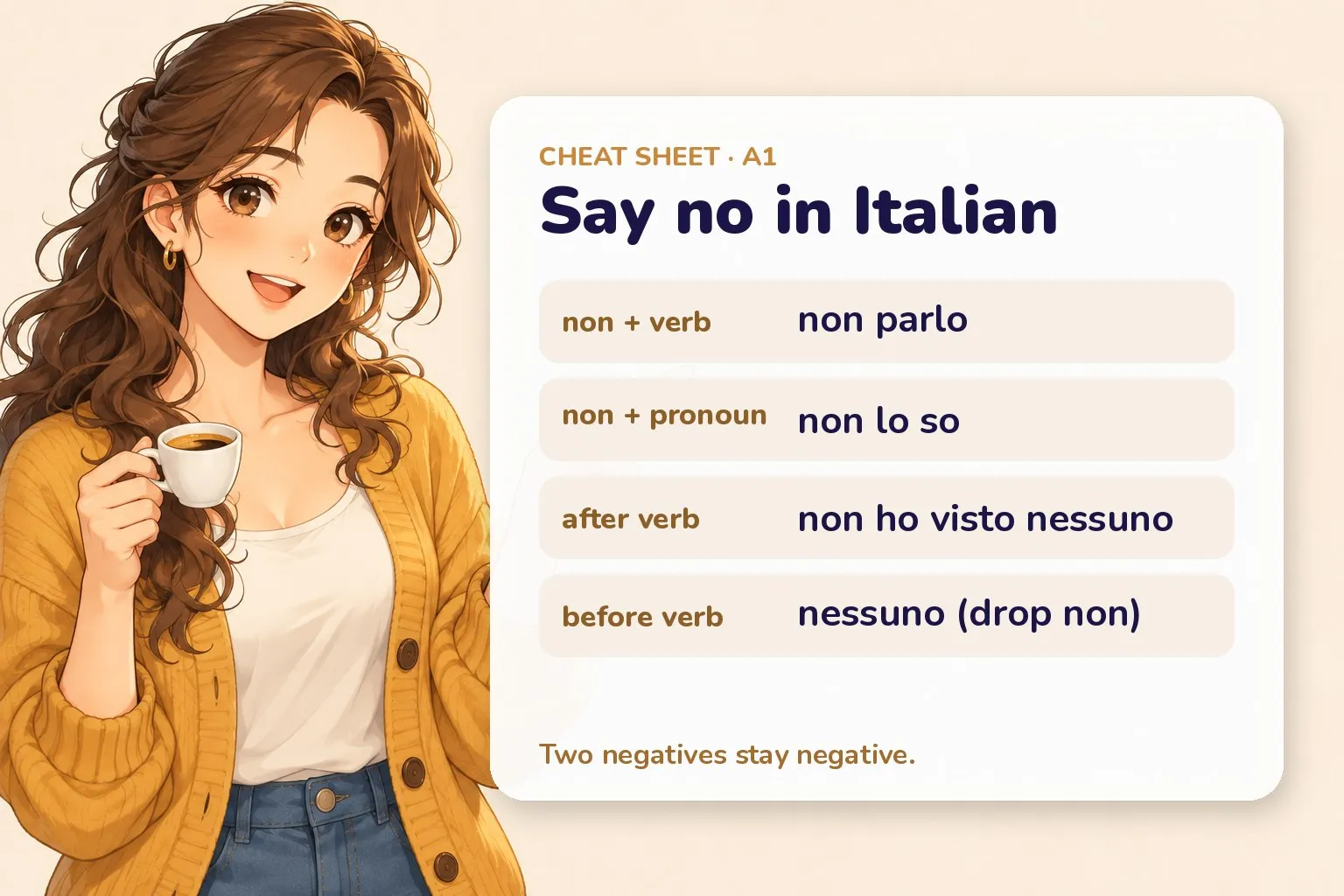
Quick recap before the quiz.
Practice
Negation practice
Try each one, then press Check. No sign-up, nothing is sent anywhere — it all runs in your browser.
Hint: the double negative is correct
Show answer
nessuno — Non ho visto nessuno = 'I saw nobody' — keep both non and nessuno.
3 Build: 'I didn't understand.'
Show answer
Non ho capito — In compound tenses non comes before the helper: Non ho capito.
4 Match each pair to its meaning.
- non… mai
- non… niente
- non… più
- non… ancora
Show answer
- non… mai → never
- non… niente → nothing
- non… più → no longer
- non… ancora → not yet
These negative pairs all keep non before the verb.
Quiz
Italian negation with non
12 questions · pick an answer and you'll see straight away if it's right.
-
Show answer
before the verb — non sits directly before the verb: non parlo.
-
Show answer
an object pronoun — Only an object pronoun: non lo so, non ti vedo.
-
Show answer
Non ho capito. — non goes before the helper ho: Non ho capito.
-
Show answer
I saw nobody. — The double negative stays negative: I saw nobody.
-
Show answer
make a stronger negative — Non… nessuno / niente stays negative; both halves are needed.
-
Show answer
dropped — Nessuno è venuto — non disappears when nessuno leads.
-
Show answer
non… mai — non… mai = never: Non vado mai.
-
Show answer
non… più — non… più = no longer: Non lavoro più qui.
-
Show answer
non… né… né — non bevo né caffè né tè.
-
Show answer
Parlo non italiano. — non must precede the verb, so 'Parlo non italiano' is wrong.
-
Show answer
lo — Non lo so — the pronoun lo sits between non and the verb.
-
Show answer
I have only one euro. — non… che means 'only', a separate construction from plain negation.
Recap cheat-sheet
| Situation | Pattern | Example |
|---|---|---|
| simple verb | non + verb | non parlo |
| with a pronoun | non + pronoun + verb | non lo so |
| compound tense | non + helper + participle | non ho capito |
| negative after verb | non + verb + niente/nessuno/mai | non ho visto nessuno |
| negative before verb | drop non | nessuno è venuto |
Next
- The verb you negate most: essere (to be)
- And its partner: avere (to have)
- Back to the Italian grammar section
- New here? Start Learning Italian Here
All Italian grammar topics
Every grammar point in order, from your first sentence to advanced structures. Pick one and go straight to it. New lessons go live every day, so topics marked Coming soon fill in over the next weeks.
Grammar path
A1 18 topics · 18 ready
- 01 Italian Definite Articles (il, la, i, le)
- 02 Italian Indefinite Articles (un, una)
- 03 Noun Gender and Number
- 04 The Verb Essere (to be)
- 05 The Verb Avere (to have)
- 06 Subject Pronouns (io, tu, lui, lei)
- 07 Present Tense: -are Verbs
- 08 Present Tense: -ere Verbs
- 09 Present Tense: -ire Verbs (and -isc-)
- 10 Plural of Nouns and Adjectives
- 11 Adjective Agreement and Position
- 12 C'è and Ci sono (there is/are)
- 13 Question Words (chi, che, dove, quando)
- 14 Numbers, Time and Dates
- 15 Possessive Adjectives (il mio, la mia)
- 16 Negation with non You are here
- 17 The Verb Piacere (to like)
- 18 Quantity Adjectives/Adverbs (molto, troppo, poco)
A2 23 topics · 3 ready
- 19 Passato Prossimo with Avere
- 20 Passato Prossimo with Essere
- 21 Irregular Past Participles
- 22 Reflexive Verbs (alzarsi, lavarsi) Coming soon
- 23 Modal Verbs (potere, dovere, volere) Coming soon
- 24 Direct Object Pronouns (lo, la, li, le) Coming soon
- 25 Indirect Object Pronouns (gli, le) Coming soon
- 26 Simple Prepositions (di, a, da, in) Coming soon
- 27 Articulated Prepositions (del, nella, sul) Coming soon
- 28 The Imperfect Tense (Imperfetto) Coming soon
- 29 The Simple Future (Futuro Semplice) Coming soon
- 30 Comparatives (più, meno, come) Coming soon
- 31 Superlatives (il più, -issimo) Coming soon
- 32 The Imperative (tu, noi, voi) Coming soon
- 33 The Particles ci and ne Coming soon
- 34 Stare + Gerund (Present Progressive) Coming soon
- 35 C'è bisogno / Ci vuole (Need & Take Time) Coming soon
- 36 The Partitive (del, dei = some) Coming soon
- 37 Pre-Noun Forms: bello, buono, quello Coming soon
- 38 Stare per + Infinitive (About To) Coming soon
- 39 Forming Adverbs with -mente Coming soon
- 40 Time: da (since/for) and fa (ago) Coming soon
- 41 Double Negatives (non...niente, nessuno) Coming soon
B1 18 topics
- 42 Passato Prossimo vs Imperfetto Coming soon
- 43 Combined Pronouns (glielo, me lo) Coming soon
- 44 The Present Conditional (Condizionale) Coming soon
- 45 Impersonal and Passivante si Coming soon
- 46 Relative Pronouns (che, cui) Coming soon
- 47 The Future Perfect (Futuro Anteriore) Coming soon
- 48 The Past Perfect (Trapassato Prossimo) Coming soon
- 49 Formal Imperative (Lei) & with Pronouns Coming soon
- 50 The Gerund: Uses and Past Gerund Coming soon
- 51 The Past Conditional (Condizionale Passato) Coming soon
- 52 Pronoun Placement with Infinitive/Imperative Coming soon
- 53 Comparative & Superlative Irregulars Coming soon
- 54 Impersonal Verbs (bisogna, basta, sembra) Coming soon
- 55 Future of Probability (Suppositional) Coming soon
- 56 Altered Words (-ino, -one, -accio) Coming soon
- 57 Relative chi and quello che Coming soon
- 58 Ne with Quantities and Participle Agreement Coming soon
- 59 Adverb Position (già, ancora, più, mai) Coming soon
B2 14 topics
- 60 The Present Subjunctive (Congiuntivo) Coming soon
- 61 The Imperfect Subjunctive Coming soon
- 62 Perfect & Pluperfect Subjunctive Coming soon
- 63 The Three Hypothetical Periods (periodo ipotetico) Coming soon
- 64 Sequence of Tenses with the Subjunctive Coming soon
- 65 Passive Voice (essere / venire / andare) Coming soon
- 66 Conjunctions Requiring the Subjunctive Coming soon
- 67 Advanced Relatives (il quale, cui possessive) Coming soon
- 68 Reported Speech (Discorso Indiretto) Coming soon
- 69 The Remote Past (Passato Remoto) Coming soon
- 70 Causative Construction (fare + infinitive) Coming soon
- 71 Indefinite Adjectives & Pronouns Coming soon
- 72 Concession: anche se vs benché Coming soon
- 73 Gerund vs Infinitive as Subject/Complement Coming soon
C1 8 topics
- 74 Independent & Optative Subjunctive Coming soon
- 75 Advanced Sequence of Tenses Coming soon
- 76 Nominalisation & Formal Register Coming soon
- 77 Advanced Connectives & Cohesion Coming soon
- 78 Absolute Participle & Implicit Clauses Coming soon
- 79 Pronominal Verbs (farcela, andarsene) Coming soon
- 80 Dislocation & Emphasis Coming soon
- 81 Register, Style and Bureaucratic Italian Coming soon