Italian Numbers, Time and Dates
Italian uses cardinal numbers for counting and for dates. For the clock, one o'clock is singular (È l'una) and every other hour is plural (Sono le due). Dates are day-month-year with il + a cardinal number, except il primo for the 1st.
Level: A1. Numbers, the clock and the calendar come up on your very first day in Italy — buying tickets, asking prices, making plans. The good news: Italian numbers are regular, and the clock and date follow two small patterns you can learn in one sitting.
The rule
A cardinal number is a counting number (one, two, three). Italian uses cardinals both to count and to write dates — there is no “first, second, third” on the calendar except for the very first day of the month.
Three patterns do most of the work:
- Counting. Learn 0–20 as words, then the tens (venti, trenta, quaranta…). Build the rest by joining the ten and the unit: ventitré, trentacinque.
- The clock. Ask Che ora è? or Che ore sono? Answer with the verb essere: È l’una for one o’clock (singular) and Sono le + number for every other hour (Sono le due).
- The date. Day comes before month: il + cardinal number + month, with the month in lowercase (il 3 maggio). Only the 1st uses an ordinal: il primo.
The numbers
| Number | Italian | Number | Italian |
|---|---|---|---|
| 0 | zero | 11 | undici |
| 1 | uno | 12 | dodici |
| 2 | due | 13 | tredici |
| 3 | tre | 16 | sedici |
| 4 | quattro | 17 | diciassette |
| 5 | cinque | 20 | venti |
| 6 | sei | 21 | ventuno |
| 7 | sette | 23 | ventitré |
| 8 | otto | 30 | trenta |
| 9 | nove | 100 | cento |
| 10 | dieci | 1000 | mille |
When you add uno (1) or otto (8) to a ten, the ten drops its final vowel: venti + uno → ventuno, venti + otto → ventotto, trenta + uno → trentuno. The plural of mille is mila: duemila (2000).
Telling the time
| Clock | Italian |
|---|---|
| 1:00 | È l’una |
| 2:00 | Sono le due |
| 3:15 | Sono le tre e un quarto |
| 7:30 | Sono le sette e mezza |
| 8:45 | Sono le nove meno un quarto |
| 12:00 (noon) | È mezzogiorno |
| 00:00 (midnight) | È mezzanotte |
Add minutes with e (and): sono le tre e dieci (3:10). From about forty minutes, Italians usually count down to the next hour with meno (minus): sono le quattro meno dieci (3:50, “four minus ten”). un quarto is a quarter and mezza (or mezzo) is half.
To say at a time, contract the preposition a with the article: all’una (at 1:00), alle due (at 2:00), a mezzogiorno (at noon). For a range use dalle … alle …: dalle nove alle diciotto (from 9:00 to 18:00). Timetables, tickets and opening hours use the 24-hour clock: le 20:30, though in speech people still say le otto e mezza.
Dates
Italian dates run day – month – year. Use il + a cardinal number + the month (lowercase):
- il 3 maggio — 3 May
- il 15 gennaio 2025 — 15 January 2025
The one exception is the first of the month, which takes the ordinal primo: il primo marzo (1 March), but il due marzo, il tre marzo after that. Ask the date with Che giorno è oggi? or, more colloquially, Quanti ne abbiamo oggi?
How to say it
A few number and time words trip up English speakers:
- c before e/i in cinque, dieci, undici: a “ch” sound — cinque = “CHEEN-kweh”.
- gi in giugno, mezzogiorno: a soft “j” — giugno = “JOON-yo”.
- zz in mezza, mezzogiorno: a “ts/dz” sound — mezza = “MED-dza”.
- tré in ventitré, trentatré: the final é carries a written accent and is stressed — “ven-tee-TREH”.
- Double consonants in sette, otto, quattro are held longer than a single one.
Example sentences
- Ho ventuno anni.I am twenty-one years old.ventuno drops the vowel of venti
- Ci sono trentuno giorni a marzo.There are thirty-one days in March.trentuno = trenta + uno
- Costa ventotto euro.It costs twenty-eight euros.ventotto, no vowel before otto
- Che ora è?What time is it?singular question form
- Che ore sono?What time is it?plural question form, equally common
- È l'una.It's one o'clock.one o'clock is singular: è l'una
- Sono le due.It's two o'clock.every other hour is plural: sono le
- Sono le tre e un quarto.It's a quarter past three.e un quarto = and a quarter
- Sono le sette e mezza.It's half past seven.e mezza = and a half
- Sono le nove meno un quarto.It's a quarter to nine.meno = counting down to the next hour
- È mezzogiorno.It's noon.singular, no article
- È mezzanotte.It's midnight.singular, no article
- Il treno parte alle otto e venti.The train leaves at 8:20.alle = a + le, 'at'
- Il negozio è aperto dalle nove alle diciotto.The shop is open from 9:00 to 18:00.dalle ... alle = from ... to; 24-hour clock
- Oggi è il tre maggio.Today is the third of May.cardinal number, month lowercase
- Il mio compleanno è il primo gennaio.My birthday is the first of January.primo = ordinal, only for the 1st
- Ci vediamo il quindici agosto.See you on the fifteenth of August.il + cardinal + month
- L'appuntamento è a mezzogiorno.The appointment is at noon.a mezzogiorno = at noon
Common mistakes
- ❌ Sono le una. → ✅ È l’una. One o’clock is singular and takes è with the elided article l’.
- ❌ È le due. → ✅ Sono le due. Every hour except one is plural: sono le.
- ❌ il terzo maggio (for a date) → ✅ il tre maggio. Dates use cardinal numbers, not ordinals.
- ❌ il uno marzo → ✅ il primo marzo. The 1st is the single exception and uses primo.
- ❌ ventiuno, ventiotto → ✅ ventuno, ventotto. The ten drops its vowel before uno and otto.
- ❌ il 3 Maggio → ✅ il 3 maggio. Months are lowercase in Italian.
A short conversation
— Scusa, che ore sono? (Excuse me, what time is it?) — Sono le due e mezza. (It’s half past two.) — Grazie. A che ora chiude il museo? (Thanks. What time does the museum close?) — Alle diciotto. E riapre domani, il tre maggio. (At 18:00. And it reopens tomorrow, the third of May.)
Usage notes
- uno agrees like an article. As a counting word before a noun, uno behaves like the indefinite article: un libro (one/a book), una casa (one/a house). The other numbers do not change.
- tré takes an accent in compounds. Tre alone has no accent, but ventitré, trentatré, quarantatré all carry a written é and stress the final syllable.
- mezza or mezzo. Both are heard for “half past”: le sette e mezza and le sette e mezzo are equally correct.
- No am/pm. Italian has no a.m./p.m. Add di mattina (morning), del pomeriggio (afternoon), di sera (evening) or di notte (night), or use the 24-hour clock.
- Habit with the article + weekday. Il lunedì means “on Mondays” (every Monday); lunedì alone means “on Monday” (this coming one).
Compared with ordinal numbers
Ordinals (primo, secondo, terzo — first, second, third) are the numbers that rank things, and they agree in gender and number like adjectives: il primo piano (the first floor), la terza volta (the third time). On the calendar you use them only for the 1st (il primo); every other day uses a plain cardinal (il due, il tre). You will meet the article forms behind l’una and le due in Italian definite articles, and the verb è / sono in the present tense of essere.
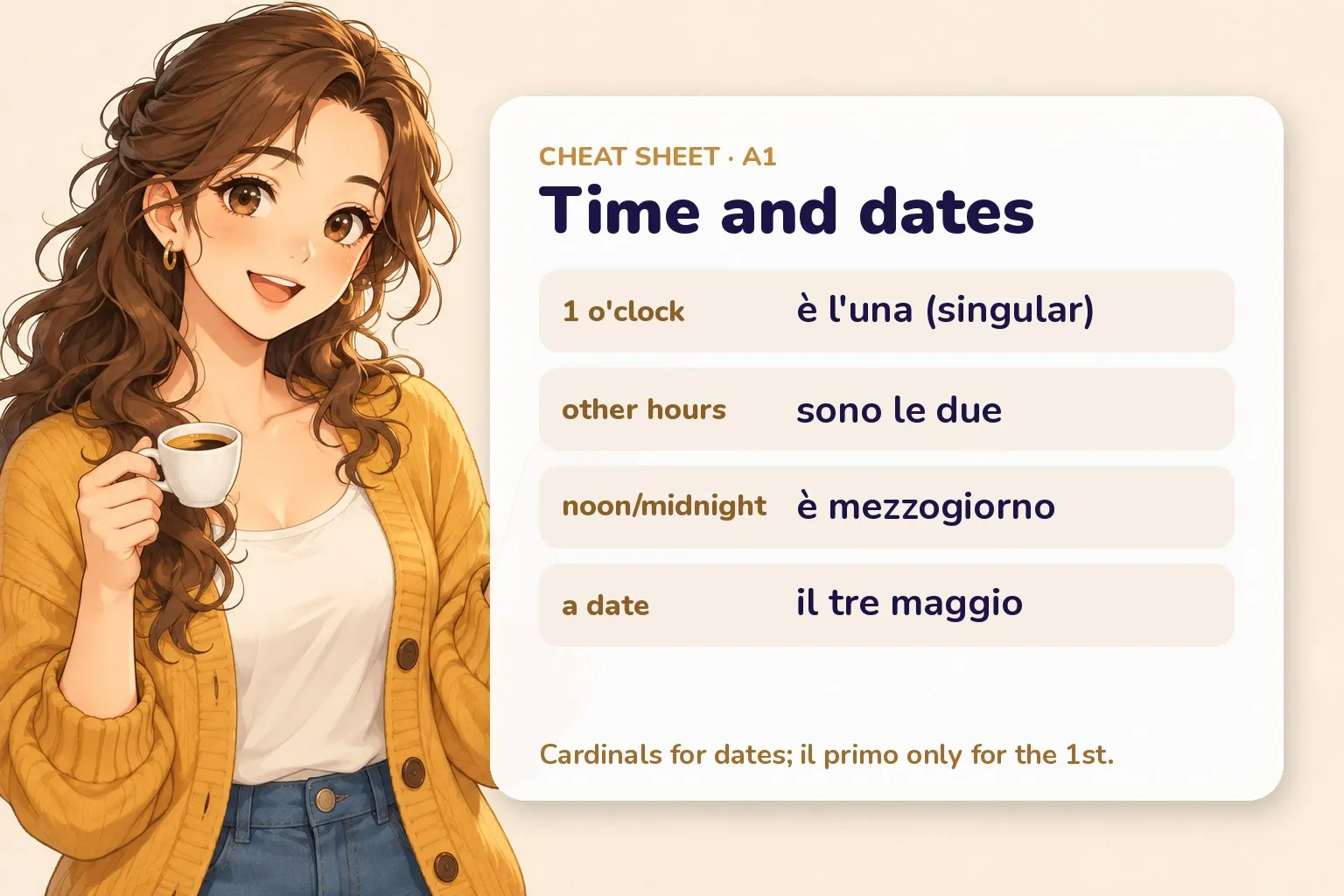
Quick recap before the quiz.
Practice
Italian numbers, time and dates practice
Try each one, then press Check. No sign-up, nothing is sent anywhere — it all runs in your browser.
Hint: plural of essere
Show answer
Sono — Every hour except one is plural: Sono le due.
Hint: venti loses its final vowel before uno
Show answer
ventuno — venti + uno = ventuno.
4 Build the date 'the first of March'.
Show answer
il primo marzo — The 1st uses the ordinal primo: il primo marzo.
5 Match each time to its Italian.
- noon
- midnight
- at 2:00
- a quarter past
Show answer
- noon → è mezzogiorno
- midnight → è mezzanotte
- at 2:00 → alle due
- a quarter past → e un quarto
Noon/midnight are singular; alle = at; e un quarto = quarter past.
Quiz
Italian numbers, time and dates
12 questions · pick an answer and you'll see straight away if it's right.
-
Show answer
both Che ora è? and Che ore sono? — Both questions are standard and interchangeable.
-
Show answer
È l'una — Singular: È l'una.
-
Show answer
Sono le sette — Plural: Sono le sette.
-
Show answer
ventotto — venti drops its vowel before otto: ventotto.
-
Show answer
sono le nove meno un quarto — meno counts down to the next hour: le nove meno un quarto.
-
Show answer
è mezzogiorno — Singular, no article: è mezzogiorno.
-
Show answer
alle due — a + le contracts to alle: alle due.
-
Show answer
the 1st (il primo) — Only the 1st: il primo; the rest are cardinals.
-
Show answer
maggio — Months are lowercase: il tre maggio.
-
Show answer
always lowercase — Italian keeps months lowercase: il 3 maggio.
-
Show answer
mila (duemila) — mille becomes mila: duemila = 2000.
-
Show answer
the 24-hour clock — Official times use the 24-hour clock: le 20:30.
Recap cheat-sheet
| Thing | Pattern | Example |
|---|---|---|
| 1 o’clock | è + l’una (singular) | È l’una. |
| other hours | sono le + number | Sono le due. |
| noon / midnight | è (singular), no article | È mezzogiorno. |
| at a time | a + article | alle due, all’una |
| date | il + cardinal + month | il tre maggio |
| the 1st | il primo (ordinal) | il primo gennaio |
Next
- Back to the Italian grammar section
- Related: Italian definite articles and the present tense of essere
- New here? Start with Start Learning Italian Here
All Italian grammar topics
Every grammar point in order, from your first sentence to advanced structures. Pick one and go straight to it. New lessons go live every day, so topics marked Coming soon fill in over the next weeks.
Grammar path
A1 18 topics · 14 ready
- 01 Italian Definite Articles (il, la, i, le)
- 02 Italian Indefinite Articles (un, una)
- 03 Noun Gender and Number
- 04 The Verb Essere (to be)
- 05 The Verb Avere (to have)
- 06 Subject Pronouns (io, tu, lui, lei)
- 07 Present Tense: -are Verbs
- 08 Present Tense: -ere Verbs
- 09 Present Tense: -ire Verbs (and -isc-)
- 10 Plural of Nouns and Adjectives
- 11 Adjective Agreement and Position
- 12 C'è and Ci sono (there is/are)
- 13 Question Words (chi, che, dove, quando)
- 14 Numbers, Time and Dates You are here
- 15 Possessive Adjectives (il mio, la mia) Coming soon
- 16 Negation with non Coming soon
- 17 The Verb Piacere (to like) Coming soon
- 18 Quantity Adjectives/Adverbs (molto, troppo, poco) Coming soon
A2 23 topics
- 19 Passato Prossimo with Avere Coming soon
- 20 Passato Prossimo with Essere Coming soon
- 21 Irregular Past Participles Coming soon
- 22 Reflexive Verbs (alzarsi, lavarsi) Coming soon
- 23 Modal Verbs (potere, dovere, volere) Coming soon
- 24 Direct Object Pronouns (lo, la, li, le) Coming soon
- 25 Indirect Object Pronouns (gli, le) Coming soon
- 26 Simple Prepositions (di, a, da, in) Coming soon
- 27 Articulated Prepositions (del, nella, sul) Coming soon
- 28 The Imperfect Tense (Imperfetto) Coming soon
- 29 The Simple Future (Futuro Semplice) Coming soon
- 30 Comparatives (più, meno, come) Coming soon
- 31 Superlatives (il più, -issimo) Coming soon
- 32 The Imperative (tu, noi, voi) Coming soon
- 33 The Particles ci and ne Coming soon
- 34 Stare + Gerund (Present Progressive) Coming soon
- 35 C'è bisogno / Ci vuole (Need & Take Time) Coming soon
- 36 The Partitive (del, dei = some) Coming soon
- 37 Pre-Noun Forms: bello, buono, quello Coming soon
- 38 Stare per + Infinitive (About To) Coming soon
- 39 Forming Adverbs with -mente Coming soon
- 40 Time: da (since/for) and fa (ago) Coming soon
- 41 Double Negatives (non...niente, nessuno) Coming soon
B1 18 topics
- 42 Passato Prossimo vs Imperfetto Coming soon
- 43 Combined Pronouns (glielo, me lo) Coming soon
- 44 The Present Conditional (Condizionale) Coming soon
- 45 Impersonal and Passivante si Coming soon
- 46 Relative Pronouns (che, cui) Coming soon
- 47 The Future Perfect (Futuro Anteriore) Coming soon
- 48 The Past Perfect (Trapassato Prossimo) Coming soon
- 49 Formal Imperative (Lei) & with Pronouns Coming soon
- 50 The Gerund: Uses and Past Gerund Coming soon
- 51 The Past Conditional (Condizionale Passato) Coming soon
- 52 Pronoun Placement with Infinitive/Imperative Coming soon
- 53 Comparative & Superlative Irregulars Coming soon
- 54 Impersonal Verbs (bisogna, basta, sembra) Coming soon
- 55 Future of Probability (Suppositional) Coming soon
- 56 Altered Words (-ino, -one, -accio) Coming soon
- 57 Relative chi and quello che Coming soon
- 58 Ne with Quantities and Participle Agreement Coming soon
- 59 Adverb Position (già, ancora, più, mai) Coming soon
B2 14 topics
- 60 The Present Subjunctive (Congiuntivo) Coming soon
- 61 The Imperfect Subjunctive Coming soon
- 62 Perfect & Pluperfect Subjunctive Coming soon
- 63 The Three Hypothetical Periods (periodo ipotetico) Coming soon
- 64 Sequence of Tenses with the Subjunctive Coming soon
- 65 Passive Voice (essere / venire / andare) Coming soon
- 66 Conjunctions Requiring the Subjunctive Coming soon
- 67 Advanced Relatives (il quale, cui possessive) Coming soon
- 68 Reported Speech (Discorso Indiretto) Coming soon
- 69 The Remote Past (Passato Remoto) Coming soon
- 70 Causative Construction (fare + infinitive) Coming soon
- 71 Indefinite Adjectives & Pronouns Coming soon
- 72 Concession: anche se vs benché Coming soon
- 73 Gerund vs Infinitive as Subject/Complement Coming soon
C1 8 topics
- 74 Independent & Optative Subjunctive Coming soon
- 75 Advanced Sequence of Tenses Coming soon
- 76 Nominalisation & Formal Register Coming soon
- 77 Advanced Connectives & Cohesion Coming soon
- 78 Absolute Participle & Implicit Clauses Coming soon
- 79 Pronominal Verbs (farcela, andarsene) Coming soon
- 80 Dislocation & Emphasis Coming soon
- 81 Register, Style and Bureaucratic Italian Coming soon