Question Words (chi, che, dove, quando)
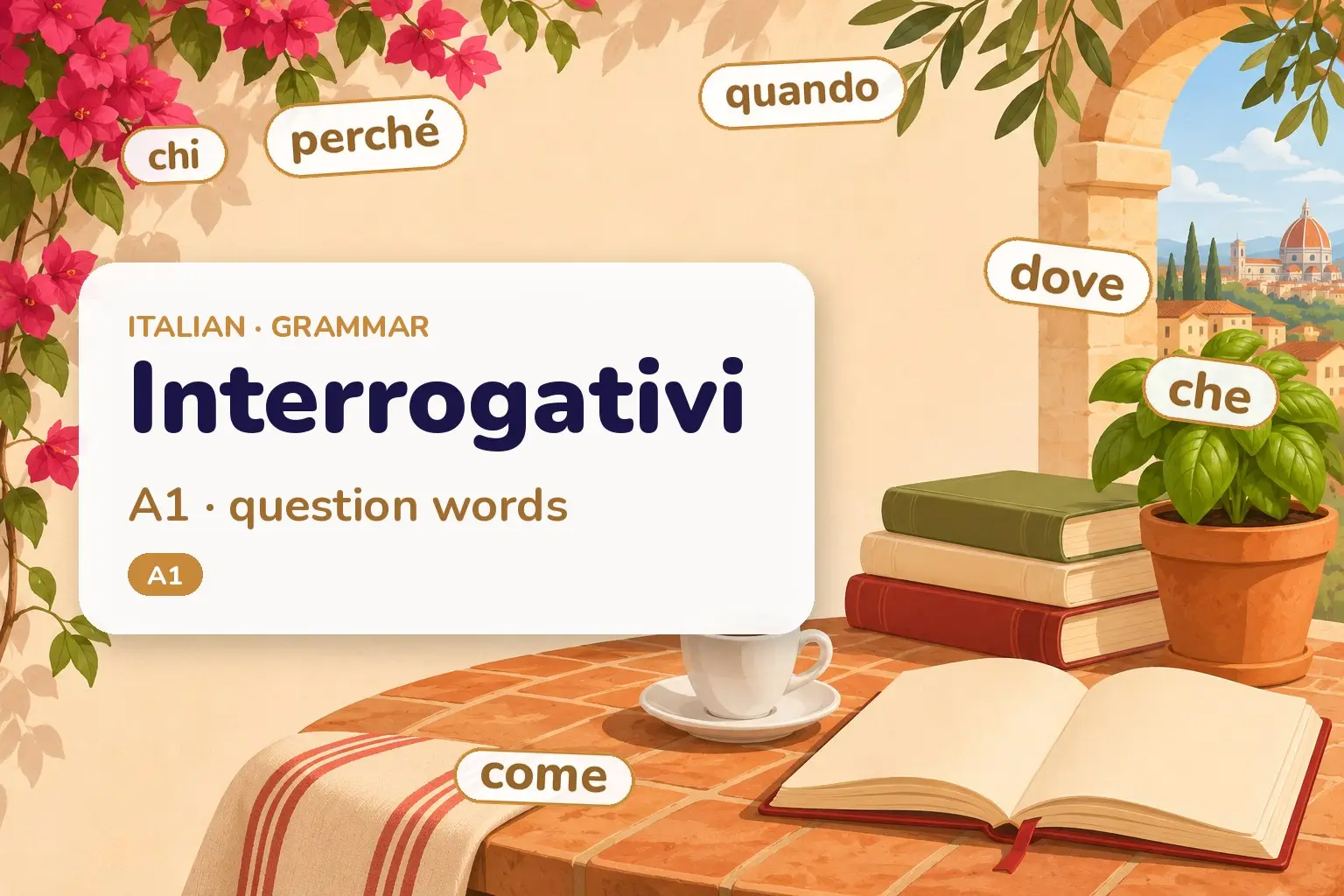
Italian questions usually start with a question word, then the verb: Dove abiti? (Where do you live?). Most are invariable — chi, che, dove, quando, come, perché — but quanto and quale change their ending to agree with the noun.
Level: A1. To ask for real information in Italian you need the question words (gli interrogativi). They are short, they go at the front, and most of them never change. Learn the handful on this page and you can ask who, what, where, when, why, how and how much.
The rule
An interrogative (a question word) opens an information question — one that cannot be answered with just sì or no. The pattern is simple: question word + verb, with the subject coming after the verb or at the very end if you name it at all.
- Dove abiti? — Where do you live?
- Che cosa fai? — What are you doing?
- Dove abita Marco? — Where does Marco live? (subject Marco after the verb)
Italian does not use a helper like English “do”. There is no Dove tu abiti?; the pronoun is usually dropped because the verb ending already shows the person.
Most question words are invariable — one fixed form: chi (who), che / cosa / che cosa (what), dove (where), quando (when), come (how), perché (why). Two of them agree with the noun that follows, and those are the ones to watch.
The question words
| Question word | Meaning | Changes? | Example |
|---|---|---|---|
| chi | who | no | Chi è? (Who is it?) |
| che / cosa / che cosa | what | no | Cosa vuoi? (What do you want?) |
| dove | where | no | Dove sei? (Where are you?) |
| quando | when | no | Quando parti? (When do you leave?) |
| come | how | no | Come stai? (How are you?) |
| perché | why | no | Perché piangi? (Why are you crying?) |
| quanto | how much/many | yes (4 forms) | Quanti anni hai? (How old are you?) |
| quale | which | yes (2 forms) | Quale libro? (Which book?) |
The two that agree
quanto (“how much / how many”) behaves like an adjective and takes four endings to match the noun:
| Form | Used with | Example |
|---|---|---|
| quanto | masculine singular | Quanto pane? (How much bread?) |
| quanta | feminine singular | Quanta acqua? (How much water?) |
| quanti | masculine plural | Quanti libri? (How many books?) |
| quante | feminine plural | Quante ragazze? (How many girls?) |
quale (“which”) has only two forms: quale (singular) and quali (plural) — Quale film? / Quali film? It does not change for gender.
How to say it
Italian spelling hides a few sounds for English speakers:
- ch is a hard “k”: che = “keh”, chi = “kee”, perché = “pehr-KEH”.
- c before e/i is soft “ch”: cosa starts hard (“KOH-za”), but cena = “CHEH-na”.
- qu is “kw”: quando = “KWAN-do”, quanto = “KWAN-to”, quale = “KWAH-leh”.
- Final accent on perché and perché-type words carries the stress: say “pehr-KEH”, not “PEHR-kay”.
Example sentences
- Chi è?Who is it?chi + essere
- Chi sono quelle persone?Who are those people?
- Che cosa fai?What are you doing?che cosa = what
- Cosa vuoi mangiare?What do you want to eat?
- Dove abiti?Where do you live?
- Dove abita Marco?Where does Marco live?subject after the verb
- Dov'è la stazione?Where is the station?dove + è elides to dov'è
- Quando parti?When are you leaving?
- Quando arriva il treno?When does the train arrive?
- Come stai?How are you?
- Come ti chiami?What's your name?literally: how do you call yourself
- Com'è il tempo oggi?What's the weather like today?come + è elides to com'è
- Perché piangi?Why are you crying?
- Piango perché sono triste.I'm crying because I'm sad.same word perché = because
- Quanti anni hai?How old are you?literally: how many years do you have
- Quanta acqua bevi?How much water do you drink?quanta = feminine singular
- Quante ragazze ci sono?How many girls are there?quante = feminine plural
- Quanto costa?How much does it cost?quanto alone = adverb, invariable
- Quale preferisci?Which one do you prefer?
- Quali libri leggi?Which books do you read?quali = plural of quale
Common mistakes
- ❌ Perché cause of this. → Keep in mind perché = why AND because. Perché studi? Studio perché mi piace. The same word opens the question and the answer.
- ❌ Quanti acqua? → ✅ Quanta acqua? quanto agrees: acqua is feminine singular, so quanta.
- ❌ Dove Marco abita? → ✅ Dove abita Marco? The subject follows the verb, not the question word.
- ❌ Dove è la stazione? → ✅ Dov’è la stazione? dove elides before è.
- ❌ Quale sono? → ✅ Quali sono? With a plural verb, use the plural form quali.
A short conversation
— Dove vai stasera? — Al cinema. — Che film guardi? — Non lo so ancora. Quanti siete? — Siamo in tre. Perché non vieni anche tu?
Usage notes
- No “do/does”. Italian forms questions from the plain verb: Dove lavori? (“Where do you work?”). There is no auxiliary.
- Rising intonation marks a yes/no question with no question word at all: Parli italiano? (“Do you speak Italian?”). Word order stays the same as a statement.
- Prepositions move to the front with the question word: Con chi esci? (“Who are you going out with?”), Di dove sei? (“Where are you from?”). Italian does not strand the preposition at the end as English does.
- che + noun also asks “what / which”: Che ora è? (“What time is it?”), Che lavoro fai? (“What job do you do?”).
- quanto as an adverb is invariable: when it is not describing a noun but a verb, it stays quanto — Quanto costa? Quanto dura?
Compared with yes/no (intonation) questions
A question word asks for information and forces a full answer: Dove abiti? — A Roma. A yes/no question needs no question word at all — you simply raise your voice at the end of a normal statement: Abiti a Roma? (“Do you live in Rome?”) → Sì / No. The verb and subject keep their statement order, which is why Italian feels easier than English here: no inversion, no “do”. Build your questions on the verbs from essere (to be) and the everyday -are verbs, and remember that the subject pronoun is usually dropped — the verb ending already shows who is asking.
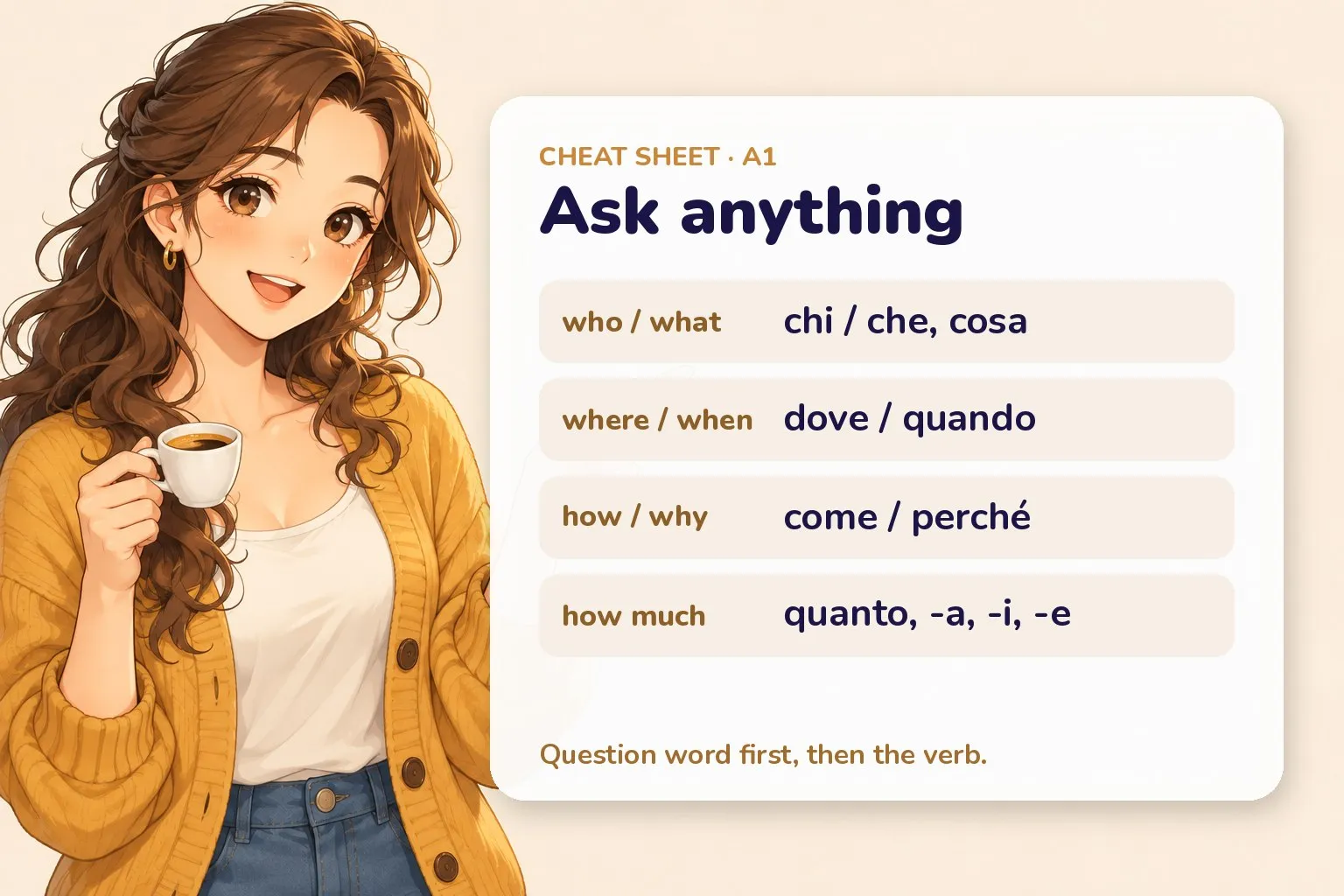
Quick recap before the quiz.
Practice
Italian question words practice
Try each one, then press Check. No sign-up, nothing is sent anywhere — it all runs in your browser.
Hint: feminine singular
Show answer
Quanta — quanto agrees: feminine singular is quanta.
3 Build: 'Where does Marco live?'
Show answer
Dove abita Marco — Question word + verb + subject: Dove abita Marco?
4 Match each question word to its meaning.
- chi
- dove
- quando
- perché
Show answer
- chi → who
- dove → where
- quando → when
- perché → why / because
These invariable interrogatives never change form.
Hint: plural of quale
Show answer
Quali — The plural of quale is quali.
Quiz
Italian question words
12 questions · pick an answer and you'll see straight away if it's right.
-
Show answer
question word + verb — Question word first, then the verb; the subject follows.
-
Show answer
Come — come = how.
-
Show answer
perché — perché opens the question and the answer alike.
-
Show answer
Quanti — anni is masculine plural, so quanti.
-
Show answer
Quanta — acqua is feminine singular, so quanta.
-
Show answer
che / cosa / che cosa — che, cosa and che cosa are interchangeable.
-
Show answer
two (quale, quali) — quale (singular) and quali (plural); no gender change.
-
Show answer
Dove abita Marco? — The subject follows the verb: Dove abita Marco?
-
Show answer
Com'è — come + è elides to com'è.
-
Show answer
raise intonation on the statement — Italian yes/no questions use rising intonation, same word order.
-
Show answer
Quanto — As an adverb (with a verb, no noun) quanto stays invariable.
-
Show answer
chi — The preposition moves to the front: Con chi esci?
Recap cheat-sheet
| Ask about | Word | Note |
|---|---|---|
| person | chi | invariable |
| thing | che / cosa / che cosa | all three work |
| place / time | dove / quando | dov’è before è |
| manner / reason | come / perché | perché = why & because |
| amount | quanto/-a/-i/-e | agrees with the noun |
| choice | quale / quali | two forms only |
Next
- Back to the Italian grammar section
- Ask about things that exist: c’è and ci sono
- New here? Start with Start Learning Italian Here
All Italian grammar topics
Every grammar point in order, from your first sentence to advanced structures. Pick one and go straight to it. New lessons go live every day, so topics marked Coming soon fill in over the next weeks.
Grammar path
A1 18 topics · 13 ready
- 01 Italian Definite Articles (il, la, i, le)
- 02 Italian Indefinite Articles (un, una)
- 03 Noun Gender and Number
- 04 The Verb Essere (to be)
- 05 The Verb Avere (to have)
- 06 Subject Pronouns (io, tu, lui, lei)
- 07 Present Tense: -are Verbs
- 08 Present Tense: -ere Verbs
- 09 Present Tense: -ire Verbs (and -isc-)
- 10 Plural of Nouns and Adjectives
- 11 Adjective Agreement and Position
- 12 C'è and Ci sono (there is/are)
- 13 Question Words (chi, che, dove, quando) You are here
- 14 Numbers, Time and Dates Coming soon
- 15 Possessive Adjectives (il mio, la mia) Coming soon
- 16 Negation with non Coming soon
- 17 The Verb Piacere (to like) Coming soon
- 18 Quantity Adjectives/Adverbs (molto, troppo, poco) Coming soon
A2 23 topics
- 19 Passato Prossimo with Avere Coming soon
- 20 Passato Prossimo with Essere Coming soon
- 21 Irregular Past Participles Coming soon
- 22 Reflexive Verbs (alzarsi, lavarsi) Coming soon
- 23 Modal Verbs (potere, dovere, volere) Coming soon
- 24 Direct Object Pronouns (lo, la, li, le) Coming soon
- 25 Indirect Object Pronouns (gli, le) Coming soon
- 26 Simple Prepositions (di, a, da, in) Coming soon
- 27 Articulated Prepositions (del, nella, sul) Coming soon
- 28 The Imperfect Tense (Imperfetto) Coming soon
- 29 The Simple Future (Futuro Semplice) Coming soon
- 30 Comparatives (più, meno, come) Coming soon
- 31 Superlatives (il più, -issimo) Coming soon
- 32 The Imperative (tu, noi, voi) Coming soon
- 33 The Particles ci and ne Coming soon
- 34 Stare + Gerund (Present Progressive) Coming soon
- 35 C'è bisogno / Ci vuole (Need & Take Time) Coming soon
- 36 The Partitive (del, dei = some) Coming soon
- 37 Pre-Noun Forms: bello, buono, quello Coming soon
- 38 Stare per + Infinitive (About To) Coming soon
- 39 Forming Adverbs with -mente Coming soon
- 40 Time: da (since/for) and fa (ago) Coming soon
- 41 Double Negatives (non...niente, nessuno) Coming soon
B1 18 topics
- 42 Passato Prossimo vs Imperfetto Coming soon
- 43 Combined Pronouns (glielo, me lo) Coming soon
- 44 The Present Conditional (Condizionale) Coming soon
- 45 Impersonal and Passivante si Coming soon
- 46 Relative Pronouns (che, cui) Coming soon
- 47 The Future Perfect (Futuro Anteriore) Coming soon
- 48 The Past Perfect (Trapassato Prossimo) Coming soon
- 49 Formal Imperative (Lei) & with Pronouns Coming soon
- 50 The Gerund: Uses and Past Gerund Coming soon
- 51 The Past Conditional (Condizionale Passato) Coming soon
- 52 Pronoun Placement with Infinitive/Imperative Coming soon
- 53 Comparative & Superlative Irregulars Coming soon
- 54 Impersonal Verbs (bisogna, basta, sembra) Coming soon
- 55 Future of Probability (Suppositional) Coming soon
- 56 Altered Words (-ino, -one, -accio) Coming soon
- 57 Relative chi and quello che Coming soon
- 58 Ne with Quantities and Participle Agreement Coming soon
- 59 Adverb Position (già, ancora, più, mai) Coming soon
B2 14 topics
- 60 The Present Subjunctive (Congiuntivo) Coming soon
- 61 The Imperfect Subjunctive Coming soon
- 62 Perfect & Pluperfect Subjunctive Coming soon
- 63 The Three Hypothetical Periods (periodo ipotetico) Coming soon
- 64 Sequence of Tenses with the Subjunctive Coming soon
- 65 Passive Voice (essere / venire / andare) Coming soon
- 66 Conjunctions Requiring the Subjunctive Coming soon
- 67 Advanced Relatives (il quale, cui possessive) Coming soon
- 68 Reported Speech (Discorso Indiretto) Coming soon
- 69 The Remote Past (Passato Remoto) Coming soon
- 70 Causative Construction (fare + infinitive) Coming soon
- 71 Indefinite Adjectives & Pronouns Coming soon
- 72 Concession: anche se vs benché Coming soon
- 73 Gerund vs Infinitive as Subject/Complement Coming soon
C1 8 topics
- 74 Independent & Optative Subjunctive Coming soon
- 75 Advanced Sequence of Tenses Coming soon
- 76 Nominalisation & Formal Register Coming soon
- 77 Advanced Connectives & Cohesion Coming soon
- 78 Absolute Participle & Implicit Clauses Coming soon
- 79 Pronominal Verbs (farcela, andarsene) Coming soon
- 80 Dislocation & Emphasis Coming soon
- 81 Register, Style and Bureaucratic Italian Coming soon