Italian molto, troppo, poco: Quantity Words
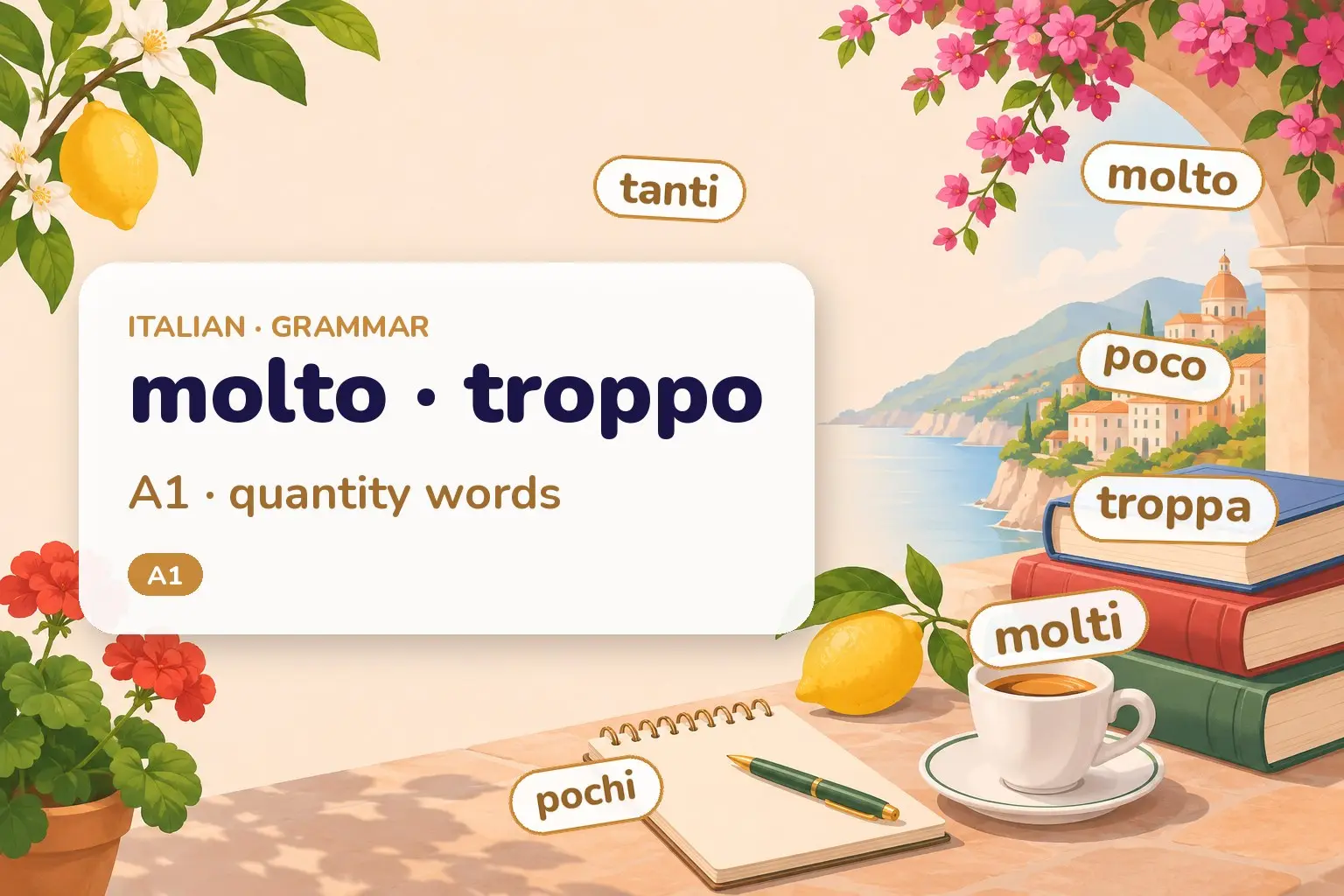
molto, troppo, poco and tanto change their ending to agree (molti libri, troppa acqua) when they describe a noun, but stay fixed as molto, troppo, poco when they modify a verb, adjective or adverb — molto bello, not molti belli.
Level: A1. The words molto, troppo, poco and tanto do double duty in Italian. Sometimes they end in -o, -a, -i or -e to match a noun; sometimes they are frozen. One simple rule tells you which.
The rule
An adjective describes a noun and, in Italian, agrees with it in gender (masculine/feminine) and number (singular/plural). An adverb describes a verb, an adjective or another adverb, and in Italian it never changes.
molto, troppo, poco and tanto can be either one:
- In front of a noun they are adjectives of quantity and agree: molti libri (“many books”), troppa acqua (“too much water”).
- In front of a verb, an adjective or another adverb they are adverbs and stay fixed in the -o form: molto bello (“very beautiful”), lavoro troppo (“I work too much”).
So the single question to ask is: what comes after the word? A noun → make it agree. Anything else → leave it as molto, troppo, poco, tanto.
The four forms
As adjectives, each word has the normal four endings:
| Meaning | Masc. sing. | Fem. sing. | Masc. pl. | Fem. pl. |
|---|---|---|---|---|
| a lot of / many | molto | molta | molti | molte |
| too much / too many | troppo | troppa | troppi | troppe |
| little / few | poco | poca | pochi | poche |
| so much / so many | tanto | tanta | tanti | tante |
As adverbs, all four freeze in one form — molto, troppo, poco, tanto — whatever they modify:
| Role | Example | English |
|---|---|---|
| + adjective | È molto alta. | She is very tall. |
| + adverb | Parli troppo velocemente. | You speak too fast. |
| + verb | Dormo poco. | I sleep little. |
molto as “very” vs “a lot of”
The most useful pair to fix early is molto:
- Before a noun = “a lot of / many”: molto pane (“a lot of bread”), molte case (“many houses”).
- Before an adjective = “very”: molto buono (“very good”), molto stanca (“very tired” — note molto stays -o even though stanca is feminine).
Example sentences
- Ho molti amici.I have many friends.molti + noun (masc. pl.) → agrees
- Ci sono molte persone.There are many people.molte + fem. pl. noun
- Bevo molta acqua.I drink a lot of water.molta + fem. sing. noun
- Questo libro è molto bello.This book is very beautiful.molto + adjective → fixed
- Lei è molto stanca.She is very tired.molto stays -o before an adjective
- C'è troppa gente qui.There are too many people here.troppa + fem. sing. noun
- Ho troppi compiti.I have too much homework.troppi + masc. pl. noun
- Mangi troppo.You eat too much.troppo + verb → fixed
- Questo caffè è troppo caro.This coffee is too expensive.troppo + adjective → fixed
- Ho poco tempo.I have little time.poco + masc. sing. noun
- Ho poca fame.I'm not very hungry. (little hunger)poca + fem. sing. noun
- Pochi studenti sono venuti.Few students came.pochi: masc. pl. with the h
- Dormo poco.I sleep little.poco + verb → fixed
- Ho tanti libri.I have so many books.tanti + masc. pl. noun
- Ho tanta voglia di partire.I really want to leave.tanta + fem. sing. noun
- Ti amo tanto.I love you so much.tanto + verb → fixed
- Parli troppo velocemente.You speak too quickly.troppo + adverb → fixed
- Ci sono poche mele.There are few apples.poche: fem. pl. with the h
- Vorrei un po' di pane.I'd like a little bread.un po' = frozen short poco
- Sono molto contento.I'm very happy.molto + adjective → fixed
Common mistakes
- ❌ Ho molto amici. → ✅ Ho molti amici. Before the noun amici (masc. pl.), molto must agree → molti.
- ❌ Lei è molta bella. → ✅ Lei è molto bella. Before the adjective bella, molto is an adverb and stays -o, even though bella is feminine.
- ❌ Ci sono troppo persone. → ✅ Ci sono troppe persone. persone is feminine plural, so troppo → troppe.
- ❌ Ho poci soldi. → ✅ Ho pochi soldi. Masculine plural of poco needs the h: pochi, not poci.
- ❌ Mangi troppi. (meaning “you eat too much”) → ✅ Mangi troppo. After a verb it is an adverb, so the fixed troppo.
A short conversation
— Hai molti amici qui? (Do you have many friends here?) — Sì, ma ho poco tempo per vederli. (Yes, but I have little time to see them.) — Lavori troppo! (You work too much!) — È vero, sono molto stanco. Mi serve un po’ di riposo. (It’s true, I’m very tired. I need a little rest.)
Notice molti amici and poco tempo (agreeing before nouns), troppo and molto fixed before a verb and an adjective, and the frozen un po’.
Usage notes
- molto bene, not “molto buono” for “very well”. bene is an adverb (“well”), buono an adjective (“good”). molto modifies both but the choice of bene vs buono depends on what you mean.
- tanto… quanto also makes comparisons of equality (tanto gentile quanto bello, “as kind as handsome”), where tanto is fixed.
- un po’ is poco worn down to a fixed little phrase; keep the apostrophe (it marks the dropped -co) and never make it agree.
- poco can soften, not just reduce. poco gentile means “not very kind” rather than “a little kind” — before an adjective it often works like a polite negative.
Compared with…
- Normal descriptive adjectives: words like bello, grande, rosso always agree with their noun, with no fixed “adverb” use. The special thing about molto/troppo/poco/tanto is that they switch off their agreement when they stop pointing at a noun — compare the steady agreement in Italian adjective agreement and how plurals form in Italian plural nouns and adjectives.
- Gender itself: knowing whether the noun is masculine or feminine is what lets you pick molti vs molte. If that is still shaky, review Italian noun gender and the articles that signal it in Italian definite articles.
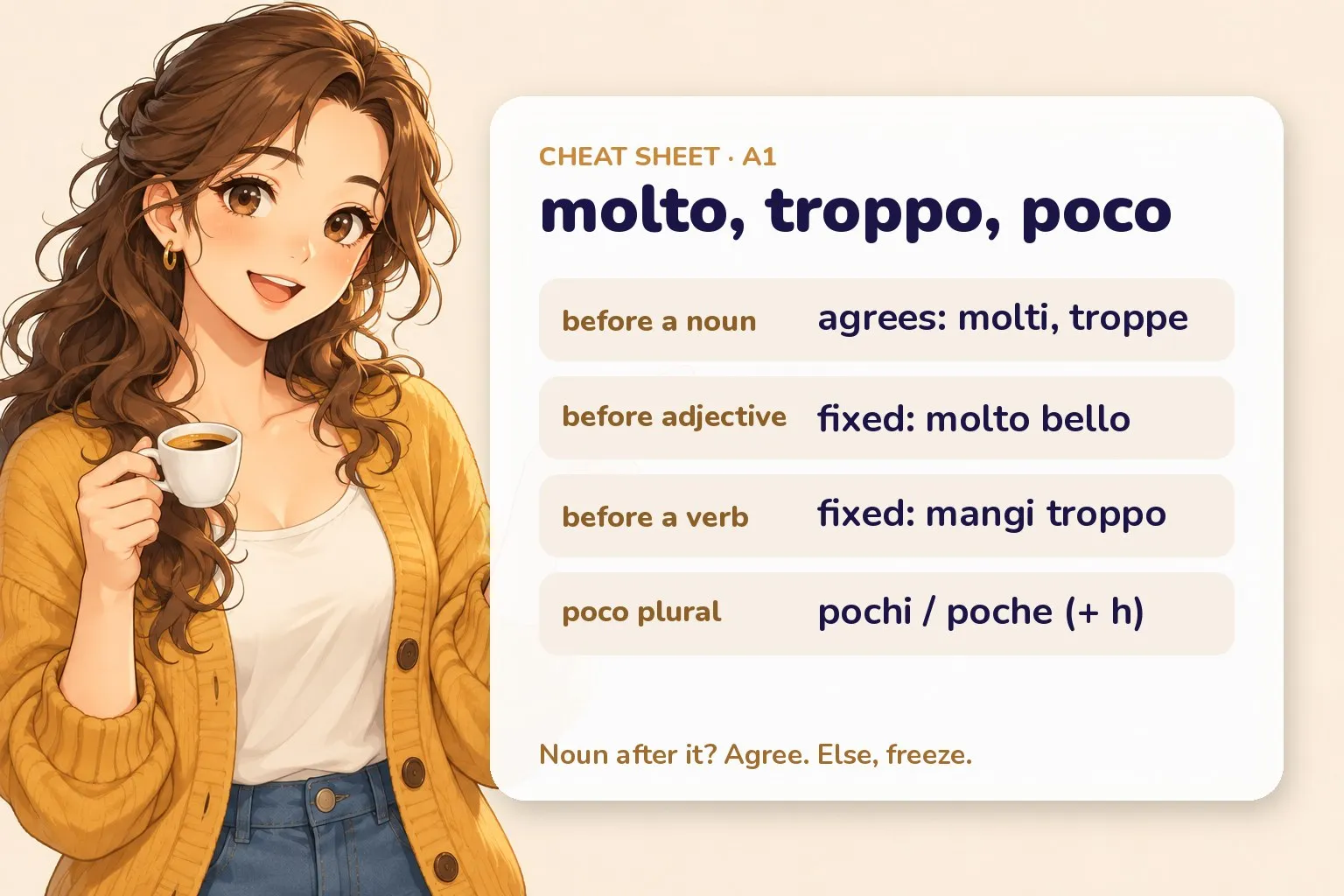
Quick recap before the quiz — noun after it, agree; anything else, freeze.
Practice
Quantity words practice
Try each one, then press Check. No sign-up, nothing is sent anywhere — it all runs in your browser.
Hint: feminine plural of troppo
Show answer
troppe — persone is feminine plural, so troppo → troppe.
Hint: masc. plural of poco, with an h
Show answer
pochi — poco → pochi; the h keeps the hard 'k' sound.
5 Build: 'I drink a lot of water.'
Show answer
Bevo molta acqua — molta agrees with the feminine noun acqua: Bevo molta acqua.
6 Match each phrase to adjective (agrees) or adverb (fixed).
- molti libri
- molto bello
- troppa acqua
- mangi troppo
Show answer
- molti libri → adjective
- molto bello → adverb
- troppa acqua → adjective
- mangi troppo → adverb
Before a noun they agree; before an adjective/verb they are fixed.
Quiz
Italian molto, troppo, poco
13 questions · pick an answer and you'll see straight away if it's right.
-
Show answer
noun — Before a noun they are adjectives and agree in gender and number.
-
Show answer
fixed (invariable) — As adverbs they never change: molto bello, mangi troppo.
-
Show answer
molta — fame is feminine singular, so molto → molta.
-
Show answer
molto — Before the adjective gentile it is an adverb: fixed molto.
-
Show answer
pochi — poco → pochi; the h keeps the hard c sound.
-
Show answer
poche — mele is feminine plural, so poco → poche.
-
Show answer
troppo — After a verb it is an adverb: fixed troppo.
-
Show answer
molto stanca — molto is an adverb before the adjective stanca, so it stays -o.
-
Show answer
poco — un po' is the frozen short form of poco ('a little').
-
Show answer
troppi — Before the masc. plural noun compiti, troppo → troppi.
-
Show answer
troppo — Masculine singular noun → troppo (also the fixed form).
-
Show answer
molto describes the adjective, so it is an adverb — molto modifies the adjective simpatica, so it is an adverb and stays fixed.
-
Show answer
tanti — tanto agrees before the masc. plural noun libri → tanti.
Recap cheat-sheet
| What follows the word | Role | Example |
|---|---|---|
| a noun | adjective — agrees | molti libri, troppa acqua, poche mele |
| an adjective | adverb — fixed | molto bello, troppo caro |
| an adverb | adverb — fixed | troppo velocemente |
| a verb | adverb — fixed | dormo poco, mangi troppo |
Next
- The agreement engine behind it: Italian adjective agreement
- How plurals are built: Italian plural nouns and adjectives
- Back to the Italian grammar section
All Italian grammar topics
Every grammar point in order, from your first sentence to advanced structures. Pick one and go straight to it. New lessons go live every day, so topics marked Coming soon fill in over the next weeks.
Grammar path
A1 18 topics · 18 ready
- 01 Italian Definite Articles (il, la, i, le)
- 02 Italian Indefinite Articles (un, una)
- 03 Noun Gender and Number
- 04 The Verb Essere (to be)
- 05 The Verb Avere (to have)
- 06 Subject Pronouns (io, tu, lui, lei)
- 07 Present Tense: -are Verbs
- 08 Present Tense: -ere Verbs
- 09 Present Tense: -ire Verbs (and -isc-)
- 10 Plural of Nouns and Adjectives
- 11 Adjective Agreement and Position
- 12 C'è and Ci sono (there is/are)
- 13 Question Words (chi, che, dove, quando)
- 14 Numbers, Time and Dates
- 15 Possessive Adjectives (il mio, la mia)
- 16 Negation with non
- 17 The Verb Piacere (to like)
- 18 Quantity Adjectives/Adverbs (molto, troppo, poco) You are here
A2 23 topics · 3 ready
- 19 Passato Prossimo with Avere
- 20 Passato Prossimo with Essere
- 21 Irregular Past Participles
- 22 Reflexive Verbs (alzarsi, lavarsi) Coming soon
- 23 Modal Verbs (potere, dovere, volere) Coming soon
- 24 Direct Object Pronouns (lo, la, li, le) Coming soon
- 25 Indirect Object Pronouns (gli, le) Coming soon
- 26 Simple Prepositions (di, a, da, in) Coming soon
- 27 Articulated Prepositions (del, nella, sul) Coming soon
- 28 The Imperfect Tense (Imperfetto) Coming soon
- 29 The Simple Future (Futuro Semplice) Coming soon
- 30 Comparatives (più, meno, come) Coming soon
- 31 Superlatives (il più, -issimo) Coming soon
- 32 The Imperative (tu, noi, voi) Coming soon
- 33 The Particles ci and ne Coming soon
- 34 Stare + Gerund (Present Progressive) Coming soon
- 35 C'è bisogno / Ci vuole (Need & Take Time) Coming soon
- 36 The Partitive (del, dei = some) Coming soon
- 37 Pre-Noun Forms: bello, buono, quello Coming soon
- 38 Stare per + Infinitive (About To) Coming soon
- 39 Forming Adverbs with -mente Coming soon
- 40 Time: da (since/for) and fa (ago) Coming soon
- 41 Double Negatives (non...niente, nessuno) Coming soon
B1 18 topics
- 42 Passato Prossimo vs Imperfetto Coming soon
- 43 Combined Pronouns (glielo, me lo) Coming soon
- 44 The Present Conditional (Condizionale) Coming soon
- 45 Impersonal and Passivante si Coming soon
- 46 Relative Pronouns (che, cui) Coming soon
- 47 The Future Perfect (Futuro Anteriore) Coming soon
- 48 The Past Perfect (Trapassato Prossimo) Coming soon
- 49 Formal Imperative (Lei) & with Pronouns Coming soon
- 50 The Gerund: Uses and Past Gerund Coming soon
- 51 The Past Conditional (Condizionale Passato) Coming soon
- 52 Pronoun Placement with Infinitive/Imperative Coming soon
- 53 Comparative & Superlative Irregulars Coming soon
- 54 Impersonal Verbs (bisogna, basta, sembra) Coming soon
- 55 Future of Probability (Suppositional) Coming soon
- 56 Altered Words (-ino, -one, -accio) Coming soon
- 57 Relative chi and quello che Coming soon
- 58 Ne with Quantities and Participle Agreement Coming soon
- 59 Adverb Position (già, ancora, più, mai) Coming soon
B2 14 topics
- 60 The Present Subjunctive (Congiuntivo) Coming soon
- 61 The Imperfect Subjunctive Coming soon
- 62 Perfect & Pluperfect Subjunctive Coming soon
- 63 The Three Hypothetical Periods (periodo ipotetico) Coming soon
- 64 Sequence of Tenses with the Subjunctive Coming soon
- 65 Passive Voice (essere / venire / andare) Coming soon
- 66 Conjunctions Requiring the Subjunctive Coming soon
- 67 Advanced Relatives (il quale, cui possessive) Coming soon
- 68 Reported Speech (Discorso Indiretto) Coming soon
- 69 The Remote Past (Passato Remoto) Coming soon
- 70 Causative Construction (fare + infinitive) Coming soon
- 71 Indefinite Adjectives & Pronouns Coming soon
- 72 Concession: anche se vs benché Coming soon
- 73 Gerund vs Infinitive as Subject/Complement Coming soon
C1 8 topics
- 74 Independent & Optative Subjunctive Coming soon
- 75 Advanced Sequence of Tenses Coming soon
- 76 Nominalisation & Formal Register Coming soon
- 77 Advanced Connectives & Cohesion Coming soon
- 78 Absolute Participle & Implicit Clauses Coming soon
- 79 Pronominal Verbs (farcela, andarsene) Coming soon
- 80 Dislocation & Emphasis Coming soon
- 81 Register, Style and Bureaucratic Italian Coming soon