Italian Irregular Past Participles: fatto, detto
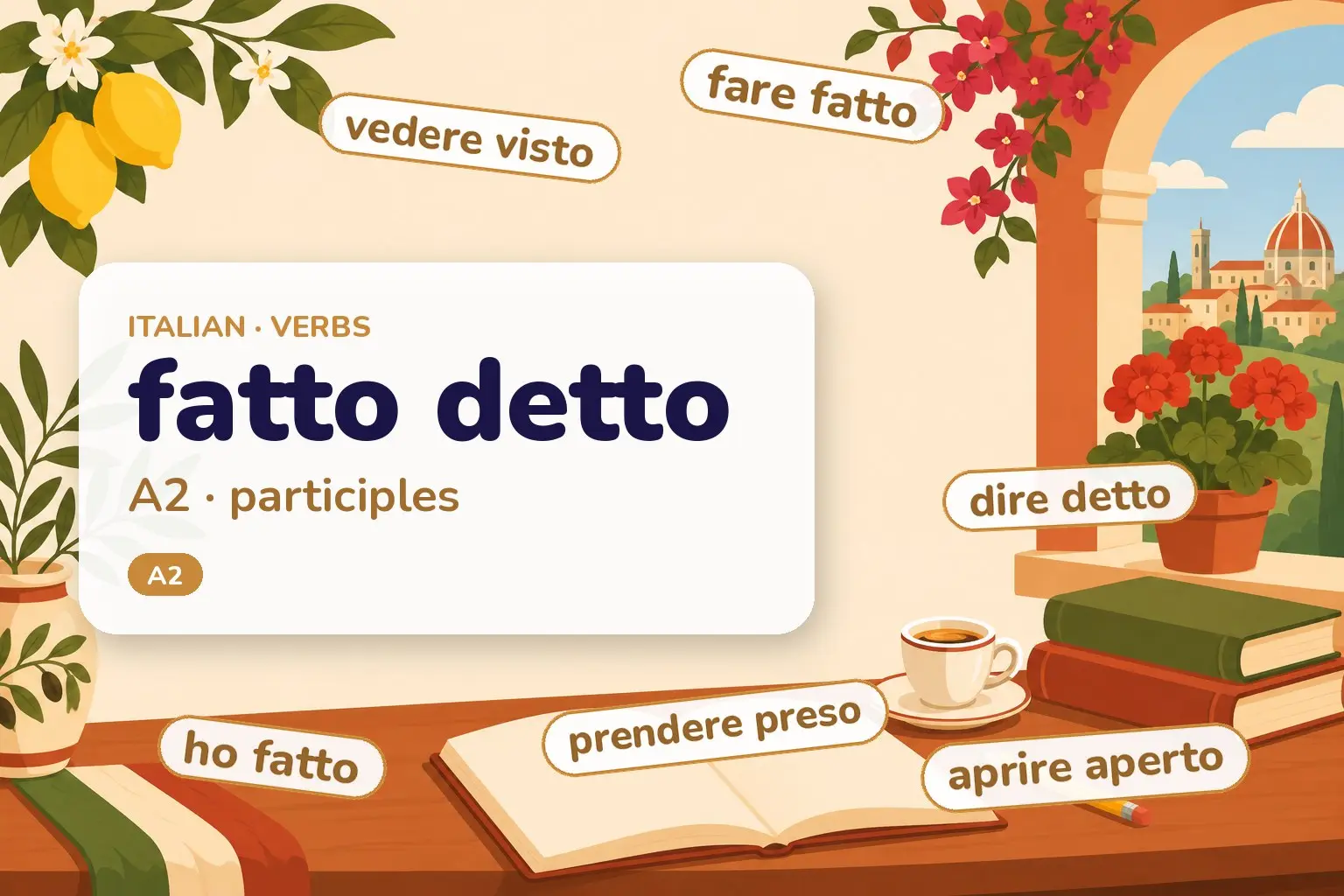
Italian past participles usually end in -ato, -uto, -ito, but many everyday verbs are irregular and must be learned: fare→fatto, dire→detto, prendere→preso, vedere→visto, aprire→aperto. You use them with avere or essere to build the passato prossimo: ho fatto, abbiamo preso.
Level: A2. Italian past participles are mostly regular — until you hit the verbs you use most. Fare, dire, prendere, vedere and a dozen others have their own participles, and because they are so common, learning them is the fastest way to speak about the past.
The rule
The past participle (Italian participio passato) is the verb form you pair with avere or essere to say what happened: ho mangiato (“I have eaten”), sono andato (“I went”). For regular verbs it follows the infinitive ending:
- -are verbs → -ato: parlare → parlato
- -ere verbs → -uto: credere → creduto
- -ire verbs → -ito: finire → finito
But many high-frequency verbs — nearly all from the -ere group — have irregular participles that do not follow this pattern. Fare becomes fatto, not “facuto”; prendere becomes preso, not “prenduto”. There is no way to predict every one, so these are learned as vocabulary. The good news: they cluster into a few shapes (-tto, -sto, -so, -lto), which makes them easier to group.
The most common irregular participles
| Infinitive | Meaning | Participle |
|---|---|---|
| fare | to do/make | fatto |
| dire | to say | detto |
| prendere | to take | preso |
| vedere | to see | visto |
| aprire | to open | aperto |
| chiudere | to close | chiuso |
| leggere | to read | letto |
| scrivere | to write | scritto |
| mettere | to put | messo |
| chiedere | to ask | chiesto |
| rispondere | to answer | risposto |
| scegliere | to choose | scelto |
| venire | to come | venuto |
| rimanere | to stay | rimasto |
| vincere | to win | vinto |
Notice the families: -tto (fatto, detto, letto, scritto), -sto (visto, chiesto, risposto, rimasto), -so (preso, chiuso, messo), -lto/-nto (scelto, vinto).
Using them: avere or essere
An irregular participle behaves like any participle once it is formed. With avere it normally stays fixed; with essere it agrees in gender and number with the subject:
| Helper | Example | Agreement |
|---|---|---|
| avere | Ho fatto i compiti. | fixed: fatto |
| avere | Abbiamo preso il treno. | fixed: preso |
| essere | Lei è rimasta a casa. | feminine: rimasta |
| essere | Loro sono venuti tardi. | masc. plural: venuti |
Example sentences
- Ho fatto i compiti.I did my homework.fare → fatto, with avere (fixed)
- Che cosa hai detto?What did you say?dire → detto
- Abbiamo preso l'autobus.We took the bus.prendere → preso
- Non ho visto il film.I haven't seen the film.vedere → visto
- Ha aperto la finestra.He opened the window.aprire → aperto
- Hanno chiuso il negozio.They closed the shop.chiudere → chiuso
- Ho letto un bel libro.I read a good book.leggere → letto
- Le ho scritto una lettera.I wrote her a letter.scrivere → scritto
- Dove hai messo le chiavi?Where did you put the keys?mettere → messo
- Ti ho chiesto aiuto.I asked you for help.chiedere → chiesto
- Non mi hanno risposto.They didn't answer me.rispondere → risposto
- Ho scelto il vino rosso.I chose the red wine.scegliere → scelto
- Maria è venuta alla festa.Maria came to the party.venire → venuta (essere, feminine)
- Siamo rimasti a casa.We stayed at home.rimanere → rimasti (essere, masc. plural)
- La squadra ha vinto la partita.The team won the match.vincere → vinto
- Sono stato molto occupato.I have been very busy.essere → stato
- Abbiamo avuto fortuna.We had luck / we were lucky.avere → avuto
- Lei è andata via presto.She left early.andare → andato → andata (essere, feminine)
Common mistakes
- ❌ Ho facuto i compiti. → ✅ Ho fatto i compiti. Fare is irregular; the participle is fatto, never the “regular” facuto.
- ❌ Ho prenduto il treno. → ✅ Ho preso il treno. Prendere → preso; most -ere verbs do not take the regular -uto here.
- ❌ Ho vedato il film. → ✅ Ho visto il film. Vedere → visto.
- ❌ Maria è venuto. → ✅ Maria è venuta. With essere the participle agrees: a feminine subject takes -a (venuta).
- ❌ Ho aperta la porta. → ✅ Ho aperto la porta. With avere the participle normally stays fixed (aperto), even if the object is feminine.
A short conversation
— Hai fatto la spesa? (Did you do the shopping?) — Sì, e ho preso anche il pane. (Yes, and I also got the bread.) — fare → fatto, prendere → preso — E Maria? (And Maria?) — È rimasta a casa, ha letto tutto il pomeriggio. (She stayed home, she read all afternoon.) — rimanere → rimasta (essere), leggere → letto (avere)
Three irregular participles in four lines — fatto, preso, letto with avere (fixed), and rimasta with essere (agreeing with Maria).
Usage notes
- Agreement only with essere (and with some object pronouns). After avere the participle is fixed (ho visto la casa), but if a direct-object pronoun lo/la/li/le comes first it agrees: La casa? L’ho vista. This finer rule is covered in the passato prossimo lessons.
- The same participle serves as an adjective: una finestra aperta (“an open window”), un lavoro fatto bene (“a job done well”). Then it always agrees like a normal adjective.
- Compounds inherit the irregularity: verbs built on an irregular root keep its participle — comporre → composto, riprendere → ripreso, descrivere → descritto.
- Stress and spelling matter: detto, fatto, letto, messo have a double consonant — dropping it (deto, meso) is a spelling error and changes the sound.
Compared with…
- Regular participles: the predictable -ato / -uto / -ito endings cover most verbs — parlato, creduto, finito. The irregular ones are the exceptions you memorise; everything else you build by rule.
- passato prossimo with avere: irregular participles slot straight into the avere perfect, where the participle stays fixed: ho fatto, abbiamo preso. See Italian passato prossimo with avere.
- passato prossimo with essere: with essere the same participle must agree in gender and number — è venuta, sono rimasti. See Italian passato prossimo with essere.
How to say it
These are the sounds English speakers get wrong in this lesson’s words:
| Sound | How to say it |
|---|---|
| double consonant in fatto, detto | hold it longer: fatto ≈ “FAHT-to”, clearly longer than a single t. |
| sc before i/e in scelto | like “sh”: scelto ≈ “SHEL-to”. |
| gl in scegliere | like “lli” in “million”: ≈ “shel-YEH-reh”. |
| s in preso, chiuso | a voiced “z” here: preso ≈ “PREH-zo”. |
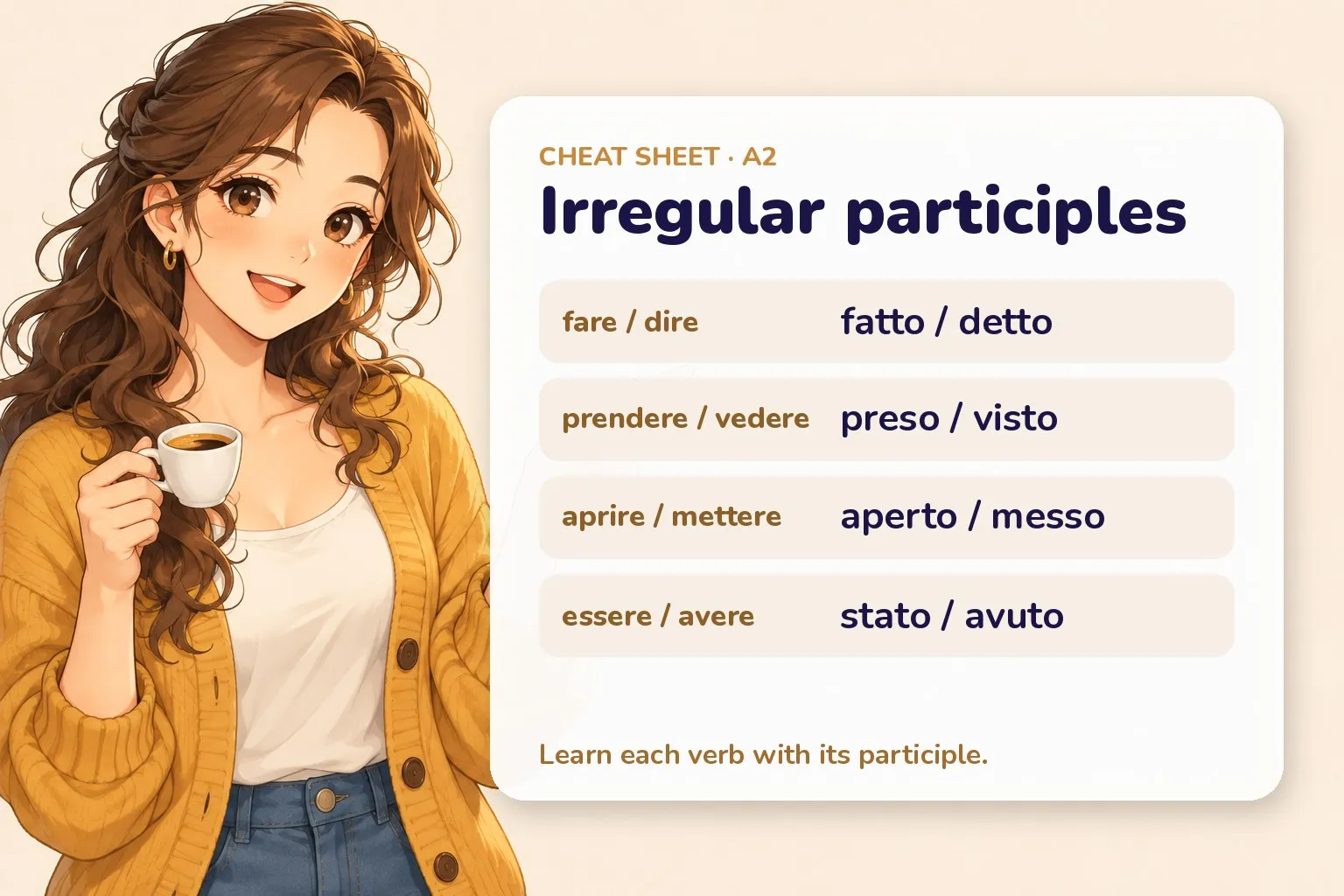
Quick recap before the quiz.
Practice
Irregular participles practice
Try each one, then press Check. No sign-up, nothing is sent anywhere — it all runs in your browser.
2 Match each verb to its irregular participle.
- dire
- prendere
- vedere
- aprire
Show answer
- dire → detto
- prendere → preso
- vedere → visto
- aprire → aperto
Store the verb and participle together as a pair.
Hint: double t
Show answer
letto — leggere → letto.
5 Build: 'We took the bus.'
Show answer
abbiamo preso l'autobus — avere + fixed participle: Abbiamo preso l'autobus.
Hint: double s
Show answer
messo — mettere → messo.
Quiz
Italian irregular past participles
10 questions · pick an answer and you'll see straight away if it's right.
-
Show answer
-ato — -are → -ato (parlato); -ere → -uto; -ire → -ito.
-
Show answer
detto — dire → detto.
-
Show answer
preso — prendere → preso.
-
Show answer
visto — vedere → visto (veduto exists but visto is the normal form).
-
Show answer
aperto — aprire → aperto.
-
Show answer
essere — essere: è andata, sono venuti; avere normally keeps it fixed.
-
Show answer
Ho fatto i compiti — fare → fatto; with avere it stays fixed: Ho fatto i compiti.
-
Show answer
Sono venuti tardi — venire + essere, masculine plural: sono venuti.
-
Show answer
messo — messo (mettere) has a double s; dropping it is a spelling error.
-
Show answer
vinto — vincere → vinto.
Recap cheat-sheet
| Verb | Participle |
|---|---|
| fare | fatto |
| dire | detto |
| prendere | preso |
| vedere | visto |
| aprire | aperto |
| scrivere | scritto |
| mettere | messo |
| essere | stato |
Next
- Use them with avere: Italian passato prossimo with avere
- Use them with essere (with agreement): Italian passato prossimo with essere
- Build regular -are verbs first: Italian present -are verbs
- Back to the Italian grammar section
All Italian grammar topics
Every grammar point in order, from your first sentence to advanced structures. Pick one and go straight to it. New lessons go live every day, so topics marked Coming soon fill in over the next weeks.
Grammar path
A1 18 topics · 18 ready
- 01 Italian Definite Articles (il, la, i, le)
- 02 Italian Indefinite Articles (un, una)
- 03 Noun Gender and Number
- 04 The Verb Essere (to be)
- 05 The Verb Avere (to have)
- 06 Subject Pronouns (io, tu, lui, lei)
- 07 Present Tense: -are Verbs
- 08 Present Tense: -ere Verbs
- 09 Present Tense: -ire Verbs (and -isc-)
- 10 Plural of Nouns and Adjectives
- 11 Adjective Agreement and Position
- 12 C'è and Ci sono (there is/are)
- 13 Question Words (chi, che, dove, quando)
- 14 Numbers, Time and Dates
- 15 Possessive Adjectives (il mio, la mia)
- 16 Negation with non
- 17 The Verb Piacere (to like)
- 18 Quantity Adjectives/Adverbs (molto, troppo, poco)
A2 23 topics · 3 ready
- 19 Passato Prossimo with Avere
- 20 Passato Prossimo with Essere
- 21 Irregular Past Participles You are here
- 22 Reflexive Verbs (alzarsi, lavarsi) Coming soon
- 23 Modal Verbs (potere, dovere, volere) Coming soon
- 24 Direct Object Pronouns (lo, la, li, le) Coming soon
- 25 Indirect Object Pronouns (gli, le) Coming soon
- 26 Simple Prepositions (di, a, da, in) Coming soon
- 27 Articulated Prepositions (del, nella, sul) Coming soon
- 28 The Imperfect Tense (Imperfetto) Coming soon
- 29 The Simple Future (Futuro Semplice) Coming soon
- 30 Comparatives (più, meno, come) Coming soon
- 31 Superlatives (il più, -issimo) Coming soon
- 32 The Imperative (tu, noi, voi) Coming soon
- 33 The Particles ci and ne Coming soon
- 34 Stare + Gerund (Present Progressive) Coming soon
- 35 C'è bisogno / Ci vuole (Need & Take Time) Coming soon
- 36 The Partitive (del, dei = some) Coming soon
- 37 Pre-Noun Forms: bello, buono, quello Coming soon
- 38 Stare per + Infinitive (About To) Coming soon
- 39 Forming Adverbs with -mente Coming soon
- 40 Time: da (since/for) and fa (ago) Coming soon
- 41 Double Negatives (non...niente, nessuno) Coming soon
B1 18 topics
- 42 Passato Prossimo vs Imperfetto Coming soon
- 43 Combined Pronouns (glielo, me lo) Coming soon
- 44 The Present Conditional (Condizionale) Coming soon
- 45 Impersonal and Passivante si Coming soon
- 46 Relative Pronouns (che, cui) Coming soon
- 47 The Future Perfect (Futuro Anteriore) Coming soon
- 48 The Past Perfect (Trapassato Prossimo) Coming soon
- 49 Formal Imperative (Lei) & with Pronouns Coming soon
- 50 The Gerund: Uses and Past Gerund Coming soon
- 51 The Past Conditional (Condizionale Passato) Coming soon
- 52 Pronoun Placement with Infinitive/Imperative Coming soon
- 53 Comparative & Superlative Irregulars Coming soon
- 54 Impersonal Verbs (bisogna, basta, sembra) Coming soon
- 55 Future of Probability (Suppositional) Coming soon
- 56 Altered Words (-ino, -one, -accio) Coming soon
- 57 Relative chi and quello che Coming soon
- 58 Ne with Quantities and Participle Agreement Coming soon
- 59 Adverb Position (già, ancora, più, mai) Coming soon
B2 14 topics
- 60 The Present Subjunctive (Congiuntivo) Coming soon
- 61 The Imperfect Subjunctive Coming soon
- 62 Perfect & Pluperfect Subjunctive Coming soon
- 63 The Three Hypothetical Periods (periodo ipotetico) Coming soon
- 64 Sequence of Tenses with the Subjunctive Coming soon
- 65 Passive Voice (essere / venire / andare) Coming soon
- 66 Conjunctions Requiring the Subjunctive Coming soon
- 67 Advanced Relatives (il quale, cui possessive) Coming soon
- 68 Reported Speech (Discorso Indiretto) Coming soon
- 69 The Remote Past (Passato Remoto) Coming soon
- 70 Causative Construction (fare + infinitive) Coming soon
- 71 Indefinite Adjectives & Pronouns Coming soon
- 72 Concession: anche se vs benché Coming soon
- 73 Gerund vs Infinitive as Subject/Complement Coming soon
C1 8 topics
- 74 Independent & Optative Subjunctive Coming soon
- 75 Advanced Sequence of Tenses Coming soon
- 76 Nominalisation & Formal Register Coming soon
- 77 Advanced Connectives & Cohesion Coming soon
- 78 Absolute Participle & Implicit Clauses Coming soon
- 79 Pronominal Verbs (farcela, andarsene) Coming soon
- 80 Dislocation & Emphasis Coming soon
- 81 Register, Style and Bureaucratic Italian Coming soon