Italian Possessive Adjectives: il mio, la mia
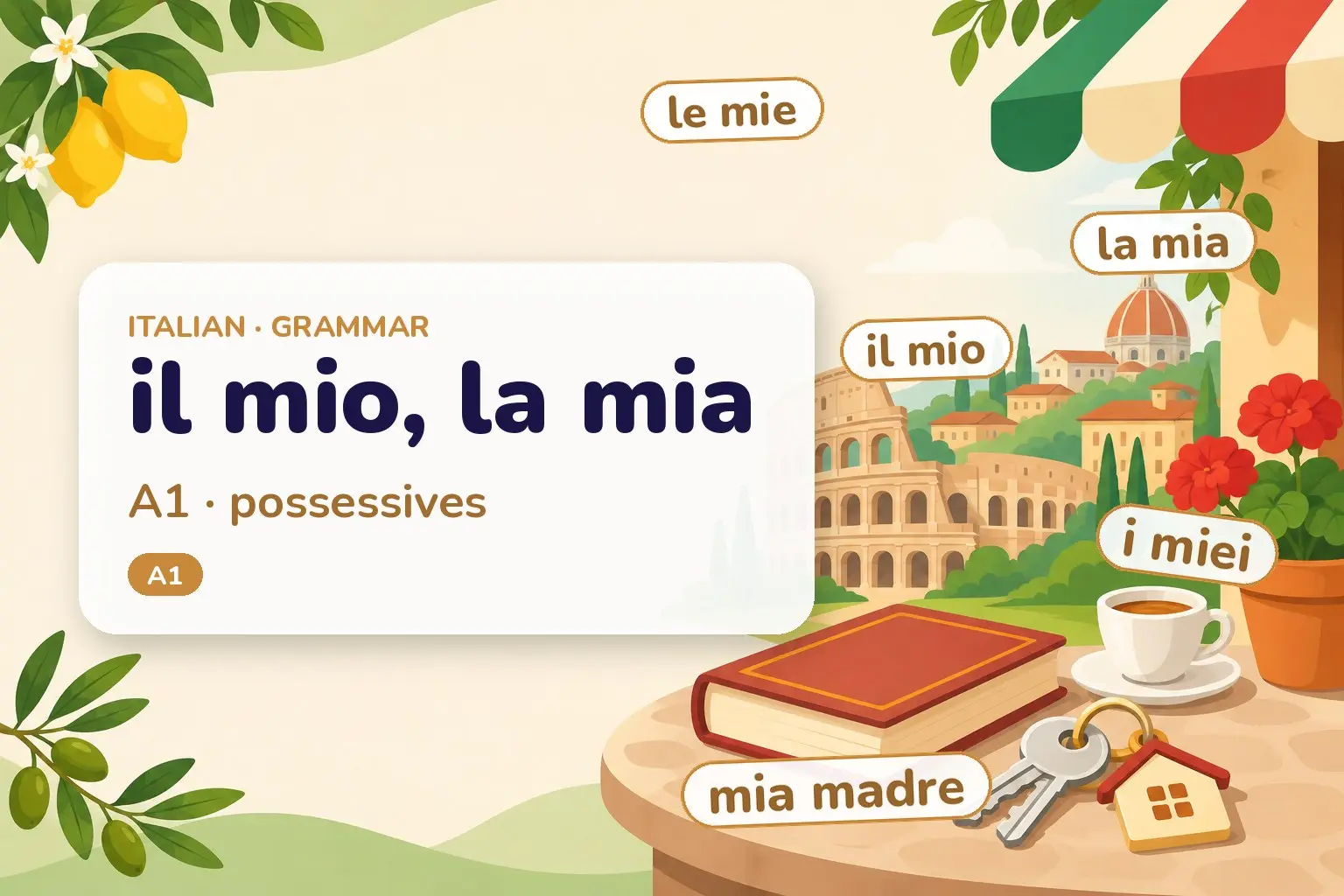
An Italian possessive usually comes as article + possessive + noun, and both the article and the possessive agree with the thing owned, not the owner: il mio libro, la mia casa, i miei amici. Singular, unmodified family nouns drop the article: mia madre.
Level: A1. To say “my”, “your”, “his” or “our” in Italian you use a possessive adjective, and it works differently from English in two ways: it usually comes with the definite article (il, la, i, le), and it agrees in gender and number with the thing owned — not with the person who owns it.
The rule
A possessive adjective tells you who something belongs to (my, your, his…). The default Italian pattern is three words:
article + possessive + noun → il mio libro (my book), la mia casa (my house), i miei amici (my friends), le mie chiavi (my keys).
Two points that surprise English speakers:
- Agreement is with the thing owned. il mio / la mia change because libro is masculine and casa is feminine — not because of who is speaking. The same goes for suo: la sua macchina is “his car” or “her car”, because it agrees with macchina (feminine), not with the owner.
- The article is normally there. Unlike English (“my book”), Italian keeps the article: il mio libro, literally “the my book”.
The forms
Each possessive has four endings — masculine singular, feminine singular, masculine plural, feminine plural — shown here with their usual articles:
| Owner | m. sing. | f. sing. | m. plur. | f. plur. |
|---|---|---|---|---|
| my | il mio | la mia | i miei | le mie |
| your (one person) | il tuo | la tua | i tuoi | le tue |
| his / her / its | il suo | la sua | i suoi | le sue |
| our | il nostro | la nostra | i nostri | le nostre |
| your (plural) | il vostro | la vostra | i vostri | le vostre |
| their | il loro | la loro | i loro | le loro |
Notice that loro never changes: only its article moves (il loro cane, la loro casa, i loro figli, le loro idee). The forms miei and tuoi/suoi are the irregular-looking masculine plurals — learn them as a set.
The family exception
With a singular, unmodified noun for a close family member, Italian drops the article:
- mia madre (my mother), tuo padre (your father), suo fratello (his/her brother), nostra sorella (our sister), mio figlio (my son).
But the article comes back the moment any of these is true:
- the noun is plural: i miei fratelli (my brothers), le tue sorelle (your sisters);
- the noun is modified by an adjective or a suffix: la mia sorellina (my little sister), il mio caro padre (my dear father);
- the possessive is loro: la loro madre (their mother) — loro always keeps the article;
- the word is mamma or papà (affectionate): la mia mamma, il mio papà.
How to say it
- miei is one syllable-ish glide, “MYEH-ee”: don’t split it into “mi-ei”.
- gl does not appear here, but c before i stays hard in amici → “a-MEE-chee” (ci = “chee”).
- suo / sua — keep both vowels pure: “SOO-oh”, “SOO-ah”.
- loro — a light tapped r: “LOH-ro”.
- Double consonant in nostro/vostro is single; but mamma, babbo hold the double.
Example sentences
- Il mio libro è sul tavolo.My book is on the table.il mio + masculine libro
- La mia casa è piccola.My house is small.la mia + feminine casa
- I miei amici arrivano domani.My friends arrive tomorrow.i miei = masculine plural
- Le mie chiavi sono qui.My keys are here.le mie = feminine plural
- Il tuo cane è grande.Your dog is big.il tuo + masculine cane
- La sua macchina è rossa.His/Her car is red.suo agrees with macchina, not the owner
- I suoi genitori sono italiani.His/Her parents are Italian.i suoi = masculine plural
- La nostra scuola è nuova.Our school is new.la nostra + feminine scuola
- Il vostro treno parte alle otto.Your (pl.) train leaves at eight.il vostro + masculine treno
- Il loro cane abbaia.Their dog barks.loro invariable, keeps the article
- Mia madre lavora in banca.My mother works at a bank.singular family noun: no article
- Tuo fratello è simpatico.Your brother is nice.singular family noun: no article
- I miei fratelli studiano.My brothers are studying.plural, so the article returns
- La mia sorellina ha cinque anni.My little sister is five.modified (-ina), so the article stays
- La loro madre è gentile.Their mother is kind.loro always keeps the article
- La mia mamma cucina bene.My mum cooks well.mamma keeps the article
- Questo è il mio.This one is mine.possessive used alone = pronoun
- Le sue idee sono interessanti.His/Her ideas are interesting.le sue + feminine plural idee
Common mistakes
- ❌ mia macchina → ✅ la mia macchina. Keep the article with ordinary nouns.
- ❌ la mia madre → ✅ mia madre. Drop the article with a singular, unmodified family noun.
- ❌ il suo macchina → ✅ la sua macchina. Agree with macchina (feminine), not the owner.
- ❌ i miei fratello → ✅ i miei fratelli / mio fratello. Match number: plural noun, plural possessive and article.
- ❌ la loro sorella meant as “no article because family” → ✅ la loro sorella. loro always keeps the article, even with family.
- ❌ mio mamma → ✅ la mia mamma. mamma and papà keep the article.
A short conversation
— È la tua borsa, questa? (Is this your bag?) — No, non è la mia. Forse è di tua sorella. (No, it isn’t mine. Maybe it’s your sister’s.) — Mia sorella è a casa. Sarà di un mio amico. (My sister is at home. It must be a friend of mine’s.)
Usage notes
- Possessive as a pronoun. Drop the noun and the same word stands alone as “mine/yours”: Questo libro è il mio (this book is mine), La mia è più grande (mine is bigger). It keeps the article and the agreement.
- “a friend of mine”. Italian says un mio amico (literally “a my friend”) — the possessive sits between the article and the noun.
- proprio. For “one’s own”, Italian often uses proprio (il proprio lavoro, one’s own work), especially with an impersonal subject.
- Emphasis. You can place the possessive after the noun for emphasis or in set phrases: casa mia (my home/my place), a modo mio (in my own way).
- Clarifying suo. Because suo is ambiguous, add di lui / di lei when it matters: la macchina di lui (his car), la macchina di lei (her car).
Compared with possessive pronouns
A possessive adjective sits before a noun (il mio libro); a possessive pronoun replaces the noun and stands alone (il mio = mine). The forms are identical — mio, tuo, suo… — and they keep the article and the agreement: La tua è rossa, la mia è blu (yours is red, mine is blue). To get the articles right first, see Italian definite articles, and for how gender and number drive the endings, see adjective agreement and noun gender.
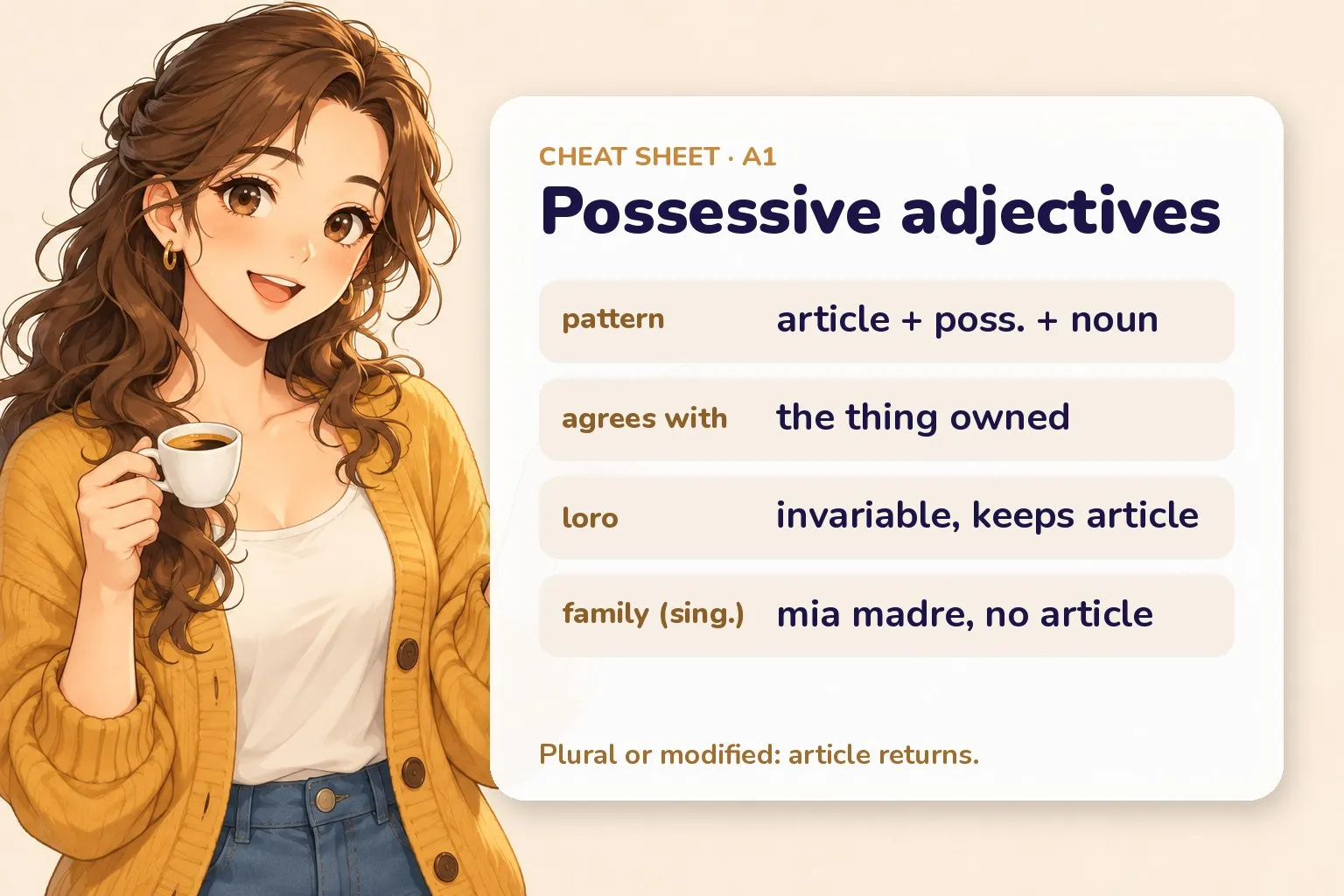
Quick recap before the quiz.
Practice
Italian possessive adjectives practice
Try each one, then press Check. No sign-up, nothing is sent anywhere — it all runs in your browser.
Hint: no article with singular family nouns
Show answer
mia — Singular, unmodified family noun drops the article: mia madre.
Hint: irregular masculine plural
Show answer
i miei — i miei amici — miei is the masculine plural of mio.
4 Build 'their dog' (dog = cane, masculine).
Show answer
il loro cane — loro is invariable and keeps the article: il loro cane.
5 Match each phrase to its form.
- my keys
- your (sg) dog
- our school
- their mother
Show answer
- my keys → le mie chiavi
- your (sg) dog → il tuo cane
- our school → la nostra scuola
- their mother → la loro madre
Agree with the thing owned; loro keeps the article even with family.
Quiz
Italian possessive adjectives
12 questions · pick an answer and you'll see straight away if it's right.
-
Show answer
the thing owned — They agree in gender and number with the thing owned.
-
Show answer
il mio libro — il mio libro — masculine singular with its article.
-
Show answer
la sua macchina — suo agrees with macchina (feminine): la sua macchina, his OR her.
-
Show answer
loro — loro is invariable; only its article changes.
-
Show answer
mia madre — Singular, unmodified family noun: no article, mia madre.
-
Show answer
i miei fratelli — Plural brings the article back: i miei fratelli.
-
Show answer
the -ina suffix modifies the noun — A diminutive counts as modification, so the article stays.
-
Show answer
la loro madre — loro keeps the article even with a family noun: la loro madre.
-
Show answer
tuoi — i tuoi — tuoi is the masculine plural of tuo.
-
Show answer
la nostra — la nostra scuola — feminine singular.
-
Show answer
Questo libro è il mio — As a pronoun it keeps the article: è il mio.
-
Show answer
un mio amico — The possessive sits between article and noun: un mio amico.
Recap cheat-sheet
| Point | Rule | Example |
|---|---|---|
| default pattern | article + possessive + noun | il mio libro |
| agreement | with the thing owned | la sua casa (his/her) |
| loro | invariable, always with article | il loro cane |
| family (sing., plain) | drop the article | mia madre |
| family plural/modified | article returns | i miei fratelli, la mia sorellina |
| as a pronoun | same form, keeps article | è il mio |
Next
- Back to the Italian grammar section
- Related: Italian definite articles and adjective agreement
- New here? Start with Start Learning Italian Here
All Italian grammar topics
Every grammar point in order, from your first sentence to advanced structures. Pick one and go straight to it. New lessons go live every day, so topics marked Coming soon fill in over the next weeks.
Grammar path
A1 18 topics · 18 ready
- 01 Italian Definite Articles (il, la, i, le)
- 02 Italian Indefinite Articles (un, una)
- 03 Noun Gender and Number
- 04 The Verb Essere (to be)
- 05 The Verb Avere (to have)
- 06 Subject Pronouns (io, tu, lui, lei)
- 07 Present Tense: -are Verbs
- 08 Present Tense: -ere Verbs
- 09 Present Tense: -ire Verbs (and -isc-)
- 10 Plural of Nouns and Adjectives
- 11 Adjective Agreement and Position
- 12 C'è and Ci sono (there is/are)
- 13 Question Words (chi, che, dove, quando)
- 14 Numbers, Time and Dates
- 15 Possessive Adjectives (il mio, la mia) You are here
- 16 Negation with non
- 17 The Verb Piacere (to like)
- 18 Quantity Adjectives/Adverbs (molto, troppo, poco)
A2 23 topics · 3 ready
- 19 Passato Prossimo with Avere
- 20 Passato Prossimo with Essere
- 21 Irregular Past Participles
- 22 Reflexive Verbs (alzarsi, lavarsi) Coming soon
- 23 Modal Verbs (potere, dovere, volere) Coming soon
- 24 Direct Object Pronouns (lo, la, li, le) Coming soon
- 25 Indirect Object Pronouns (gli, le) Coming soon
- 26 Simple Prepositions (di, a, da, in) Coming soon
- 27 Articulated Prepositions (del, nella, sul) Coming soon
- 28 The Imperfect Tense (Imperfetto) Coming soon
- 29 The Simple Future (Futuro Semplice) Coming soon
- 30 Comparatives (più, meno, come) Coming soon
- 31 Superlatives (il più, -issimo) Coming soon
- 32 The Imperative (tu, noi, voi) Coming soon
- 33 The Particles ci and ne Coming soon
- 34 Stare + Gerund (Present Progressive) Coming soon
- 35 C'è bisogno / Ci vuole (Need & Take Time) Coming soon
- 36 The Partitive (del, dei = some) Coming soon
- 37 Pre-Noun Forms: bello, buono, quello Coming soon
- 38 Stare per + Infinitive (About To) Coming soon
- 39 Forming Adverbs with -mente Coming soon
- 40 Time: da (since/for) and fa (ago) Coming soon
- 41 Double Negatives (non...niente, nessuno) Coming soon
B1 18 topics
- 42 Passato Prossimo vs Imperfetto Coming soon
- 43 Combined Pronouns (glielo, me lo) Coming soon
- 44 The Present Conditional (Condizionale) Coming soon
- 45 Impersonal and Passivante si Coming soon
- 46 Relative Pronouns (che, cui) Coming soon
- 47 The Future Perfect (Futuro Anteriore) Coming soon
- 48 The Past Perfect (Trapassato Prossimo) Coming soon
- 49 Formal Imperative (Lei) & with Pronouns Coming soon
- 50 The Gerund: Uses and Past Gerund Coming soon
- 51 The Past Conditional (Condizionale Passato) Coming soon
- 52 Pronoun Placement with Infinitive/Imperative Coming soon
- 53 Comparative & Superlative Irregulars Coming soon
- 54 Impersonal Verbs (bisogna, basta, sembra) Coming soon
- 55 Future of Probability (Suppositional) Coming soon
- 56 Altered Words (-ino, -one, -accio) Coming soon
- 57 Relative chi and quello che Coming soon
- 58 Ne with Quantities and Participle Agreement Coming soon
- 59 Adverb Position (già, ancora, più, mai) Coming soon
B2 14 topics
- 60 The Present Subjunctive (Congiuntivo) Coming soon
- 61 The Imperfect Subjunctive Coming soon
- 62 Perfect & Pluperfect Subjunctive Coming soon
- 63 The Three Hypothetical Periods (periodo ipotetico) Coming soon
- 64 Sequence of Tenses with the Subjunctive Coming soon
- 65 Passive Voice (essere / venire / andare) Coming soon
- 66 Conjunctions Requiring the Subjunctive Coming soon
- 67 Advanced Relatives (il quale, cui possessive) Coming soon
- 68 Reported Speech (Discorso Indiretto) Coming soon
- 69 The Remote Past (Passato Remoto) Coming soon
- 70 Causative Construction (fare + infinitive) Coming soon
- 71 Indefinite Adjectives & Pronouns Coming soon
- 72 Concession: anche se vs benché Coming soon
- 73 Gerund vs Infinitive as Subject/Complement Coming soon
C1 8 topics
- 74 Independent & Optative Subjunctive Coming soon
- 75 Advanced Sequence of Tenses Coming soon
- 76 Nominalisation & Formal Register Coming soon
- 77 Advanced Connectives & Cohesion Coming soon
- 78 Absolute Participle & Implicit Clauses Coming soon
- 79 Pronominal Verbs (farcela, andarsene) Coming soon
- 80 Dislocation & Emphasis Coming soon
- 81 Register, Style and Bureaucratic Italian Coming soon