Negating the Present & Future: لا and لَنْ (lā, lan)
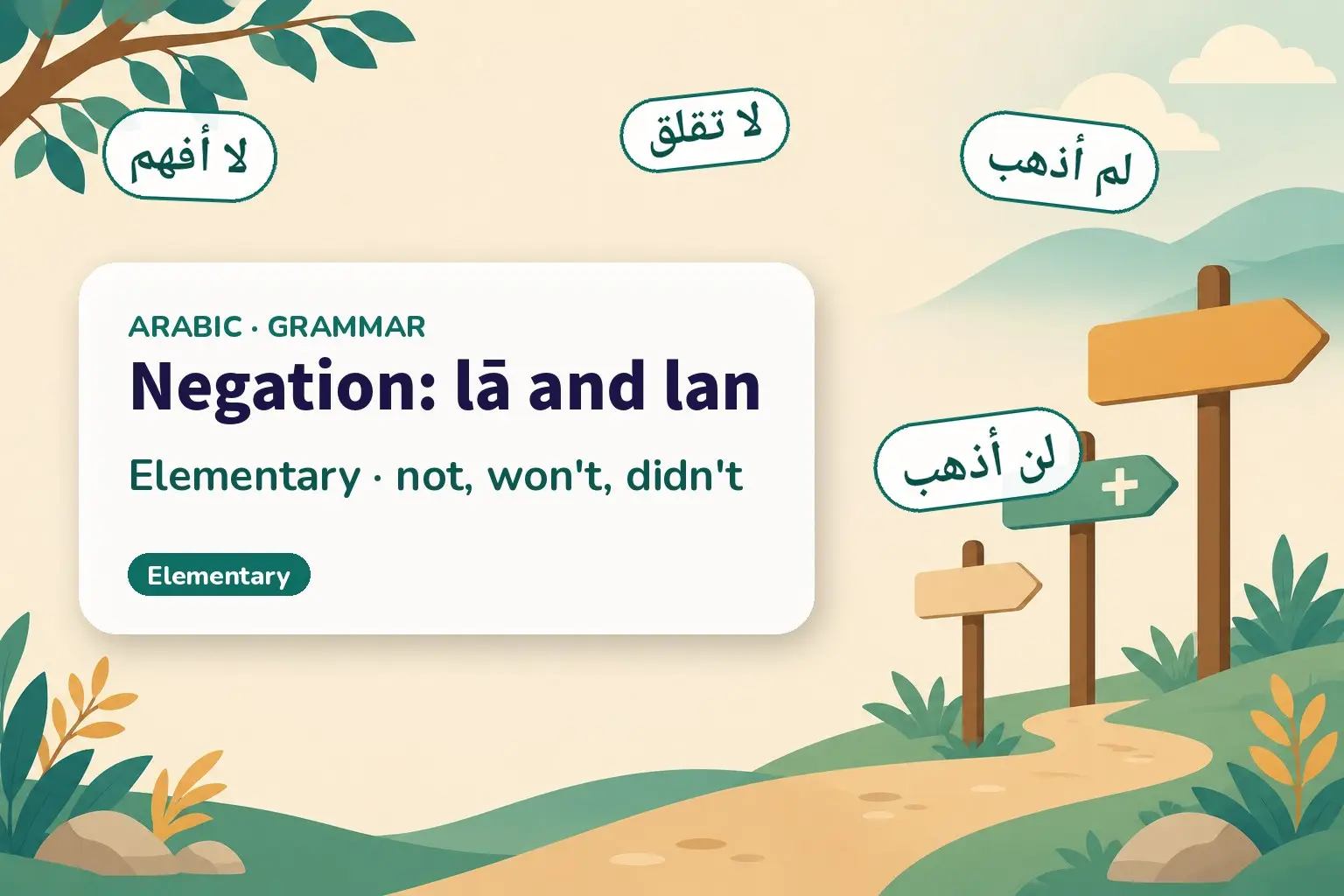
Put لا (lā) before a present-tense verb to say it does not happen: لَا أَفْهَم (lā afham, I don't understand). For the future, use لَنْ (lan) and switch the verb to the subjunctive: لَنْ أَذْهَبَ (lan adhhaba, I will not go).
Level: Elementary. Arabic negates a verb with a particle in front of it, and the particle rewrites one vowel at the end of the verb. Learn which vowel each particle demands and the rest follows mechanically: لا (lā) for what is not happening, لَنْ (lan) for what will not happen.
The rule
A particle is a small invariable word that carries grammar instead of meaning — Arabic has no separate word for “not”. Negative particles sit directly before the verb, and each one requires a particular mood: the set of endings that shows how the speaker views the action.
- لا (lā) + present indicative. The verb keeps its normal present ending, -u. لَا أَفْهَم (lā afham) — I don’t understand. This is the everyday negation of a present or habitual action.
- لَنْ (lan) + present subjunctive. The verb’s final vowel becomes -a. لَنْ أَذْهَبَ (lan adhhaba) — I will not go. The particle لَنْ (lan) also carries a firm “not at all, not ever” flavour.
- لَمْ (lam) + jussive. The verb loses its final vowel altogether. لَمْ أَذْهَبْ (lam adhhab) — I did not go. لَمْ (lam) is the third member of the family and the one that shoves the action into the past.
The endings themselves are the whole story. An imperfect verb in the indicative ends in -u — يَكْتُبُ (yaktubu) — in the subjunctive in -a — يَكْتُبَ (yaktuba) — and in the jussive in a sukun, no vowel at all: يَكْتُبْ (yaktub). Arabic grammar calls these three states marfūʿ (raised), manṣūb (set upright) and majzūm (cut).
The three negations compared
| Particle | Verb needed | Example | Meaning |
|---|---|---|---|
| لَا (lā) | present indicative, -u | لَا يَكْتُبُ (lā yaktubu) | he does not write |
| لَنْ (lan) | present subjunctive, -a | لَنْ يَكْتُبَ (lan yaktuba) | he will not write |
| لَمْ (lam) | present jussive, no vowel | لَمْ يَكْتُبْ (lam yaktub) | he did not write |
Note what the table does not say: لَنْ (lan) is not followed by a special “future tense”. Arabic has no future inflection, so the future is expressed by the present verb, and the particle لَنْ (lan) is what marks it as negated future.
What happens to the ending
| Person | Indicative | After لَنْ | After لَمْ |
|---|---|---|---|
| I | أَكْتُبُ (aktubu) | لَنْ أَكْتُبَ (lan aktuba) | لَمْ أَكْتُبْ (lam aktub) |
| you (m) | تَكْتُبُ (taktubu) | لَنْ تَكْتُبَ (lan taktuba) | لَمْ تَكْتُبْ (lam taktub) |
| she | تَكْتُبُ (taktubu) | لَنْ تَكْتُبَ (lan taktuba) | لَمْ تَكْتُبْ (lam taktub) |
| he | يَكْتُبُ (yaktubu) | لَنْ يَكْتُبَ (lan yaktuba) | لَمْ يَكْتُبْ (lam yaktub) |
| we | نَكْتُبُ (naktubu) | لَنْ نَكْتُبَ (lan naktuba) | لَمْ نَكْتُبْ (lam naktub) |
| they (m) | يَكْتُبُونَ (yaktubūna) | لَنْ يَكْتُبُوا (lan yaktubū) | لَمْ يَكْتُبُوا (lam yaktubū) |
The plural needs a second look. يَكْتُبُونَ (yaktubūna) keeps its ن (nūn) in the indicative, but the subjunctive and jussive both drop it: يَكْتُبُوا (yaktubū). So the -a and -∅ rule shows up as “lose the nūn” on plurals, and as “change or drop the last vowel” everywhere else.
Verb type changes the surface form, never the rule:
| Verb type | Indicative | After لَنْ | After لَمْ |
|---|---|---|---|
| sound: كَتَبَ (kataba) | يَكْتُبُ (yaktubu) | لَنْ يَكْتُبَ (lan yaktuba) | لَمْ يَكْتُبْ (lam yaktub) |
| hollow: قَالَ (qāla) | يَقُولُ (yaqūlu) | لَنْ يَقُولَ (lan yaqūla) | لَمْ يَقُلْ (lam yaqul) |
| defective: نَسِيَ (nasiya) | يَنْسَى (yansā) | لَنْ يَنْسَى (lan yansā) | لَمْ يَنْسَ (lam yansa) |
A hollow verb shortens its long vowel in the jussive — يَقُولُ (yaqūlu) becomes يَقُلْ (yaqul) — and a defective verb loses its final alif but keeps it under لَنْ (lan). Those two shapes are worth memorising as a pair.
Example sentences
Each sentence was written for this lesson. Listen for the final vowel on the verb.
- لَا أَفْهَم.lā afham.I don't understand.indicative after lā
- لَا نَعْرِفُ الْجَوَابَ.lā naʿrifu al-jawāba.We don't know the answer.
- هُوَ لَا يَتَكَلَّمُ الْعَرَبِيَّةَ.huwa lā yatakallamu al-ʿarabiyya.He doesn't speak Arabic.
- لَا أُحِبُّ الْقَهْوَةَ.lā uḥibbu al-qahwa.I don't like coffee.
- الطَّعَامُ لَا يَطِيبُ بِدُونِ مِلْحٍ.aṭ-ṭaʿāmu lā yaṭību bidūni milḥin.Food isn't good without salt.
- لَنْ أَتَأَخَّرَ غَدًا.lan ataʾakhkhara ghadan.I won't be late tomorrow.subjunctive -a
- لَنْ نَنْسَى هَذَا الْيَوْمَ.lan nansā hādhā al-yawma.We will never forget this day.defective verb keeps its alif
- لَنْ يَكُونَ سَهْلًا.lan yakūna sahlan.It won't be easy.hollow verb
- لَنْ تَجِدَ أَرْخَصَ مِنْ هَذَا.lan tajida arkhaṣa min hādhā.You won't find anything cheaper than this.
- لَنْ أَشْتَرِيَ السَّيَّارَةَ.lan ashtariya as-sayyāra.I'm not going to buy the car.
- لَمْ أَذْهَبْ إِلَى الْعَمَلِ أَمْسِ.lam adhhab ilā al-ʿamali amsi.I didn't go to work yesterday.jussive, no final vowel
- لَمْ يَكْتُبْ شَيْئًا.lam yaktub shayʾan.He didn't write anything.
- لَمْ نَسْمَعْ الْخَبَرَ.lam nasmaʿ al-khabara.We didn't hear the news.
- لَمْ يَكُنْ عِنْدِي وَقْتٌ.lam yakun ʿindī waqtun.I didn't have time.kāna in the jussive
- لَا تَذْهَبْ وَحْدَكَ.lā tadhhab waḥdaka.Don't go alone.prohibitive lā + jussive
- لَا تَقْلَقْ، الْأَمْرُ سَهْلٌ.lā taqlaq, al-amru sahlun.Don't worry, it's easy.
- لَا تَنْسَ الْمِفْتَاحَ.lā tansa al-miftāḥa.Don't forget the key.
- لَنْ أُسَافِرَ هَذَا الشَّهْرَ وَلَا الشَّهْرَ الْقَادِمَ.lan usāfira hādhā ash-shahra wa-lā ash-shahra al-qādima.I won't travel this month or next month.
Common mistakes
- ❌ لَنْ أَذْهَبُ (lan adhhabu) with the indicative ending → ✅ لَنْ أَذْهَبَ (lan adhhaba). لَنْ (lan) demands the subjunctive, so -u becomes -a.
- ❌ لَا أَذْهَبَ (lā adhhaba) with a subjunctive ending → ✅ لَا أَذْهَبُ (lā adhhabu). Plain present negation keeps the indicative.
- ❌ using لَنْ (lan) for the past, as in لَنْ ذَهَبْتُ (lan dhahabtu) → ✅ لَمْ أَذْهَبْ (lam adhhab). Past negation belongs to لَمْ (lam) or مَا (mā); لَنْ (lan) never takes a past verb.
- ❌ reading لَا تَكْتُبْ (lā taktub) as “he doesn’t write” → ✅ it means don’t write. The jussive ending marks a prohibition.
- ❌ keeping the nūn on a negated plural, as in لَنْ يَكْتُبُونَ (lan yaktubūna) → ✅ لَنْ يَكْتُبُوا (lan yaktubū). Subjunctive and jussive both drop the ن (nūn).
A short conversation
— هَلْ تَفْهَمُ الْيَابَانِيَّة؟ — Hal tafhamu al-yābāniyya? — Do you understand Japanese? — لَا، لَا أَفْهَمُهَا. — Lā, lā afhamuhā. — No, I don’t understand it. — سَتَتَعَلَّمُهَا بِسُرْعَة. — Sa-tataʿallamuhā bi-surʿa. — You’ll learn it quickly. — لَنْ أَتَعَلَّمَهَا وَحْدِي. — Lan ataʿallamahā waḥdī. — I won’t learn it on my own. — لَا تَقْلَقْ، أَنَا مَعَكَ. — Lā taqlaq, anā maʿaka. — Don’t worry, I’m with you.
Three particles, three endings: لَا أَفْهَمُهَا (lā afhamuhā) keeps -u, لَنْ أَتَعَلَّمَهَا (lan ataʿallamahā) takes -a, and لَا تَقْلَقْ (lā taqlaq) drops the vowel.
Usage notes
- The prohibitive لا (lā) is a different job. Before a jussive verb, it means “don’t” and addresses someone. لَا تَنْسَ (lā tansa) is an instruction; لَا يَنْسَى (lā yansā) is a statement that someone does not forget. Context and ending decide, so say the ending clearly.
- Answers use plain لا (lā). A bare لَا (lā) is also the word for “no” — لَا، شُكْرًا (lā, shukran, no thank you). It carries no verb and no mood.
- لَنْ (lan) can be strengthened. Arabic often pairs it with أَبَدًا (abadan, ever): لَنْ أَنْسَاكَ أَبَدًا (lan ansāka abadan, I will never forget you). The particle still governs the subjunctive.
- Doubled negatives chain. وَلَا (wa-lā, and not) adds a second item: لَا أُحِبُّ الشَّايَ وَلَا الْقَهْوَةَ (lā uḥibbu ash-shāya wa-lā al-qahwa, I like neither tea nor coffee).
- كانَ (kāna) follows the same endings. لَمْ يَكُنْ (lam yakun) is the jussive of كانَ (kāna, to be), and it is the standard way to say “was not”.
Compared with…
- Past negation with مَا (mā). مَا كَتَبْتُ (mā katabtu, I did not write) negates a completed action with the perfect verb and no mood change. لَمْ يَكْتُبْ (lam yaktub) says the same thing in a more literary register and does change the mood. See negating the past with مَا (mā).
- Nominal negation. A sentence with no verb is negated with لَيْسَ (laysa) or مَا (mā), not with لا (lā) or لَنْ (lan): الطَّعَامُ لَيْسَ جَاهِزًا (aṭ-ṭaʿāmu laysa jāhizan, the food is not ready). See negating a nominal sentence.
Both contrasts use the same English “not”, which is why the Arabic split needs a decision before you speak: is there a verb, and is it present, future or past?
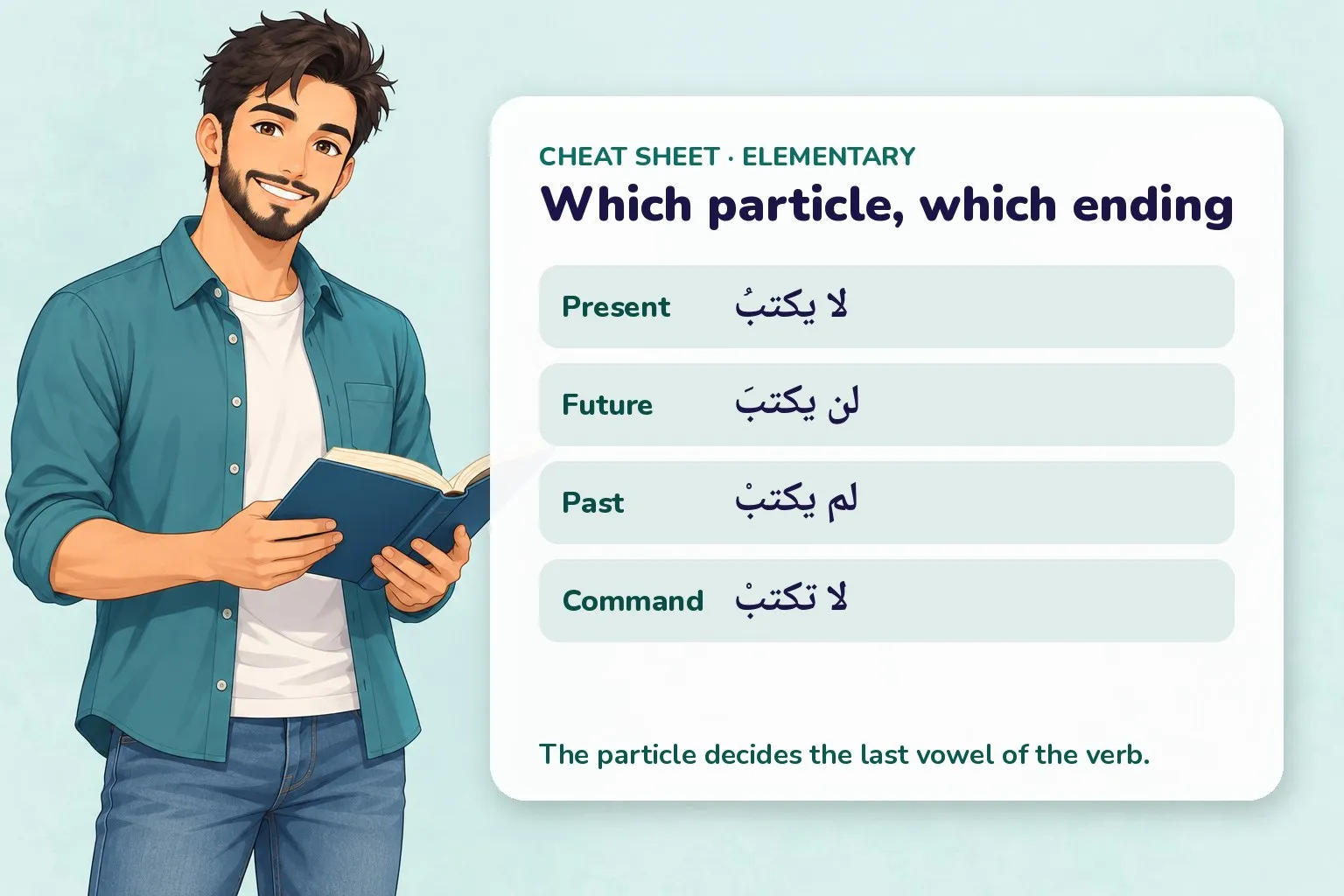
Quick recap before the quiz.
Practice
Arabic negation practice
Try each one, then press Check. No sign-up, nothing is sent anywhere — it all runs in your browser.
Hint: the present-tense particle
Show answer
lā — Present negation takes لا (lā) and keeps the indicative -u.
4 Match each particle to the mood it governs.
- لا (lā)
- لَنْ (lan)
- لَمْ (lam)
Show answer
- لا (lā) → indicative
- لَنْ (lan) → subjunctive
- لَمْ (lam) → jussive
Each negative particle fixes one mood of the imperfect verb.
5 Build the sentence: I will not go tomorrow.
Show answer
لَنْ (lan) أَذْهَبَ (adhhaba) غَدًا (ghadan) — Particle, then subjunctive verb, then the time word: لَنْ أَذْهَبَ غَدًا (lan adhhaba ghadan).
Quiz
Arabic negation: la, lan, lam
12 questions · pick an answer and you'll see straight away if it's right.
-
Show answer
the indicative — لا (lā) keeps the indicative ending -u.
-
Show answer
the subjunctive — لَنْ (lan) puts the verb in the subjunctive, ending in -a.
-
Show answer
لَمْ (lam) — لَمْ (lam) plus the jussive negates a past event.
-
Show answer
he will not write — لَنْ (lan) negates the future; the -a ending marks the subjunctive.
-
Show answer
يَكْتُبُوا (yaktubū) — Subjunctive and jussive both drop the final ن (nūn).
-
Show answer
a prohibition — لا (lā) with a jussive verb is the prohibitive: don't go.
-
Show answer
لَنْ أَنْسَى (lan ansā) — لَنْ (lan) plus the defective verb نَسِيَ (nasiya) keeps its alif.
-
Show answer
يَقُلْ (yaqul) — A hollow verb shortens its long vowel in the jussive.
-
Show answer
a completed past action — مَا (mā) with a perfect verb negates the past without any mood change.
-
Show answer
لَيْسَ (laysa) — Nominal sentences take لَيْسَ (laysa) or مَا (mā), not لا (lā) or لَنْ (lan).
-
Show answer
lan — لَنْ (lan) plus the subjunctive: لَنْ نَنْسَى (lan nansā).
-
Show answer
لَنْ أَذْهَبُ (lan adhhabu) — لَنْ (lan) cannot take the indicative ending -u.
Recap cheat-sheet
| Particle | Verb form | Example | Meaning |
|---|---|---|---|
| لَا (lā) | present indicative (-u) | لَا يَكْتُبُ (lā yaktubu) | he does not write |
| لَا (lā) | jussive (no vowel) | لَا تَكْتُبْ (lā taktub) | don’t write |
| لَنْ (lan) | present subjunctive (-a) | لَنْ يَكْتُبَ (lan yaktuba) | he will not write |
| لَمْ (lam) | jussive (no vowel) | لَمْ يَكْتُبْ (lam yaktub) | he did not write |
Next
- The other past negation: negating the past with مَا (mā)
- Sentences without verbs: negating a nominal sentence
- The verb you are negating: the Arabic present tense
- Back to the Arabic grammar section
All Arabic grammar topics
Every grammar point in order, from your first sentence to advanced structures. Pick one and go straight to it. New lessons go live every day, so topics marked Coming soon fill in over the next weeks.
Grammar path
Beginner 16 topics · 16 ready
- 01 The Definite Article الـ (al-)
- 02 Indefiniteness and Tanwin
- 03 Noun Gender (Masculine & Feminine)
- 04 The Nominal Sentence (Jumla Ismiyya)
- 05 Adjective Agreement (Na't)
- 06 Personal Pronouns (Separate)
- 07 Attached (Possessive/Object) Pronouns
- 08 Demonstratives (هذا hādhā، هذه hādhihi، ذلك dhālika)
- 09 The Idafa (Possessive Construction)
- 10 Prepositions (Huruf al-Jarr)
- 11 Questions (هل hal، أ a، ما mā، من man، أين ayna)
- 12 Negating Nominal Sentences (ليس laysa)
- 13 Numbers 1-10 and Counting
- 14 Pointing Sentences (هذا كتاب hādhā kitāb)
- 15 Prepositional & Adverbial Predicates
- 16 Expressing 'Have' (عند / لـ / مع ʿinda / li- / maʿa)
Elementary 17 topics · 6 ready
- 17 The Present Tense (al-Mudari')
- 18 The Past Tense (al-Madi)
- 19 The Verbal Sentence (Jumla Fi'liyya)
- 20 Verb Agreement with the Subject
- 21 Negating the Past (ما / لم mā / lam)
- 22 Negating the Present & Future (لا / لن lā / lan) You are here
- 23 The Future (سـ / سوف sa- / sawfa) Coming soon
- 24 The Dual (al-Muthanna) Coming soon
- 25 Sound Plurals (Masculine & Feminine) Coming soon
- 26 Broken Plurals (Jam' Taksir) Coming soon
- 27 Kana and Its Sisters Coming soon
- 28 Inna and Its Sisters Coming soon
- 29 Non-Human Plural Agreement Coming soon
- 30 Days, Months and Time Expressions Coming soon
- 31 Adverbs of Time & Place (Zarf) Coming soon
- 32 Hamzat al-Wasl vs Hamzat al-Qat' Coming soon
- 33 Colours & Defects (Af'al pattern) Coming soon
Intermediate 22 topics
- 34 The Three Cases (I'rab) Coming soon
- 35 Uses of the Accusative (Mansubat) Coming soon
- 36 The Derived Verb Forms (I-X) Coming soon
- 37 Root and Pattern Morphology Coming soon
- 38 Active & Passive Participles Coming soon
- 39 The Verbal Noun (Masdar) Coming soon
- 40 The Subjunctive (Mansub) after أن / لـ (an / li-) Coming soon
- 41 The Jussive (Majzum) & Commands Coming soon
- 42 The Imperative (al-Amr) Coming soon
- 43 Weak Verbs (Assimilated, Hollow, Defective) Coming soon
- 44 Relative Clauses (الذي alladhī، التي allatī) Coming soon
- 45 Comparative & Superlative (Af'al) Coming soon
- 46 Conditional Sentences (إذا idhā، إنْ in، لو law) Coming soon
- 47 Numbers 11-99 and Agreement Coming soon
- 48 The Five Nouns (al-Asma' al-Khamsa) Coming soon
- 49 Diptotes (al-Mamnu' min as-Sarf) Coming soon
- 50 Object of Purpose & Accompaniment Coming soon
- 51 Apposition & Substitution (Badal) Coming soon
- 52 Emphasis (at-Tawkid: نفس nafs، كل kull) Coming soon
- 53 Coordination (al-'Atf) & Case Carrying Coming soon
- 54 Questions of Quantity (كم kam) & Number Syntax Coming soon
- 55 The Nisba Adjective (-iyy) Coming soon
Upper-Intermediate 14 topics
- 56 The Circumstantial Clause (Hal) Coming soon
- 57 Specification (Tamyiz) Coming soon
- 58 Exception (al-Istithna': إلا illā) Coming soon
- 59 The Absolute Object (al-Maf'ul al-Mutlaq) Coming soon
- 60 The Passive Voice (al-Majhul) Coming soon
- 61 The Vocative (an-Nida': يا yā) Coming soon
- 62 Energetic Mood & Emphasis (Nun al-Tawkid) Coming soon
- 63 Verbs with Prepositions Coming soon
- 64 Connectors & Cohesion (و wa، ف fa، ثم thumma، لكنّ lākinna) Coming soon
- 65 Verbs of Certainty/Doubt (Dhanna & Sisters) Coming soon
- 66 Verbs with Two Objects Coming soon
- 67 The Diminutive (at-Tasghir) Coming soon
- 68 Collective & Unit Nouns Coming soon
- 69 Conditional Particles & Jussive Pair Coming soon
Advanced 10 topics
- 70 Advanced I'rab & Government Coming soon
- 71 Expressing Aspect (قد qad، كان قد kāna qad، لمّا lammā) Coming soon
- 72 Rhetorical Structures (Taqdim wa-Ta'khir) Coming soon
- 73 Advanced Conditionals & Oaths Coming soon
- 74 Classical/Formal Register (Fusha Style) Coming soon
- 75 Nominal Style & Masdar-Heavy Syntax Coming soon
- 76 Advanced Exception & Restriction (إنما innamā، غير ghayr) Coming soon
- 77 Absolute Negation (لا النافية للجنس lā an-nāfiya lil-jins) Coming soon
- 78 Particle Review: إنّ (inna)، أنّ (anna)، أنْ (an)، كأنّ (ka-anna) Coming soon
- 79 Verb-Initial vs Noun-Initial Style Coming soon