Arabic Numbers 1-10 and How to Count
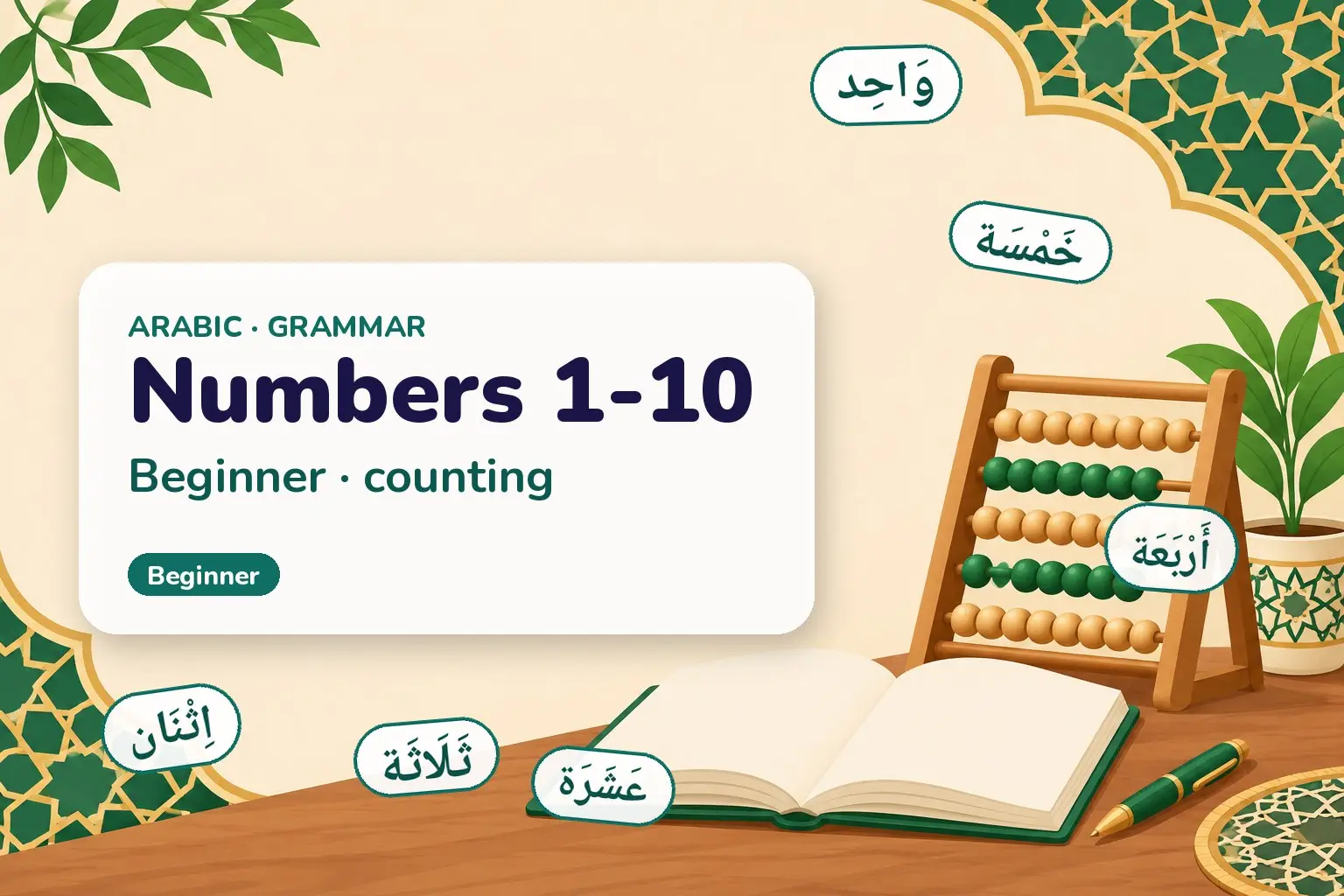
The Arabic numbers 1-10 are wāḥid, ithnān, thalātha, arbaʿa, khamsa, sitta, sabʿa, thamāniya, tisʿa, ʿashara. One and two agree with the noun; three to ten take the opposite gender (polarity) and are followed by a plural noun in the genitive.
Level: Beginner. Counting from one to ten in Arabic is easy to say but has one rule that surprises English speakers: for three to ten, the number takes the opposite gender to the thing you are counting. Learn the ten words first, then the polarity rule, and you can count almost anything.
The rule
A number (ʿadad) that counts a noun behaves differently depending on its size. There are three groups.
One and two agree. The number وَاحِد (wāḥid, one) acts like an adjective: it follows the noun and matches its gender — كِتَابٌ وَاحِدٌ (kitābun wāḥidun, one book), بِنْتٌ وَاحِدَةٌ (bintun wāḥidatun, one girl). For “two” you rarely need a separate word at all, because Arabic has a dual ending: كِتَابَانِ (kitābāni) already means “two books”. The word اِثْنَان (ithnān, two) is added only for emphasis.
Three to ten flip gender (polarity). This is the key rule. With a masculine noun, the number 3-10 takes the feminine form, the one with the tā marbūṭa ending; with a feminine noun, it takes the masculine form, with no such ending. So ثَلَاثَةُ كُتُبٍ (thalāthatu kutubin) is “three books” — كِتَاب (kitāb) is masculine, so the number wears the feminine tā marbūṭa — while ثَلَاثُ بَنَاتٍ (thalāthu banātin) is “three girls”, where the number drops it. This reverse agreement is called polarity.
The counted noun is plural and genitive. After 3-10, the thing you count is plural and in the genitive case, normally indefinite, which you hear as an -in ending: كُتُبٍ (kutubin), بَنَاتٍ (banātin). So the pattern is: number + plural noun in the genitive.
The numbers 1-10
| Number | Arabic | Reading | Meaning |
|---|---|---|---|
| 1 | وَاحِد | wāḥid | one |
| 2 | اِثْنَان | ithnān | two |
| 3 | ثَلَاثَة | thalātha | three |
| 4 | أَرْبَعَة | arbaʿa | four |
| 5 | خَمْسَة | khamsa | five |
| 6 | سِتَّة | sitta | six |
| 7 | سَبْعَة | sabʿa | seven |
| 8 | ثَمَانِيَة | thamāniya | eight |
| 9 | تِسْعَة | tisʿa | nine |
| 10 | عَشَرَة | ʿashara | ten |
The forms above (with the tā marbūṭa ending on 3-10) are the ones you use when you recite numbers on their own and when you count a masculine noun. Drop that ending to count a feminine noun.
Polarity side by side
| Counting a masculine noun | Reading | Counting a feminine noun | Reading |
|---|---|---|---|
| ثَلَاثَةُ كُتُبٍ | thalāthatu kutubin (3 books) | ثَلَاثُ بَنَاتٍ | thalāthu banātin (3 girls) |
| خَمْسَةُ رِجَالٍ | khamsatu rijālin (5 men) | خَمْسُ سَيَّارَاتٍ | khamsu sayyārātin (5 cars) |
| عَشَرَةُ طُلَّابٍ | ʿasharatu ṭullābin (10 students, m) | عَشْرُ بَنَاتٍ | ʿashru banātin (10 girls) |
Example sentences
- عِنْدِي كِتَابٌ وَاحِدٌ.ʿindī kitābun wāḥidun.I have one book.1 follows the noun and agrees (masculine)
- هُنَاكَ بِنْتٌ وَاحِدَةٌ.hunāka bintun wāḥidatun.There is one girl.1 agrees (feminine, with ة)
- عِنْدِي كِتَابَانِ.ʿindī kitābāni.I have two books.the dual ending means 'two'
- هُنَاكَ بِنْتَانِ.hunāka bintāni.There are two girls.dual, no separate word for 'two'
- عِنْدِي ثَلَاثَةُ كُتُبٍ.ʿindī thalāthatu kutubin.I have three books.masculine noun to feminine number (ة)
- عِنْدِي ثَلَاثُ بَنَاتٍ.ʿindī thalāthu banātin.I have three daughters.feminine noun to masculine number (no ة)
- فِي الصَّفِّ أَرْبَعَةُ أَوْلَادٍ.fī ṣ-ṣaffi arbaʿatu awlādin.There are four boys in the class.
- عِنْدَهَا أَرْبَعُ سَيَّارَاتٍ.ʿindahā arbaʿu sayyārātin.She has four cars.sayyāra is feminine, so the number drops ة
- خَمْسَةُ رِجَالٍ يَعْمَلُونَ هُنَا.khamsatu rijālin yaʿmalūna hunā.Five men work here.
- خَمْسُ نِسَاءٍ فِي الغُرْفَةِ.khamsu nisāʾin fī l-ghurfati.Five women are in the room.
- فِي الأُسْبُوعِ سَبْعَةُ أَيَّامٍ.fī l-usbūʿi sabʿatu ayyāmin.There are seven days in a week.
- اِشْتَرَيْتُ سِتَّةَ أَقْلَامٍ.ishtaraytu sittata aqlāmin.I bought six pens.
- عِنْدِي ثَمَانِيَةُ كُتُبٍ.ʿindī thamāniyatu kutubin.I have eight books.
- فِي البَيْتِ تِسْعُ غُرَفٍ.fī l-bayti tisʿu ghurafin.There are nine rooms in the house.ghurfa is feminine, so tisʿ with no ة
- فِي الصَّفِّ عَشَرَةُ طُلَّابٍ.fī ṣ-ṣaffi ʿasharatu ṭullābin.There are ten students (male) in the class.
- عَشْرُ بَنَاتٍ فِي الفَرِيقِ.ʿashru banātin fī l-farīqi.Ten girls are on the team.
Common mistakes
- ❌ ثَلَاثَةُ بَنَاتٍ (thalāthatu banātin) → ✅ ثَلَاثُ بَنَاتٍ (thalāthu banātin). بِنْت (bint) is feminine, so the number 3 drops the tā marbūṭa.
- ❌ خَمْسُ رِجَالٍ (khamsu rijālin) → ✅ خَمْسَةُ رِجَالٍ (khamsatu rijālin). رَجُل (rajul) is masculine, so the number 5 keeps the tā marbūṭa.
- ❌ ثَلَاثَةُ كِتَابٍ (thalāthatu kitābin, singular) → ✅ ثَلَاثَةُ كُتُبٍ (thalāthatu kutubin). After 3-10 the noun must be plural.
- ❌ ثَلَاثَةُ الكُتُبِ (thalāthatu l-kutubi) → ✅ ثَلَاثَةُ كُتُبٍ (thalāthatu kutubin). The counted noun is normally indefinite (with -in), not with الـ (al-).
- ❌ وَاحِدٌ كِتَابٌ (wāḥidun kitābun) → ✅ كِتَابٌ وَاحِدٌ (kitābun wāḥidun). “One” comes after its noun, like an adjective.
A short conversation
A: كَمْ كِتَابًا عِنْدَكَ؟ (kam kitāban ʿindaka?) — How many books do you have? B: عِنْدِي خَمْسَةُ كُتُبٍ. (ʿindī khamsatu kutubin.) — I have five books. A: وَكَمْ أُخْتًا؟ (wa-kam ukhtan?) — And how many sisters? B: عِنْدِي ثَلَاثُ أَخَوَاتٍ. (ʿindī thalāthu akhawātin.) — I have three sisters.
Usage notes
- “How many” takes the singular. After كَمْ (kam, how many) the noun is singular and in the accusative with -an: كَمْ كِتَابًا (kam kitāban), not a plural. The number answers with the plural.
- Build the plural first. Because 3-10 need a plural, you must know the noun’s plural, and many are “broken” (irregular): كِتَاب (kitāb) to كُتُب (kutub), وَلَد (walad) to أَوْلَاد (awlād), رَجُل (rajul) to رِجَال (rijāl). Learn the plural with the word.
- Case endings move with the sentence. The -u, -a, -i you hear on the number (thalāthatu, thalāthata, thalāthati) change with the number’s role in the sentence; in speech many endings are dropped, but they matter in careful or written Arabic.
Compared with higher numbers
- 11 and 12 use a different structure again, and from 11-99 the counted noun becomes singular accusative (أَحَدَ عَشَرَ كِتَابًا — aḥada ʿashara kitāban — eleven books), so the plural-genitive rule here is only for 3-10. Keep going in the Arabic grammar section once 1-10 feel solid.
- Polarity builds on noun gender in Arabic: if you cannot yet tell a masculine noun from a feminine one, review that first, because the whole rule depends on it.
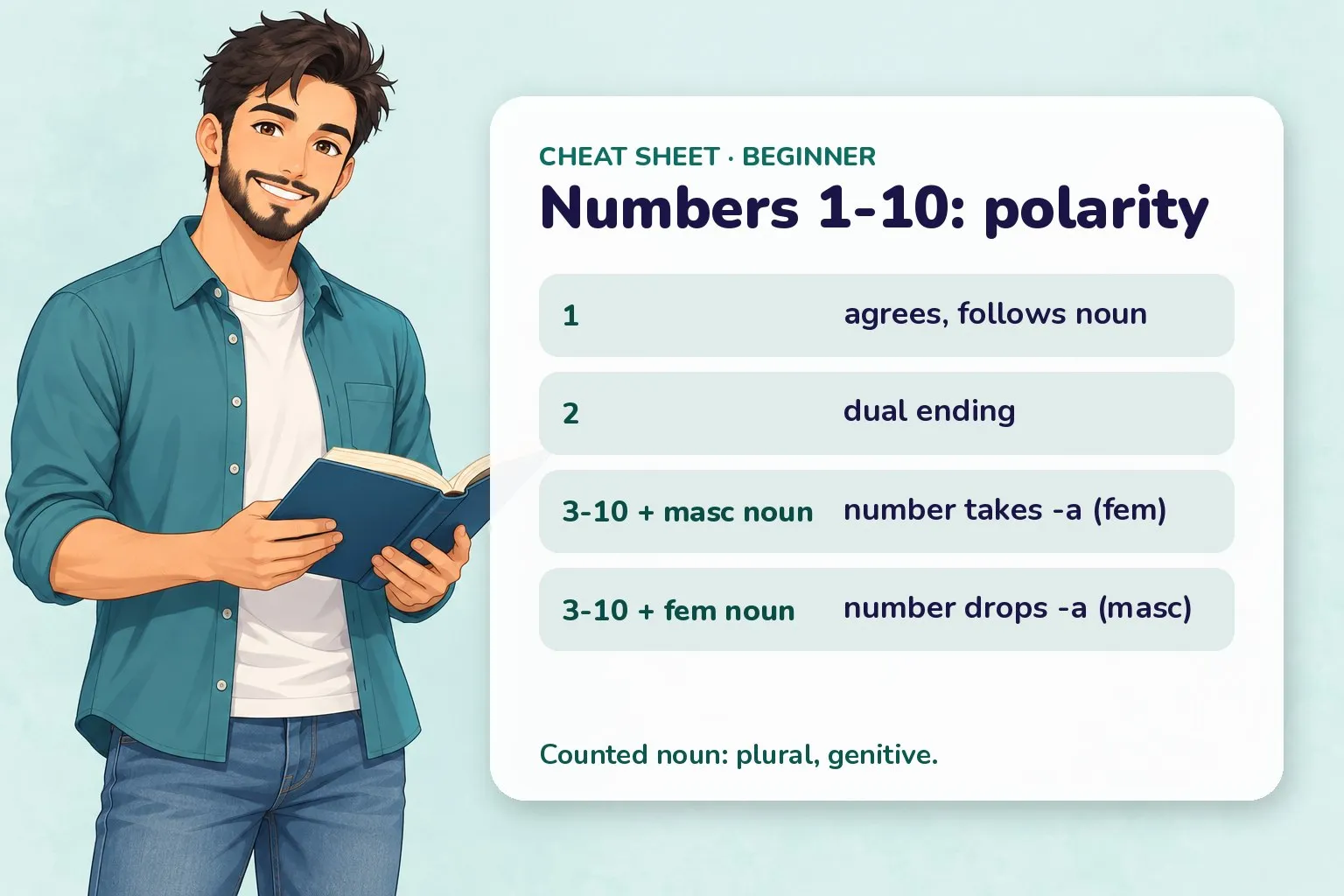
Quick recap before you practise.
Practice
Arabic numbers 1-10 practice
Try each one, then press Check. No sign-up, nothing is sent anywhere — it all runs in your browser.
Hint: 1 agrees with a feminine noun and follows it
Show answer
wāḥidatun — 1 agrees in gender and follows the noun: بِنْتٌ وَاحِدَةٌ (bintun wāḥidatun).
4 Put the words in order: 'I have two books.'
Show answer
عِنْدِي (ʿindī) كِتَابَانِ (kitābāni) — The dual ending alone means 'two': عِنْدِي كِتَابَانِ (ʿindī kitābāni).
5 Match each number to its reading.
- ثَلَاثَة (thalātha)
- خَمْسَة (khamsa)
- سَبْعَة (sabʿa)
- عَشَرَة (ʿashara)
Show answer
- ثَلَاثَة (thalātha) → three (3)
- خَمْسَة (khamsa) → five (5)
- سَبْعَة (sabʿa) → seven (7)
- عَشَرَة (ʿashara) → ten (10)
3 thalātha, 5 khamsa, 7 sabʿa, 10 ʿashara.
Quiz
Arabic numbers 1-10 quiz
12 questions · pick an answer and you'll see straight away if it's right.
-
Show answer
سَبْعَة (sabʿa) — سَبْعَة (sabʿa) is seven; سِتَّة (sitta) is six.
-
Show answer
the feminine form (with the tā marbūṭa) — Polarity: a masculine noun takes the feminine number form, with the tā marbūṭa.
-
Show answer
plural and genitive — The counted noun after 3-10 is plural and in the genitive, usually indefinite (-in).
-
Show answer
ثَلَاثُ بَنَاتٍ (thalāthu banātin) — Feminine noun to masculine number (no tā marbūṭa), plural: ثَلَاثُ بَنَاتٍ (thalāthu banātin).
-
Show answer
كِتَابَانِ (kitābāni) — The dual ending كِتَابَانِ (kitābāni) already means 'two books'.
-
Show answer
after the noun, agreeing with it — 1 follows its noun like an adjective and agrees: كِتَابٌ وَاحِدٌ (kitābun wāḥidun).
-
Show answer
خَمْسُ رِجَالٍ (khamsu rijālin) — رِجَال (rijāl) is masculine, so it needs the feminine number: خَمْسَةُ رِجَالٍ (khamsatu rijālin).
-
Show answer
singular accusative (-an) — After كَمْ (kam) the noun is singular accusative: كَمْ كِتَابًا (kam kitāban).
-
Show answer
the counted noun must be plural — 3-10 require a plural counted noun, and many plurals are irregular (broken).
-
Show answer
عَشَرَة (ʿashara) — On its own, ten is عَشَرَة (ʿashara); the masculine counting form عَشْر (ʿashr) drops the ة.
-
Show answer
polarity — The number taking the opposite gender to the noun is called polarity.
-
Show answer
sabʿatu — Masculine noun to feminine number: سَبْعَةُ أَيَّامٍ (sabʿatu ayyāmin).
Recap cheat-sheet
| Group | Rule | Example | Reading |
|---|---|---|---|
| 1 | agrees, follows noun | كِتَابٌ وَاحِدٌ | kitābun wāḥidun |
| 2 | dual ending | كِتَابَانِ | kitābāni |
| 3-10 masc noun | number takes ة | ثَلَاثَةُ كُتُبٍ | thalāthatu kutubin |
| 3-10 fem noun | number drops ة | ثَلَاثُ بَنَاتٍ | thalāthu banātin |
Next
- Build the foundation it rests on: noun gender in Arabic
- Back to the Arabic grammar section
- New here? Start with Start Learning Arabic Here
All Arabic grammar topics
Every grammar point in order, from your first sentence to advanced structures. Pick one and go straight to it. New lessons go live every day, so topics marked Coming soon fill in over the next weeks.
Grammar path
Beginner 16 topics · 13 ready
- 01 The Definite Article الـ (al-)
- 02 Indefiniteness and Tanwin
- 03 Noun Gender (Masculine & Feminine)
- 04 The Nominal Sentence (Jumla Ismiyya)
- 05 Adjective Agreement (Na't)
- 06 Personal Pronouns (Separate)
- 07 Attached (Possessive/Object) Pronouns
- 08 Demonstratives (هذا hādhā، هذه hādhihi، ذلك dhālika)
- 09 The Idafa (Possessive Construction)
- 10 Prepositions (Huruf al-Jarr)
- 11 Questions (هل hal، أ a، ما mā، من man، أين ayna)
- 12 Negating Nominal Sentences (ليس laysa)
- 13 Numbers 1-10 and Counting You are here
- 14 Pointing Sentences (هذا كتاب hādhā kitāb) Coming soon
- 15 Prepositional & Adverbial Predicates Coming soon
- 16 Expressing 'Have' (عند / لـ / مع ʿinda / li- / maʿa) Coming soon
Elementary 17 topics
- 17 The Present Tense (al-Mudari') Coming soon
- 18 The Past Tense (al-Madi) Coming soon
- 19 The Verbal Sentence (Jumla Fi'liyya) Coming soon
- 20 Verb Agreement with the Subject Coming soon
- 21 Negating the Past (ما / لم mā / lam) Coming soon
- 22 Negating the Present & Future (لا / لن lā / lan) Coming soon
- 23 The Future (سـ / سوف sa- / sawfa) Coming soon
- 24 The Dual (al-Muthanna) Coming soon
- 25 Sound Plurals (Masculine & Feminine) Coming soon
- 26 Broken Plurals (Jam' Taksir) Coming soon
- 27 Kana and Its Sisters Coming soon
- 28 Inna and Its Sisters Coming soon
- 29 Non-Human Plural Agreement Coming soon
- 30 Days, Months and Time Expressions Coming soon
- 31 Adverbs of Time & Place (Zarf) Coming soon
- 32 Hamzat al-Wasl vs Hamzat al-Qat' Coming soon
- 33 Colours & Defects (Af'al pattern) Coming soon
Intermediate 22 topics
- 34 The Three Cases (I'rab) Coming soon
- 35 Uses of the Accusative (Mansubat) Coming soon
- 36 The Derived Verb Forms (I-X) Coming soon
- 37 Root and Pattern Morphology Coming soon
- 38 Active & Passive Participles Coming soon
- 39 The Verbal Noun (Masdar) Coming soon
- 40 The Subjunctive (Mansub) after أن / لـ (an / li-) Coming soon
- 41 The Jussive (Majzum) & Commands Coming soon
- 42 The Imperative (al-Amr) Coming soon
- 43 Weak Verbs (Assimilated, Hollow, Defective) Coming soon
- 44 Relative Clauses (الذي alladhī، التي allatī) Coming soon
- 45 Comparative & Superlative (Af'al) Coming soon
- 46 Conditional Sentences (إذا idhā، إنْ in، لو law) Coming soon
- 47 Numbers 11-99 and Agreement Coming soon
- 48 The Five Nouns (al-Asma' al-Khamsa) Coming soon
- 49 Diptotes (al-Mamnu' min as-Sarf) Coming soon
- 50 Object of Purpose & Accompaniment Coming soon
- 51 Apposition & Substitution (Badal) Coming soon
- 52 Emphasis (at-Tawkid: نفس nafs، كل kull) Coming soon
- 53 Coordination (al-'Atf) & Case Carrying Coming soon
- 54 Questions of Quantity (كم kam) & Number Syntax Coming soon
- 55 The Nisba Adjective (-iyy) Coming soon
Upper-Intermediate 14 topics
- 56 The Circumstantial Clause (Hal) Coming soon
- 57 Specification (Tamyiz) Coming soon
- 58 Exception (al-Istithna': إلا illā) Coming soon
- 59 The Absolute Object (al-Maf'ul al-Mutlaq) Coming soon
- 60 The Passive Voice (al-Majhul) Coming soon
- 61 The Vocative (an-Nida': يا yā) Coming soon
- 62 Energetic Mood & Emphasis (Nun al-Tawkid) Coming soon
- 63 Verbs with Prepositions Coming soon
- 64 Connectors & Cohesion (و wa، ف fa، ثم thumma، لكنّ lākinna) Coming soon
- 65 Verbs of Certainty/Doubt (Dhanna & Sisters) Coming soon
- 66 Verbs with Two Objects Coming soon
- 67 The Diminutive (at-Tasghir) Coming soon
- 68 Collective & Unit Nouns Coming soon
- 69 Conditional Particles & Jussive Pair Coming soon
Advanced 10 topics
- 70 Advanced I'rab & Government Coming soon
- 71 Expressing Aspect (قد qad، كان قد kāna qad، لمّا lammā) Coming soon
- 72 Rhetorical Structures (Taqdim wa-Ta'khir) Coming soon
- 73 Advanced Conditionals & Oaths Coming soon
- 74 Classical/Formal Register (Fusha Style) Coming soon
- 75 Nominal Style & Masdar-Heavy Syntax Coming soon
- 76 Advanced Exception & Restriction (إنما innamā، غير ghayr) Coming soon
- 77 Absolute Negation (لا النافية للجنس lā an-nāfiya lil-jins) Coming soon
- 78 Particle Review: إنّ (inna)، أنّ (anna)، أنْ (an)، كأنّ (ka-anna) Coming soon
- 79 Verb-Initial vs Noun-Initial Style Coming soon