Attached (Possessive/Object) Pronouns
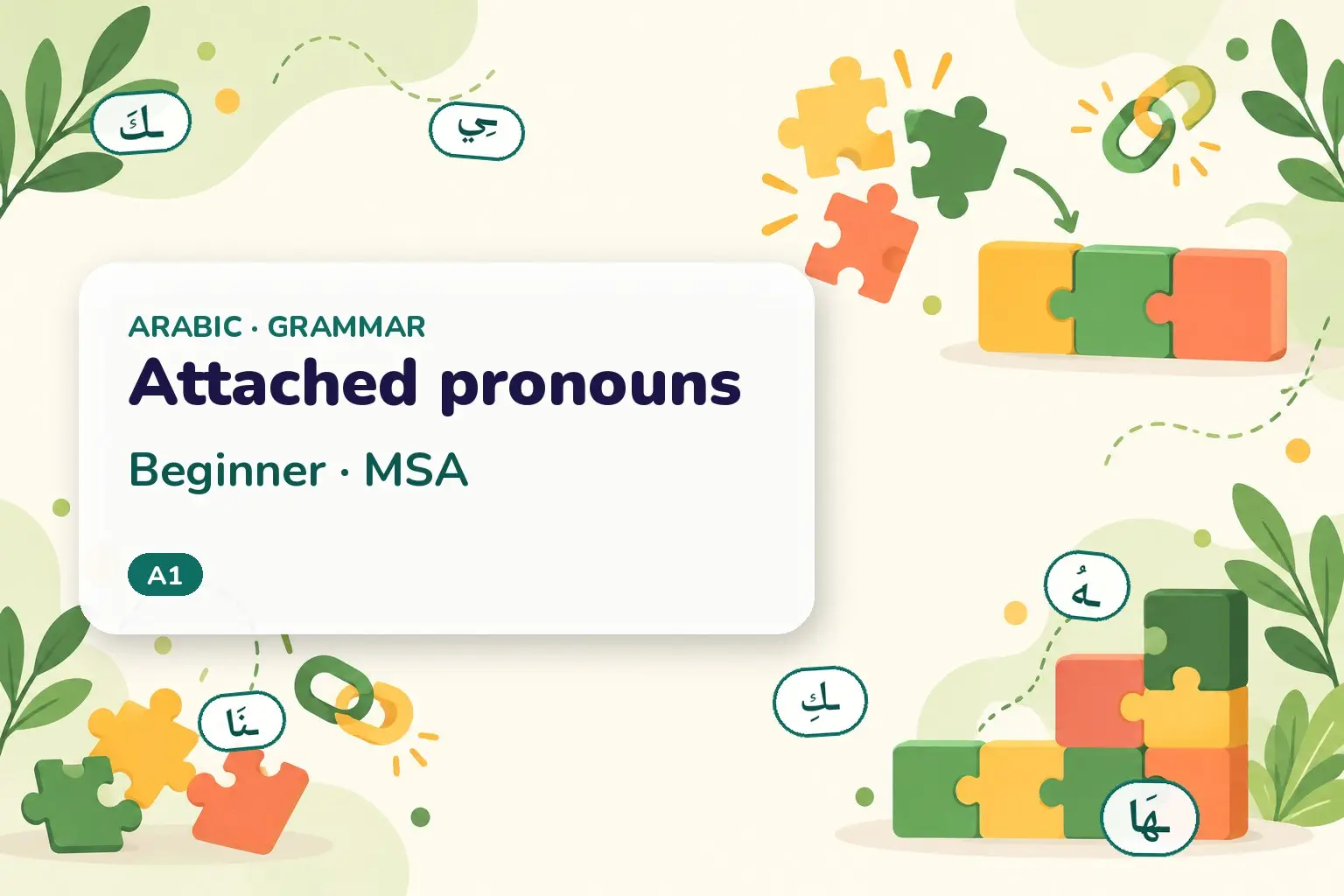
Arabic attached pronouns are endings stuck onto a word: on a noun they show possession (كِتَابِي, kitābī, my book; كِتَابُكَ, kitābuka, your book), and on a verb or preposition they mark the object (رَآنِي, ra'ānī, he saw me; مَعَهُ, maʿahu, with him). They are not separate words.
Level: Beginner. Attached pronouns are short endings you stick onto the end of a word. On a noun they mean “my, your, his…”; on a verb or a preposition they mean “me, you, him…”. They do in one syllable what English needs separate words for, so learning them unlocks possession and objects at once.
The rule
A suffix is an ending added to a word. The attached pronouns — مُتَّصِلة (muttaṣila) — are suffixes, unlike the standalone separate pronouns أنا (anā), أنتَ (anta) and so on. The same set of endings does two jobs, depending on what you attach it to:
- On a noun → possession. كِتَاب (kitāb, a book) + ـِي (ī) = كِتَابِي (kitābī, my book); + ـكَ (ka) = كِتَابُكَ (kitābuka, your book).
- On a verb → the object. The verb رَأَى (raʾā, he saw) + ـهُ (hu) = رَآهُ (raʾāhu, he saw him).
- On a preposition → its object. مَعَ (maʿa, with) + ـهُ (hu) = مَعَهُ (maʿahu, with him); مِنْ (min, from) + ـهُ (hu) = مِنْهُ (minhu, from him).
Two of the endings differ by job. The possessive “my” is ـِي (ī), but the verb object “me” is ـنِي (nī) — the extra ن (nūn) keeps the verb sounding right: رَآنِي (raʾānī, he saw me). Everything else (ـكَ (ka), ـهُ (hu), ـهَا (hā) …) is identical for possession and for objects.
The attached pronouns
| Person | Suffix | Reading | On a noun | On a verb/prep |
|---|---|---|---|---|
| 1st sing. | ـِي / ـنِي | -ī / -nī | my | me (-nī on verbs) |
| 1st plural | ـنَا | -nā | our | us |
| 2nd masc. sing. | ـكَ | -ka | your (to a man) | you (m) |
| 2nd fem. sing. | ـكِ | -ki | your (to a woman) | you (f) |
| 2nd masc. plural | ـكُم | -kum | your (men/mixed) | you (pl) |
| 2nd fem. plural | ـكُنَّ | -kunna | your (women) | you (f pl) |
| 3rd masc. sing. | ـهُ | -hu | his | him |
| 3rd fem. sing. | ـهَا | -hā | her | her |
| 3rd masc. plural | ـهُم | -hum | their (m) | them (m) |
| 3rd fem. plural | ـهُنَّ | -hunna | their (f) | them (f) |
The hu-to-hi vowel rule
The 3rd-person endings that start with هُ (hu) — ـهُ (hu), ـهُم (hum), ـهُمَا (humā), ـهُنَّ (hunna) — change their u to i when they come right after an i-sound (a kasra), a long ـِي (ī) or the letter yā’:
- فِي (fī, in) + ـهُ (hu) → فِيهِ (fīhi, in it)
- بِ (bi, with/by) + ـهُ (hu) → بِهِ (bihi, with it)
- كِتَابِهِ (kitābihi, his book — when a kasra falls before the ending)
Example sentences
- هَذَا كِتَابِي.hādhā kitābī.This is my book.ī = my
- أَيْنَ بَيْتُكَ؟ayna baytuka?Where is your house?ka, to a man
- أَيْنَ بَيْتُكِ؟ayna baytuki?Where is your house?ki, to a woman
- اِسْمُهُ أَحْمَد.ismuhu Aḥmad.His name is Ahmad.hu = his
- اِسْمُهَا لَيْلَى.ismuhā Laylā.Her name is Layla.hā = her
- سَيَّارَتُنَا جَدِيدَةٌ.sayyāratunā jadīdatun.Our car is new.nā = our
- هَذِهِ حَقِيبَتُهُم.hādhihi ḥaqībatuhum.This is their bag.hum = their (m)
- رَآنِي فِي السُّوقِ.raʾānī fī s-sūqi.He saw me in the market.nī = me, verb object
- رَأَيْتُهُ أَمْسِ.raʾaytuhu amsi.I saw him yesterday.hu = him
- أُحِبُّكِ.uḥibbuki.I love you.to a woman
- هَلْ تَعْرِفُهَا؟hal taʿrifuhā?Do you know her?
- هَذَا لَكَ.hādhā laka.This is for you.لِ (li) + ka on a preposition
- الكِتَابُ مَعِي.al-kitābu maʿī.The book is with me.مع (maʿ) + ī
- مَا اسْمُكَ؟mā smuka?What is your name?to a man
- فِيهِ مَاءٌ.fīhi māʾun.There is water in it.فِي (fī) + hu → fīhi
- تَكَلَّمْتُ مَعَهُ.takallamtu maʿahu.I spoke with him.
- هَذِهِ أُمُّهَا.hādhihi ummuhā.This is her mother.
- أَصْدِقَاؤُهُم هُنَا.aṣdiqāʾuhum hunā.Their friends are here.
Common mistakes
- ❌ رَآئِي (raʾāʾī, wrong) → ✅ رَآنِي (raʾānī). The object “me” on a verb needs the extra ن (nūn): ـنِي (nī), not the possessive ـِي (ī).
- ❌ بِهُ (bihu) → ✅ بِهِ (bihi). After an i-sound, ـهُ (hu) becomes ـهِ (hi): بِهِ (bihi, with it), فِيهِ (fīhi, in it).
- ❌ البَيْتِي (al-baytī) → ✅ بَيْتِي (baytī). A noun with a possessive suffix is already definite; do not add الـ (al).
- ❌ ـكَ (ka) to a woman → ✅ ـكِ (ki). The “your/you” ending matches the person’s gender: ـكَ (ka) for a man, ـكِ (ki) for a woman.
- ❌ كِتَابٌي (kitābunī, keeping the tanwīn) → ✅ كِتَابِي (kitābī). The ـِي (ī) replaces the final case ending; no tanwīn before it.
A short conversation
A: مَا اسْمُكَ؟ (mā smuka?) — What is your name? (to a man) B: اسْمِي سَامِي. (ismī Sāmī.) — My name is Sami. A: وَهَذِهِ صَدِيقَتِي لَيْلَى. هَلْ تَعْرِفُهَا؟ (wa-hādhihi ṣadīqatī Laylā. hal taʿrifuhā?) — And this is my friend Layla. Do you know her? B: نَعَمْ، رَأَيْتُهَا أَمْسِ. (naʿam, raʾaytuhā amsi.) — Yes, I saw her yesterday.
Usage notes
- The suffix points to the owner, not the gender of the thing. كِتَابُهَا (kitābuhā) is “her book” whatever the book is; the ـهَا (hā) refers to the female owner.
- On prepositions the endings are everyday words. لَهُ (lahu, for him), لَهَا (lahā, for her), مِنْهُ (minhu, from him), عِنْدِي (ʿindī, I have — literally “at me”). You will meet these constantly.
- ـنَا (nā) does double duty. On a noun it is “our”: بَيْتُنَا (baytunā, our house); on a verb it is “us”: رَآنَا (raʾānā, he saw us). Only the 1st singular splits into ـِي (ī) and ـنِي (nī).
- Short vs long reading. The 3rd masculine ـهُ (hu) is written with a short u; in careful recitation it can lengthen to hū between vowels, but the spelling stays ـهُ (hu).
Compared with…
- Separate pronouns are the standalone words أنا (anā, I), أنتَ (anta, you), هو (huwa, he) and so on. They are full words that start a sentence or stand alone; attached pronouns can never stand alone — they must cling to a noun, verb or preposition. Use a separate pronoun for the subject — هُوَ طَالِبٌ (huwa ṭālibun, he is a student) — and an attached one for possession or the object, كِتَابُهُ (kitābuhu, his book). See Arabic Personal Pronouns (Separate).
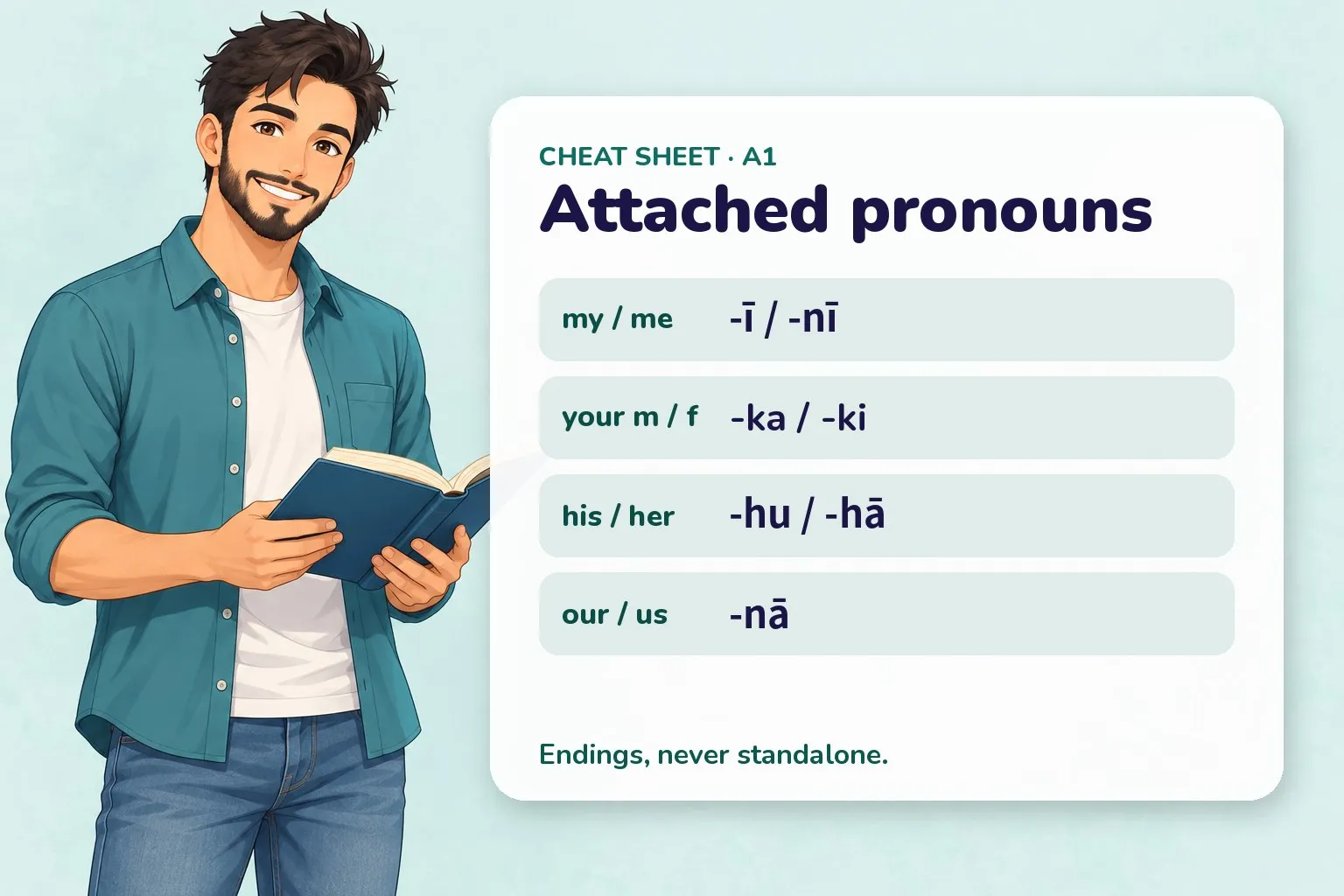
Quick recap before you practise.
Practice
Arabic attached pronouns practice
Try each one, then press Check. No sign-up, nothing is sent anywhere — it all runs in your browser.
Hint: ـهُ (hu) softens after an i-sound
Show answer
hi — After the i of بِ (bi), ـهُ (hu) becomes ـهِ (hi): بِهِ (bihi, with it/him).
4 Put in order: 'His name is Ahmad.'
Show answer
اسْمُهُ (ismuhu) أَحْمَد (Aḥmad) — اسْمُهُ أَحْمَد (ismuhu Aḥmad) — noun + possessive suffix, then the name.
5 Match each suffix to its meaning.
- ـكَ (ka)
- ـكِ (ki)
- ـهَا (hā)
- ـنَا (nā)
Show answer
- ـكَ (ka) → your (to a man)
- ـكِ (ki) → your (to a woman)
- ـهَا (hā) → her
- ـنَا (nā) → our / us
ـكَ (ka) to a man; ـكِ (ki) to a woman; ـهَا (hā) her; ـنَا (nā) our/us.
Quiz
Arabic attached pronouns quiz
12 questions · pick an answer and you'll see straight away if it's right.
-
Show answer
a suffix added to a noun, verb or preposition — Attached pronouns are suffixes; they cannot stand alone.
-
Show answer
كِتَابِي (kitābī) — ـِي (ī) = my: كِتَابِي (kitābī).
-
Show answer
ـنِي (nī) — Verbs take ـنِي (nī): رَآنِي (raʾānī).
-
Show answer
one man — ـكَ (ka) addresses a man; ـكِ (ki) a woman.
-
Show answer
his / him — ـهُ (hu) is his (on a noun) or him (on a verb/prep).
-
Show answer
ـهِ (hi) — فِيهِ (fīhi), بِهِ (bihi): the u shifts to i after a kasra or yā'.
-
Show answer
بَيْتِي (baytī) — A suffixed noun is definite: بَيْتِي (baytī), no الـ (al) and no tanwīn.
-
Show answer
اسْمُهَا لَيْلَى (ismuhā Laylā) — ـهَا (hā) = her: اسْمُهَا لَيْلَى (ismuhā Laylā).
-
Show answer
our — ـنَا (nā) is 'our' on a noun, 'us' on a verb.
-
Show answer
بِهُ مَاءٌ (bihu māʾun) — After the i of بِ (bi) it must be بِهِ (bihi), not بِهُ (bihu).
-
Show answer
لَهُ (lahu) — لِ (li) + ـهُ (hu) = لَهُ (lahu), 'for him'.
-
Show answer
ī — ـِي (ī) on a noun is 'my': كِتَابِي (kitābī).
Recap cheat-sheet
| Meaning | Suffix | Reading |
|---|---|---|
| my (noun) / me (verb) | ـِي / ـنِي | -ī / -nī |
| our / us | ـنَا | -nā |
| your m / f | ـكَ / ـكِ | -ka / -ki |
| his / her | ـهُ / ـهَا | -hu / -hā |
| their m / f | ـهُم / ـهُنَّ | -hum / -hunna |
Next
- Compare these with the standalone Arabic Personal Pronouns (Separate)
- Back to the Arabic grammar section
- New here? Start with Start Learning Arabic Here
All Arabic grammar topics
Every grammar point in order, from your first sentence to advanced structures. Pick one and go straight to it. New lessons go live every day, so topics marked Coming soon fill in over the next weeks.
Grammar path
Beginner 16 topics · 12 ready
- 01 The Definite Article الـ (al-)
- 02 Indefiniteness and Tanwin
- 03 Noun Gender (Masculine & Feminine)
- 04 The Nominal Sentence (Jumla Ismiyya)
- 05 Adjective Agreement (Na't)
- 06 Personal Pronouns (Separate)
- 07 Attached (Possessive/Object) Pronouns You are here
- 08 Demonstratives (هذا hādhā، هذه hādhihi، ذلك dhālika)
- 09 The Idafa (Possessive Construction)
- 10 Prepositions (Huruf al-Jarr)
- 11 Questions (هل hal، أ a، ما mā، من man، أين ayna)
- 12 Negating Nominal Sentences (ليس laysa)
- 13 Numbers 1-10 and Counting Coming soon
- 14 Pointing Sentences (هذا كتاب hādhā kitāb) Coming soon
- 15 Prepositional & Adverbial Predicates Coming soon
- 16 Expressing 'Have' (عند / لـ / مع ʿinda / li- / maʿa) Coming soon
Elementary 17 topics
- 17 The Present Tense (al-Mudari') Coming soon
- 18 The Past Tense (al-Madi) Coming soon
- 19 The Verbal Sentence (Jumla Fi'liyya) Coming soon
- 20 Verb Agreement with the Subject Coming soon
- 21 Negating the Past (ما / لم mā / lam) Coming soon
- 22 Negating the Present & Future (لا / لن lā / lan) Coming soon
- 23 The Future (سـ / سوف sa- / sawfa) Coming soon
- 24 The Dual (al-Muthanna) Coming soon
- 25 Sound Plurals (Masculine & Feminine) Coming soon
- 26 Broken Plurals (Jam' Taksir) Coming soon
- 27 Kana and Its Sisters Coming soon
- 28 Inna and Its Sisters Coming soon
- 29 Non-Human Plural Agreement Coming soon
- 30 Days, Months and Time Expressions Coming soon
- 31 Adverbs of Time & Place (Zarf) Coming soon
- 32 Hamzat al-Wasl vs Hamzat al-Qat' Coming soon
- 33 Colours & Defects (Af'al pattern) Coming soon
Intermediate 22 topics
- 34 The Three Cases (I'rab) Coming soon
- 35 Uses of the Accusative (Mansubat) Coming soon
- 36 The Derived Verb Forms (I-X) Coming soon
- 37 Root and Pattern Morphology Coming soon
- 38 Active & Passive Participles Coming soon
- 39 The Verbal Noun (Masdar) Coming soon
- 40 The Subjunctive (Mansub) after أن / لـ (an / li-) Coming soon
- 41 The Jussive (Majzum) & Commands Coming soon
- 42 The Imperative (al-Amr) Coming soon
- 43 Weak Verbs (Assimilated, Hollow, Defective) Coming soon
- 44 Relative Clauses (الذي alladhī، التي allatī) Coming soon
- 45 Comparative & Superlative (Af'al) Coming soon
- 46 Conditional Sentences (إذا idhā، إنْ in، لو law) Coming soon
- 47 Numbers 11-99 and Agreement Coming soon
- 48 The Five Nouns (al-Asma' al-Khamsa) Coming soon
- 49 Diptotes (al-Mamnu' min as-Sarf) Coming soon
- 50 Object of Purpose & Accompaniment Coming soon
- 51 Apposition & Substitution (Badal) Coming soon
- 52 Emphasis (at-Tawkid: نفس nafs، كل kull) Coming soon
- 53 Coordination (al-'Atf) & Case Carrying Coming soon
- 54 Questions of Quantity (كم kam) & Number Syntax Coming soon
- 55 The Nisba Adjective (-iyy) Coming soon
Upper-Intermediate 14 topics
- 56 The Circumstantial Clause (Hal) Coming soon
- 57 Specification (Tamyiz) Coming soon
- 58 Exception (al-Istithna': إلا illā) Coming soon
- 59 The Absolute Object (al-Maf'ul al-Mutlaq) Coming soon
- 60 The Passive Voice (al-Majhul) Coming soon
- 61 The Vocative (an-Nida': يا yā) Coming soon
- 62 Energetic Mood & Emphasis (Nun al-Tawkid) Coming soon
- 63 Verbs with Prepositions Coming soon
- 64 Connectors & Cohesion (و wa، ف fa، ثم thumma، لكنّ lākinna) Coming soon
- 65 Verbs of Certainty/Doubt (Dhanna & Sisters) Coming soon
- 66 Verbs with Two Objects Coming soon
- 67 The Diminutive (at-Tasghir) Coming soon
- 68 Collective & Unit Nouns Coming soon
- 69 Conditional Particles & Jussive Pair Coming soon
Advanced 10 topics
- 70 Advanced I'rab & Government Coming soon
- 71 Expressing Aspect (قد qad، كان قد kāna qad، لمّا lammā) Coming soon
- 72 Rhetorical Structures (Taqdim wa-Ta'khir) Coming soon
- 73 Advanced Conditionals & Oaths Coming soon
- 74 Classical/Formal Register (Fusha Style) Coming soon
- 75 Nominal Style & Masdar-Heavy Syntax Coming soon
- 76 Advanced Exception & Restriction (إنما innamā، غير ghayr) Coming soon
- 77 Absolute Negation (لا النافية للجنس lā an-nāfiya lil-jins) Coming soon
- 78 Particle Review: إنّ (inna)، أنّ (anna)، أنْ (an)، كأنّ (ka-anna) Coming soon
- 79 Verb-Initial vs Noun-Initial Style Coming soon