Noun Gender in Arabic (Masculine & Feminine)
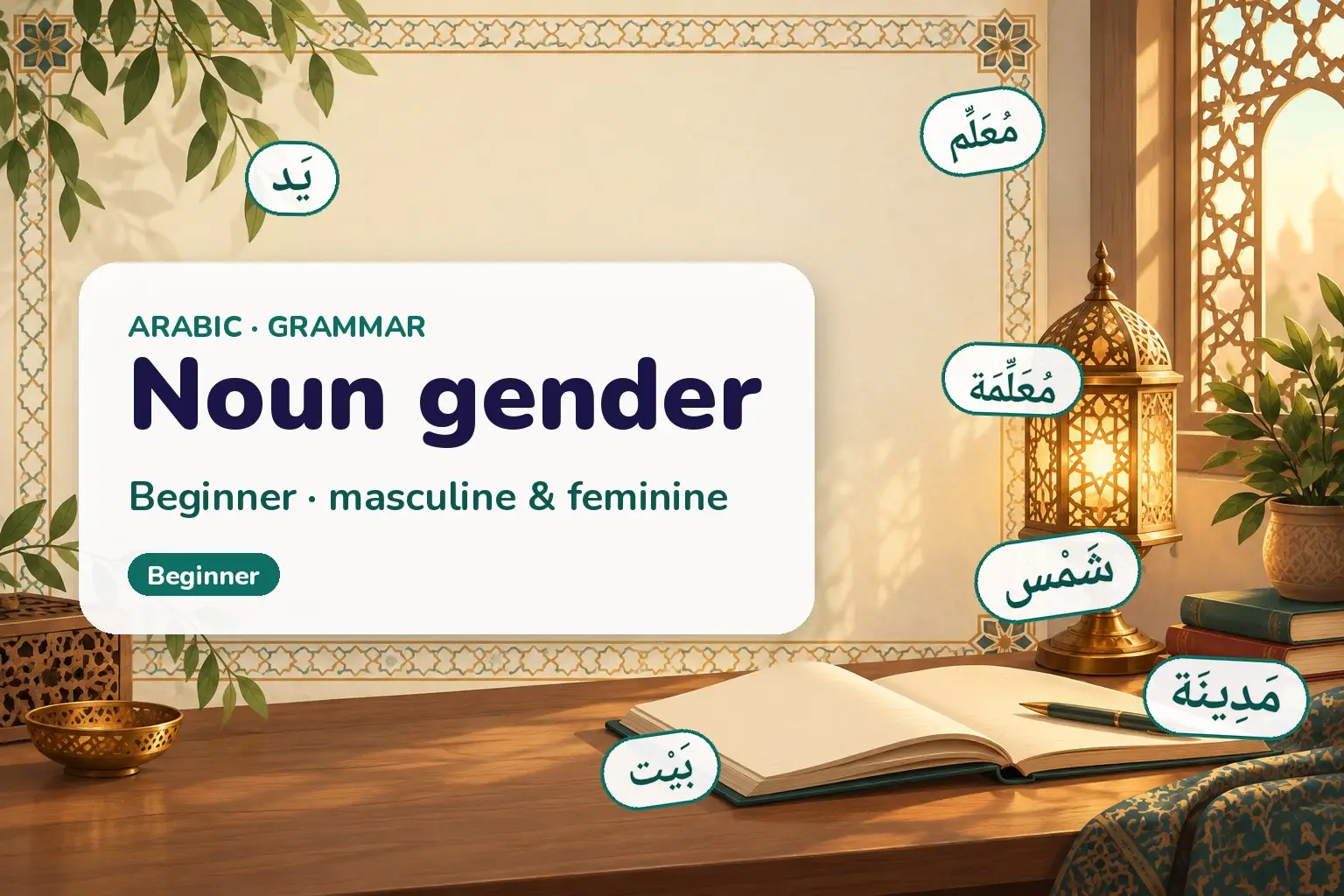
Every Arabic noun is masculine or feminine. Most feminine nouns end in ة (ta marbuta), like مُعَلِّمَة (muʿallima, a female teacher); nouns with no ending are usually masculine. Some nouns are feminine by convention, and the adjective must match the noun's gender.
Level: Beginner. Every noun in Arabic is either masculine or feminine, and that gender decides the ending on any adjective you use with it. The good news: most feminine nouns carry a clear marker, so you can spot them by sight.
The rule
Gender is a grammatical class — not about biology. In Arabic a noun (a word for a person, place or thing) is either masculine (mudhakkar) or feminine (muʾannath).
The most common signal is the ending ة (tā marbūṭa) — a special “tied” t written like a h with two dots. A noun that ends in ة (tā marbūṭa) is almost always feminine: مُعَلِّمَة (muʿallima, a female teacher), سَيَّارَة (sayyāra, a car), مَدِينَة (madīna, a city). A noun with no special ending is usually masculine: مُعَلِّم (muʿallim, a male teacher), بَيْت (bayt, a house), كِتَاب (kitāb, a book).
Two things break the simple “ة (tā marbūṭa) means feminine” picture. First, a small group of words that end in ة (tā marbūṭa) are masculine — mostly men’s names like حَمْزَة (Ḥamza) and أُسَامَة (Usāma). Second, some nouns are feminine by convention even with no marker at all.
Markers of gender
| Type | Transliteration | Gender | Example | Reading |
|---|---|---|---|---|
| Ends in ة (tā marbūṭa) | tā marbūṭa | feminine | سَيَّارَة | sayyāra (a car) |
| No ending | — | masculine | بَيْت | bayt (a house) |
| Feminine by convention | — | feminine | شَمْس | shams (the sun) |
| Ends in ة but a name | — | masculine | حَمْزَة | Ḥamza (a man’s name) |
Feminine by convention
Some nouns have no tā marbūṭa but are still feminine, so their adjectives take the feminine ending. The common beginner set:
- Female people without a marker: أُمّ (umm, mother), بِنْت (bint, girl / daughter).
- Paired body parts: يَد (yad, hand), عَيْن (ʿayn, eye), رِجْل (rijl, leg), أُذُن (udhun, ear).
- A fixed list of other everyday nouns: شَمْس (shams, sun), أَرْض (arḍ, earth), نَار (nār, fire), رِيح (rīḥ, wind).
- Most country and city names: مِصْر (Miṣr, Egypt), دِمَشْق (Dimashq, Damascus).
Adjective agreement
An adjective (a describing word) must match its noun’s gender. For a feminine noun you add ة (tā marbūṭa) to the adjective:
- مُعَلِّمٌ جَدِيدٌ (muʿallimun jadīdun) — a new (male) teacher.
- مُعَلِّمَةٌ جَدِيدَةٌ (muʿallimatun jadīdatun) — a new (female) teacher.
So the gender of the noun controls the ending you hear twice: once on the noun, once on the adjective.
Example sentences
- هٰذَا مُعَلِّمٌ.hādhā muʿallimun.This is a (male) teacher.no ending = masculine
- هٰذِهِ مُعَلِّمَةٌ.hādhihi muʿallimatun.This is a (female) teacher.ends in ة = feminine
- الوَلَدُ صَغِيرٌ.al-waladu ṣaghīrun.The boy is small.
- البِنْتُ صَغِيرَةٌ.al-bintu ṣaghīratun.The girl is small.bint is feminine, so the adjective adds ة
- البَيْتُ جَدِيدٌ.al-baytu jadīdun.The house is new.masculine
- السَّيَّارَةُ جَدِيدَةٌ.as-sayyāratu jadīdatun.The car is new.feminine by ة
- الشَّمْسُ حَارَّةٌ.ash-shamsu ḥārratun.The sun is hot.shams is feminine by convention
- أُمِّي طَبِيبَةٌ.ummī ṭabībatun.My mother is a doctor.
- يَدِي كَبِيرَةٌ.yadī kabīratun.My hand is big.yad is feminine
- عَيْنُهَا جَمِيلَةٌ.ʿaynuhā jamīlatun.Her eye is beautiful.ʿayn is feminine
- المَدِينَةُ جَمِيلَةٌ.al-madīnatu jamīlatun.The city is beautiful.
- الطَّاوِلَةُ نَظِيفَةٌ.aṭ-ṭāwilatu naẓīfatun.The table is clean.
- الكِتَابُ مُفِيدٌ.al-kitābu mufīdun.The book is useful.masculine
- الأَرْضُ وَاسِعَةٌ.al-arḍu wāsiʿatun.The earth is vast.arḍ is feminine by convention
- حَمْزَةُ طَالِبٌ.Ḥamzatu ṭālibun.Hamza is a student.a man's name ending in ة, so masculine
- المُعَلِّمَةُ الجَدِيدَةُ هُنَا.al-muʿallimatu l-jadīdatu hunā.The new (female) teacher is here.
Common mistakes
- ❌ حَمْزَة (Ḥamza) treated as feminine → ✅ it is masculine. A few words ending in ة (tā marbūṭa) are men’s names and stay masculine.
- ❌ الشَّمْسُ حَارٌّ (ash-shamsu ḥārrun) → ✅ الشَّمْسُ حَارَّةٌ (ash-shamsu ḥārratun). شَمْس (shams) is feminine by convention, so the adjective needs the feminine ة (tā marbūṭa) ending.
- ❌ بِنْتٌ صَغِيرٌ (bintun ṣaghīrun) → ✅ بِنْتٌ صَغِيرَةٌ (bintun ṣaghīratun). The noun is feminine, so the adjective must match.
- ❌ assuming يَد (yad) is masculine because it carries no visible marker → ✅ يَد (yad) is feminine: يَدِي كَبِيرَةٌ (yadī kabīratun).
- ❌ adding a feminine ending to a masculine adjective: بَيْتٌ كَبِيرَةٌ (baytun kabīratun) → ✅ بَيْتٌ كَبِيرٌ (baytun kabīrun).
A short conversation
A: مَا هٰذِهِ؟ (mā hādhihi?) — What is this? B: هٰذِهِ سَيَّارَةٌ جَدِيدَةٌ. (hādhihi sayyāratun jadīdatun.) — This is a new car. A: وَهٰذَا؟ (wa-hādhā?) — And this? B: هٰذَا بَيْتٌ كَبِيرٌ. (hādhā baytun kabīrun.) — This is a big house.
Usage notes
- Non-human plurals act feminine. A plural of things (not people) usually takes a feminine singular adjective: الكُتُبُ جَدِيدَةٌ (al-kutubu jadīdatun, “the books are new”). This is a later topic, but it is worth meeting early so the feminine ending does not surprise you.
- The “hidden” t. The ة (tā marbūṭa) is read as -a at the end of a phrase but as -at when an ending follows: مُعَلِّمَة (muʿallima) on its own, مُعَلِّمَةٌ (muʿallimatun) with the indefinite ending.
Compared with…
- Adjective agreement builds directly on gender: once you know a noun is feminine, every adjective and demonstrative with it takes the feminine form. Browse the next points in the Arabic grammar section.
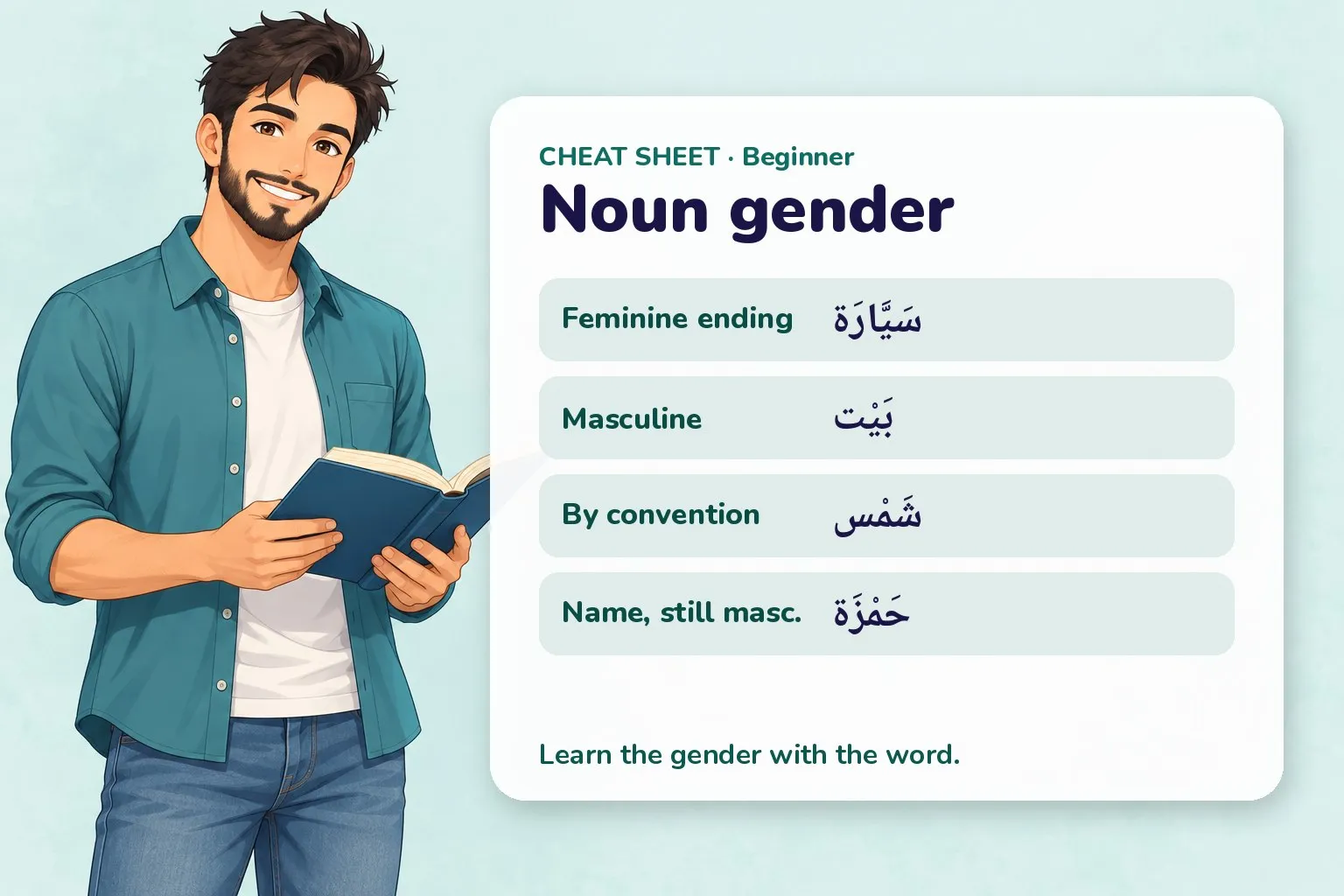
Quick recap before you practise.
Practice
Noun gender practice
Try each one, then press Check. No sign-up, nothing is sent anywhere — it all runs in your browser.
Hint: shams is feminine by convention
Show answer
ḥārratun — شَمْس (shams) is feminine, so the adjective takes the feminine form ḥārratun (حَارَّةٌ).
4 Put the words in order: 'The girl is small.'
Show answer
البِنْتُ (al-bintu) صَغِيرَةٌ (ṣaghīratun) — Noun first, then the matching feminine adjective: البِنْتُ صَغِيرَةٌ (al-bintu ṣaghīratun).
5 Match each noun to its gender.
- مُعَلِّمَة (muʿallima)
- بَيْت (bayt)
- شَمْس (shams)
- حَمْزَة (Ḥamza)
Show answer
- مُعَلِّمَة (muʿallima) → feminine
- بَيْت (bayt) → masculine
- شَمْس (shams) → feminine
- حَمْزَة (Ḥamza) → masculine
ة (tā marbūṭa) usually marks feminine; شَمْس (shams) is feminine by convention; حَمْزَة (Ḥamza) is a masculine name.
Quiz
Arabic noun gender quiz
12 questions · pick an answer and you'll see straight away if it's right.
-
Show answer
feminine — ة (tā marbūṭa) is the common feminine marker: مُعَلِّمَة (muʿallima).
-
Show answer
masculine — Unmarked nouns like بَيْت (bayt) are usually masculine.
-
Show answer
شَمْس (shams) — شَمْس (shams) is feminine by convention, with no visible marker.
-
Show answer
masculine (a man's name) — A few words ending in ة are men's names and stay masculine: حَمْزَة (Ḥamza).
-
Show answer
مُعَلِّمَةٌ جَدِيدَةٌ (muʿallimatun jadīdatun) — Feminine noun and feminine adjective both take the ة (tā marbūṭa) ending.
-
Show answer
feminine — Paired body parts like يَد (yad) are feminine, so يَدِي كَبِيرَةٌ (yadī kabīratun).
-
Show answer
its ending — The noun's gender controls the adjective's ending: جَدِيد (jadīd) or جَدِيدَة (jadīda).
-
Show answer
بِنْتٌ صَغِيرٌ (bintun ṣaghīrun) — بِنْت (bint) is feminine, so the adjective must add ة: بِنْتٌ صَغِيرَةٌ (bintun ṣaghīratun).
-
Show answer
feminine singular — Non-human plurals take a feminine singular adjective: الكُتُبُ جَدِيدَةٌ (al-kutubu jadīdatun).
-
Show answer
feminine — Place names like مِصْر (Miṣr) are generally feminine.
-
Show answer
note its gender with the word — Gender is not always predictable, so record it together with the noun.
-
Show answer
kabīratun — طَاوِلَة (ṭāwila) is feminine, so the adjective takes the feminine form kabīratun (كَبِيرَةٌ).
Recap cheat-sheet
| Signal | Gender | Example | Reading |
|---|---|---|---|
| Ends in ة | feminine | سَيَّارَة | sayyāra |
| No ending | masculine | بَيْت | bayt |
| By convention | feminine | شَمْس, يَد | shams, yad |
| Name in ة | masculine | حَمْزَة | Ḥamza |
Next
- Back to the Arabic grammar section
- New here? Start with Start Learning Arabic Here
All Arabic grammar topics
Every grammar point in order, from your first sentence to advanced structures. Pick one and go straight to it. New lessons go live every day, so topics marked Coming soon fill in over the next weeks.
Grammar path
Beginner 16 topics · 12 ready
- 01 The Definite Article الـ (al-)
- 02 Indefiniteness and Tanwin
- 03 Noun Gender (Masculine & Feminine) You are here
- 04 The Nominal Sentence (Jumla Ismiyya)
- 05 Adjective Agreement (Na't)
- 06 Personal Pronouns (Separate)
- 07 Attached (Possessive/Object) Pronouns
- 08 Demonstratives (هذا hādhā، هذه hādhihi، ذلك dhālika)
- 09 The Idafa (Possessive Construction)
- 10 Prepositions (Huruf al-Jarr)
- 11 Questions (هل hal، أ a، ما mā، من man، أين ayna)
- 12 Negating Nominal Sentences (ليس laysa)
- 13 Numbers 1-10 and Counting Coming soon
- 14 Pointing Sentences (هذا كتاب hādhā kitāb) Coming soon
- 15 Prepositional & Adverbial Predicates Coming soon
- 16 Expressing 'Have' (عند / لـ / مع ʿinda / li- / maʿa) Coming soon
Elementary 17 topics
- 17 The Present Tense (al-Mudari') Coming soon
- 18 The Past Tense (al-Madi) Coming soon
- 19 The Verbal Sentence (Jumla Fi'liyya) Coming soon
- 20 Verb Agreement with the Subject Coming soon
- 21 Negating the Past (ما / لم mā / lam) Coming soon
- 22 Negating the Present & Future (لا / لن lā / lan) Coming soon
- 23 The Future (سـ / سوف sa- / sawfa) Coming soon
- 24 The Dual (al-Muthanna) Coming soon
- 25 Sound Plurals (Masculine & Feminine) Coming soon
- 26 Broken Plurals (Jam' Taksir) Coming soon
- 27 Kana and Its Sisters Coming soon
- 28 Inna and Its Sisters Coming soon
- 29 Non-Human Plural Agreement Coming soon
- 30 Days, Months and Time Expressions Coming soon
- 31 Adverbs of Time & Place (Zarf) Coming soon
- 32 Hamzat al-Wasl vs Hamzat al-Qat' Coming soon
- 33 Colours & Defects (Af'al pattern) Coming soon
Intermediate 22 topics
- 34 The Three Cases (I'rab) Coming soon
- 35 Uses of the Accusative (Mansubat) Coming soon
- 36 The Derived Verb Forms (I-X) Coming soon
- 37 Root and Pattern Morphology Coming soon
- 38 Active & Passive Participles Coming soon
- 39 The Verbal Noun (Masdar) Coming soon
- 40 The Subjunctive (Mansub) after أن / لـ (an / li-) Coming soon
- 41 The Jussive (Majzum) & Commands Coming soon
- 42 The Imperative (al-Amr) Coming soon
- 43 Weak Verbs (Assimilated, Hollow, Defective) Coming soon
- 44 Relative Clauses (الذي alladhī، التي allatī) Coming soon
- 45 Comparative & Superlative (Af'al) Coming soon
- 46 Conditional Sentences (إذا idhā، إنْ in، لو law) Coming soon
- 47 Numbers 11-99 and Agreement Coming soon
- 48 The Five Nouns (al-Asma' al-Khamsa) Coming soon
- 49 Diptotes (al-Mamnu' min as-Sarf) Coming soon
- 50 Object of Purpose & Accompaniment Coming soon
- 51 Apposition & Substitution (Badal) Coming soon
- 52 Emphasis (at-Tawkid: نفس nafs، كل kull) Coming soon
- 53 Coordination (al-'Atf) & Case Carrying Coming soon
- 54 Questions of Quantity (كم kam) & Number Syntax Coming soon
- 55 The Nisba Adjective (-iyy) Coming soon
Upper-Intermediate 14 topics
- 56 The Circumstantial Clause (Hal) Coming soon
- 57 Specification (Tamyiz) Coming soon
- 58 Exception (al-Istithna': إلا illā) Coming soon
- 59 The Absolute Object (al-Maf'ul al-Mutlaq) Coming soon
- 60 The Passive Voice (al-Majhul) Coming soon
- 61 The Vocative (an-Nida': يا yā) Coming soon
- 62 Energetic Mood & Emphasis (Nun al-Tawkid) Coming soon
- 63 Verbs with Prepositions Coming soon
- 64 Connectors & Cohesion (و wa، ف fa، ثم thumma، لكنّ lākinna) Coming soon
- 65 Verbs of Certainty/Doubt (Dhanna & Sisters) Coming soon
- 66 Verbs with Two Objects Coming soon
- 67 The Diminutive (at-Tasghir) Coming soon
- 68 Collective & Unit Nouns Coming soon
- 69 Conditional Particles & Jussive Pair Coming soon
Advanced 10 topics
- 70 Advanced I'rab & Government Coming soon
- 71 Expressing Aspect (قد qad، كان قد kāna qad، لمّا lammā) Coming soon
- 72 Rhetorical Structures (Taqdim wa-Ta'khir) Coming soon
- 73 Advanced Conditionals & Oaths Coming soon
- 74 Classical/Formal Register (Fusha Style) Coming soon
- 75 Nominal Style & Masdar-Heavy Syntax Coming soon
- 76 Advanced Exception & Restriction (إنما innamā، غير ghayr) Coming soon
- 77 Absolute Negation (لا النافية للجنس lā an-nāfiya lil-jins) Coming soon
- 78 Particle Review: إنّ (inna)، أنّ (anna)، أنْ (an)، كأنّ (ka-anna) Coming soon
- 79 Verb-Initial vs Noun-Initial Style Coming soon