Arabic Personal Pronouns (Separate)
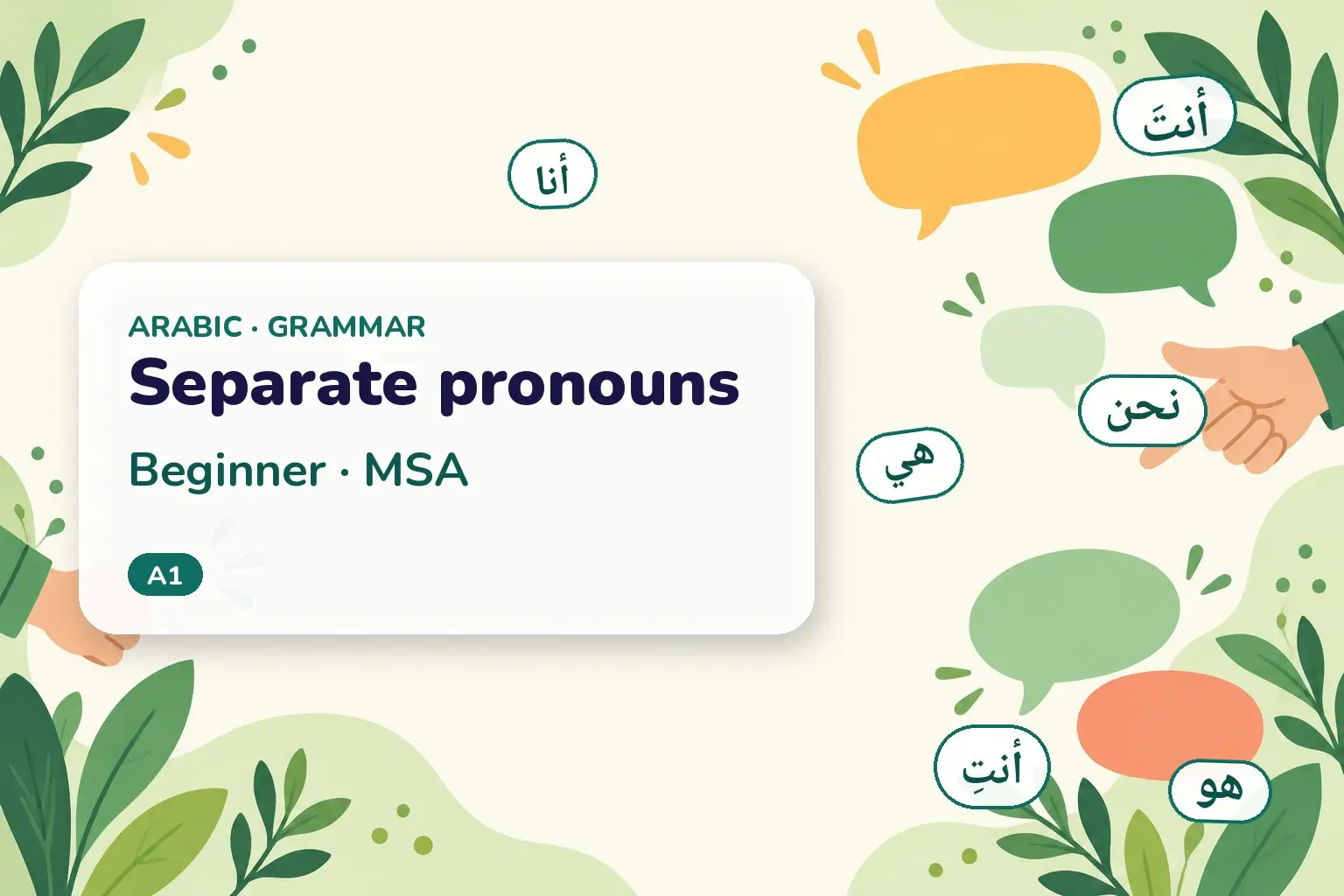
Arabic separate pronouns are standalone words for 'I, you, he…': أنا (anā, I), أنتَ (anta, you to a man), أنتِ (anti, you to a woman), هو (huwa, he), هي (hiya, she). They change for gender and have special dual forms, and need no verb 'to be'.
Level: Beginner. Separate pronouns are the standalone words for “I”, “you”, “he”, “she” and so on — the ones you use to point at yourself or someone else and build your first sentences. Arabic has more of them than English, because it marks gender and adds a special dual for exactly two.
The rule
A pronoun is a short word that stands in for a noun: instead of naming the person, you say “I”, “you” or “she”. The separate (منفصلة, munfaṣila) pronouns are full words that stand on their own, unlike the endings you attach to other words (those are a later topic).
Arabic sorts them by three things:
- Person — the speaker (I/we), the one spoken to (you), or the one spoken about (he/she/they).
- Gender — most forms have a masculine and a feminine version.
- Number — singular (one), dual (exactly two), and plural (three or more).
Because the pronoun already shows the person, you do not add a verb “to be” in the present: أنا طالب (anā ṭālib) means “I am a student”, with no separate word for “am”.
The separate pronouns
| Person | Arabic | Reading | English |
|---|---|---|---|
| 1st singular | أنا | anā | I |
| 1st plural | نحن | naḥnu | we |
| 2nd masc. singular | أنتَ | anta | you (to one man) |
| 2nd fem. singular | أنتِ | anti | you (to one woman) |
| 2nd dual | أنتما | antumā | you two |
| 2nd masc. plural | أنتم | antum | you (men / mixed) |
| 2nd fem. plural | أنتنّ | antunna | you (women) |
| 3rd masc. singular | هو | huwa | he / it |
| 3rd fem. singular | هي | hiya | she / it |
| 3rd dual | هما | humā | they two |
| 3rd masc. plural | هم | hum | they (men / mixed) |
| 3rd fem. plural | هنّ | hunna | they (women) |
Gender, dual and number
Three points surprise English speakers:
- “You” is not one word. You choose by who you address: أنتَ (anta) to one man, أنتِ (anti) to one woman, أنتم (antum) to a group, أنتنّ (antunna) to a group of women.
- The dual is for exactly two. أنتما (antumā, you two) and هما (humā, they two) cover two people of any gender; for three or more you move to the plural.
- “They” splits by gender. هم (hum) is for men or a mixed group; هنّ (hunna) is only for women.
Example sentences
- أَنَا طَالِبٌ.anā ṭālibun.I am a student.no word for 'am'
- نَحْنُ أَصْدِقَاءٌ.naḥnu aṣdiqāʾu.We are friends.
- أَنْتَ مُعَلِّمٌ.anta muʿallimun.You are a teacher.to a man
- أَنْتِ مُعَلِّمَةٌ.anti muʿallimatun.You are a teacher.to a woman
- هُوَ طَبِيبٌ.huwa ṭabībun.He is a doctor.
- هِيَ طَبِيبَةٌ.hiya ṭabībatun.She is a doctor.
- هُمَا أَخَوَانِ.humā akhawāni.They (two) are brothers.dual
- أَنْتُمَا صَدِيقَانِ.antumā ṣadīqāni.You two are friends.dual
- هُمْ طُلَّابٌ.hum ṭullābun.They are students.men / mixed
- هُنَّ طَالِبَاتٌ.hunna ṭālibātun.They are students.women only
- أَنْتُمْ عُمَّالٌ.antum ʿummālun.You are workers.to a group
- أَنَا مِنْ مِصْرَ.anā min Miṣra.I am from Egypt.
- هُوَ فِي البَيْتِ.huwa fī l-bayti.He is in the house.
- هِيَ جَمِيلَةٌ.hiya jamīlatun.She is beautiful.
- نَحْنُ مِنْ لُبْنَانَ.naḥnu min Lubnāna.We are from Lebanon.
- أَنْتِ ذَكِيَّةٌ.anti dhakiyyatun.You are clever.to a woman
- هَلْ أَنْتَ مُدَرِّسٌ؟hal anta mudarrisun?Are you a teacher?to a man
- هُمْ فِي المَدْرَسَةِ.hum fī l-madrasati.They are at the school.
Common mistakes
- ❌ أَنْتَ (anta) to a woman → ✅ أَنْتِ (anti). The “you” form must match the person’s gender: أنتَ (anta) for a man, أنتِ (anti) for a woman.
- ❌ هُمْ (hum) for a group of women → ✅ هُنَّ (hunna). “They” splits by gender, so women take هنّ (hunna).
- ❌ أَنَا أَكُونُ طَالِبًا (anā akūnu ṭāliban) → ✅ أَنَا طَالِبٌ (anā ṭālibun). The present needs no verb “to be”; the pronoun is enough.
- ❌ هُمْ (hum) for exactly two → ✅ هُمَا (humā). Two people take the dual, not the plural.
A short conversation
A: مَنْ أَنْتَ؟ (man anta?) — Who are you? (to a man) B: أَنَا سَامِي. وَأَنْتِ؟ (anā Sāmī. wa-anti?) — I am Sami. And you? (to a woman) A: أَنَا لَيْلَى. هَلْ هُمَا صَدِيقَاكَ؟ (anā Laylā. hal humā ṣadīqāka?) — I am Layla. Are those two your friends? B: نَعَمْ، هُمْ طُلَّابٌ مِثْلِي. (naʿam, hum ṭullābun mithlī.) — Yes, they are students like me.
Usage notes
- Pronouns add emphasis. Because the verb already shows the person, a separate pronoun with a verb is used for stress or contrast: أَنَا كَتَبْتُ (anā katabtu) means “I wrote it (not someone else)”. In a nominal sentence (pronoun + noun/adjective) the pronoun is required.
- نحن (naḥnu) is “we” for any number. From two speakers upward, “we” is نحن (naḥnu); there is no separate dual “we” in standard use.
- Short endings you may hear. In careful speech هو (huwa) and هي (hiya) keep their final vowel; in fast speech it can shorten. The spelling stays the same.
- Spoken dialects differ. Everyday Arabic often reduces the set (for example dropping some dual and feminine-plural forms). This lesson gives Modern Standard Arabic, which keeps all twelve.
Compared with…
- Attached pronouns are the suffixes that mean “my / your / his” and mark objects: ـي (ī), ـكَ (ka), ـهُ (hu), as in كِتَابِي (kitābī, my book). They do the possessive and object work that separate pronouns do not. See the next point in the Arabic grammar section.
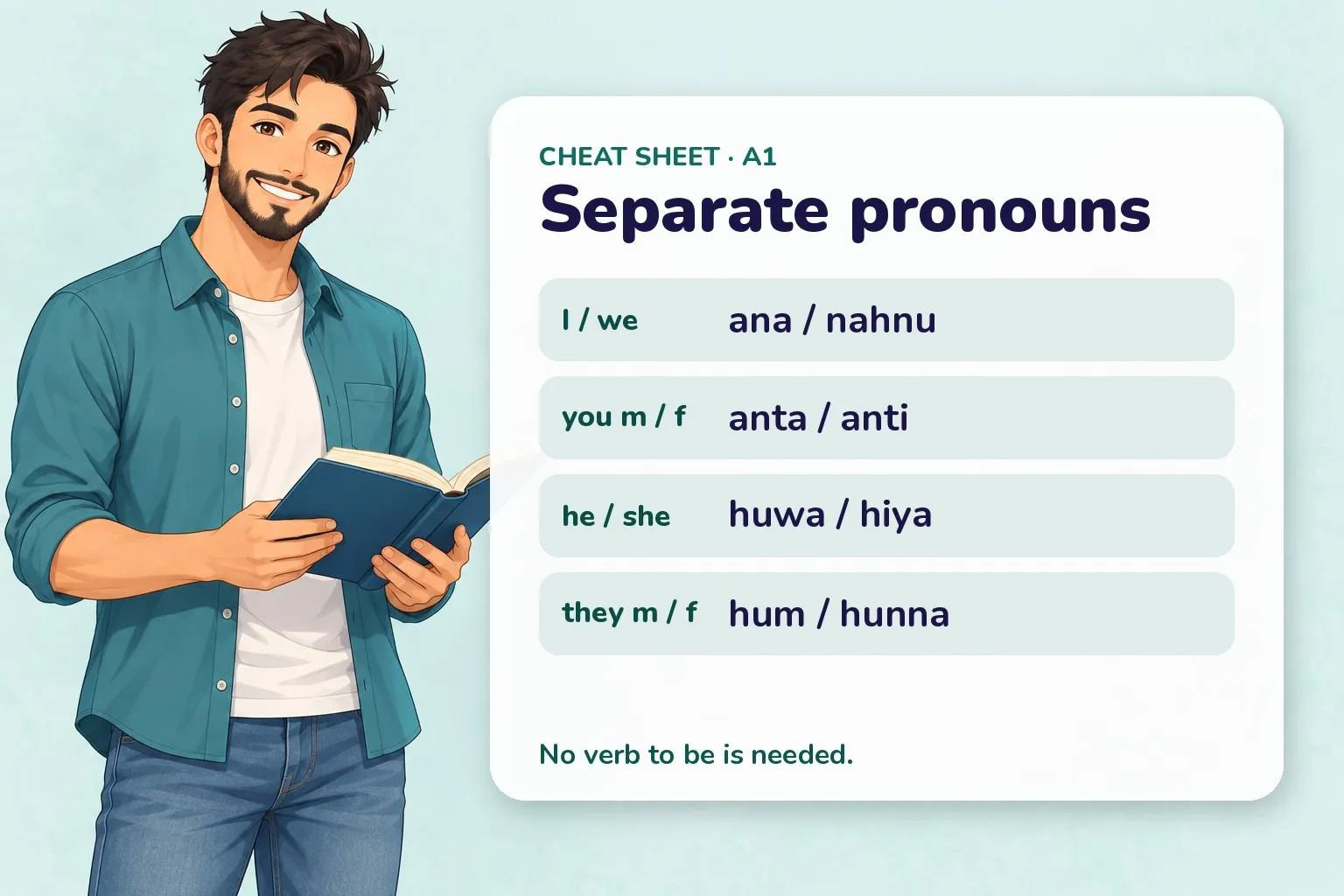
Quick recap before you practise.
Practice
Arabic separate pronouns practice
Try each one, then press Check. No sign-up, nothing is sent anywhere — it all runs in your browser.
Hint: the speaker, first person singular
Show answer
anā — أنا (anā) is 'I'; the present needs no verb 'to be'.
4 Put the words in order: 'She is a doctor.'
Show answer
هي (hiya) طبيبةٌ (ṭabībatun) — Pronoun first, then the predicate: هي طبيبةٌ (hiya ṭabībatun).
5 Match each pronoun to its meaning.
- نحن (naḥnu)
- هم (hum)
- هنّ (hunna)
- أنتَ (anta)
Show answer
- نحن (naḥnu) → we
- هم (hum) → they (men / mixed)
- هنّ (hunna) → they (women)
- أنتَ (anta) → you (to one man)
نحن (naḥnu) we; هم (hum) men/mixed; هنّ (hunna) women; أنتَ (anta) one man.
Quiz
Arabic personal pronouns quiz
12 questions · pick an answer and you'll see straight away if it's right.
-
Show answer
أنا (anā) — أنا (anā) is the first-person singular, 'I'.
-
Show answer
أنتَ (anta) — أنتَ (anta) addresses a single man.
-
Show answer
she / it (feminine) — هي (hiya) is 'she', and also 'it' for a feminine noun.
-
Show answer
هما (humā) — هما (humā) is the dual, used for exactly two.
-
Show answer
هنّ (hunna) — هنّ (hunna) is 'they' for women; هم (hum) is men or mixed.
-
Show answer
أنا طالبٌ (anā ṭālibun) — No verb 'to be' in the present: أنا طالبٌ (anā ṭālibun).
-
Show answer
هو (huwa) — الكِتَاب (al-kitāb) is masculine, so 'it' is هو (huwa).
-
Show answer
نحن (naḥnu) — نحن (naḥnu) is 'we' for any number of speakers.
-
Show answer
أنتم (antum) — أنتم (antum) is 'you' for a group of men or a mixed group.
-
Show answer
The dual is for exactly two — The dual forms هما (humā) and أنتما (antumā) are used for exactly two.
-
Show answer
هي (hiya), feminine singular — Plurals of things act as feminine singular, so they take هي (hiya).
-
Show answer
huwa — هو (huwa) is 'he' (and 'it' for a masculine noun).
Recap cheat-sheet
| Meaning | Arabic | Reading |
|---|---|---|
| I / we | أنا / نحن | anā / naḥnu |
| you (m / f sing.) | أنتَ / أنتِ | anta / anti |
| you (dual / plural) | أنتما / أنتم | antumā / antum |
| he / she | هو / هي | huwa / hiya |
| they (m / f) | هم / هنّ | hum / hunna |
Next
- Back to the Arabic grammar section
- New here? Start with Start Learning Arabic Here
All Arabic grammar topics
Every grammar point in order, from your first sentence to advanced structures. Pick one and go straight to it. New lessons go live every day, so topics marked Coming soon fill in over the next weeks.
Grammar path
Beginner 16 topics · 12 ready
- 01 The Definite Article الـ (al-)
- 02 Indefiniteness and Tanwin
- 03 Noun Gender (Masculine & Feminine)
- 04 The Nominal Sentence (Jumla Ismiyya)
- 05 Adjective Agreement (Na't)
- 06 Personal Pronouns (Separate) You are here
- 07 Attached (Possessive/Object) Pronouns
- 08 Demonstratives (هذا hādhā، هذه hādhihi، ذلك dhālika)
- 09 The Idafa (Possessive Construction)
- 10 Prepositions (Huruf al-Jarr)
- 11 Questions (هل hal، أ a، ما mā، من man، أين ayna)
- 12 Negating Nominal Sentences (ليس laysa)
- 13 Numbers 1-10 and Counting Coming soon
- 14 Pointing Sentences (هذا كتاب hādhā kitāb) Coming soon
- 15 Prepositional & Adverbial Predicates Coming soon
- 16 Expressing 'Have' (عند / لـ / مع ʿinda / li- / maʿa) Coming soon
Elementary 17 topics
- 17 The Present Tense (al-Mudari') Coming soon
- 18 The Past Tense (al-Madi) Coming soon
- 19 The Verbal Sentence (Jumla Fi'liyya) Coming soon
- 20 Verb Agreement with the Subject Coming soon
- 21 Negating the Past (ما / لم mā / lam) Coming soon
- 22 Negating the Present & Future (لا / لن lā / lan) Coming soon
- 23 The Future (سـ / سوف sa- / sawfa) Coming soon
- 24 The Dual (al-Muthanna) Coming soon
- 25 Sound Plurals (Masculine & Feminine) Coming soon
- 26 Broken Plurals (Jam' Taksir) Coming soon
- 27 Kana and Its Sisters Coming soon
- 28 Inna and Its Sisters Coming soon
- 29 Non-Human Plural Agreement Coming soon
- 30 Days, Months and Time Expressions Coming soon
- 31 Adverbs of Time & Place (Zarf) Coming soon
- 32 Hamzat al-Wasl vs Hamzat al-Qat' Coming soon
- 33 Colours & Defects (Af'al pattern) Coming soon
Intermediate 22 topics
- 34 The Three Cases (I'rab) Coming soon
- 35 Uses of the Accusative (Mansubat) Coming soon
- 36 The Derived Verb Forms (I-X) Coming soon
- 37 Root and Pattern Morphology Coming soon
- 38 Active & Passive Participles Coming soon
- 39 The Verbal Noun (Masdar) Coming soon
- 40 The Subjunctive (Mansub) after أن / لـ (an / li-) Coming soon
- 41 The Jussive (Majzum) & Commands Coming soon
- 42 The Imperative (al-Amr) Coming soon
- 43 Weak Verbs (Assimilated, Hollow, Defective) Coming soon
- 44 Relative Clauses (الذي alladhī، التي allatī) Coming soon
- 45 Comparative & Superlative (Af'al) Coming soon
- 46 Conditional Sentences (إذا idhā، إنْ in، لو law) Coming soon
- 47 Numbers 11-99 and Agreement Coming soon
- 48 The Five Nouns (al-Asma' al-Khamsa) Coming soon
- 49 Diptotes (al-Mamnu' min as-Sarf) Coming soon
- 50 Object of Purpose & Accompaniment Coming soon
- 51 Apposition & Substitution (Badal) Coming soon
- 52 Emphasis (at-Tawkid: نفس nafs، كل kull) Coming soon
- 53 Coordination (al-'Atf) & Case Carrying Coming soon
- 54 Questions of Quantity (كم kam) & Number Syntax Coming soon
- 55 The Nisba Adjective (-iyy) Coming soon
Upper-Intermediate 14 topics
- 56 The Circumstantial Clause (Hal) Coming soon
- 57 Specification (Tamyiz) Coming soon
- 58 Exception (al-Istithna': إلا illā) Coming soon
- 59 The Absolute Object (al-Maf'ul al-Mutlaq) Coming soon
- 60 The Passive Voice (al-Majhul) Coming soon
- 61 The Vocative (an-Nida': يا yā) Coming soon
- 62 Energetic Mood & Emphasis (Nun al-Tawkid) Coming soon
- 63 Verbs with Prepositions Coming soon
- 64 Connectors & Cohesion (و wa، ف fa، ثم thumma، لكنّ lākinna) Coming soon
- 65 Verbs of Certainty/Doubt (Dhanna & Sisters) Coming soon
- 66 Verbs with Two Objects Coming soon
- 67 The Diminutive (at-Tasghir) Coming soon
- 68 Collective & Unit Nouns Coming soon
- 69 Conditional Particles & Jussive Pair Coming soon
Advanced 10 topics
- 70 Advanced I'rab & Government Coming soon
- 71 Expressing Aspect (قد qad، كان قد kāna qad، لمّا lammā) Coming soon
- 72 Rhetorical Structures (Taqdim wa-Ta'khir) Coming soon
- 73 Advanced Conditionals & Oaths Coming soon
- 74 Classical/Formal Register (Fusha Style) Coming soon
- 75 Nominal Style & Masdar-Heavy Syntax Coming soon
- 76 Advanced Exception & Restriction (إنما innamā، غير ghayr) Coming soon
- 77 Absolute Negation (لا النافية للجنس lā an-nāfiya lil-jins) Coming soon
- 78 Particle Review: إنّ (inna)، أنّ (anna)، أنْ (an)، كأنّ (ka-anna) Coming soon
- 79 Verb-Initial vs Noun-Initial Style Coming soon