Negating Nominal Sentences (ليس laysa)
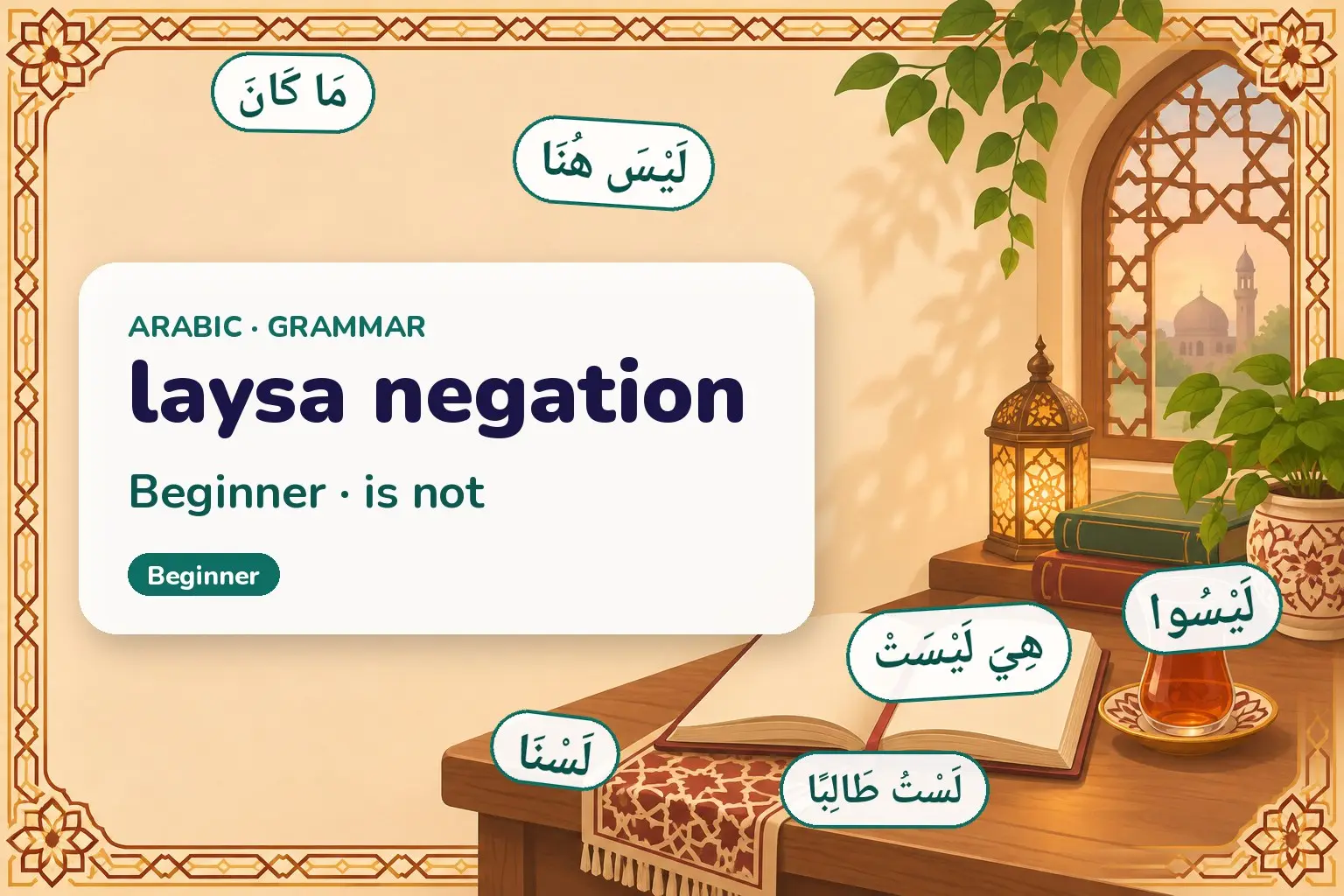
Use ليس (laysa) to say is not, am not or are not in a verbless Arabic sentence. It conjugates for the subject (lastu, laysa, laysat...) and puts the predicate into the accusative: لَسْتُ طَالِبًا (lastu ṭāliban) means I am not a student.
Level: beginner. You already know the Arabic nominal sentence needs no word for is — البَيْتُ كَبِيرٌ (al-baytu kabīrun), the house is big. To say the house is not big, you add one special little verb: لَيْسَ (laysa).
The rule
A nominal sentence (a sentence that starts with a noun and has no verb) is made negative with لَيْسَ (laysa), the word for is not / am not / are not. It comes at the front, before the subject, and it conjugates — it changes its ending to match who you are talking about.
لَيْسَ (laysa) is unusual. Its endings are the ones you see on a past-tense verb (lastu, lasta, laysat…), yet its meaning is firmly in the present. Grammarians call it a defective verb for this reason; you can simply treat it as the ready-made negative copula.
The second important point is case. In a plain nominal sentence the predicate (the describing word, the khabar) is nominative: كَبِيرٌ (kabīrun), ending in -un. After لَيْسَ (laysa) that predicate turns accusative — it ends in -an (tanwīn fatḥ) instead: كَبِيرًا (kabīran). The subject (the noun laysa governs) stays nominative.
The forms of laysa
| Person | Arabic | Reading | Meaning |
|---|---|---|---|
| I | لَسْتُ | lastu | I am not |
| you (m.) | لَسْتَ | lasta | you are not |
| you (f.) | لَسْتِ | lasti | you are not |
| he | لَيْسَ | laysa | he / it is not |
| she | لَيْسَتْ | laysat | she / it is not |
| we | لَسْنَا | lasnā | we are not |
| you (pl. m.) | لَسْتُمْ | lastum | you all are not |
| they (m.) | لَيْسُوا | laysū | they are not |
| they (f.) | لَسْنَ | lasna | they are not |
Notice the pattern: the he/she/they-masculine forms keep the lays- stem (laysa, laysat, laysū), while the I/you/we forms switch to las- (lastu, lasta, lasnā).
Example sentences
- لَسْتُ طَالِبًا.lastu ṭāliban.I am not a student.predicate accusative: -an
- هُوَ لَيْسَ هُنَا.huwa laysa hunā.He is not here.
- البَيْتُ لَيْسَ كَبِيرًا.al-baytu laysa kabīran.The house is not big.
- هِيَ لَيْسَتْ مُعَلِّمَةً.hiya laysat muʿallimatan.She is not a teacher.feminine subject: laysat
- لَسْنَا مُتْعَبِينَ.lasnā mutʿabīna.We are not tired.masculine plural predicate: -īna
- أَنْتَ لَسْتَ وَحْدَكَ.anta lasta waḥdaka.You are not alone.
- الطَّقْسُ لَيْسَ بَارِدًا.aṭ-ṭaqsu laysa bāridan.The weather is not cold.
- القَهْوَةُ لَيْسَتْ سَاخِنَةً.al-qahwatu laysat sākhinatan.The coffee is not hot.
- هُمْ لَيْسُوا جَاهِزِينَ.hum laysū jāhizīna.They are not ready.plural subject: laysū
- لَسْتُ جَائِعًا.lastu jāʾiʿan.I am not hungry.
- هَذَا لَيْسَ صَحِيحًا.hādhā laysa ṣaḥīḥan.This is not correct.
- المَطْعَمُ لَيْسَ مَفْتُوحًا.al-maṭʿamu laysa maftūḥan.The restaurant is not open.
- أَنْتِ لَسْتِ مُتَأَخِّرَةً.anti lasti mutaʾakhkhiratan.You (f.) are not late.
- الدَّرْسُ لَيْسَ صَعْبًا.ad-darsu laysa ṣaʿban.The lesson is not difficult.
- نَحْنُ لَسْنَا مِنْ هُنَا.naḥnu lasnā min hunā.We are not from here.
- السَّيَّارَةُ لَيْسَتْ جَدِيدَةً.as-sayyāratu laysat jadīdatan.The car is not new.
- القِصَّةُ لَيْسَتْ طَوِيلَةً.al-qiṣṣatu laysat ṭawīlatan.The story is not long.
- هُمَا لَيْسَا صَدِيقَيْنِ.humā laysā ṣadīqayni.The two of them are not friends.dual predicate: -ayni
Every predicate above wears the accusative ending because لَيْسَ (laysa) demands it.
Common mistakes
- ❌ أَنَا لا طَالِبٌ (anā lā ṭālibun) → ✅ لَسْتُ طَالِبًا (lastu ṭāliban). The particle لا (lā) does not negate a verbless sentence; the copula negator is لَيْسَ (laysa).
- ❌ لَسْتُ طَالِبٌ (lastu ṭālibun) → ✅ لَسْتُ طَالِبًا (lastu ṭāliban). laysa forces the predicate into the accusative (-an), not the nominative (-un).
- ❌ هِيَ لَيْسَ مُعَلِّمَةً (hiya laysa muʿallimatan) → ✅ هِيَ لَيْسَتْ مُعَلِّمَةً (hiya laysat muʿallimatan). laysa agrees with the subject, so a feminine subject needs لَيْسَتْ (laysat).
- ❌ هُمْ لَيْسَ جَاهِزِينَ (hum laysa jāhizīna) → ✅ هُمْ لَيْسُوا جَاهِزِينَ (hum laysū jāhizīna). A masculine-plural subject takes لَيْسُوا (laysū).
- ❌ Using لَيْسَ (laysa) for the past → ✅ laysa is present only. For was not, use مَا كَانَ (mā kāna) or لَمْ يَكُنْ (lam yakun).
A short conversation
— سَامِي (Sāmī): هَلْ أَنْتَ مُتْعَبٌ؟ — hal anta mutʿabun? — Are you tired? — لَيْلَى (Laylā): لا، لَسْتُ مُتْعَبَةً، لَكِنِّي جَائِعَةٌ. — lā, lastu mutʿabatan, lākinnī jāʾiʿatun. — No, I am not tired, but I am hungry. — سَامِي (Sāmī): المَطْعَمُ لَيْسَ بَعِيدًا. — al-maṭʿamu laysa baʿīdan. — The restaurant is not far.
Each negative here is لَيْسَ (laysa) in the right form, with the predicate in the accusative.
Usage notes
- Word order. laysa usually comes first, then the subject, then the predicate: لَيْسَ الوَلَدُ مَرِيضًا (laysa l-waladu marīḍan), the boy is not ill. With a pronoun subject you often drop the pronoun because the laysa ending already shows it: لَسْتُ جَاهِزًا (lastu jāhizan).
- Only the predicate moves. The subject keeps its nominative ending (الوَلَدُ al-waladu, with -u); only the predicate takes the accusative (مَرِيضًا marīḍan, with -an).
- laysa plus a preposition. To say I do not have, Arabic often uses laysa with a possessive phrase: لَيْسَ عِنْدِي وَقْتٌ (laysa ʿindī waqtun), I have no time. Here the thing you lack stays nominative — a special pattern worth recognising.
- Feminine and plural endings. Match the subject: لَيْسَتْ (laysat) for a single female, لَسْنَ (lasna) for a group of females, لَيْسُوا (laysū) for a group of males.
Compared with verb negation
لَيْسَ (laysa) only negates nominal (verbless) sentences. When a sentence has a real verb, you use a different negator:
- لا (lā) + present verb = a general does not: لا أَعْرِفُ (lā aʿrifu), I do not know.
- لَمْ (lam) + jussive verb = did not (the usual past negative): لَمْ أَذْهَبْ (lam adhhab), I did not go.
- مَا (mā) + past verb = another did not: مَا ذَهَبْتُ (mā dhahabtu), I did not go.
Rule of thumb: no verb in the sentence → use laysa; a verb in the sentence → use lā, lam or mā. Review the positive pattern on the Arabic nominal sentence page, or browse the whole Arabic grammar section.
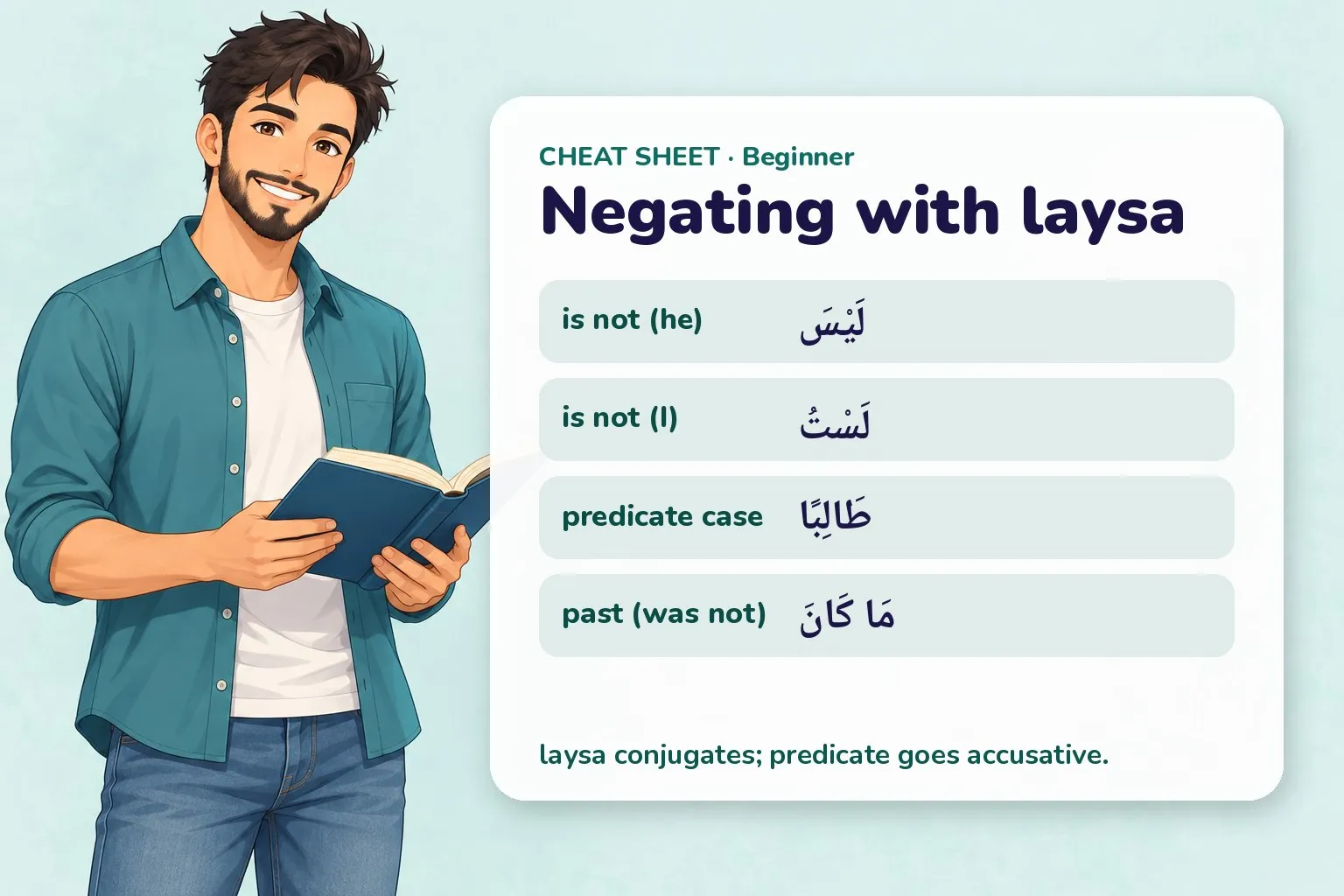
Quick recap before you practise.
Practice
laysa negation practice
Try each one, then press Check. No sign-up, nothing is sent anywhere — it all runs in your browser.
Hint: feminine singular subject
Show answer
laysat — هِيَ لَيْسَتْ مُعَلِّمَةً (hiya laysat muʿallimatan): laysa agrees with a feminine subject.
Hint: accusative, -an
Show answer
kabīran — البَيْتُ لَيْسَ كَبِيرًا (al-baytu laysa kabīran): the predicate is accusative after laysa.
5 Order the words: I am not tired. (feminine speaker)
Show answer
لَسْتُ (lastu) مُتْعَبَةً (mutʿabatan) — لَسْتُ مُتْعَبَةً (lastu mutʿabatan): laysa form first, then the accusative predicate.
6 Match each subject to its laysa form.
- أَنَا (anā)
- هُوَ (huwa)
- هِيَ (hiya)
- هُمْ (hum)
Show answer
- أَنَا (anā) → لَسْتُ (lastu)
- هُوَ (huwa) → لَيْسَ (laysa)
- هِيَ (hiya) → لَيْسَتْ (laysat)
- هُمْ (hum) → لَيْسُوا (laysū)
lastu for I, laysa for he, laysat for she, laysū for they (m.).
Quiz
laysa negation quiz
12 questions · pick an answer and you'll see straight away if it's right.
-
Show answer
a verbless (nominal) sentence — laysa is the negator for nominal (verbless) sentences.
-
Show answer
accusative (-a / -an) — The predicate after laysa is accusative, e.g. كَبِيرًا (kabīran).
-
Show answer
nominative — Only the predicate changes; the subject keeps its nominative ending.
-
Show answer
هُوَ لَيْسَ هُنَا (huwa laysa hunā) — Third-person masculine uses laysa.
-
Show answer
القَهْوَةُ لَيْسَتْ سَاخِنَةً (al-qahwatu laysat sākhinatan) — Feminine subject takes laysat and an accusative predicate sākhinatan.
-
Show answer
the predicate should be accusative (ṭāliban) — After laysa the predicate is accusative: طَالِبًا (ṭāliban).
-
Show answer
هُمْ لَيْسُوا جَاهِزِينَ (hum laysū jāhizīna) — Masculine plural subject takes laysū.
-
Show answer
مَا كَانَ (mā kāna) or لَمْ يَكُنْ (lam yakun) — laysa is present only; the past uses mā kāna or lam yakun.
-
Show answer
لا (lā) — A verb takes lā (here), not laysa: لا أَعْرِفُ (lā aʿrifu).
-
Show answer
لَسْتُ جَائِعًا (lastu jāʾiʿan) — First person lastu, accusative predicate jāʾiʿan.
-
Show answer
lasnā — نَحْنُ لَسْنَا مِنْ هُنَا (naḥnu lasnā min hunā): first-person plural is lasnā.
-
Show answer
it has past-tense endings but present meaning — It conjugates like a past verb yet means the present is not.
Recap cheat-sheet
| Point | Arabic | Reading | Note |
|---|---|---|---|
| is not (he) | لَيْسَ | laysa | base form |
| is not (I) | لَسْتُ | lastu | las- stem |
| is not (she) | لَيْسَتْ | laysat | feminine |
| predicate case | طَالِبًا | ṭāliban | accusative -an |
| past (was not) | مَا كَانَ | mā kāna | not laysa |
Next
- Review the positive pattern: The Nominal Sentence (Jumla Ismiyya)
- Back to the Arabic grammar section
- New here? Start with Start Learning Arabic Here
All Arabic grammar topics
Every grammar point in order, from your first sentence to advanced structures. Pick one and go straight to it. New lessons go live every day, so topics marked Coming soon fill in over the next weeks.
Grammar path
Beginner 16 topics · 12 ready
- 01 The Definite Article الـ (al-)
- 02 Indefiniteness and Tanwin
- 03 Noun Gender (Masculine & Feminine)
- 04 The Nominal Sentence (Jumla Ismiyya)
- 05 Adjective Agreement (Na't)
- 06 Personal Pronouns (Separate)
- 07 Attached (Possessive/Object) Pronouns
- 08 Demonstratives (هذا hādhā، هذه hādhihi، ذلك dhālika)
- 09 The Idafa (Possessive Construction)
- 10 Prepositions (Huruf al-Jarr)
- 11 Questions (هل hal، أ a، ما mā، من man، أين ayna)
- 12 Negating Nominal Sentences (ليس laysa) You are here
- 13 Numbers 1-10 and Counting Coming soon
- 14 Pointing Sentences (هذا كتاب hādhā kitāb) Coming soon
- 15 Prepositional & Adverbial Predicates Coming soon
- 16 Expressing 'Have' (عند / لـ / مع ʿinda / li- / maʿa) Coming soon
Elementary 17 topics
- 17 The Present Tense (al-Mudari') Coming soon
- 18 The Past Tense (al-Madi) Coming soon
- 19 The Verbal Sentence (Jumla Fi'liyya) Coming soon
- 20 Verb Agreement with the Subject Coming soon
- 21 Negating the Past (ما / لم mā / lam) Coming soon
- 22 Negating the Present & Future (لا / لن lā / lan) Coming soon
- 23 The Future (سـ / سوف sa- / sawfa) Coming soon
- 24 The Dual (al-Muthanna) Coming soon
- 25 Sound Plurals (Masculine & Feminine) Coming soon
- 26 Broken Plurals (Jam' Taksir) Coming soon
- 27 Kana and Its Sisters Coming soon
- 28 Inna and Its Sisters Coming soon
- 29 Non-Human Plural Agreement Coming soon
- 30 Days, Months and Time Expressions Coming soon
- 31 Adverbs of Time & Place (Zarf) Coming soon
- 32 Hamzat al-Wasl vs Hamzat al-Qat' Coming soon
- 33 Colours & Defects (Af'al pattern) Coming soon
Intermediate 22 topics
- 34 The Three Cases (I'rab) Coming soon
- 35 Uses of the Accusative (Mansubat) Coming soon
- 36 The Derived Verb Forms (I-X) Coming soon
- 37 Root and Pattern Morphology Coming soon
- 38 Active & Passive Participles Coming soon
- 39 The Verbal Noun (Masdar) Coming soon
- 40 The Subjunctive (Mansub) after أن / لـ (an / li-) Coming soon
- 41 The Jussive (Majzum) & Commands Coming soon
- 42 The Imperative (al-Amr) Coming soon
- 43 Weak Verbs (Assimilated, Hollow, Defective) Coming soon
- 44 Relative Clauses (الذي alladhī، التي allatī) Coming soon
- 45 Comparative & Superlative (Af'al) Coming soon
- 46 Conditional Sentences (إذا idhā، إنْ in، لو law) Coming soon
- 47 Numbers 11-99 and Agreement Coming soon
- 48 The Five Nouns (al-Asma' al-Khamsa) Coming soon
- 49 Diptotes (al-Mamnu' min as-Sarf) Coming soon
- 50 Object of Purpose & Accompaniment Coming soon
- 51 Apposition & Substitution (Badal) Coming soon
- 52 Emphasis (at-Tawkid: نفس nafs، كل kull) Coming soon
- 53 Coordination (al-'Atf) & Case Carrying Coming soon
- 54 Questions of Quantity (كم kam) & Number Syntax Coming soon
- 55 The Nisba Adjective (-iyy) Coming soon
Upper-Intermediate 14 topics
- 56 The Circumstantial Clause (Hal) Coming soon
- 57 Specification (Tamyiz) Coming soon
- 58 Exception (al-Istithna': إلا illā) Coming soon
- 59 The Absolute Object (al-Maf'ul al-Mutlaq) Coming soon
- 60 The Passive Voice (al-Majhul) Coming soon
- 61 The Vocative (an-Nida': يا yā) Coming soon
- 62 Energetic Mood & Emphasis (Nun al-Tawkid) Coming soon
- 63 Verbs with Prepositions Coming soon
- 64 Connectors & Cohesion (و wa، ف fa، ثم thumma، لكنّ lākinna) Coming soon
- 65 Verbs of Certainty/Doubt (Dhanna & Sisters) Coming soon
- 66 Verbs with Two Objects Coming soon
- 67 The Diminutive (at-Tasghir) Coming soon
- 68 Collective & Unit Nouns Coming soon
- 69 Conditional Particles & Jussive Pair Coming soon
Advanced 10 topics
- 70 Advanced I'rab & Government Coming soon
- 71 Expressing Aspect (قد qad، كان قد kāna qad، لمّا lammā) Coming soon
- 72 Rhetorical Structures (Taqdim wa-Ta'khir) Coming soon
- 73 Advanced Conditionals & Oaths Coming soon
- 74 Classical/Formal Register (Fusha Style) Coming soon
- 75 Nominal Style & Masdar-Heavy Syntax Coming soon
- 76 Advanced Exception & Restriction (إنما innamā، غير ghayr) Coming soon
- 77 Absolute Negation (لا النافية للجنس lā an-nāfiya lil-jins) Coming soon
- 78 Particle Review: إنّ (inna)، أنّ (anna)، أنْ (an)، كأنّ (ka-anna) Coming soon
- 79 Verb-Initial vs Noun-Initial Style Coming soon