Adjective Agreement in Arabic (Na't)

An Arabic adjective comes after its noun and must match it in four ways: gender, number, case (the ending vowel) and definiteness. So a definite feminine noun needs a definite feminine adjective, as in البِنْتُ الصَّغِيرَةُ (al-bintu ṣ-ṣaghīratu, the small girl).
Level: Beginner. In Arabic a describing word follows the noun it describes and copies several of the noun’s features. Once you can read a noun’s gender, number, case and definiteness, the adjective’s ending is no longer a guess — it mirrors the noun.
The rule
An adjective (a describing word — ṣifa or naʿt in Arabic) does two things that surprise English speakers. First, it comes after the noun, not before: you say “the house the big”, not “the big house”. Second, it agrees with the noun in four features at once:
- Gender: masculine or feminine. A feminine noun takes a feminine adjective, usually with the ending ة (tā marbūṭa).
- Number: singular, dual or plural.
- Case: the short vowel on the end that marks the noun’s job in the sentence — nominative ـُ (u), accusative ـَ (a), genitive ـِ (i). The adjective copies it, so the two words rhyme.
- Definiteness: if the noun is definite — it has the prefix أل (al-) — the adjective must be definite too; if the noun is indefinite, the adjective stays indefinite.
So a noun–adjective phrase keeps all four features lined up. البَيْتُ الكَبِيرُ (al-baytu l-kabīru) means “the big house”: both words are masculine, singular, nominative and definite.
The four features that must agree
| Feature | Masculine example | Reading | Feminine example | Reading |
|---|---|---|---|---|
| Gender | وَلَدٌ طَوِيلٌ | waladun ṭawīlun (a tall boy) | بِنْتٌ طَوِيلَةٌ | bintun ṭawīlatun (a tall girl) |
| Definiteness | بَيْتٌ كَبِيرٌ | baytun kabīrun (a big house) | البَيْتُ الكَبِيرُ | al-baytu l-kabīru (the big house) |
| Case (nominative → genitive) | البَيْتُ الكَبِيرُ | al-baytu l-kabīru | فِي البَيْتِ الكَبِيرِ | fī l-bayti l-kabīri (in the big house) |
Definiteness in detail
Arabic marks “the” with the prefix أل (al-). In a noun–adjective phrase both words carry it or neither does:
- Indefinite + indefinite: مَدِينَةٌ جَمِيلَةٌ (madīnatun jamīlatun) — “a beautiful city”.
- Definite + definite: المَدِينَةُ الجَمِيلَةُ (al-madīnatu l-jamīlatu) — “the beautiful city”.
If only the noun is definite, الكِتَابُ جَدِيدٌ (al-kitābu jadīdun), you no longer have a phrase — you have the sentence “the book is new”.
Case: why the endings rhyme
Case is the short final vowel that shows a word’s role. After a preposition such as فِي (fī, in) the noun takes the genitive ـِ (i), and the adjective follows it: فِي البَيْتِ الكَبِيرِ (fī l-bayti l-kabīri, “in the big house”). You do not choose the adjective’s ending separately — you copy the noun’s.
Example sentences
- البَيْتُ الكَبِيرُ جَمِيلٌ.al-baytu l-kabīru jamīlun.The big house is beautiful.al-baytu l-kabīru = the big house (both definite)
- هٰذَا وَلَدٌ طَوِيلٌ.hādhā waladun ṭawīlun.This is a tall boy.both indefinite and masculine
- هٰذِهِ بِنْتٌ طَوِيلَةٌ.hādhihi bintun ṭawīlatun.This is a tall girl.feminine noun, feminine adjective
- عِنْدِي سَيَّارَةٌ جَدِيدَةٌ.ʿindī sayyāratun jadīdatun.I have a new car.feminine, both indefinite
- السَّيَّارَةُ الجَدِيدَةُ سَرِيعَةٌ.as-sayyāratu l-jadīdatu sarīʿatun.The new car is fast.
- قَرَأْتُ كِتَابًا مُفِيدًا.qaraʾtu kitāban mufīdan.I read a useful book.accusative: both end in -an
- نَسْكُنُ فِي البَيْتِ القَدِيمِ.naskunu fī l-bayti l-qadīmi.We live in the old house.genitive after fī: both end in -i
- المُعَلِّمُ الجَدِيدُ هُنَا.al-muʿallimu l-jadīdu hunā.The new (male) teacher is here.
- المُعَلِّمَةُ الجَدِيدَةُ هُنَا.al-muʿallimatu l-jadīdatu hunā.The new (female) teacher is here.
- هٰذِهِ مَدِينَةٌ جَمِيلَةٌ.hādhihi madīnatun jamīlatun.This is a beautiful city.
- الطَّالِبُ الذَّكِيُّ يَدْرُسُ.aṭ-ṭālibu dh-dhakiyyu yadrusu.The clever student is studying.
- عِنْدَهَا قِطَّةٌ صَغِيرَةٌ.ʿindahā qiṭṭatun ṣaghīratun.She has a small cat.
- الكُتُبُ الجَدِيدَةُ عَلَى الطَّاوِلَةِ.al-kutubu l-jadīdatu ʿalā ṭ-ṭāwilati.The new books are on the table.non-human plural takes a feminine singular adjective
- رَأَيْتُ رَجُلًا كَبِيرًا.raʾaytu rajulan kabīran.I saw an old man.accusative, both indefinite
- البَابُ الأَبْيَضُ مَفْتُوحٌ.al-bābu l-abyaḍu maftūḥun.The white door is open.
- هٰذِهِ قِصَّةٌ قَصِيرَةٌ جَمِيلَةٌ.hādhihi qiṣṣatun qaṣīratun jamīlatun.This is a nice short story.two adjectives, both agree with the noun
Common mistakes
- ❌ كَبِيرٌ بَيْتٌ (kabīrun baytun) → ✅ بَيْتٌ كَبِيرٌ (baytun kabīrun). The adjective follows the noun; English puts it first, Arabic second.
- ❌ البَيْتُ كَبِيرُ (al-baytu kabīru) as “the big house” → ✅ البَيْتُ الكَبِيرُ (al-baytu l-kabīru). Definiteness must match: a definite noun needs أل (al-) on the adjective too.
- ❌ بِنْتٌ طَوِيلٌ (bintun ṭawīlun) → ✅ بِنْتٌ طَوِيلَةٌ (bintun ṭawīlatun). The noun is feminine, so the adjective needs the feminine ة (tā marbūṭa).
- ❌ الكُتُبُ الجُدُدُ (al-kutubu l-judud, a human-style plural adjective) for things → ✅ الكُتُبُ الجَدِيدَةُ (al-kutubu l-jadīdatu). Non-human plurals take a feminine singular adjective.
- ❌ فِي البَيْتِ الكَبِيرُ (fī l-bayti l-kabīru) → ✅ فِي البَيْتِ الكَبِيرِ (fī l-bayti l-kabīri). After فِي (fī) the noun is genitive, so the adjective copies the genitive ـِ (i).
A short conversation
A: هَلْ هٰذَا بَيْتُكَ الجَدِيدُ؟ (hal hādhā baytuka l-jadīdu?) — Is this your new house? B: نَعَمْ، هٰذَا هُوَ البَيْتُ الجَدِيدُ. (naʿam, hādhā huwa l-baytu l-jadīdu.) — Yes, this is the new house. A: إِنَّهُ بَيْتٌ كَبِيرٌ وَجَمِيلٌ. (innahu baytun kabīrun wa-jamīlun.) — It is a big, beautiful house. B: شُكْرًا، الغُرْفَةُ الوَاسِعَةُ هُنَاكَ. (shukran, al-ghurfatu l-wāsiʿatu hunāka.) — Thank you, the spacious room is over there.
Usage notes
- Non-human plurals act feminine singular. A plural of things, not people, takes a feminine singular adjective: الأَبْوَابُ المَفْتُوحَةُ (al-abwābu l-maftūḥatu, “the open doors”). Human plurals use true plural adjectives, a later topic.
- Several adjectives stack after the noun, each agreeing: بَيْتٌ كَبِيرٌ جَمِيلٌ (baytun kabīrun jamīlun, “a big beautiful house”).
- Demonstratives are different. هٰذَا (hādhā, this) and هٰذِهِ (hādhihi, this, fem.) come before a definite noun: هٰذَا البَيْتُ (hādhā l-baytu, “this house”). A plain adjective still comes after.
- Colour and defect adjectives such as أَبْيَض (abyaḍ, white) follow a special pattern for the feminine, as in بَيْضَاء (bayḍāʾ), but they still agree in gender, number, case and definiteness.
Compared with…
- Noun gender decides the feminine ة (tā marbūṭa) ending on the adjective — review it first in the Arabic grammar section.
- The possessive construction (iḍāfa) also puts two nouns together, but there definiteness works differently: only the second noun carries أل (al-). Keep agreement (this page) and iḍāfa separate in your mind. Browse the Arabic grammar section for more.
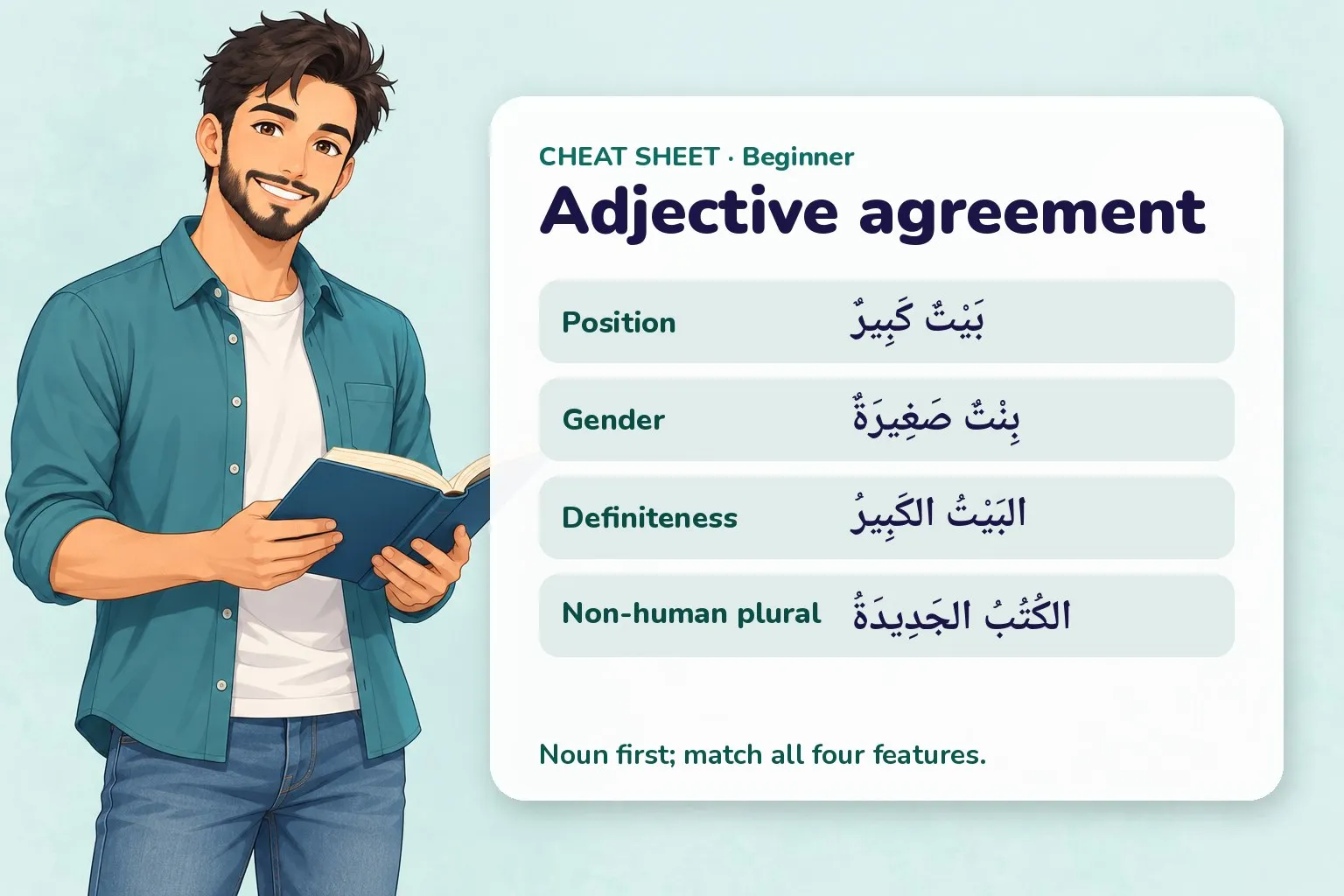
Quick recap before you practise.
Practice
Adjective agreement practice
Try each one, then press Check. No sign-up, nothing is sent anywhere — it all runs in your browser.
Hint: definite + feminine
Show answer
al-jadīdatu — A definite feminine noun needs a definite feminine adjective: السَّيَّارَةُ الجَدِيدَةُ (as-sayyāratu l-jadīdatu).
4 Put the words in order: 'a useful book' (indefinite).
Show answer
كِتَابٌ (kitābun) مُفِيدٌ (mufīdun) — Noun first, then the matching adjective: كِتَابٌ مُفِيدٌ (kitābun mufīdun).
5 Match each noun to a correctly agreeing adjective.
- بِنْتٌ (bintun)
- وَلَدٌ (waladun)
- البَيْتُ (al-baytu)
- كُتُبٌ (kutubun)
Show answer
- بِنْتٌ (bintun) → صَغِيرَةٌ (ṣaghīratun)
- وَلَدٌ (waladun) → صَغِيرٌ (ṣaghīrun)
- البَيْتُ (al-baytu) → الكَبِيرُ (al-kabīru)
- كُتُبٌ (kutubun) → جَدِيدَةٌ (jadīdatun)
Gender and definiteness must match; non-human plurals like كُتُب (kutub) take a feminine singular adjective.
Quiz
Arabic adjective agreement quiz
12 questions · pick an answer and you'll see straight away if it's right.
-
Show answer
after the noun — The adjective follows its noun: بَيْتٌ كَبِيرٌ (baytun kabīrun), 'a house a big'.
-
Show answer
four (gender, number, case, definiteness) — Gender, number, case and definiteness all line up.
-
Show answer
the sentence 'the house is big' — A definite noun with an indefinite adjective makes a sentence, not a phrase.
-
Show answer
المَدِينَةُ الجَمِيلَةُ (al-madīnatu l-jamīlatu) — Both words definite and in order: المَدِينَةُ الجَمِيلَةُ (al-madīnatu l-jamīlatu).
-
Show answer
ة (tā marbūṭa) — The feminine marker ة (tā marbūṭa) appears on the adjective: بِنْتٌ صَغِيرَةٌ (bintun ṣaghīratun).
-
Show answer
the genitive ـِ (i) — فِي (fī) forces the genitive: فِي البَيْتِ الكَبِيرِ (fī l-bayti l-kabīri).
-
Show answer
feminine singular — Non-human plurals agree with a feminine singular adjective: الكُتُبُ الجَدِيدَةُ (al-kutubu l-jadīdatu).
-
Show answer
سَيَّارَةٌ جَدِيدٌ (sayyāratun jadīdun) — سَيَّارَة (sayyāra) is feminine, so the adjective must be جَدِيدَة (jadīda), not جَدِيد (jadīd).
-
Show answer
even (zero or two) — Both words are definite or both indefinite, so you see zero or two أل (al-) marks.
-
Show answer
before the noun — هٰذَا البَيْتُ (hādhā l-baytu, 'this house') — the demonstrative comes first, unlike a plain adjective.
-
Show answer
because the adjective copies the noun's case ending — The adjective takes the same case vowel as the noun, so both endings match.
-
Show answer
al-qadīmu — Definite masculine noun → definite masculine adjective: البَيْتُ القَدِيمُ (al-baytu l-qadīmu).
Recap cheat-sheet
| Feature | Rule | Example | Reading |
|---|---|---|---|
| Position | adjective after noun | بَيْتٌ كَبِيرٌ | baytun kabīrun |
| Gender | copy masc/fem | بِنْتٌ صَغِيرَةٌ | bintun ṣaghīratun |
| Definiteness | both or neither | البَيْتُ الكَبِيرُ | al-baytu l-kabīru |
| Case | copy the ending | فِي البَيْتِ الكَبِيرِ | fī l-bayti l-kabīri |
| Non-human plural | feminine singular adj | الكُتُبُ الجَدِيدَةُ | al-kutubu l-jadīdatu |
Next
- Back to the Arabic grammar section
- New here? Start with Start Learning Arabic Here
All Arabic grammar topics
Every grammar point in order, from your first sentence to advanced structures. Pick one and go straight to it. New lessons go live every day, so topics marked Coming soon fill in over the next weeks.
Grammar path
Beginner 16 topics · 12 ready
- 01 The Definite Article الـ (al-)
- 02 Indefiniteness and Tanwin
- 03 Noun Gender (Masculine & Feminine)
- 04 The Nominal Sentence (Jumla Ismiyya)
- 05 Adjective Agreement (Na't) You are here
- 06 Personal Pronouns (Separate)
- 07 Attached (Possessive/Object) Pronouns
- 08 Demonstratives (هذا hādhā، هذه hādhihi، ذلك dhālika)
- 09 The Idafa (Possessive Construction)
- 10 Prepositions (Huruf al-Jarr)
- 11 Questions (هل hal، أ a، ما mā، من man، أين ayna)
- 12 Negating Nominal Sentences (ليس laysa)
- 13 Numbers 1-10 and Counting Coming soon
- 14 Pointing Sentences (هذا كتاب hādhā kitāb) Coming soon
- 15 Prepositional & Adverbial Predicates Coming soon
- 16 Expressing 'Have' (عند / لـ / مع ʿinda / li- / maʿa) Coming soon
Elementary 17 topics
- 17 The Present Tense (al-Mudari') Coming soon
- 18 The Past Tense (al-Madi) Coming soon
- 19 The Verbal Sentence (Jumla Fi'liyya) Coming soon
- 20 Verb Agreement with the Subject Coming soon
- 21 Negating the Past (ما / لم mā / lam) Coming soon
- 22 Negating the Present & Future (لا / لن lā / lan) Coming soon
- 23 The Future (سـ / سوف sa- / sawfa) Coming soon
- 24 The Dual (al-Muthanna) Coming soon
- 25 Sound Plurals (Masculine & Feminine) Coming soon
- 26 Broken Plurals (Jam' Taksir) Coming soon
- 27 Kana and Its Sisters Coming soon
- 28 Inna and Its Sisters Coming soon
- 29 Non-Human Plural Agreement Coming soon
- 30 Days, Months and Time Expressions Coming soon
- 31 Adverbs of Time & Place (Zarf) Coming soon
- 32 Hamzat al-Wasl vs Hamzat al-Qat' Coming soon
- 33 Colours & Defects (Af'al pattern) Coming soon
Intermediate 22 topics
- 34 The Three Cases (I'rab) Coming soon
- 35 Uses of the Accusative (Mansubat) Coming soon
- 36 The Derived Verb Forms (I-X) Coming soon
- 37 Root and Pattern Morphology Coming soon
- 38 Active & Passive Participles Coming soon
- 39 The Verbal Noun (Masdar) Coming soon
- 40 The Subjunctive (Mansub) after أن / لـ (an / li-) Coming soon
- 41 The Jussive (Majzum) & Commands Coming soon
- 42 The Imperative (al-Amr) Coming soon
- 43 Weak Verbs (Assimilated, Hollow, Defective) Coming soon
- 44 Relative Clauses (الذي alladhī، التي allatī) Coming soon
- 45 Comparative & Superlative (Af'al) Coming soon
- 46 Conditional Sentences (إذا idhā، إنْ in، لو law) Coming soon
- 47 Numbers 11-99 and Agreement Coming soon
- 48 The Five Nouns (al-Asma' al-Khamsa) Coming soon
- 49 Diptotes (al-Mamnu' min as-Sarf) Coming soon
- 50 Object of Purpose & Accompaniment Coming soon
- 51 Apposition & Substitution (Badal) Coming soon
- 52 Emphasis (at-Tawkid: نفس nafs، كل kull) Coming soon
- 53 Coordination (al-'Atf) & Case Carrying Coming soon
- 54 Questions of Quantity (كم kam) & Number Syntax Coming soon
- 55 The Nisba Adjective (-iyy) Coming soon
Upper-Intermediate 14 topics
- 56 The Circumstantial Clause (Hal) Coming soon
- 57 Specification (Tamyiz) Coming soon
- 58 Exception (al-Istithna': إلا illā) Coming soon
- 59 The Absolute Object (al-Maf'ul al-Mutlaq) Coming soon
- 60 The Passive Voice (al-Majhul) Coming soon
- 61 The Vocative (an-Nida': يا yā) Coming soon
- 62 Energetic Mood & Emphasis (Nun al-Tawkid) Coming soon
- 63 Verbs with Prepositions Coming soon
- 64 Connectors & Cohesion (و wa، ف fa، ثم thumma، لكنّ lākinna) Coming soon
- 65 Verbs of Certainty/Doubt (Dhanna & Sisters) Coming soon
- 66 Verbs with Two Objects Coming soon
- 67 The Diminutive (at-Tasghir) Coming soon
- 68 Collective & Unit Nouns Coming soon
- 69 Conditional Particles & Jussive Pair Coming soon
Advanced 10 topics
- 70 Advanced I'rab & Government Coming soon
- 71 Expressing Aspect (قد qad، كان قد kāna qad، لمّا lammā) Coming soon
- 72 Rhetorical Structures (Taqdim wa-Ta'khir) Coming soon
- 73 Advanced Conditionals & Oaths Coming soon
- 74 Classical/Formal Register (Fusha Style) Coming soon
- 75 Nominal Style & Masdar-Heavy Syntax Coming soon
- 76 Advanced Exception & Restriction (إنما innamā، غير ghayr) Coming soon
- 77 Absolute Negation (لا النافية للجنس lā an-nāfiya lil-jins) Coming soon
- 78 Particle Review: إنّ (inna)، أنّ (anna)، أنْ (an)، كأنّ (ka-anna) Coming soon
- 79 Verb-Initial vs Noun-Initial Style Coming soon