Arabic Idafa: The Possessive Construction
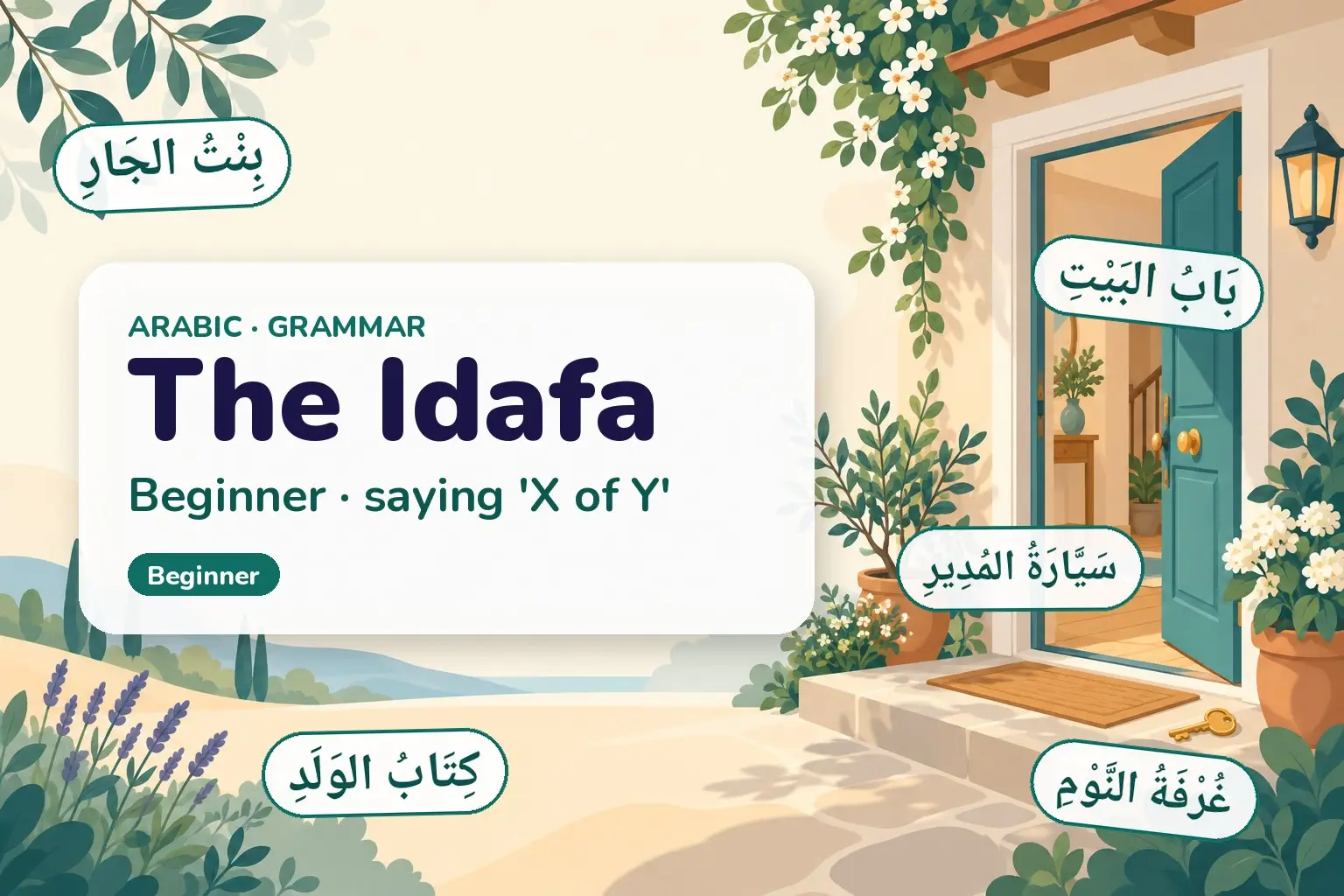
The idafa is Arabic's way to say 'X of Y': two nouns side by side, like بَابُ البَيْتِ (bābu al-bayti, the door of the house). The first noun drops الـ (al-) and tanwīn; the second noun goes in the genitive case.
On this page10 sections · tap to jump
Level: Beginner. The idafa — in Arabic إِضَافة (iḍāfa) — is how Arabic joins two nouns to mean “the X of Y” — the door of the house, the student’s book, the manager’s car. There is no separate word for “of”; the two nouns simply stand next to each other, and small changes on their endings do the work. Once you see the pattern, a huge amount of everyday Arabic opens up.
The rule
An idafa is two (or more) nouns in a row where the second one owns, defines or belongs to the first. Grammar books call the first noun the mudaf — المُضَاف (al-muḍāf), “the added” — and the second the mudaf ilayh — المُضَاف إِلَيْه (al-muḍāf ilayh), “the one added to”. Three things happen:
- The first noun drops its own article and tanwīn. It never takes الـ (al-) and never ends in the indefinite -n of tanwīn — even though it is understood as definite. So “the door of the house” is بَابُ البَيْتِ (bābu al-bayti), not البَابُ (al-bābu) and not بَابٌ (bābun).
- The second noun goes into the genitive case — المَجْرُور (al-majrūr) — the -i / -in ending. البَيْتِ (al-bayti) ends in -i because it is the second term, whatever the whole phrase is doing in the sentence.
- The first noun keeps whatever case its job in the sentence needs (-u as subject, -a as object, -i after a preposition), but still with no tanwīn.
The definiteness of the whole phrase comes from the second noun. If the second noun has الـ (al-), the phrase is definite (“the door of the house”); if the second noun is indefinite, the phrase is indefinite: بَابُ بَيْتٍ (bābu baytin) = “a door of a house”.
The forms
The second noun is always genitive (-i / -in). Only the first noun changes case for its role in the sentence — and it never takes tanwīn:
| Role of the phrase | First noun (no al-, no tanwīn) | Second noun (genitive) | Reading | Meaning |
|---|---|---|---|---|
| Subject | بَابُ | البَيْتِ | bābu al-bayti | the door of the house (as subject) |
| Object | بَابَ | البَيْتِ | bāba al-bayti | the door of the house (as object) |
| After a preposition | بَابِ | البَيْتِ | bābi al-bayti | the door of the house (after fī, min…) |
| Indefinite | بَابُ | بَيْتٍ | bābu baytin | a door of a house |
Example sentences
- هَذَا بَابُ البَيْتِ.hādhā bābu al-bayti.This is the door of the house.first noun bare, second genitive
- كِتَابُ الوَلَدِ جَدِيدٌ.kitābu al-waladi jadīdun.The boy's book is new.
- سَيَّارَةُ المُدِيرِ حَمْرَاءُ.sayyāratu al-mudīri ḥamrāʾu.The manager's car is red.tā marbūṭa sounds -t: sayyāratu
- أَيْنَ مِفْتَاحُ السَّيَّارَةِ؟ayna miftāḥu as-sayyārati?Where is the car key?
- بِنْتُ الجَارِ طَالِبَةٌ.bintu al-jāri ṭālibatun.The neighbour's daughter is a student.
- غُرْفَةُ النَّوْمِ كَبِيرَةٌ.ghurfatu an-nawmi kabīratun.The bedroom is big.literally 'the room of sleep'
- قَرَأْتُ كِتَابَ التَّارِيخِ.qaraʾtu kitāba at-tārīkhi.I read the history book.first noun is object: kitāba
- جَلَسْتُ فِي حَدِيقَةِ المَدْرَسَةِ.jalastu fī ḥadīqati al-madrasati.I sat in the school garden.first noun after a preposition: ḥadīqati
- هَذِهِ حَقِيبَةُ الطَّالِبَةِ.hādhihi ḥaqībatu aṭ-ṭālibati.This is the student's bag.
- رَأَيْتُ مُدِيرَ المَدْرَسَةِ.raʾaytu mudīra al-madrasati.I saw the school principal.
- بَابُ بَيْتٍ قَدِيمٌ.bābu baytin qadīmun.A door of an old house.second noun indefinite → whole phrase indefinite
- مِفْتَاحُ بَابِ البَيْتِ ضَاعَ.miftāḥu bābi al-bayti ḍāʿa.The key of the house door was lost.a chain of three nouns
- اسْمُ الطَّالِبِ عَلِيٌّ.ismu aṭ-ṭālibi ʿalīyun.The student's name is Ali.
- لَوْنُ السَّمَاءِ أَزْرَقُ.lawnu as-samāʾi azraqu.The colour of the sky is blue.
- نَافِذَةُ الغُرْفَةِ مَفْتُوحَةٌ.nāfidhatu al-ghurfati maftūḥatun.The window of the room is open.
- هَذَا قَلَمُ المُعَلِّمِ.hādhā qalamu al-muʿallimi.This is the teacher's pen.
- سَيَّارَةُ أَبِي جَدِيدَةٌ.sayyāratu abī jadīdatun.My father's car is new.second noun 'my father' is definite
- بَيْتُ العَائِلَةِ قَرِيبٌ.baytu al-ʿāʾilati qarībun.The family's house is nearby.
Common mistakes
- ❌ البَابُ البَيْتِ (al-bābu al-bayti) → ✅ بَابُ البَيْتِ (bābu al-bayti). The first noun never keeps الـ (al-); only the second noun may carry it.
- ❌ بَابٌ البَيْتِ (bābun al-bayti) → ✅ بَابُ البَيْتِ (bābu al-bayti). The first noun drops tanwīn, so it ends in a plain -u (here), not -un.
- ❌ بَابُ البَيْتُ (bābu al-baytu) → ✅ بَابُ البَيْتِ (bābu al-bayti). The second noun must be genitive (-i), not nominative (-u).
- ❌ بَابُ الكَبِيرُ البَيْتِ (bābu al-kabīru al-bayti) → ✅ بَابُ البَيْتِ الكَبِيرُ (bābu al-bayti al-kabīru). An adjective goes after the whole idafa, never between the two nouns.
- ❌ بَابِي البَيْتِ (bābī al-bayti) → ✅ بَابُ البَيْتِ (bābu al-bayti). Do not add a possessive suffix to the first noun of an idafa; use one or the other.
A short conversation
A: هَذِهِ سَيَّارَةُ المُدِيرِ؟ (hādhihi sayyāratu al-mudīri?) — Is this the manager’s car? B: لَا، هَذِهِ سَيَّارَةُ أَخِي. (lā, hādhihi sayyāratu akhī.) — No, this is my brother’s car. A: وَأَيْنَ مِفْتَاحُ السَّيَّارَةِ؟ (wa-ayna miftāḥu as-sayyārati?) — And where is the car key? B: فِي حَقِيبَةِ البَيْتِ. (fī ḥaqībati al-bayti.) — In the house bag.
Usage notes
- Definiteness comes from the last noun. بَابُ البَيْتِ (bābu al-bayti) is “the door of the house”; بَابُ بَيْتٍ (bābu baytin) is “a door of a house”. You cannot make the phrase definite by putting الـ (al-) on the first noun.
- The feminine ending ة (tā marbūṭa) is pronounced -t on the first noun. On its own, مَدِينَة (madīna) ends in a soft -a, but as the first term of an idafa it becomes مَدِينَةُ (madīnatu): مَدِينَةُ القَاهِرَةِ (madīnatu al-qāhirati), “the city of Cairo”.
- Chains are normal. Every noun except the last is a “first noun”: مِفْتَاحُ بَابِ البَيْتِ (miftāḥu bābi al-bayti). Each link drops its article and tanwīn; only the final noun may take الـ (al-).
- A proper name counts as definite. سَيَّارَةُ عَلِيٍّ (sayyāratu ʿalīyin) is “Ali’s car” — the name Ali is already definite, so the phrase is definite without any الـ (al-).
Compared with…
- Attached possessive pronouns express “my / your / his” with a suffix instead of a second noun: كِتَابِي (kitābī, my book), كِتَابُكَ (kitābuka, your book). Use an idafa when the owner is a full noun — كِتَابُ الوَلَدِ (kitābu al-waladi), “the boy’s book” — and a suffix when the owner is a pronoun. The two never combine on the same noun. See Arabic Attached Pronouns.
- The definite article الـ (al-) marks a single noun as “the”: البَيْتُ (al-baytu, the house). In an idafa it appears on the second noun only; the first noun relies on the construction for its definiteness. See The Arabic Definite Article الـ (al-).
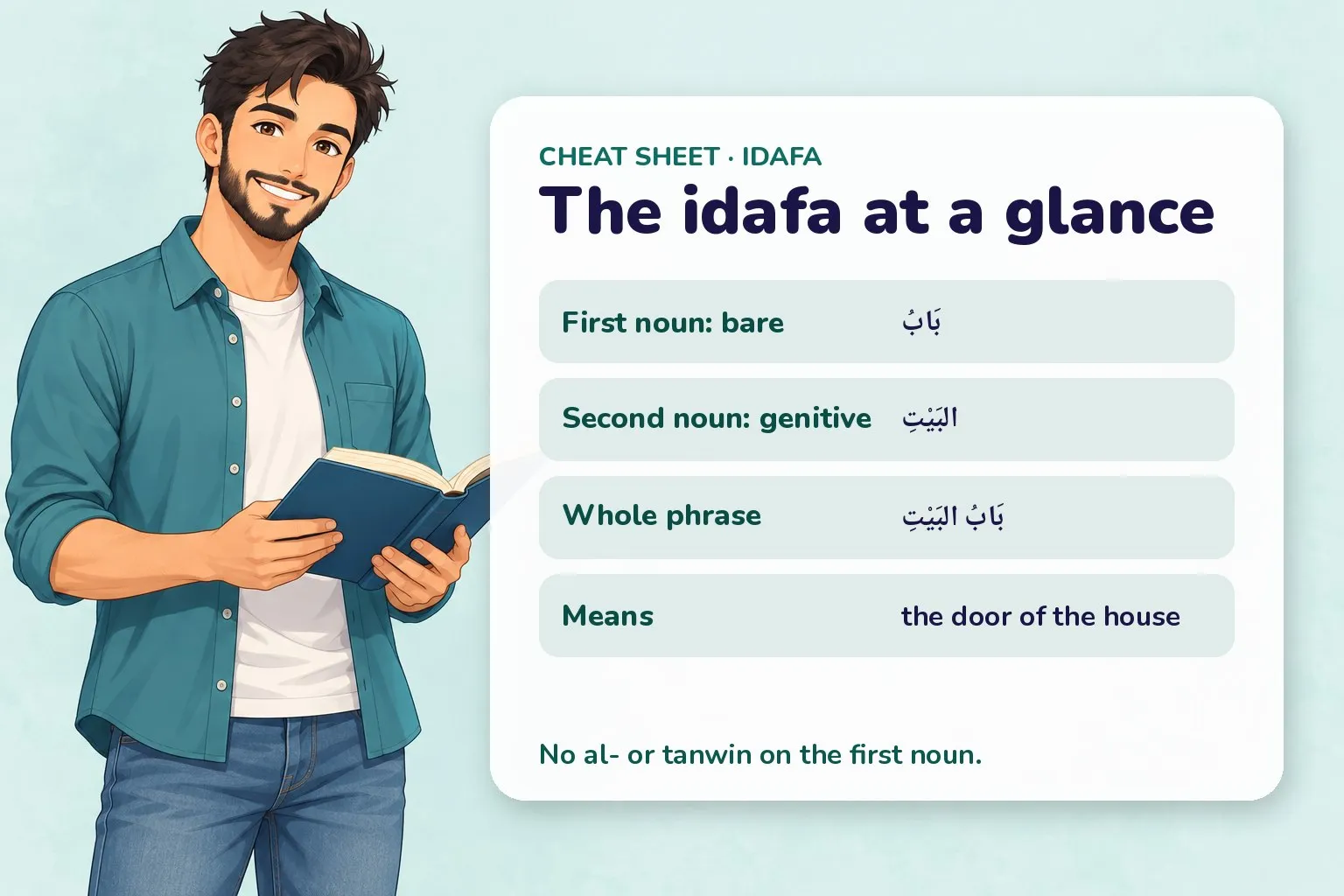
Quick recap before you practise.
Practice
Arabic idafa practice
Try each one, then press Check. No sign-up, nothing is sent anywhere — it all runs in your browser.
Hint: second noun, genitive -i, with the sun-letter article
Show answer
as-sayyārati — مِفْتَاحُ السَّيَّارَةِ (miftāḥu as-sayyārati) — the second noun is genitive.
4 Put in order: 'the manager's car' (as subject).
Show answer
سَيَّارَةُ (sayyāratu) المُدِيرِ (al-mudīri) — First noun then second: سَيَّارَةُ المُدِيرِ (sayyāratu al-mudīri).
5 Match each idafa to its meaning.
- بَابُ البَيْتِ (bābu al-bayti)
- كِتَابُ الوَلَدِ (kitābu al-waladi)
- غُرْفَةُ النَّوْمِ (ghurfatu an-nawmi)
- بَابُ بَيْتٍ (bābu baytin)
Show answer
- بَابُ البَيْتِ (bābu al-bayti) → the door of the house
- كِتَابُ الوَلَدِ (kitābu al-waladi) → the boy's book
- غُرْفَةُ النَّوْمِ (ghurfatu an-nawmi) → the bedroom
- بَابُ بَيْتٍ (bābu baytin) → a door of a house
The last noun's definiteness sets the whole phrase: al-bayti 'the house', baytin 'a house'.
Quiz
Arabic idafa quiz
12 questions · pick an answer and you'll see straight away if it's right.
-
Show answer
two nouns side by side meaning 'X of Y' — The idafa joins two nouns: 'the X of Y', with no separate word for 'of'.
-
Show answer
it drops الـ (al-) and tanwīn — The first noun (al-muḍāf) drops both its article and its tanwīn.
-
Show answer
genitive (-i) — The second noun is always genitive: البَيْتِ (al-bayti).
-
Show answer
كِتَابُ الوَلَدِ (kitābu al-waladi) — First noun bare, second noun definite genitive: كِتَابُ الوَلَدِ (kitābu al-waladi).
-
Show answer
a door of a house — The second noun is indefinite (baytin), so the whole phrase is indefinite.
-
Show answer
after the whole idafa — بَابُ البَيْتِ الكَبِيرُ (bābu al-bayti al-kabīru) — the adjective follows the whole phrase.
-
Show answer
البَابُ البَيْتِ (al-bābu al-bayti) — Never put الـ (al-) on the first noun: البَابُ البَيْتِ is wrong.
-
Show answer
as -t (madīnatu) — On the first term of an idafa, tā marbūṭa is pronounced -t: madīnatu.
-
Show answer
مِفْتَاحُ بَابِ البَيْتِ (miftāḥu bābi al-bayti) — Every noun but the last is bare; only البَيْتِ (al-bayti) takes الـ (al-).
-
Show answer
yes, because 'my father' is definite — The second term أَبِي (abī, my father) is definite, so the whole phrase is definite.
-
Show answer
the second (last) noun — Only the final noun of the construction may take الـ (al-).
-
Show answer
kitābu — The first noun loses tanwīn: كِتَابُ (kitābu), here nominative as the subject.
Recap cheat-sheet
| Term | Arabic | Reading | What it does |
|---|---|---|---|
| First noun (mudaf) | بَابُ | bābu | no al-, no tanwīn; takes its own case |
| Second noun (mudaf ilayh) | البَيْتِ | al-bayti | always genitive (-i) |
| Whole phrase (definite) | بَابُ البَيْتِ | bābu al-bayti | the door of the house |
| Whole phrase (indefinite) | بَابُ بَيْتٍ | bābu baytin | a door of a house |
Next
- Compare the suffix way to show possession: Arabic Attached Pronouns
- Review how الـ (al-) marks a single noun: The Arabic Definite Article الـ (al-)
- Back to the Arabic grammar section
- New here? Start with Start Learning Arabic Here
All Arabic grammar topics
Every grammar point in order, from your first sentence to advanced structures. Pick one and go straight to it. New lessons go live every day, so topics marked Coming soon fill in over the next weeks.
Grammar path
Beginner 16 topics · 12 ready
- 01 The Definite Article الـ (al-)
- 02 Indefiniteness and Tanwin
- 03 Noun Gender (Masculine & Feminine)
- 04 The Nominal Sentence (Jumla Ismiyya)
- 05 Adjective Agreement (Na't)
- 06 Personal Pronouns (Separate)
- 07 Attached (Possessive/Object) Pronouns
- 08 Demonstratives (هذا hādhā، هذه hādhihi، ذلك dhālika)
- 09 The Idafa (Possessive Construction) You are here
- 10 Prepositions (Huruf al-Jarr)
- 11 Questions (هل hal، أ a، ما mā، من man، أين ayna)
- 12 Negating Nominal Sentences (ليس laysa)
- 13 Numbers 1-10 and Counting Coming soon
- 14 Pointing Sentences (هذا كتاب hādhā kitāb) Coming soon
- 15 Prepositional & Adverbial Predicates Coming soon
- 16 Expressing 'Have' (عند / لـ / مع ʿinda / li- / maʿa) Coming soon
Elementary 17 topics
- 17 The Present Tense (al-Mudari') Coming soon
- 18 The Past Tense (al-Madi) Coming soon
- 19 The Verbal Sentence (Jumla Fi'liyya) Coming soon
- 20 Verb Agreement with the Subject Coming soon
- 21 Negating the Past (ما / لم mā / lam) Coming soon
- 22 Negating the Present & Future (لا / لن lā / lan) Coming soon
- 23 The Future (سـ / سوف sa- / sawfa) Coming soon
- 24 The Dual (al-Muthanna) Coming soon
- 25 Sound Plurals (Masculine & Feminine) Coming soon
- 26 Broken Plurals (Jam' Taksir) Coming soon
- 27 Kana and Its Sisters Coming soon
- 28 Inna and Its Sisters Coming soon
- 29 Non-Human Plural Agreement Coming soon
- 30 Days, Months and Time Expressions Coming soon
- 31 Adverbs of Time & Place (Zarf) Coming soon
- 32 Hamzat al-Wasl vs Hamzat al-Qat' Coming soon
- 33 Colours & Defects (Af'al pattern) Coming soon
Intermediate 22 topics
- 34 The Three Cases (I'rab) Coming soon
- 35 Uses of the Accusative (Mansubat) Coming soon
- 36 The Derived Verb Forms (I-X) Coming soon
- 37 Root and Pattern Morphology Coming soon
- 38 Active & Passive Participles Coming soon
- 39 The Verbal Noun (Masdar) Coming soon
- 40 The Subjunctive (Mansub) after أن / لـ (an / li-) Coming soon
- 41 The Jussive (Majzum) & Commands Coming soon
- 42 The Imperative (al-Amr) Coming soon
- 43 Weak Verbs (Assimilated, Hollow, Defective) Coming soon
- 44 Relative Clauses (الذي alladhī، التي allatī) Coming soon
- 45 Comparative & Superlative (Af'al) Coming soon
- 46 Conditional Sentences (إذا idhā، إنْ in، لو law) Coming soon
- 47 Numbers 11-99 and Agreement Coming soon
- 48 The Five Nouns (al-Asma' al-Khamsa) Coming soon
- 49 Diptotes (al-Mamnu' min as-Sarf) Coming soon
- 50 Object of Purpose & Accompaniment Coming soon
- 51 Apposition & Substitution (Badal) Coming soon
- 52 Emphasis (at-Tawkid: نفس nafs، كل kull) Coming soon
- 53 Coordination (al-'Atf) & Case Carrying Coming soon
- 54 Questions of Quantity (كم kam) & Number Syntax Coming soon
- 55 The Nisba Adjective (-iyy) Coming soon
Upper-Intermediate 14 topics
- 56 The Circumstantial Clause (Hal) Coming soon
- 57 Specification (Tamyiz) Coming soon
- 58 Exception (al-Istithna': إلا illā) Coming soon
- 59 The Absolute Object (al-Maf'ul al-Mutlaq) Coming soon
- 60 The Passive Voice (al-Majhul) Coming soon
- 61 The Vocative (an-Nida': يا yā) Coming soon
- 62 Energetic Mood & Emphasis (Nun al-Tawkid) Coming soon
- 63 Verbs with Prepositions Coming soon
- 64 Connectors & Cohesion (و wa، ف fa، ثم thumma، لكنّ lākinna) Coming soon
- 65 Verbs of Certainty/Doubt (Dhanna & Sisters) Coming soon
- 66 Verbs with Two Objects Coming soon
- 67 The Diminutive (at-Tasghir) Coming soon
- 68 Collective & Unit Nouns Coming soon
- 69 Conditional Particles & Jussive Pair Coming soon
Advanced 10 topics
- 70 Advanced I'rab & Government Coming soon
- 71 Expressing Aspect (قد qad، كان قد kāna qad، لمّا lammā) Coming soon
- 72 Rhetorical Structures (Taqdim wa-Ta'khir) Coming soon
- 73 Advanced Conditionals & Oaths Coming soon
- 74 Classical/Formal Register (Fusha Style) Coming soon
- 75 Nominal Style & Masdar-Heavy Syntax Coming soon
- 76 Advanced Exception & Restriction (إنما innamā، غير ghayr) Coming soon
- 77 Absolute Negation (لا النافية للجنس lā an-nāfiya lil-jins) Coming soon
- 78 Particle Review: إنّ (inna)، أنّ (anna)، أنْ (an)، كأنّ (ka-anna) Coming soon
- 79 Verb-Initial vs Noun-Initial Style Coming soon