The Arabic Definite Article ال (al-): Sun and Moon Letters
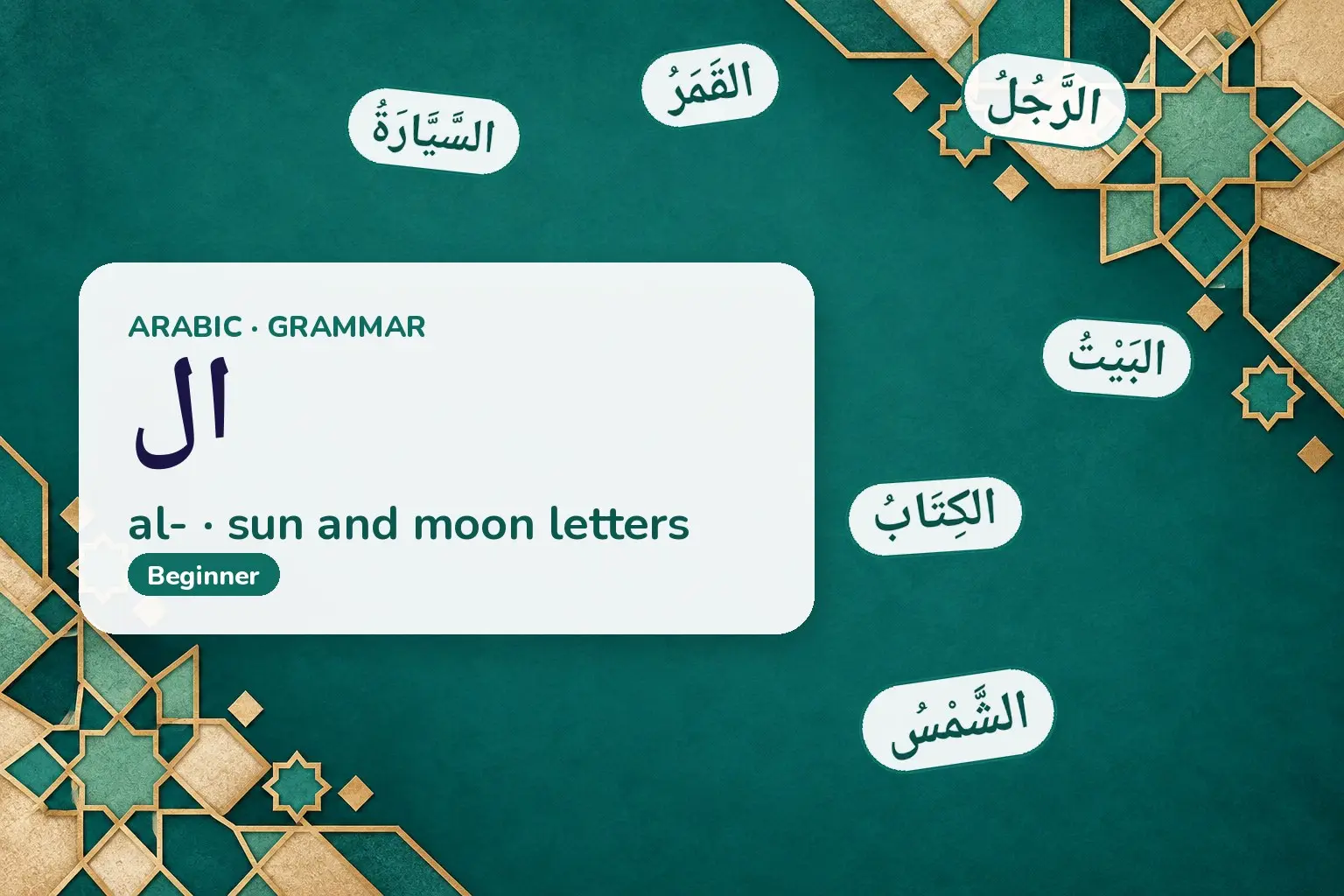
Arabic makes a noun definite by adding ال (al-) to the front: كِتَاب (kitāb, 'a book') becomes الكِتَاب (al-kitāb, 'the book'). It is always written the same way, but before the 14 'sun letters' the l is not pronounced and the next letter is doubled: الشَّمْس is said ash-shams, not al-shams.
Level: beginner. Modern Standard Arabic has no indefinite article like English “a/an” — a noun without ال is usually indefinite. To say “the”, you attach ال (al-) to the front of the noun. Before sun and moon letters it is written the same way, but the sound depends on the letter that follows. (After the preposition لِ the alif drops: لِلْبَيْتِ, lil-bayti.)
The rule
- كِتَابٌ kitābun — a book → الكِتَابُ al-kitābu — the book
- بَيْتٌ baytun — a house → البَيْتُ al-baytu — the house
When a noun takes ال, it drops the indefinite ending (tanwīn, the doubled vowel mark heard as -un, -an, -in).
Sun letters and moon letters
| What happens | Letters | Example | |
|---|---|---|---|
| Moon letters (14) | You pronounce the l | ء ب ج ح خ ع غ ف ق ك م ه و ي | القَمَرُ al-qamar — the moon |
| Sun letters (14) | The l is silent; the next letter is doubled (shadda ّ) | ت ث د ذ ر ز س ش ص ض ط ظ ل ن | الشَّمْسُ ash-shams — the sun |
The groups are named after these two words. A quick tip: sun letters are all made with the front of the tongue (like l itself), which is why the l blends into them.
Example sentences and phrases
- الكِتَابُ جَدِيدٌ. — al-kitābu jadīdun. — The book is new. (moon)
- البَيْتُ كَبِيرٌ. — al-baytu kabīrun. — The house is big. (moon)
- الوَلَدُ هُنَا. — al-waladu hunā. — The boy is here. (moon)
- المَدْرَسَةُ قَرِيبَةٌ. — al-madrasatu qarībatun. — The school is near. (moon)
- الجَامِعَةُ كَبِيرَةٌ. — al-jāmiʿatu kabīratun. — The university is big. (moon)
- السَّيَّارَةُ جَمِيلَةٌ. — as-sayyāratu jamīlatun. — The car is beautiful. (sun)
- الرَّجُلُ طَوِيلٌ. — ar-rajulu ṭawīlun. — The man is tall. (sun)
- الدَّرْسُ سَهْلٌ. — ad-darsu sahlun. — The lesson is easy. (sun)
- النُّورُ قَوِيٌّ. — an-nūru qawiyyun. — The light is strong. (sun)
- التُّفَّاحُ لَذِيذٌ. — at-tuffāḥu ladhīdhun. — Apples are delicious. (sun; التفاح is a collective noun, so the adjective is singular)
Notice that Arabic needs no word for “is” in these present-tense sentences.
Common mistakes
- ❌ al-shams → ✅ ash-shams. ش is a sun letter, so the l assimilates.
- ❌ الكِتَابٌ (al-kitābun) → ✅ الكِتَابُ (al-kitābu). A noun with ال loses tanwīn.
- ❌ Writing اشَّمْس because you hear ash-shams → ✅ الشَّمْس. The ل is always written.
- ❌ al-rajul → ✅ ar-rajul. ر is a sun letter.
Compared with…
- English “the” — one word; Arabic attaches the article to the noun.
- Joining words — at the start of speech you say al-; after another word the a is usually dropped (fī l-bayt, “in the house”). This and the idāfa construction come later in the Arabic grammar section.
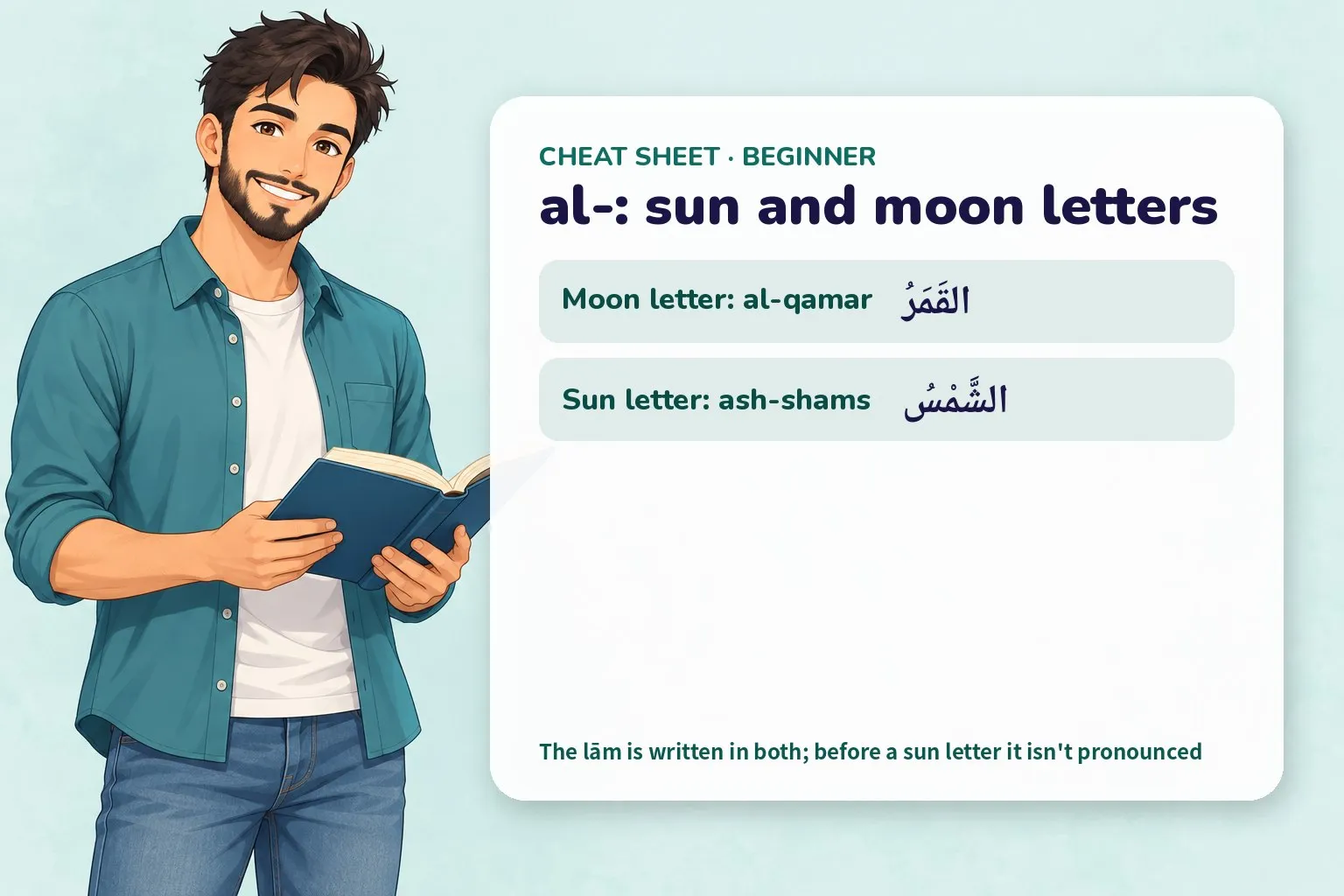
Quick recap before the quiz.
Mini quiz
- How do you say القَلَمُ (the pen)?
- How do you say الشَّايُ (the tea)?
- Sun or moon letter: ب?
- Sun or moon letter: ن?
- Correct or not: البَابٌ
Answers
- al-qalamu — ق is a moon letter.
- ash-shāyu — ش is a sun letter.
- Moon — al-bayt.
- Sun — an-nūr.
- Not correct — a noun with ال drops tanwīn: البَابُ al-bābu.
Sources
- Rules and forms checked against Modern Standard Arabic teaching materials (Al Jazeera Learning Arabic) and standard MSA grammar.
- This topic sits at beginner level in common Modern Standard Arabic course sequencing; there is no single international level framework for Arabic.
- Example sentences were written for this lesson; no third-party sentences were copied.
Next
- Back to the Arabic grammar section
- New here? Start with Start Learning Arabic Here
Sources
- King Salman Global Academy for Arabic Language — King Salman Global Academy for Arabic Language
- Learning Arabic (Modern Standard Arabic course) — Al Jazeera Media Institute