The Present Tense in Arabic (al-Mudari')
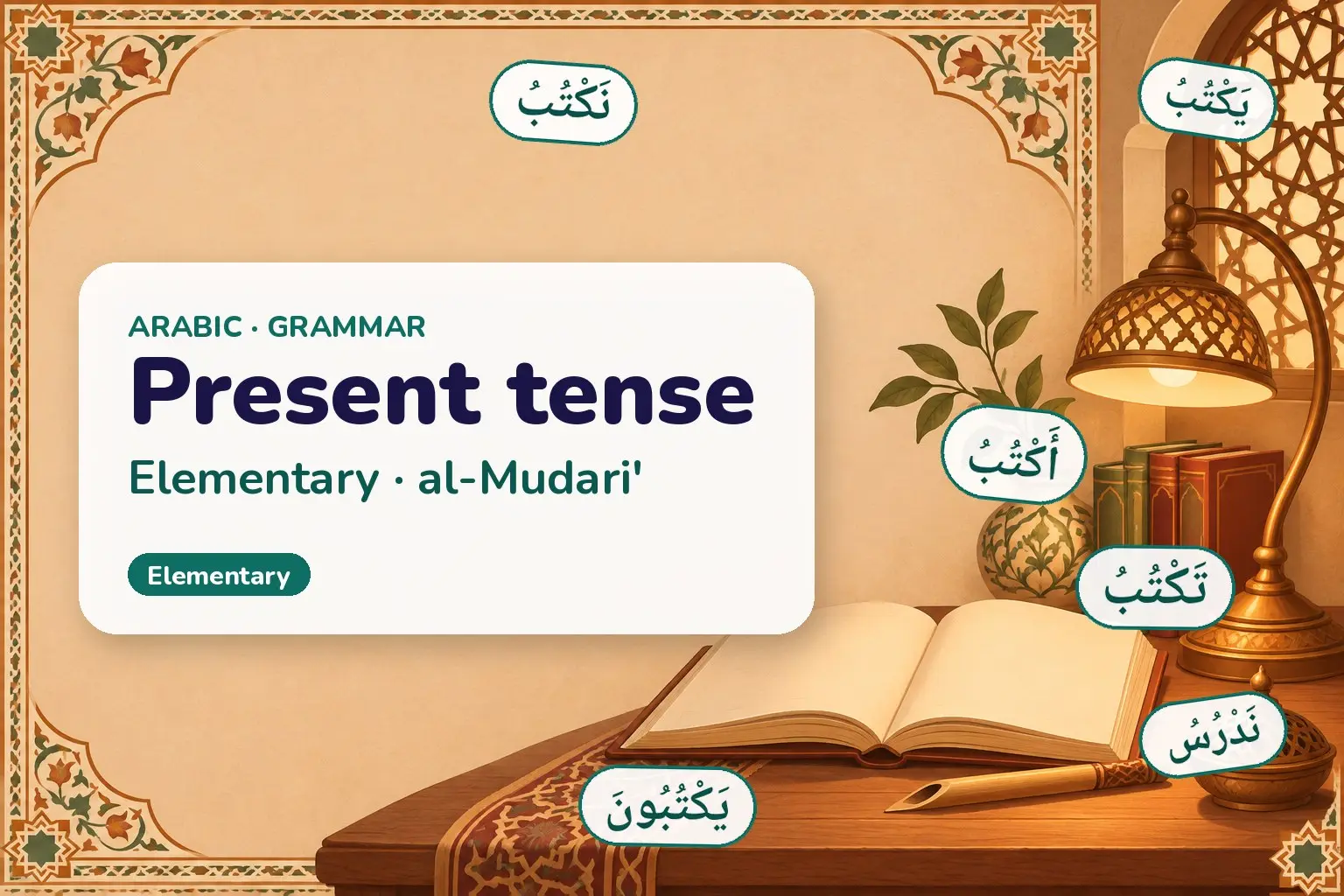
The Arabic present tense (al-mudari') is built with a prefix and a suffix on a fixed stem. From كَتَبَ (kataba, wrote) you get يَكْتُبُ (yaktubu, he writes): the ya- prefix means he and the final -u marks the plain indicative.
Level: Elementary. The Arabic present tense, called المُضَارِع (al-muḍāriʿ), is the verb form you use for what happens now, repeatedly, or generally. Unlike the past tense, it is built mostly with prefixes: a small letter added to the front of the verb tells you who is doing the action. Learn four prefixes and a handful of endings and you can conjugate most regular verbs.
The rule
A verb is an action word; its conjugation is the set of forms it takes for different subjects. The Arabic present tense works from a fixed inner shape called the stem. For the model verb كَتَبَ (kataba, he wrote), the present stem is -ktub-, and you wrap it in a prefix and (sometimes) a suffix.
The prefix marks the person. There are only four prefix letters to learn:
- أَ (a-) for I: أَكْتُبُ (aktubu, I write)
- تَ (ta-) for you and for she: تَكْتُبُ (taktubu, you/she write)
- يَ (ya-) for he and for they: يَكْتُبُ (yaktubu, he writes)
- نَ (na-) for we: نَكْتُبُ (naktubu, we write)
The final short vowel -u is the mark of the plain, everyday present — grammarians call it the indicative, المَرْفُوع (al-marfūʿ). When the subject is feminine, dual or plural, a suffix is added as well, and that suffix can replace the -u.
The conjugation of a sound verb
Here is كَتَبَ (kataba, to write) in the full present indicative. Notice how the stem -ktub- never changes; only the prefix and ending move.
| Subject | Reading | Present form | Reading |
|---|---|---|---|
| أَنَا (I) | anā | أَكْتُبُ | aktubu |
| أَنْتَ (you, m) | anta | تَكْتُبُ | taktubu |
| أَنْتِ (you, f) | anti | تَكْتُبِينَ | taktubīna |
| هُوَ (he) | huwa | يَكْتُبُ | yaktubu |
| هِيَ (she) | hiya | تَكْتُبُ | taktubu |
| نَحْنُ (we) | naḥnu | نَكْتُبُ | naktubu |
| أَنْتُمْ (you, m pl) | antum | تَكْتُبُونَ | taktubūna |
| أَنْتُنَّ (you, f pl) | antunna | تَكْتُبْنَ | taktubna |
| هُمْ (they, m) | hum | يَكْتُبُونَ | yaktubūna |
| هُنَّ (they, f) | hunna | يَكْتُبْنَ | yaktubna |
The dual (two people) also exists: أَنْتُمَا تَكْتُبَانِ (antumā taktubāni, you two write) and هُمَا يَكْتُبَانِ (humā yaktubāni, the two of them write). Start by mastering the singular and plural above; the dual follows the same logic.
Example sentences
- أَكْتُبُ رِسَالَةً.Aktubu risālatan.I am writing a letter.a- = I
- أَنْتَ تَكْتُبُ بِسُرْعَةٍ.Anta taktubu bi-surʿatin.You (m) write quickly.
- أَنْتِ تَكْتُبِينَ جَيِّدًا.Anti taktubīna jayyidan.You (f) write well.feminine -īna
- هُوَ يَكْتُبُ كِتَابًا.Huwa yaktubu kitāban.He is writing a book.ya- = he
- هِيَ تَكْتُبُ فِي الدَّفْتَرِ.Hiya taktubu fī ad-daftari.She writes in the notebook.
- نَحْنُ نَكْتُبُ الوَاجِبَ.Naḥnu naktubu al-wājiba.We are writing the homework.na- = we
- هُمْ يَكْتُبُونَ القِصَّةَ.Hum yaktubūna al-qiṣṣata.They (m) write the story.plural -ūna
- البَنَاتُ يَكْتُبْنَ الدَّرْسَ.Al-banātu yaktubna ad-darsa.The girls write the lesson.feminine plural -na
- أَدْرُسُ العَرَبِيَّةَ.Adrusu al-ʿarabiyyata.I study Arabic.verb darasa
- يَشْرَبُ المَاءَ.Yashrabu al-māʾa.He drinks the water.
- تَأْكُلُ التُّفَّاحَةَ.Taʾkulu at-tuffāḥata.She eats the apple.
- نَسْكُنُ فِي المَدِينَةِ.Naskunu fī al-madīnati.We live in the city.
- يَعْمَلُ فِي المَكْتَبِ.Yaʿmalu fī al-maktabi.He works in the office.
- تَذْهَبِينَ إِلَى المَدْرَسَةِ.Tadhhabīna ilā al-madrasati.You (f) go to the school.
- يَلْعَبُونَ فِي الحَدِيقَةِ.Yalʿabūna fī al-ḥadīqati.They (m) play in the park.
- أَفْهَمُ الدَّرْسَ.Afhamu ad-darsa.I understand the lesson.
- هَلْ تَتَكَلَّمُ العَرَبِيَّةَ؟Hal tatakallamu al-ʿarabiyyata?Do you speak Arabic?
- لَا نَعْرِفُ الطَّرِيقَ.Lā naʿrifu aṭ-ṭarīqa.We do not know the way.
Every verb above keeps its stem and simply changes the front letter and the ending to match the subject.
Common mistakes
- ❌ هُوَ كَتَبَ الآنَ (huwa kataba al-āna) for he is writing now → ✅ هُوَ يَكْتُبُ الآنَ (huwa yaktubu al-āna). كَتَبَ (kataba) is the past; the present needs the يَ (ya-) prefix.
- ❌ هِيَ يَكْتُبُ (hiya yaktubu) → ✅ هِيَ تَكْتُبُ (hiya taktubu). She takes the تَ (ta-) prefix, not يَ (ya-); only he and they (m) use يَ (ya-).
- ❌ أَنْتِ تَكْتُبُ (anti taktubu) for you (f) write → ✅ أَنْتِ تَكْتُبِينَ (anti taktubīna). The feminine you adds the suffix -īna.
- ❌ هُمْ يَكْتُبُ (hum yaktubu) → ✅ هُمْ يَكْتُبُونَ (hum yaktubūna). A masculine plural subject needs the -ūna ending.
- ❌ أَنَا تَكْتُبُ (anā taktubu) → ✅ أَنَا أَكْتُبُ (anā aktubu). I uses the أَ (a-) prefix, which beginners often skip.
A short conversation
— سَامِي (Sāmī): مَاذَا تَفْعَلُ؟ — Mādhā tafʿalu? — What are you doing? — لَيْلَى (Laylā): أَكْتُبُ رِسَالَةً. — Aktubu risālatan. — I am writing a letter. — سَامِي (Sāmī): وَأَخُوكِ؟ — Wa-akhūki? — And your brother? — لَيْلَى (Laylā): هُوَ يَدْرُسُ. — Huwa yadrusu. — He is studying.
Usage notes
- Drop the pronoun freely. Because the prefix shows the person, أَكْتُبُ (aktubu) already means I write; adding أَنَا (anā) only gives emphasis.
- The middle vowel varies by verb. The present stem keeps the root letters but its inner vowel is fixed per verb: يَكْتُبُ (yaktubu) has -u-, while يَشْرَبُ (yashrabu, he drinks) has -a-. Learn the present shape together with each new verb.
- Negation is simple. Put لَا (lā) before the verb for a general negative: لَا يَكْتُبُ (lā yaktubu, he does not write).
- Questions need no change. Add هَلْ (hal) at the front and keep the same verb: هَلْ تَكْتُبُ؟ (hal taktubu? do you write?).
Compared with the past tense
The past tense, الماضِي (al-māḍī), is built the opposite way — with suffixes and no prefix: كَتَبْتُ (katabtu, I wrote), كَتَبَ (kataba, he wrote). So the quick test is the front of the word: a prefix such as يَ (ya-) or تَ (ta-) means present, while a bare stem with an ending means past. Before this, make sure you can read vowelled words; see the Arabic nominal sentence, which also needs no present-tense verb, and browse the full Arabic grammar section.
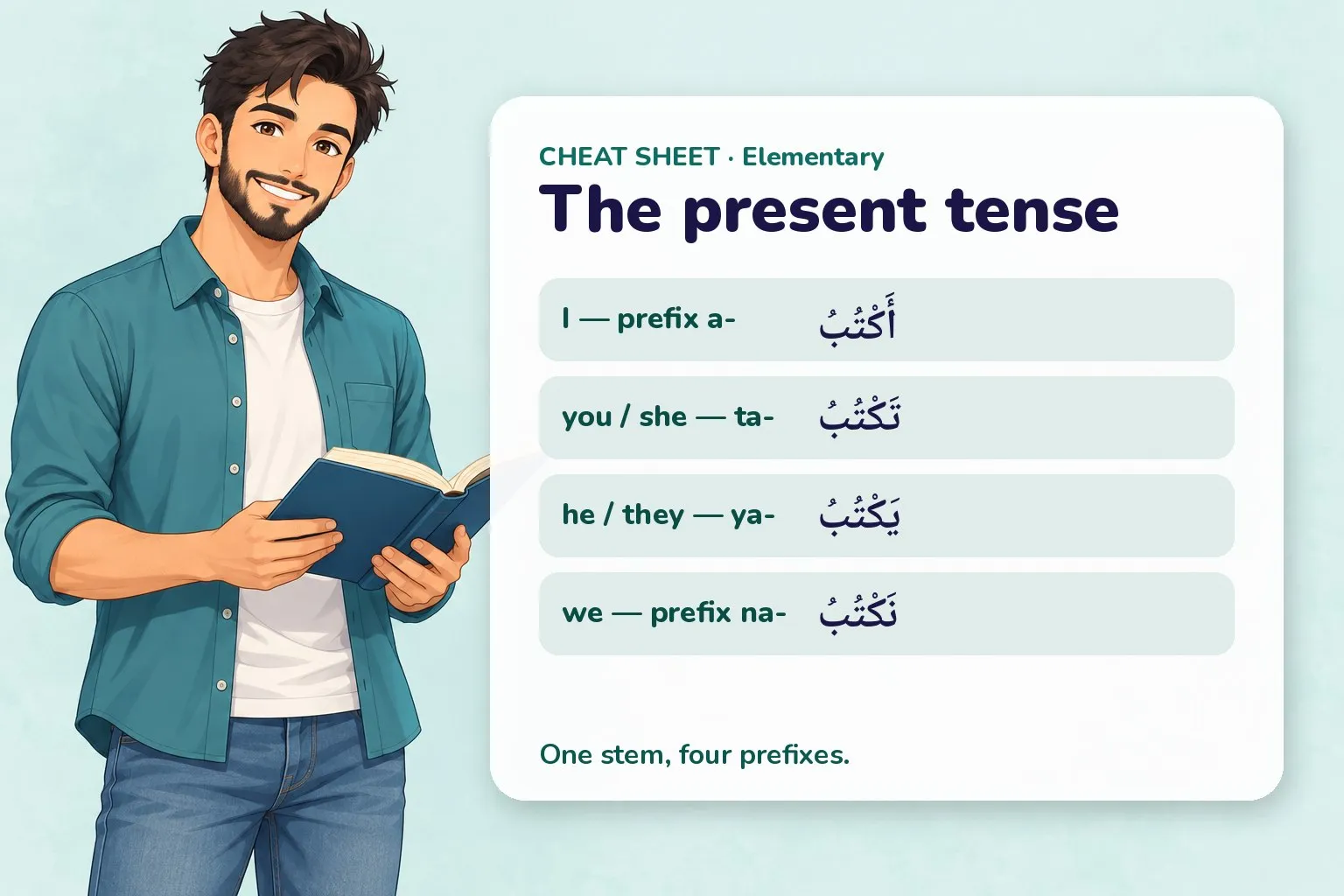
Quick recap before you practise.
Practice
Present tense practice
Try each one, then press Check. No sign-up, nothing is sent anywhere — it all runs in your browser.
Hint: we = na-
Show answer
naktubu — نَكْتُبُ (naktubu): the نَ (na-) prefix means we.
3 Order the words: 'She is writing the lesson.'
Show answer
هِيَ (hiya) تَكْتُبُ (taktubu) الدَّرْسَ (ad-darsa) — هِيَ تَكْتُبُ الدَّرْسَ (hiya taktubu ad-darsa): she takes the ta- prefix.
4 Match each prefix to its subject.
- أَ (a-)
- تَ (ta-)
- يَ (ya-)
- نَ (na-)
Show answer
- أَ (a-) → I
- تَ (ta-) → you / she
- يَ (ya-) → he / they (m)
- نَ (na-) → we
The four prefixes carry the person of the Arabic present verb.
Quiz
Arabic present tense quiz
12 questions · pick an answer and you'll see straight away if it's right.
-
Show answer
المُضَارِع (al-muḍāriʿ) — The present/imperfect is المُضَارِع (al-muḍāriʿ).
-
Show answer
a prefix (and sometimes a suffix) — A prefix marks the person; endings mark gender/number.
-
Show answer
أَ (a-) — I = أَكْتُبُ (aktubu), with the أَ (a-) prefix.
-
Show answer
تَكْتُبُ (taktubu) — She shares the تَ (ta-) prefix with you (m): تَكْتُبُ (taktubu).
-
Show answer
يَكْتُبُونَ (yaktubūna) — Masculine plural takes -ūna: يَكْتُبُونَ (yaktubūna).
-
Show answer
plain indicative present — The -u ending is the indicative (al-marfūʿ) of the present.
-
Show answer
he writes OR he is writing — One present form covers both English present tenses.
-
Show answer
-ktub- — The present stem is -ktub-, wrapped by prefix and ending.
-
Show answer
كَتَبَ (kataba) is the past; the present needs the ya- prefix — كَتَبَ (kataba) means he wrote; use يَكْتُبُ (yaktubu).
-
Show answer
نَدْرُسُ (nadrusu) — We = the نَ (na-) prefix: نَدْرُسُ (nadrusu).
-
Show answer
put لَا (lā) before it — لَا يَكْتُبُ (lā yaktubu) = he does not write.
-
Show answer
yashrabu — يَشْرَبُ (yashrabu): ya- prefix on the -shrab- stem.
Recap cheat-sheet
| Subject | Prefix | Example | Reading |
|---|---|---|---|
| I | أَ (a-) | أَكْتُبُ | aktubu |
| you / she | تَ (ta-) | تَكْتُبُ | taktubu |
| he / they (m) | يَ (ya-) | يَكْتُبُ | yaktubu |
| we | نَ (na-) | نَكْتُبُ | naktubu |
| you (f) | تَ … ـينَ | تَكْتُبِينَ | taktubīna |
Next
- Revisit the verbless Arabic nominal sentence
- Back to the Arabic grammar section
- New here? Start with Start Learning Arabic Here
All Arabic grammar topics
Every grammar point in order, from your first sentence to advanced structures. Pick one and go straight to it. New lessons go live every day, so topics marked Coming soon fill in over the next weeks.
Grammar path
Beginner 16 topics · 16 ready
- 01 The Definite Article الـ (al-)
- 02 Indefiniteness and Tanwin
- 03 Noun Gender (Masculine & Feminine)
- 04 The Nominal Sentence (Jumla Ismiyya)
- 05 Adjective Agreement (Na't)
- 06 Personal Pronouns (Separate)
- 07 Attached (Possessive/Object) Pronouns
- 08 Demonstratives (هذا hādhā، هذه hādhihi، ذلك dhālika)
- 09 The Idafa (Possessive Construction)
- 10 Prepositions (Huruf al-Jarr)
- 11 Questions (هل hal، أ a، ما mā، من man، أين ayna)
- 12 Negating Nominal Sentences (ليس laysa)
- 13 Numbers 1-10 and Counting
- 14 Pointing Sentences (هذا كتاب hādhā kitāb)
- 15 Prepositional & Adverbial Predicates
- 16 Expressing 'Have' (عند / لـ / مع ʿinda / li- / maʿa)
Elementary 17 topics · 5 ready
- 17 The Present Tense (al-Mudari') You are here
- 18 The Past Tense (al-Madi)
- 19 The Verbal Sentence (Jumla Fi'liyya)
- 20 Verb Agreement with the Subject
- 21 Negating the Past (ما / لم mā / lam)
- 22 Negating the Present & Future (لا / لن lā / lan) Coming soon
- 23 The Future (سـ / سوف sa- / sawfa) Coming soon
- 24 The Dual (al-Muthanna) Coming soon
- 25 Sound Plurals (Masculine & Feminine) Coming soon
- 26 Broken Plurals (Jam' Taksir) Coming soon
- 27 Kana and Its Sisters Coming soon
- 28 Inna and Its Sisters Coming soon
- 29 Non-Human Plural Agreement Coming soon
- 30 Days, Months and Time Expressions Coming soon
- 31 Adverbs of Time & Place (Zarf) Coming soon
- 32 Hamzat al-Wasl vs Hamzat al-Qat' Coming soon
- 33 Colours & Defects (Af'al pattern) Coming soon
Intermediate 22 topics
- 34 The Three Cases (I'rab) Coming soon
- 35 Uses of the Accusative (Mansubat) Coming soon
- 36 The Derived Verb Forms (I-X) Coming soon
- 37 Root and Pattern Morphology Coming soon
- 38 Active & Passive Participles Coming soon
- 39 The Verbal Noun (Masdar) Coming soon
- 40 The Subjunctive (Mansub) after أن / لـ (an / li-) Coming soon
- 41 The Jussive (Majzum) & Commands Coming soon
- 42 The Imperative (al-Amr) Coming soon
- 43 Weak Verbs (Assimilated, Hollow, Defective) Coming soon
- 44 Relative Clauses (الذي alladhī، التي allatī) Coming soon
- 45 Comparative & Superlative (Af'al) Coming soon
- 46 Conditional Sentences (إذا idhā، إنْ in، لو law) Coming soon
- 47 Numbers 11-99 and Agreement Coming soon
- 48 The Five Nouns (al-Asma' al-Khamsa) Coming soon
- 49 Diptotes (al-Mamnu' min as-Sarf) Coming soon
- 50 Object of Purpose & Accompaniment Coming soon
- 51 Apposition & Substitution (Badal) Coming soon
- 52 Emphasis (at-Tawkid: نفس nafs، كل kull) Coming soon
- 53 Coordination (al-'Atf) & Case Carrying Coming soon
- 54 Questions of Quantity (كم kam) & Number Syntax Coming soon
- 55 The Nisba Adjective (-iyy) Coming soon
Upper-Intermediate 14 topics
- 56 The Circumstantial Clause (Hal) Coming soon
- 57 Specification (Tamyiz) Coming soon
- 58 Exception (al-Istithna': إلا illā) Coming soon
- 59 The Absolute Object (al-Maf'ul al-Mutlaq) Coming soon
- 60 The Passive Voice (al-Majhul) Coming soon
- 61 The Vocative (an-Nida': يا yā) Coming soon
- 62 Energetic Mood & Emphasis (Nun al-Tawkid) Coming soon
- 63 Verbs with Prepositions Coming soon
- 64 Connectors & Cohesion (و wa، ف fa، ثم thumma، لكنّ lākinna) Coming soon
- 65 Verbs of Certainty/Doubt (Dhanna & Sisters) Coming soon
- 66 Verbs with Two Objects Coming soon
- 67 The Diminutive (at-Tasghir) Coming soon
- 68 Collective & Unit Nouns Coming soon
- 69 Conditional Particles & Jussive Pair Coming soon
Advanced 10 topics
- 70 Advanced I'rab & Government Coming soon
- 71 Expressing Aspect (قد qad، كان قد kāna qad، لمّا lammā) Coming soon
- 72 Rhetorical Structures (Taqdim wa-Ta'khir) Coming soon
- 73 Advanced Conditionals & Oaths Coming soon
- 74 Classical/Formal Register (Fusha Style) Coming soon
- 75 Nominal Style & Masdar-Heavy Syntax Coming soon
- 76 Advanced Exception & Restriction (إنما innamā، غير ghayr) Coming soon
- 77 Absolute Negation (لا النافية للجنس lā an-nāfiya lil-jins) Coming soon
- 78 Particle Review: إنّ (inna)، أنّ (anna)، أنْ (an)، كأنّ (ka-anna) Coming soon
- 79 Verb-Initial vs Noun-Initial Style Coming soon