Negating the Past (ما / لم mā / lam)
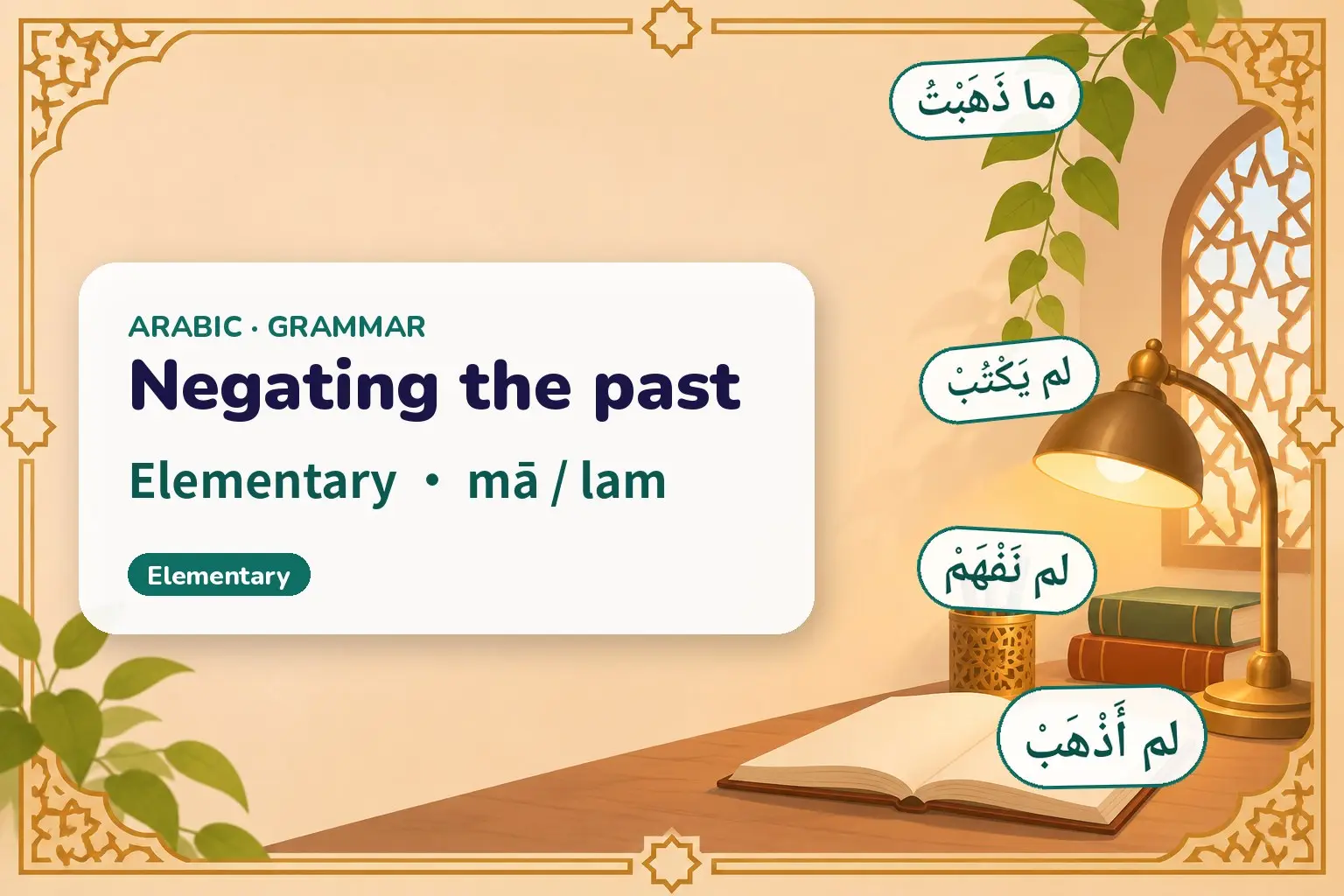
Arabic has two ways to negate a past action. Add ما (mā) before the past-tense verb — ما ذَهَبْتُ (mā dhahabtu), I did not go — or, more formally, use لم (lam) before the jussive present: لم أَذْهَبْ (lam adhhab), also 'I did not go'.
Level: Elementary. You already know the Arabic past tense — ذَهَبْتُ (dhahabtu), I went. To turn it into I did not go, Arabic gives you two tools, and both are right: ما (mā) placed before the past verb, or لم (lam) placed before the present verb with a clipped ending.
The rule
A past (perfect) verb describes a finished action: ذَهَبَ (dhahaba), he went. To negate it you can simply put ما (mā) in front and change nothing else: ما ذَهَبَ (mā dhahaba), he did not go. The verb stays in the past.
The second way uses لم (lam). Here the verb switches to the present form, but لم (lam) forces that present verb into a mood called the jussive — المَجْزُوم (al-majzūm). In practice the jussive just means the final short vowel -u is dropped and replaced by a sukūn (no vowel): يَذْهَبُ (yadhhabu, he goes) becomes يَذْهَبْ (yadhhab). So لم يَذْهَبْ (lam yadhhab) also means he did not go.
Both sentences translate the same way. The difference is register: لم (lam) + jussive is the default in careful written Modern Standard Arabic, while ما (mā) + past is fully correct and common, with a slightly more spoken or emphatic feel.
The forms: لم (lam) + jussive
Drop the -u of the present verb and write a sukūn. The subject prefix — أَ (a), تَ (ta), يَ (ya), نَ (na) — stays.
| Person | Present | Jussive after لم (lam) | Reading | Meaning |
|---|---|---|---|---|
| I | أَذْهَبُ | لم أَذْهَبْ | lam adhhab | I did not go |
| you (m.) | تَذْهَبُ | لم تَذْهَبْ | lam tadhhab | you did not go |
| you (f.) | تَذْهَبِينَ | لم تَذْهَبِي | lam tadhhabī | you (f.) did not go |
| he | يَذْهَبُ | لم يَذْهَبْ | lam yadhhab | he did not go |
| she | تَذْهَبُ | لم تَذْهَبْ | lam tadhhab | she did not go |
| we | نَذْهَبُ | لم نَذْهَبْ | lam nadhhab | we did not go |
| they (m.) | يَذْهَبُونَ | لم يَذْهَبُوا | lam yadhhabū | they did not go |
For the ما (mā) + past pattern you simply keep the normal past conjugation: ما ذَهَبْتُ (mā dhahabtu), ما ذَهَبْتَ (mā dhahabta), ما ذَهَبَ (mā dhahaba), ما ذَهَبْنَا (mā dhahabnā).
Example sentences
- ما ذَهَبْتُ إِلَى المَدْرَسَةِ.mā dhahabtu ilā al-madrasati.I did not go to school.mā + past
- لم أَذْهَبْ إِلَى المَدْرَسَةِ.lam adhhab ilā al-madrasati.I did not go to school.same meaning, lam + jussive
- ما كَتَبَ الوَاجِبَ.mā kataba al-wājiba.He did not write the homework.
- لم يَكْتُبِ الوَاجِبَ.lam yaktubi al-wājiba.He did not write the homework.
- ما شَرِبْتُ القَهْوَةَ.mā sharibtu al-qahwata.I did not drink the coffee.
- لم أَشْرَبِ القَهْوَةَ.lam ashrabi al-qahwata.I did not drink the coffee.
- ما فَهِمْتُ السُّؤَالَ.mā fahimtu as-suʾāla.I did not understand the question.
- لم نَفْهَمِ الدَّرْسَ.lam nafhami ad-darsa.We did not understand the lesson.
- هِيَ ما دَرَسَتْ أَمْسِ.hiya mā darasat amsi.She did not study yesterday.
- هِيَ لم تَدْرُسْ أَمْسِ.hiya lam tadrus amsi.She did not study yesterday.
- ما سَمِعْتُ الخَبَرَ.mā samiʿtu al-khabara.I did not hear the news.
- لم أَسْمَعِ الخَبَرَ.lam asmaʿi al-khabara.I did not hear the news.
- هُمْ ما وَصَلُوا بَعْدُ.hum mā waṣalū baʿdu.They have not arrived yet.
- هُمْ لم يَصِلُوا بَعْدُ.hum lam yaṣilū baʿdu.They have not arrived yet.
- ما أَكَلْتُ شَيْئًا.mā akaltu shayʾan.I did not eat anything.
- لم تَذْهَبِي إِلَى العَمَلِ.lam tadhhabī ilā al-ʿamali.You (f.) did not go to work.
- ما قَرَأْتُ الكِتَابَ كُلَّهُ.mā qaraʾtu al-kitāba kullahu.I did not read the whole book.
- لم نَرَ الفِيلْمَ.lam nara al-fīlma.We did not see the film.
Each pair above says the same thing two ways: ما (mā) with the past verb, لم (lam) with the jussive present.
Common mistakes
- ❌ لم ذَهَبْتُ (lam dhahabtu) → ✅ لم أَذْهَبْ (lam adhhab). لم (lam) is never followed by a past verb; it needs the present verb in the jussive.
- ❌ ما أَذْهَبْ (mā adhhab) → ✅ ما ذَهَبْتُ (mā dhahabtu). ما (mā) for the past is followed by the past verb, not the jussive.
- ❌ لم أَذْهَبُ (lam adhhabu) → ✅ لم أَذْهَبْ (lam adhhab). The jussive drops the final -u; keep a sukūn, not a ḍamma.
- ❌ لم يَذْهَبُونَ (lam yadhhabūna) → ✅ لم يَذْهَبُوا (lam yadhhabū). In the jussive the masculine plural loses its -na.
- ❌ Using لا (lā) for the past, لا ذَهَبْتُ (lā dhahabtu) → ✅ لا (lā) negates the present/future; the past takes ما (mā) or لم (lam).
A short conversation
— سَامِي (Sāmī): هَلْ ذَهَبْتَ إِلَى السُّوقِ؟ — hal dhahabta ilā as-sūqi? — Did you go to the market? — عُمَر (ʿUmar): لا، لم أَذْهَبْ، كُنْتُ مَرِيضًا. — lā, lam adhhab, kuntu marīḍan. — No, I did not go, I was ill. — سَامِي (Sāmī): وَما اشْتَرَيْتَ الخُبْزَ؟ — wa-mā ishtarayta al-khubza? — And you did not buy the bread? — عُمَر (ʿUmar): لا، ما اشْتَرَيْتُ شَيْئًا. — lā, mā ishtaraytu shayʾan. — No, I did not buy anything.
Notice عُمَر (ʿUmar) uses both tools in one exchange: لم أَذْهَبْ (lam adhhab) and ما اشْتَرَيْتُ (mā ishtaraytu).
Usage notes
- Register. In newspapers, books and formal speech, لم (lam) + jussive is the normal choice. ما (mā) + past is correct everywhere and is common in speech and in emphatic statements.
- A “not yet” flavour. لم (lam) often pairs with بَعْدُ (baʿdu, yet): لم يَصِلْ بَعْدُ (lam yaṣil baʿdu), he has not arrived yet.
- Weak verbs shorten more. A verb ending in a long vowel loses it in the jussive: يَرَى (yarā, he sees) → لم يَرَ (lam yara); نَرَى (narā) → لم نَرَ (lam nara). Learn these as you meet them.
- The helping vowel. When the sukūn of a jussive meets the next word’s article, a short -i is added to ease the join: لم يَكْتُبِ الوَاجِبَ (lam yaktubi al-wājiba). This is pronunciation only.
Compared with other negatives
Match the negator to the time and sentence type:
- Present / future: لا (lā) + present verb — لا أَعْرِفُ (lā aʿrifu), I do not know. For the future, لن (lan) + subjunctive — لن أَذْهَبَ (lan adhhaba), I will not go.
- Verbless (nominal) sentences: ليس (laysa), not ما (mā) or لم (lam). See Negating Nominal Sentences (laysa).
- Past: this page — ما (mā) + past, or لم (lam) + jussive.
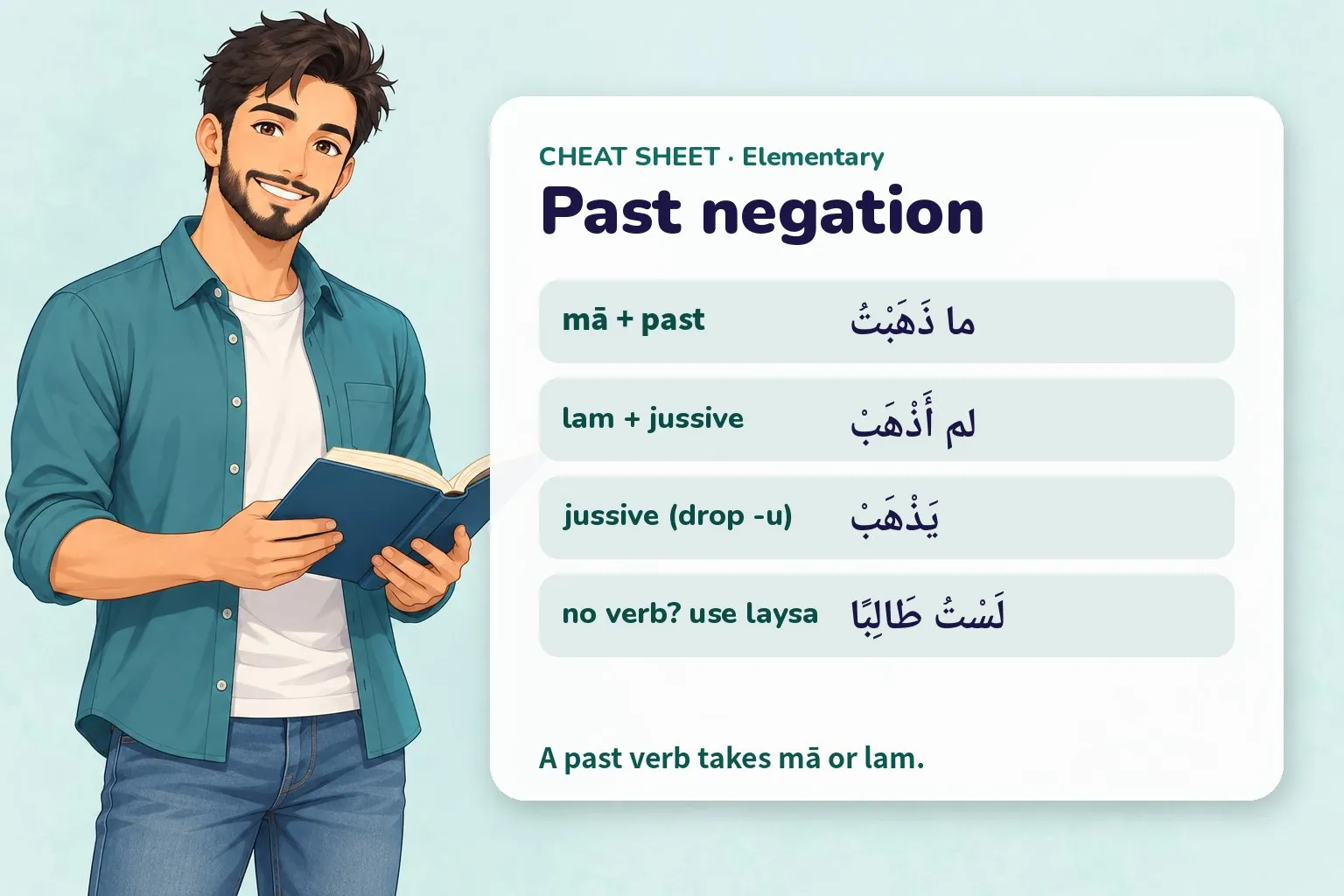
Rule of thumb: a past verb → ما (mā) or لم (lam); a present verb → لا (lā); no verb → ليس (laysa). Review the positive forms on the Arabic past tense page, or browse the whole Arabic grammar section.
Quick recap before you practise.
Practice
Past negation practice
Try each one, then press Check. No sign-up, nothing is sent anywhere — it all runs in your browser.
Hint: the past negator
Show answer
mā — ما ذَهَبْتُ (mā dhahabtu): ما keeps the past verb.
Hint: drop the final -u
Show answer
nafham — لم نَفْهَمْ (lam nafham): the jussive replaces -u with sukūn.
5 Order the words: 'I did not drink the coffee.' (lam pattern)
Show answer
لم (lam) أَشْرَبِ (ashrabi) القَهْوَةَ (al-qahwata) — لم أَشْرَبِ القَهْوَةَ (lam ashrabi al-qahwata): negator, jussive verb, object.
6 Match each negator to what follows it.
- لم (lam)
- ما (mā)
- لا (lā)
- ليس (laysa)
Show answer
- لم (lam) → present verb, jussive
- ما (mā) → past verb
- لا (lā) → present verb (general)
- ليس (laysa) → verbless sentence
Each negator has its own slot: lam+jussive, mā+past, lā+present, laysa for nominal sentences.
Quiz
Past negation quiz
12 questions · pick an answer and you'll see straight away if it's right.
-
Show answer
present, jussive — لم takes the present verb in the jussive (final -u becomes sukūn).
-
Show answer
past (perfect) — ما + past keeps the normal past verb: ما ذَهَبَ (mā dhahaba).
-
Show answer
لم أَذْهَبْ (lam adhhab) — لم أَذْهَبْ (lam adhhab): jussive, with a sukūn ending.
-
Show answer
يَدْرُسْ (yadrus) — Drop the final -u for a sukūn: يَدْرُسْ (yadrus).
-
Show answer
the jussive plural drops -na: يَذْهَبُوا (yadhhabū) — In the jussive the masculine plural ends in -ū: يَذْهَبُوا (yadhhabū), losing -na.
-
Show answer
ما دَرَسَتْ (mā darasat) — ما + past: ما دَرَسَتْ (mā darasat).
-
Show answer
لا (lā) — A general present takes لا (lā): لا أَعْرِفُ (lā aʿrifu).
-
Show answer
بَعْدُ (baʿdu) — لم يَصِلْ بَعْدُ (lam yaṣil baʿdu): he has not arrived yet.
-
Show answer
ما ذَهَبْتُ (mā dhahabtu) / لم أَذْهَبْ (lam adhhab) — ما ذَهَبْتُ (mā dhahabtu) and لم أَذْهَبْ (lam adhhab) both mean 'I did not go'.
-
Show answer
لم (lam) + jussive — لم (lam) + jussive is the standard written choice; ما (mā) + past is also correct.
-
Show answer
yasmaʿ — لم يَسْمَعْ (lam yasmaʿ): present يَسْمَعُ minus the final -u.
-
Show answer
the past (negated) — Despite using the present form, لم (lam) + jussive means a negated past action.
Recap cheat-sheet
| Negator | What follows | Example | Reading |
|---|---|---|---|
| ما | past verb | ما ذَهَبْتُ | mā dhahabtu |
| لم | present, jussive | لم أَذْهَبْ | lam adhhab |
| لا | present verb | لا أَعْرِفُ | lā aʿrifu |
| ليس | verbless sentence | لَسْتُ طَالِبًا | lastu ṭāliban |
Next
- Review the positive forms: The Arabic Past Tense
- Compare verbless negation: Negating Nominal Sentences (laysa)
- Back to the Arabic grammar section
All Arabic grammar topics
Every grammar point in order, from your first sentence to advanced structures. Pick one and go straight to it. New lessons go live every day, so topics marked Coming soon fill in over the next weeks.
Grammar path
Beginner 16 topics · 16 ready
- 01 The Definite Article الـ (al-)
- 02 Indefiniteness and Tanwin
- 03 Noun Gender (Masculine & Feminine)
- 04 The Nominal Sentence (Jumla Ismiyya)
- 05 Adjective Agreement (Na't)
- 06 Personal Pronouns (Separate)
- 07 Attached (Possessive/Object) Pronouns
- 08 Demonstratives (هذا hādhā، هذه hādhihi، ذلك dhālika)
- 09 The Idafa (Possessive Construction)
- 10 Prepositions (Huruf al-Jarr)
- 11 Questions (هل hal، أ a، ما mā، من man، أين ayna)
- 12 Negating Nominal Sentences (ليس laysa)
- 13 Numbers 1-10 and Counting
- 14 Pointing Sentences (هذا كتاب hādhā kitāb)
- 15 Prepositional & Adverbial Predicates
- 16 Expressing 'Have' (عند / لـ / مع ʿinda / li- / maʿa)
Elementary 17 topics · 5 ready
- 17 The Present Tense (al-Mudari')
- 18 The Past Tense (al-Madi)
- 19 The Verbal Sentence (Jumla Fi'liyya)
- 20 Verb Agreement with the Subject
- 21 Negating the Past (ما / لم mā / lam) You are here
- 22 Negating the Present & Future (لا / لن lā / lan) Coming soon
- 23 The Future (سـ / سوف sa- / sawfa) Coming soon
- 24 The Dual (al-Muthanna) Coming soon
- 25 Sound Plurals (Masculine & Feminine) Coming soon
- 26 Broken Plurals (Jam' Taksir) Coming soon
- 27 Kana and Its Sisters Coming soon
- 28 Inna and Its Sisters Coming soon
- 29 Non-Human Plural Agreement Coming soon
- 30 Days, Months and Time Expressions Coming soon
- 31 Adverbs of Time & Place (Zarf) Coming soon
- 32 Hamzat al-Wasl vs Hamzat al-Qat' Coming soon
- 33 Colours & Defects (Af'al pattern) Coming soon
Intermediate 22 topics
- 34 The Three Cases (I'rab) Coming soon
- 35 Uses of the Accusative (Mansubat) Coming soon
- 36 The Derived Verb Forms (I-X) Coming soon
- 37 Root and Pattern Morphology Coming soon
- 38 Active & Passive Participles Coming soon
- 39 The Verbal Noun (Masdar) Coming soon
- 40 The Subjunctive (Mansub) after أن / لـ (an / li-) Coming soon
- 41 The Jussive (Majzum) & Commands Coming soon
- 42 The Imperative (al-Amr) Coming soon
- 43 Weak Verbs (Assimilated, Hollow, Defective) Coming soon
- 44 Relative Clauses (الذي alladhī، التي allatī) Coming soon
- 45 Comparative & Superlative (Af'al) Coming soon
- 46 Conditional Sentences (إذا idhā، إنْ in، لو law) Coming soon
- 47 Numbers 11-99 and Agreement Coming soon
- 48 The Five Nouns (al-Asma' al-Khamsa) Coming soon
- 49 Diptotes (al-Mamnu' min as-Sarf) Coming soon
- 50 Object of Purpose & Accompaniment Coming soon
- 51 Apposition & Substitution (Badal) Coming soon
- 52 Emphasis (at-Tawkid: نفس nafs، كل kull) Coming soon
- 53 Coordination (al-'Atf) & Case Carrying Coming soon
- 54 Questions of Quantity (كم kam) & Number Syntax Coming soon
- 55 The Nisba Adjective (-iyy) Coming soon
Upper-Intermediate 14 topics
- 56 The Circumstantial Clause (Hal) Coming soon
- 57 Specification (Tamyiz) Coming soon
- 58 Exception (al-Istithna': إلا illā) Coming soon
- 59 The Absolute Object (al-Maf'ul al-Mutlaq) Coming soon
- 60 The Passive Voice (al-Majhul) Coming soon
- 61 The Vocative (an-Nida': يا yā) Coming soon
- 62 Energetic Mood & Emphasis (Nun al-Tawkid) Coming soon
- 63 Verbs with Prepositions Coming soon
- 64 Connectors & Cohesion (و wa، ف fa، ثم thumma، لكنّ lākinna) Coming soon
- 65 Verbs of Certainty/Doubt (Dhanna & Sisters) Coming soon
- 66 Verbs with Two Objects Coming soon
- 67 The Diminutive (at-Tasghir) Coming soon
- 68 Collective & Unit Nouns Coming soon
- 69 Conditional Particles & Jussive Pair Coming soon
Advanced 10 topics
- 70 Advanced I'rab & Government Coming soon
- 71 Expressing Aspect (قد qad، كان قد kāna qad، لمّا lammā) Coming soon
- 72 Rhetorical Structures (Taqdim wa-Ta'khir) Coming soon
- 73 Advanced Conditionals & Oaths Coming soon
- 74 Classical/Formal Register (Fusha Style) Coming soon
- 75 Nominal Style & Masdar-Heavy Syntax Coming soon
- 76 Advanced Exception & Restriction (إنما innamā، غير ghayr) Coming soon
- 77 Absolute Negation (لا النافية للجنس lā an-nāfiya lil-jins) Coming soon
- 78 Particle Review: إنّ (inna)، أنّ (anna)، أنْ (an)، كأنّ (ka-anna) Coming soon
- 79 Verb-Initial vs Noun-Initial Style Coming soon