Arabic Pointing Sentences: hādhā kitāb (This Is a Book)
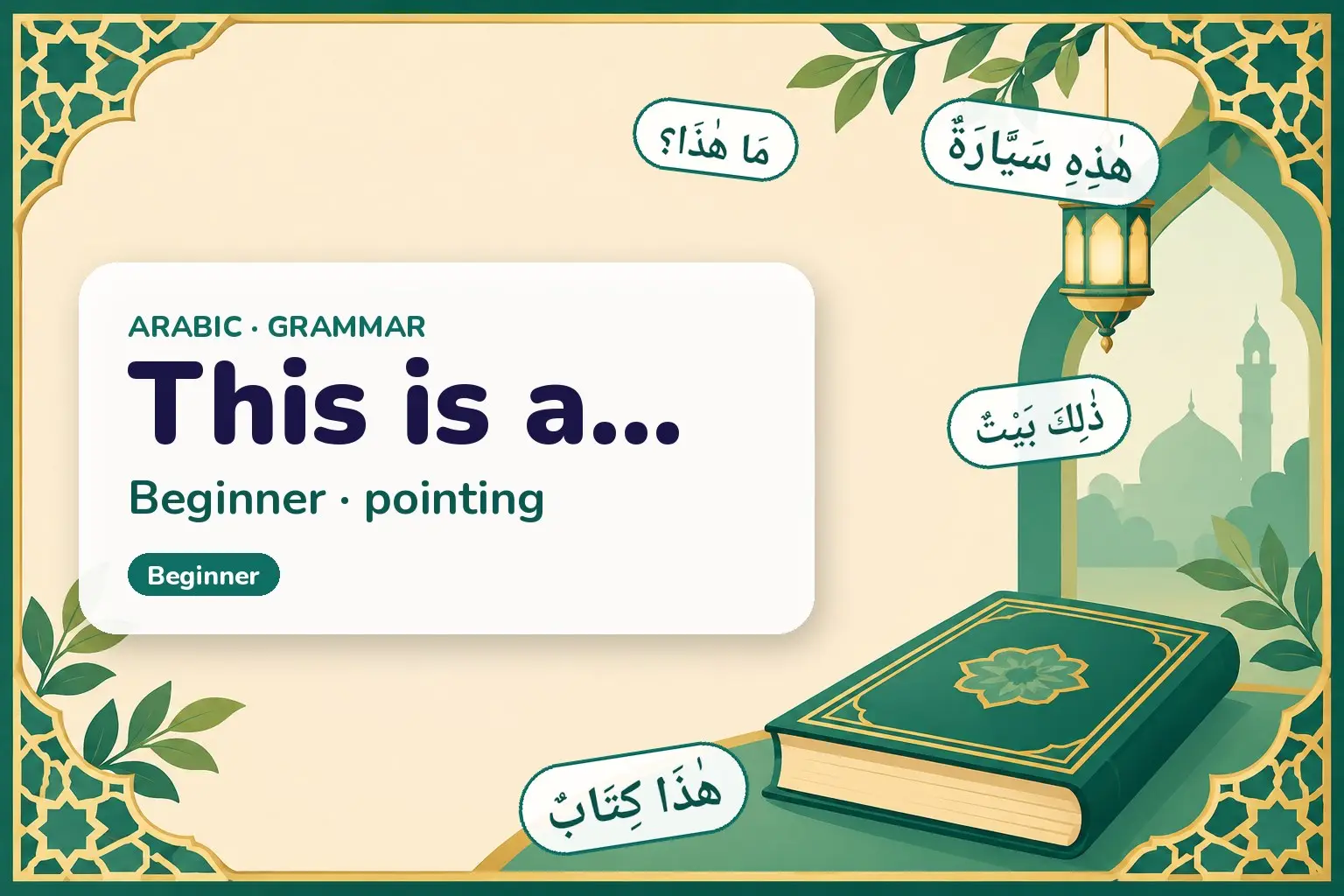
To say 'this is a book' in Arabic you just put a demonstrative before an indefinite noun — هٰذَا كِتَابٌ (hādhā kitābun). There is no word for 'is'. Add the article ال (al-) and the meaning flips to the phrase 'this book': هٰذَا الكِتَابُ (hādhā al-kitābu).
On this page10 sections · tap to jump
Level: beginner. One of the first full sentences you can build in Arabic is a pointing sentence: “this is a book”, “that is a house”. You make it with a demonstrative (a pointing word) and a noun — and, surprisingly, no verb at all. هٰذَا كِتَابٌ (hādhā kitābun) is a complete sentence meaning “This is a book”.
The rule
A demonstrative is a pointing word: هٰذَا (hādhā) “this” (masculine), هٰذِهِ (hādhihi) “this” (feminine), ذٰلِكَ (dhālika) “that” (masculine), تِلْكَ (tilka) “that” (feminine). A noun is a naming word like كِتَابٌ (kitābun) “a book”. A noun is indefinite when it means “a/an” and carries tanwīn — the doubled vowel ending written -un here.
Arabic has no verb “to be” in the present. So when you put a demonstrative directly before an indefinite noun, the two words alone make a full sentence: هٰذَا كِتَابٌ (hādhā kitābun) = “This is a book”. Nothing stands for “is” — the meaning is built into the pattern.
The twist comes with the definite article ال (al-), “the”. Put it on the noun and the same two words become a phrase, not a sentence: هٰذَا الكِتَابُ (hādhā al-kitābu) = “this book” (just a label, waiting for more). So the single difference between a sentence and a phrase is that little ال (al-).
Forms
| Pattern | Arabic | Transliteration | Meaning |
|---|---|---|---|
| this + indefinite noun | هٰذَا كِتَابٌ | hādhā kitābun | This is a book. |
| this (f.) + indefinite noun | هٰذِهِ سَيَّارَةٌ | hādhihi sayyāratun | This is a car. |
| that + indefinite noun | ذٰلِكَ بَيْتٌ | dhālika baytun | That is a house. |
| this + definite noun (phrase) | هٰذَا الكِتَابُ | hādhā al-kitābu | this book |
| this + noun + adjective | هٰذَا كِتَابٌ جَدِيدٌ | hādhā kitābun jadīdun | This is a new book. |
| question | مَا هٰذَا؟ | mā hādhā? | What is this? |
Example sentences
- هٰذَا كِتَابٌ.hādhā kitābun.This is a book.demonstrative + indefinite noun = sentence
- هٰذِهِ سَيَّارَةٌ.hādhihi sayyāratun.This is a car.sayyāra is feminine, so hādhihi
- ذٰلِكَ بَيْتٌ.dhālika baytun.That is a house.
- تِلْكَ مَدِينَةٌ.tilka madīnatun.That is a city.
- هٰذَا قَلَمٌ.hādhā qalamun.This is a pen.
- هٰذِهِ بِنْتٌ.hādhihi bintun.This is a girl.
- هٰذَا وَلَدٌ.hādhā waladun.This is a boy.
- هٰذَا رَجُلٌ.hādhā rajulun.This is a man.
- هٰذَا بَابٌ.hādhā bābun.This is a door.
- هٰذِهِ طَاوِلَةٌ.hādhihi ṭāwilatun.This is a table.
- هٰذَا طَالِبٌ.hādhā ṭālibun.This is a student.
- هٰذِهِ مُعَلِّمَةٌ.hādhihi muʿallimatun.This is a (female) teacher.
- ذٰلِكَ مَسْجِدٌ.dhālika masjidun.That is a mosque.
- هٰذَا كِتَابٌ جَدِيدٌ.hādhā kitābun jadīdun.This is a new book.adjective after the noun, also indefinite
- هٰذِهِ سَيَّارَةٌ سَرِيعَةٌ.hādhihi sayyāratun sarīʿatun.This is a fast car.
- مَا هٰذَا؟mā hādhā?What is this?
- هَلْ هٰذَا كِتَابٌ؟hal hādhā kitābun?Is this a book?hal makes a yes/no question
- هٰذَا الكِتَابُ جَدِيدٌ.hādhā al-kitābu jadīdun.This book is new.with al-, the phrase needs a predicate
Common mistakes
- ❌ هٰذَا الكِتَابُ (meaning “this is a book”) → ✅ هٰذَا كِتَابٌ (hādhā kitābun). With ال (al-) you have said the phrase “this book”; drop it for the sentence.
- ❌ هٰذَا يَكُونُ كِتَابًا (hādhā yakūnu kitāban) → ✅ هٰذَا كِتَابٌ (hādhā kitābun). There is no verb “to be” in the present — do not add one.
- ❌ هٰذَا سَيَّارَةٌ (hādhā sayyāratun) → ✅ هٰذِهِ سَيَّارَةٌ (hādhihi sayyāratun). سَيَّارَة (sayyāra) is feminine, so use هٰذِهِ (hādhihi).
- ❌ هٰذَا كِتَابُ (hādhā kitābu) → ✅ هٰذَا كِتَابٌ (hādhā kitābun). The indefinite predicate noun needs tanwīn, the -un ending.
- ❌ كِتَابٌ هٰذَا (kitābun hādhā) → ✅ هٰذَا كِتَابٌ (hādhā kitābun). The pointing word comes first.
A short conversation
— مَا هٰذَا؟ (mā hādhā?) — What is this? — هٰذَا قَلَمٌ. (hādhā qalamun.) — This is a pen. — وَمَا تِلْكَ؟ (wa-mā tilka?) — And what is that (feminine)? — تِلْكَ سَيَّارَةٌ. (tilka sayyāratun.) — That is a car.
Each answer is just a demonstrative plus an indefinite noun — no verb, no article.
Usage notes
- The predicate is indefinite and nominative. The noun after the demonstrative takes tanwīn with a ḍamma: كِتَابٌ (kitābun), بَيْتٌ (baytun). That ending signals “a book / a house”.
- Adjectives follow and agree. A describing word comes after the noun and matches it — indefinite with indefinite: هٰذَا بَيْتٌ كَبِيرٌ (hādhā baytun kabīrun), “This is a big house”.
- Ask yes/no with هَلْ (hal). Put هَلْ (hal) in front: هَلْ هٰذَا كِتَابٌ؟ (hal hādhā kitābun?), “Is this a book?”. Answer نَعَمْ (naʿam), “yes”, or لَا (lā), “no”.
- Ask “what/who” with مَا (mā) and مَنْ (man). مَا هٰذَا؟ (mā hādhā?) is “What is this?”; مَنْ هٰذَا؟ (man hādhā?) is “Who is this?”.
Compared with…
- The demonstratives themselves. This page is about the sentence; to drill the four pointing words and their gender and number agreement, see Arabic Demonstratives: hādhā, hādhihi, dhālika.
- The definite article ال (al-). It is the one piece that flips a sentence into a phrase. Learn how it attaches, with sun and moon letters, on The Arabic Definite Article ال (al-).
- The nominal sentence in general. “This is a book” is one kind of verbless Arabic sentence; the wider pattern of subject + predicate is covered in The Arabic Nominal Sentence.
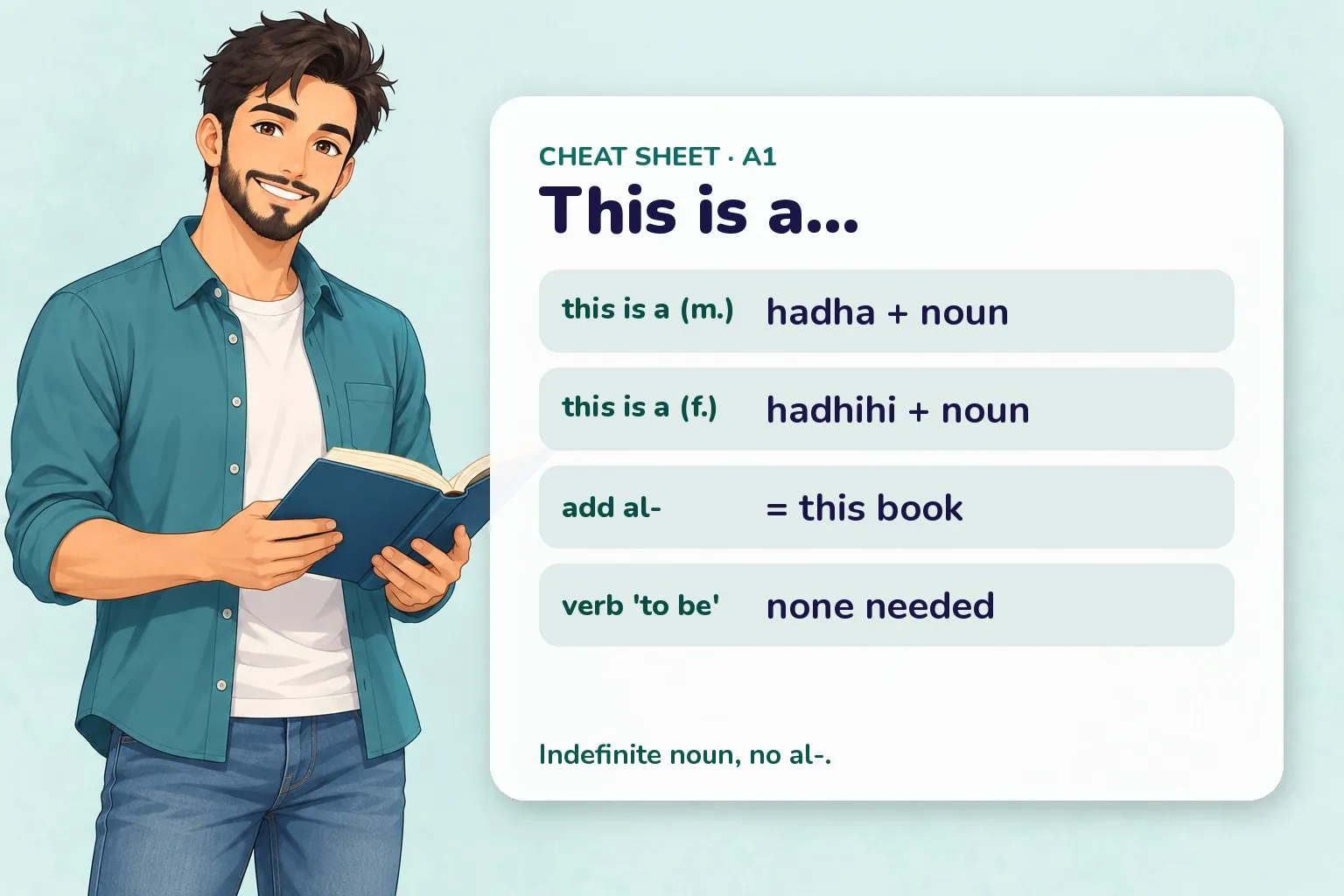
Quick recap before the quiz.
Practice
Pointing sentences practice
Try each one, then press Check. No sign-up, nothing is sent anywhere — it all runs in your browser.
Hint: the -un tanwīn ending
Show answer
baytun — هٰذَا بَيْتٌ (hādhā baytun) — the predicate noun takes tanwīn -un.
4 Build 'This is a pen.'
Show answer
هٰذَا (hādhā) قَلَمٌ (qalamun) — Pointing word first: هٰذَا قَلَمٌ (hādhā qalamun).
5 Match each Arabic to its English.
- هٰذَا كِتَابٌ (hādhā kitābun)
- هٰذَا الكِتَابُ (hādhā al-kitābu)
- مَا هٰذَا؟ (mā hādhā?)
- هٰذِهِ سَيَّارَةٌ (hādhihi sayyāratun)
Show answer
- هٰذَا كِتَابٌ (hādhā kitābun) → This is a book.
- هٰذَا الكِتَابُ (hādhā al-kitābu) → this book
- مَا هٰذَا؟ (mā hādhā?) → What is this?
- هٰذِهِ سَيَّارَةٌ (hādhihi sayyāratun) → This is a car.
No al- = sentence; with al- = phrase.
Quiz
Arabic pointing sentences quiz
11 questions · pick an answer and you'll see straight away if it's right.
-
Show answer
Arabic needs no present 'to be'; demonstrative + indefinite noun is complete — There is no present 'to be'; the pattern alone is the sentence.
-
Show answer
this is a book — Demonstrative + indefinite noun = 'this is a book'.
-
Show answer
this book — With ال (al-) it is the phrase 'this book', not a sentence.
-
Show answer
adding the article ال (al-) — Adding ال (al-) to the noun makes it 'this book' instead of 'this is a book'.
-
Show answer
indefinite with tanwīn (-un) — It stays indefinite and takes tanwīn: كِتَابٌ (kitābun).
-
Show answer
هٰذِهِ سَيَّارَةٌ (hādhihi sayyāratun) — Feminine noun, near, indefinite: هٰذِهِ سَيَّارَةٌ (hādhihi sayyāratun).
-
Show answer
هٰذَا كِتَابٌ (hādhā kitābun) — The demonstrative comes first: هٰذَا كِتَابٌ (hādhā kitābun).
-
Show answer
هَلْ هٰذَا كِتَابٌ؟ (hal hādhā kitābun?) — Put هَلْ (hal) in front for a yes/no question.
-
Show answer
مَا هٰذَا؟ (mā hādhā?) — مَا (mā) asks 'what': مَا هٰذَا؟ (mā hādhā?).
-
Show answer
after the noun and indefinite — هٰذَا كِتَابٌ جَدِيدٌ (hādhā kitābun jadīdun): the adjective follows and is indefinite.
-
Show answer
hādhā baytun — هٰذَا بَيْتٌ (hādhā baytun).
Recap cheat-sheet
| Want to say | Pattern | Example |
|---|---|---|
| this is a (m.) | hādhā + indefinite noun | هٰذَا كِتَابٌ (hādhā kitābun) |
| this is a (f.) | hādhihi + indefinite noun | هٰذِهِ سَيَّارَةٌ (hādhihi sayyāratun) |
| that is a | dhālika / tilka + noun | ذٰلِكَ بَيْتٌ (dhālika baytun) |
| this (phrase) | demonstrative + al- noun | هٰذَا الكِتَابُ (hādhā al-kitābu) |
| what is this? | mā + demonstrative | مَا هٰذَا؟ (mā hādhā?) |
Next
- Drill the pointing words themselves: Arabic Demonstratives
- Back to the Arabic grammar section
- New here? Start with Start Learning Arabic Here
All Arabic grammar topics
Every grammar point in order, from your first sentence to advanced structures. Pick one and go straight to it. New lessons go live every day, so topics marked Coming soon fill in over the next weeks.
Grammar path
Beginner 16 topics · 14 ready
- 01 The Definite Article الـ (al-)
- 02 Indefiniteness and Tanwin
- 03 Noun Gender (Masculine & Feminine)
- 04 The Nominal Sentence (Jumla Ismiyya)
- 05 Adjective Agreement (Na't)
- 06 Personal Pronouns (Separate)
- 07 Attached (Possessive/Object) Pronouns
- 08 Demonstratives (هذا hādhā، هذه hādhihi، ذلك dhālika)
- 09 The Idafa (Possessive Construction)
- 10 Prepositions (Huruf al-Jarr)
- 11 Questions (هل hal، أ a، ما mā، من man، أين ayna)
- 12 Negating Nominal Sentences (ليس laysa)
- 13 Numbers 1-10 and Counting
- 14 Pointing Sentences (هذا كتاب hādhā kitāb) You are here
- 15 Prepositional & Adverbial Predicates Coming soon
- 16 Expressing 'Have' (عند / لـ / مع ʿinda / li- / maʿa) Coming soon
Elementary 17 topics
- 17 The Present Tense (al-Mudari') Coming soon
- 18 The Past Tense (al-Madi) Coming soon
- 19 The Verbal Sentence (Jumla Fi'liyya) Coming soon
- 20 Verb Agreement with the Subject Coming soon
- 21 Negating the Past (ما / لم mā / lam) Coming soon
- 22 Negating the Present & Future (لا / لن lā / lan) Coming soon
- 23 The Future (سـ / سوف sa- / sawfa) Coming soon
- 24 The Dual (al-Muthanna) Coming soon
- 25 Sound Plurals (Masculine & Feminine) Coming soon
- 26 Broken Plurals (Jam' Taksir) Coming soon
- 27 Kana and Its Sisters Coming soon
- 28 Inna and Its Sisters Coming soon
- 29 Non-Human Plural Agreement Coming soon
- 30 Days, Months and Time Expressions Coming soon
- 31 Adverbs of Time & Place (Zarf) Coming soon
- 32 Hamzat al-Wasl vs Hamzat al-Qat' Coming soon
- 33 Colours & Defects (Af'al pattern) Coming soon
Intermediate 22 topics
- 34 The Three Cases (I'rab) Coming soon
- 35 Uses of the Accusative (Mansubat) Coming soon
- 36 The Derived Verb Forms (I-X) Coming soon
- 37 Root and Pattern Morphology Coming soon
- 38 Active & Passive Participles Coming soon
- 39 The Verbal Noun (Masdar) Coming soon
- 40 The Subjunctive (Mansub) after أن / لـ (an / li-) Coming soon
- 41 The Jussive (Majzum) & Commands Coming soon
- 42 The Imperative (al-Amr) Coming soon
- 43 Weak Verbs (Assimilated, Hollow, Defective) Coming soon
- 44 Relative Clauses (الذي alladhī، التي allatī) Coming soon
- 45 Comparative & Superlative (Af'al) Coming soon
- 46 Conditional Sentences (إذا idhā، إنْ in، لو law) Coming soon
- 47 Numbers 11-99 and Agreement Coming soon
- 48 The Five Nouns (al-Asma' al-Khamsa) Coming soon
- 49 Diptotes (al-Mamnu' min as-Sarf) Coming soon
- 50 Object of Purpose & Accompaniment Coming soon
- 51 Apposition & Substitution (Badal) Coming soon
- 52 Emphasis (at-Tawkid: نفس nafs، كل kull) Coming soon
- 53 Coordination (al-'Atf) & Case Carrying Coming soon
- 54 Questions of Quantity (كم kam) & Number Syntax Coming soon
- 55 The Nisba Adjective (-iyy) Coming soon
Upper-Intermediate 14 topics
- 56 The Circumstantial Clause (Hal) Coming soon
- 57 Specification (Tamyiz) Coming soon
- 58 Exception (al-Istithna': إلا illā) Coming soon
- 59 The Absolute Object (al-Maf'ul al-Mutlaq) Coming soon
- 60 The Passive Voice (al-Majhul) Coming soon
- 61 The Vocative (an-Nida': يا yā) Coming soon
- 62 Energetic Mood & Emphasis (Nun al-Tawkid) Coming soon
- 63 Verbs with Prepositions Coming soon
- 64 Connectors & Cohesion (و wa، ف fa، ثم thumma، لكنّ lākinna) Coming soon
- 65 Verbs of Certainty/Doubt (Dhanna & Sisters) Coming soon
- 66 Verbs with Two Objects Coming soon
- 67 The Diminutive (at-Tasghir) Coming soon
- 68 Collective & Unit Nouns Coming soon
- 69 Conditional Particles & Jussive Pair Coming soon
Advanced 10 topics
- 70 Advanced I'rab & Government Coming soon
- 71 Expressing Aspect (قد qad، كان قد kāna qad، لمّا lammā) Coming soon
- 72 Rhetorical Structures (Taqdim wa-Ta'khir) Coming soon
- 73 Advanced Conditionals & Oaths Coming soon
- 74 Classical/Formal Register (Fusha Style) Coming soon
- 75 Nominal Style & Masdar-Heavy Syntax Coming soon
- 76 Advanced Exception & Restriction (إنما innamā، غير ghayr) Coming soon
- 77 Absolute Negation (لا النافية للجنس lā an-nāfiya lil-jins) Coming soon
- 78 Particle Review: إنّ (inna)، أنّ (anna)، أنْ (an)، كأنّ (ka-anna) Coming soon
- 79 Verb-Initial vs Noun-Initial Style Coming soon