Contractions: au, aux, du, des (à/de + le)
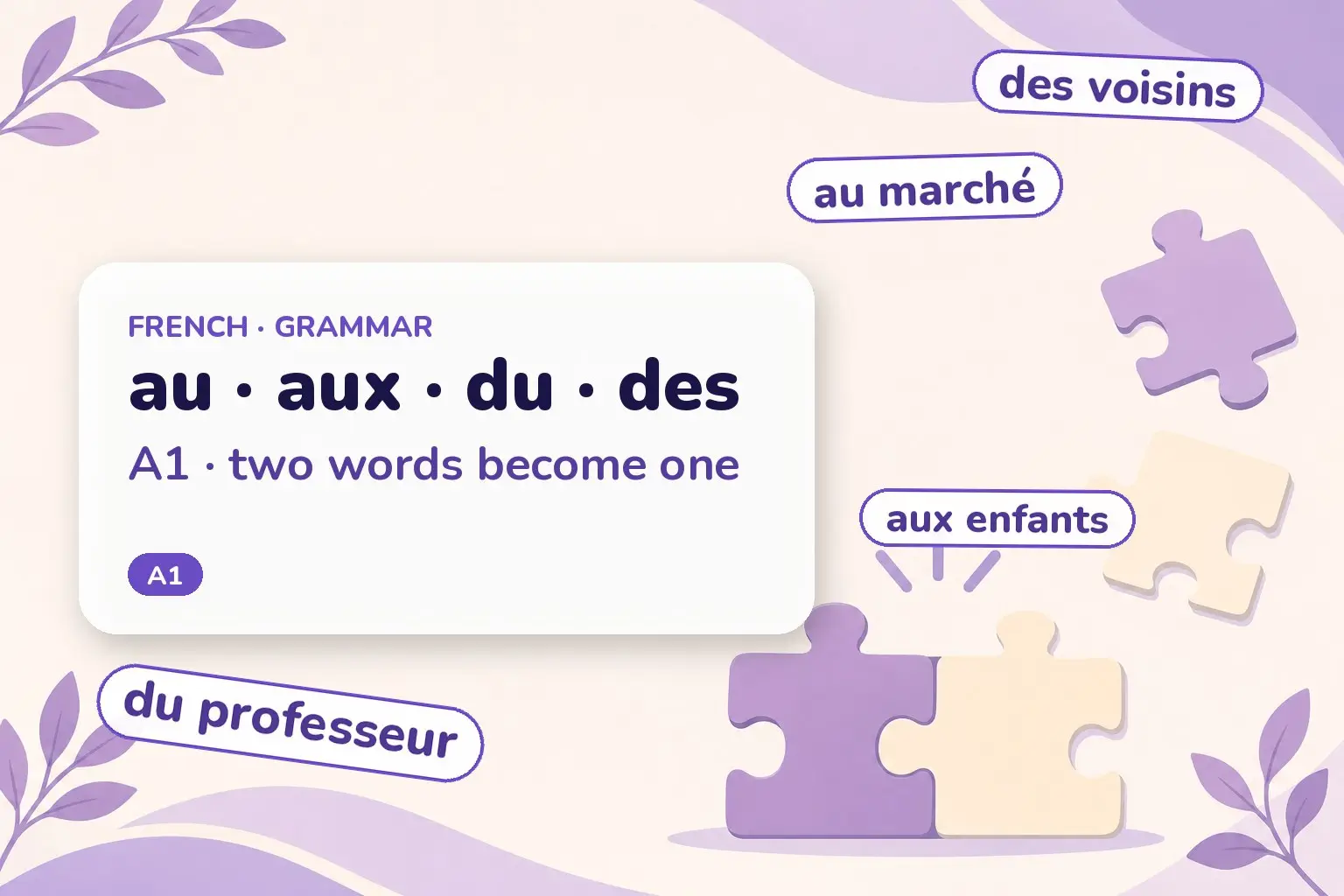
French must contract à and de with the masculine and plural articles: à + le = au, à + les = aux, de + le = du, de + les = des. With la and l' nothing contracts — à la, de la, à l', de l'.
Level: A1. Two prepositions, à (“to, at”) and de (“of, from”), refuse to sit next to the masculine or plural article. They fuse with it: au, aux, du, des. Four forms, no exceptions to the fusion itself — only to which article triggers it.
The rule
A contraction here means two words written and pronounced as one. French contracts à and de with le and les, and with nothing else.
| Preposition + article | Contraction | Example | Meaning |
|---|---|---|---|
| à + le | au | au marché | to the market |
| à + les | aux | aux enfants | to the children |
| de + le | du | du professeur | of the teacher |
| de + les | des | des voisins | of the neighbours |
With the feminine article la and with the elided l’, nothing happens:
- à la plage — to the beach
- de la gare — from the station
- à l’école — to the school
- de l’hôpital — from the hospital
The rule is mechanical, and it is compulsory. à le and de le are not informal or old-fashioned; they are simply not French. This is why the contraction is a reliable gender test: if you hear au or du, the noun is masculine singular; if you hear à la or de la, it is feminine.
The four forms side by side
| Masculine singular | Feminine singular | Before a vowel | Plural | |
|---|---|---|---|---|
| à (to, at) | au cinéma | à la plage | à l’école | aux enfants |
| de (of, from) | du cinéma | de la plage | de l’école | des enfants |
Read the table as a grid and the pattern is obvious: the left-hand column fuses, the middle two do not, the right-hand one fuses again.
Elision is a different change
Two shorteners act on French phrases and learners file them under the same heading. They are not the same operation.
| Change | Trigger | What happens | Example |
|---|---|---|---|
| Elision | a word ending in -e meets a vowel or mute h | the vowel drops and an apostrophe takes its place | le + enfant → l’enfant |
| Contraction | à or de meets le or les | the two words fuse into one unbreakable word | à + le → au |
Elision shortens the first word but leaves two words on the page: l’enfant still separates into “the” and “child”. Contraction welds them: au contains no visible le, and you cannot put anything between its letters. That is why au marché cannot be written as à le marché under any circumstances, while l’enfant is simply the normal way to write le enfant.
How to say it
The four contractions sound nothing like their parts, so learn them as words.
| Sound | How to say it |
|---|---|
| au, aux, eau | all “oh”: au marché = “oh mar-SHAY”, aux enfants = “oh-zahn-FAHN” |
| du | “dü” — say “dee” and round your lips; not “doo” |
| des | “day”: des voisins = “day vwah-ZAN” |
| à and de | “ah” and “duh”; the e of de is a light schwa, often almost swallowed |
| Liaison | des amis = “day-za-MEE”, aux étudiants = “oh-zay-tü-DYAHN” |
Two traps for English speakers. au is a single vowel, not “ow” as in “cow”. And du must keep the rounded ü sound — “doo” is a different word to French ears.
Example sentences
Each sentence was written for this lesson. Every contracted form is a decision you can now make in one step.
- Je vais au marché.I'm going to the market.à + le = au
- Il parle au professeur.He is talking to the teacher.masculine singular
- Je pense aux vacances.I'm thinking about the holidays.à + les = aux
- Elle téléphone aux enfants.She is calling the children.plural
- Je viens du bureau.I'm coming from the office.de + le = du
- Elle revient des États-Unis.She is coming back from the United States.de + les = des
- C'est le livre du professeur.It's the teacher's book.possession with du
- Les enfants des voisins sont ici.The neighbours' children are here.possession with des
- Je vais à la plage.I'm going to the beach.la blocks the contraction
- Il parle à l'étudiant.He is talking to the student.l' blocks the contraction
- Je reviens de la gare.I'm coming back from the station.
- Elle vient de l'hôpital.She is coming from the hospital.
- Je mange du pain.I'm eating some bread.partitive du
- Il achète des pommes.He's buying some apples.partitive des
- Je ne bois pas de café.I don't drink coffee.de after a negation
- Il va au Japon en mars.He is going to Japan in March.masculine country
- Elle habite aux Pays-Bas.She lives in the Netherlands.plural country
- Je joue au tennis.I play tennis.au with sports
Common mistakes
- ❌ Je vais à le marché. → ✅ Je vais au marché. à + le always fuses.
- ❌ Je viens de les voisins. → ✅ Je viens des voisins. de + les always fuses.
- ❌ Je vais au plage. → ✅ Je vais à la plage. The noun is feminine, so the article is la and nothing fuses.
- ❌ Il à un livre. → ✅ Il a un livre. The verb avoir has no accent: a, not à.
- ❌ Je n’ai pas des pommes. → ✅ Je n’ai pas de pommes. After a negation, the partitive drops to plain de.
A short conversation
— Tu vas au bureau cet après-midi ? — Tu vas au bureau cet après-midi ? — Are you going to the office this afternoon? — Non, je vais à la banque, puis au marché. — Non, je vais à la banque, puis au marché. — No, I’m going to the bank, then to the market. — Tu reviens des courses à quelle heure ? — Tu reviens des courses à quelle heure ? — What time do you get back from the shopping? — Vers six heures. J’achète du pain et des fruits. — Vers six heures. J’achète du pain et des fruits. — Around six. I’m buying some bread and some fruit.
Five contracted forms in four lines, each one triggered by a masculine or plural noun: au bureau, au marché, des courses, du pain, des fruits.
Usage notes
- du and des as partitives. The same forms mean “some” when the quantity is unspecified: du pain, des pommes, de l’eau. The contraction reading and the partitive reading are historically the same thing, which is why the forms look identical.
- After a negation or a quantity, de stands alone. Je n’ai pas de pain, beaucoup de monde, un kilo de pommes. No article survives, so nothing contracts.
- With lequel, the fusion shows up again. à + lequel = auquel, à + lesquels = auxquels, de + lequel = duquel, de + lesquels = desquels. The same rule, one level up.
- Countries and places keep the same logic. Masculine country: au Japon, du Japon. Plural: aux États-Unis, des États-Unis. Feminine: en France, de France.
- Fixed phrases are fixed. au revoir, au fait, au moins, au maximum — the contraction is baked in, so do not try to unpack it.
Compared with…
- The definite articles themselves. le, la, les and l’ stand alone as “the”: le marché, la plage, les enfants. The contraction only happens when à or de comes first. See French definite articles.
- Partitive articles. du, de la, de l’ and des also mean “some” without any preposition: je mange du pain. The shape is the same, the job is different. See the French partitive.
- Prepositions of place. à and de cover “to/at” and “from/of”, while dans, sur, sous and chez answer different questions. The contraction rule only ever applies to à and de, so dans le salon keeps its two words.
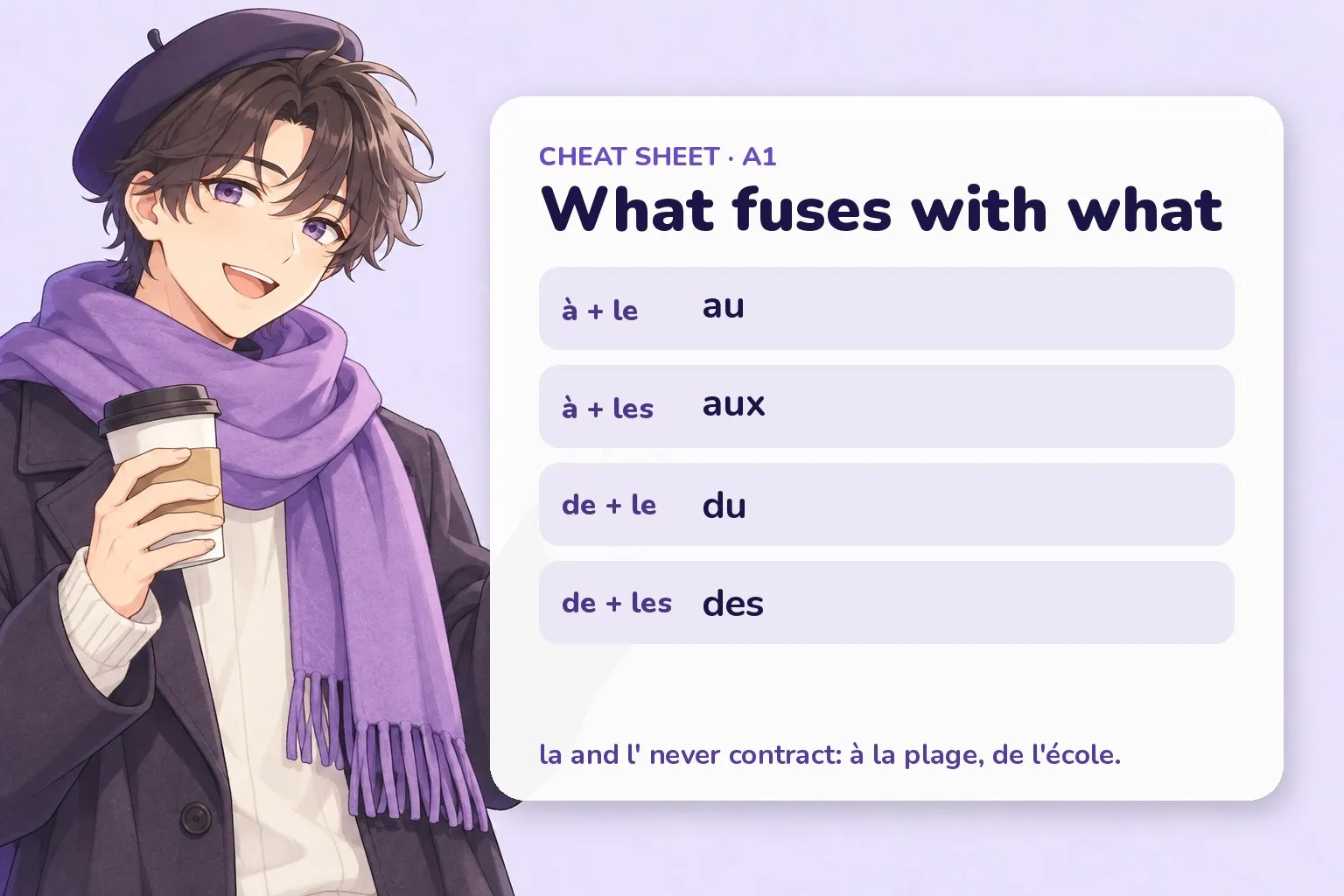
Quick recap before the quiz.
Practice
French contractions practice
Try each one, then press Check. No sign-up, nothing is sent anywhere — it all runs in your browser.
Hint: à + les
Show answer
aux — à + les = aux, so aux enfants.
4 Match each pair to its contraction.
- à + le
- à + les
- de + le
- de + les
Show answer
- à + le → au
- à + les → aux
- de + le → du
- de + les → des
Only the masculine singular and the plural fuse.
5 Order the words: She comes from the station.
Show answer
Elle revient de la gare — Feminine gare keeps de la — no contraction.
Quiz
French contractions au, aux, du, des
12 questions · pick an answer and you'll see straight away if it's right.
-
Show answer
au — The masculine singular fuses into au.
-
Show answer
des — The plural of de fuses into des.
-
Show answer
aux — The plural of à fuses into aux.
-
Show answer
du — The masculine singular of de fuses into du.
-
Show answer
la — la and l' block it: à la plage, de l'école.
-
Show answer
au — Japon is masculine, so à + le = au.
-
Show answer
I'm eating some bread — Here du is the partitive article, 'some'.
-
Show answer
de — Je n'ai pas de pain — plain de replaces du or des.
-
Show answer
les enfants des voisins — de + les = des.
-
Show answer
auquel — The same fusion applies inside auquel and auxquels.
-
Show answer
des — de + les = des, so des États-Unis.
-
Show answer
Il à un livre. — The verb avoir is written a, with no accent; à is the preposition.
Recap cheat-sheet
| Form | Made of | Example | Translation |
|---|---|---|---|
| au | à + le | au marché | to the market |
| aux | à + les | aux enfants | to the children |
| du | de + le | du professeur | of the teacher |
| des | de + les | des voisins | of the neighbours |
| à la / de la | no fusion | à la plage | to the beach |
| à l’ / de l’ | no fusion | de l’école | from the school |
Next
- The articles behind the contractions: French definite articles
- “Some” without a preposition: the French partitive
- Why gender decides: noun gender in French
- New here? Start with Start Learning French Here
All French grammar topics
Every grammar point in order, from your first sentence to advanced structures. Pick one and go straight to it. New lessons go live every day, so topics marked Coming soon fill in over the next weeks.
Grammar path
A1 32 topics · 22 ready
- 01 Definite Articles: le, la, les, l'
- 02 Indefinite Articles: un, une, des
- 03 Partitive Articles: du, de la, des
- 04 Noun Gender in French
- 05 Forming Plurals in French
- 06 Subject Pronouns (je, tu, il, nous, vous)
- 07 The Verb Être (To Be) - Present
- 08 The Verb Avoir (To Have) - Present
- 09 Present Tense: -ER Verbs
- 10 Present Tense: -IR Verbs (finir)
- 11 Present Tense: -RE Verbs (vendre)
- 12 Aller + Near Future (futur proche)
- 13 The Verb Faire (To Do/Make)
- 14 Negation: ne...pas
- 15 Asking Questions (est-ce que, inversion)
- 16 Adjective Agreement (Gender & Number)
- 17 Position of Adjectives (BAGS)
- 18 Possessive Adjectives (mon, ma, mes)
- 19 Demonstrative Adjectives (ce, cette, ces)
- 20 C'est vs Il/Elle Est
- 21 Il Y A (There Is / There Are)
- 22 Contractions: au, aux, du, des (à/de + le) You are here
- 23 Question Words (qui, que, où, quand, comment) Coming soon
- 24 Vouloir, Pouvoir, Devoir (Present) Coming soon
- 25 Aimer / Préférer + Infinitive (Preferences) Coming soon
- 26 Pronominal (Reflexive) Verbs - Present Coming soon
- 27 The Imperative (Commands) Coming soon
- 28 Venir and Venir De (Recent Past) Coming soon
- 29 Prepositions with Places (à, en, au, aux) Coming soon
- 30 Expressions with Avoir (avoir faim, avoir 20 ans) Coming soon
- 31 Prepositions of Time (à, en, dans, depuis) Coming soon
- 32 Weather & Impersonal Expressions (il fait, il pleut) Coming soon
A2 26 topics
- 33 Passé Composé with Avoir Coming soon
- 34 Passé Composé with Être (+ agreement) Coming soon
- 35 The Imperfect Tense (imparfait) Coming soon
- 36 Passé Composé vs Imparfait Coming soon
- 37 The Simple Future (futur simple) Coming soon
- 38 Direct Object Pronouns (le, la, les) Coming soon
- 39 Indirect Object Pronouns (lui, leur) Coming soon
- 40 The Pronoun Y Coming soon
- 41 The Pronoun En Coming soon
- 42 Comparatives (plus, moins, aussi ... que) Coming soon
- 43 Superlatives (le plus, le moins) Coming soon
- 44 Forming Adverbs in -ment Coming soon
- 45 Depuis, Pendant, Il Y A, Pour (Time) Coming soon
- 46 Partitive & Articles in the Negative (de) Coming soon
- 47 Expressions of Quantity (beaucoup de, trop de) Coming soon
- 48 Pronominal Verbs in Passé Composé Coming soon
- 49 Stressed (Disjunctive) Pronouns (moi, toi, lui) Coming soon
- 50 Possessive Pronouns (le mien, la tienne) Coming soon
- 51 Object Pronoun Placement & Order Coming soon
- 52 Adverb Position in French Coming soon
- 53 Savoir vs Connaître (Two Ways to Know) Coming soon
- 54 Il Faut + Infinitive (Necessity) Coming soon
- 55 Verbs + à / de + Infinitive Coming soon
- 56 Comparing Quantities (plus de ... que) Coming soon
- 57 Adverbs of Frequency (souvent, toujours, jamais) Coming soon
- 58 Quel in Exclamations (Quel beau jour!) Coming soon
B1 24 topics
- 59 The Present Conditional Coming soon
- 60 The Present Subjunctive: Formation Coming soon
- 61 Subjunctive After Will & Necessity (il faut que) Coming soon
- 62 Subjunctive After Emotion & Opinion Coming soon
- 63 The Pluperfect (plus-que-parfait) Coming soon
- 64 The Future Perfect (futur antérieur) Coming soon
- 65 The Past Conditional (conditionnel passé) Coming soon
- 66 Si Clauses (Conditional Sentences) Coming soon
- 67 Relative Pronouns: qui, que, où, dont Coming soon
- 68 Order of Double Object Pronouns Coming soon
- 69 The Gérondif (en + -ant) Coming soon
- 70 The Present Participle (-ant) Coming soon
- 71 Reported Speech (discours indirect) Coming soon
- 72 Irregular Comparatives (meilleur, pire, mieux) Coming soon
- 73 Demonstrative Pronouns (celui, celle, ceux) Coming soon
- 74 The Causative Faire (faire faire) Coming soon
- 75 Depuis Que & Time Conjunctions Coming soon
- 76 Être en Train de / Sur le Point de Coming soon
- 77 Varied Negations (ne...jamais/rien/personne/plus) Coming soon
- 78 Y and En with Verbs (penser à / parler de) Coming soon
- 79 The Past Infinitive (après avoir fait) Coming soon
- 80 Tout: Adjective, Pronoun and Adverb Coming soon
- 81 Types of Pronominal Verbs (reflexive, reciprocal, idiomatic) Coming soon
- 82 Expressing Opinion (à mon avis, trouver que) Coming soon
B2 20 topics
- 83 The Past Subjunctive (subjonctif passé) Coming soon
- 84 Subjunctive After Conjunctions (bien que, pour que) Coming soon
- 85 Subjunctive vs Indicative (penser que, espérer) Coming soon
- 86 Sequence of Tenses (concordance des temps) Coming soon
- 87 The Passé Simple (Recognition) Coming soon
- 88 The Passive Voice (voix passive) Coming soon
- 89 Reported Speech in the Past Coming soon
- 90 Compound Relatives (lequel, auquel, duquel) Coming soon
- 91 Past Participle Agreement with Avoir Coming soon
- 92 Participle Agreement: Pronominal Verbs Coming soon
- 93 Expressing Opposition & Concession (bien que, malgré) Coming soon
- 94 Expressing Cause (parce que, puisque, comme, car) Coming soon
- 95 Expressing Consequence (donc, si bien que, tellement) Coming soon
- 96 Expressing Purpose (pour que, afin de, de peur que) Coming soon
- 97 Highlighting: C'est...qui / C'est...que Coming soon
- 98 Indefinite Adjectives (tout, chaque, quelques) Coming soon
- 99 Indefinite Pronouns (quelqu'un, chacun, certains) Coming soon
- 100 Verbs + Preposition + Noun (penser à, dépendre de) Coming soon
- 101 Verbs of Perception + Infinitive (je le vois arriver) Coming soon
- 102 When to Omit the Article Coming soon
C1 14 topics
- 103 The Imperfect Subjunctive (Literary) Coming soon
- 104 The Passé Antérieur (Literary) Coming soon
- 105 Sequence of Tenses with the Subjunctive Coming soon
- 106 The Expletive Ne (ne explétif) Coming soon
- 107 Restriction & Only (ne...que, ne faire que) Coming soon
- 108 Stylistic & Interrogative Inversion Coming soon
- 109 Advanced Logical Connectors (néanmoins, en revanche) Coming soon
- 110 Nominalisation (Formal/Press Style) Coming soon
- 111 Advanced Hypothesis (au cas où, à moins que) Coming soon
- 112 The Pronominal Passive (se + verb) Coming soon
- 113 Subjunctive in Relative Clauses (le seul qui...) Coming soon
- 114 Absolute & Participial Constructions (Le travail terminé) Coming soon
- 115 Registers: Soutenu, Courant, Familier Coming soon
- 116 Proportional & Advanced Comparison (plus...plus) Coming soon