French Negation: ne...pas Explained
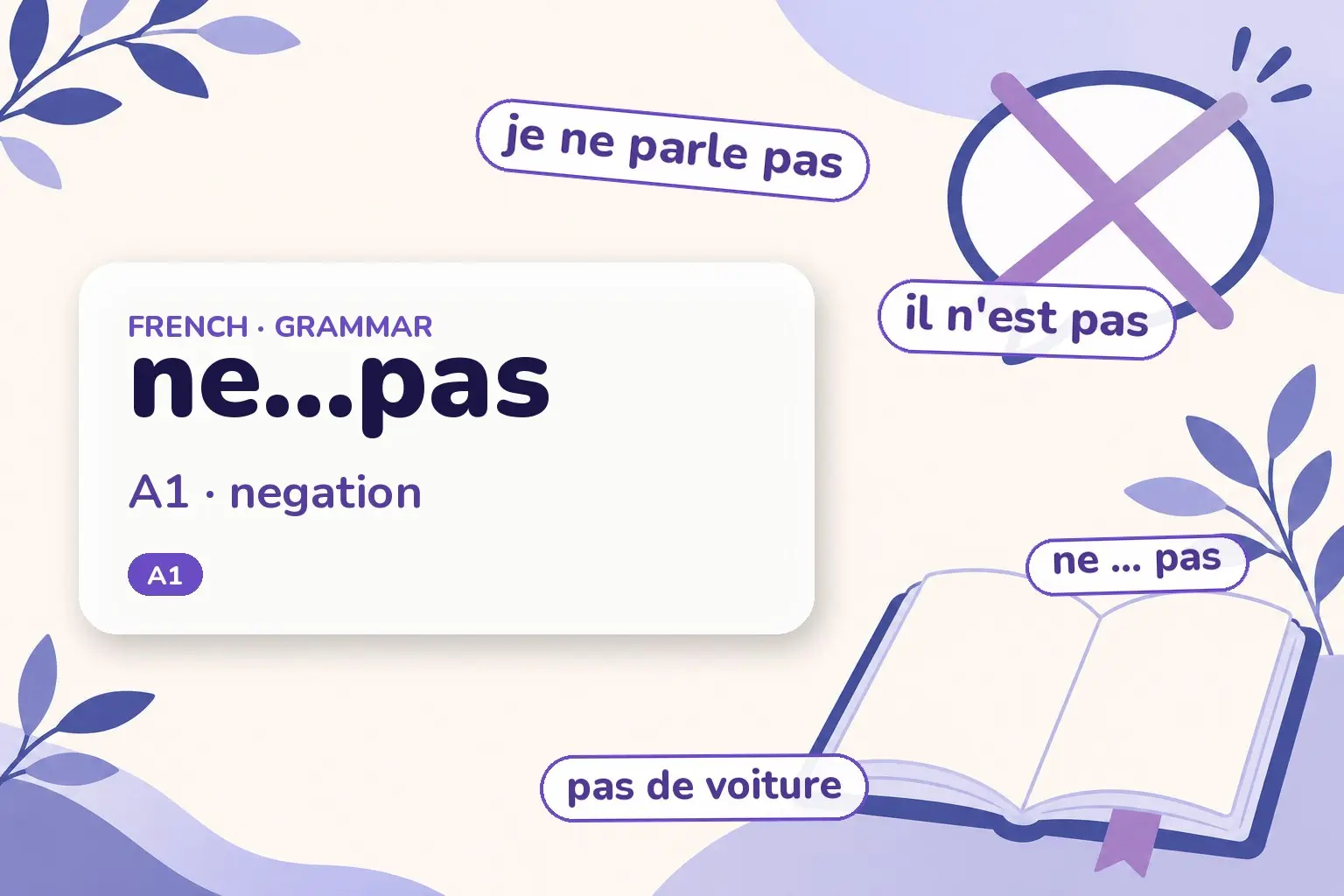
French makes a verb negative by wrapping it in ne ... pas: je parle (I speak) becomes je ne parle pas (I do not speak). Ne goes before the verb, pas after, and ne shortens to n' before a vowel.
Level: A1. To say not in French you need two little words, not one. You put ne in front of the verb and pas after it, and the verb sits in the middle: Je ne parle pas — “I do not speak”. Once you see the sandwich, every negative sentence works the same way.
The rule
A verb is the action or state word in a sentence (parle, speaks; est, is). To make it negative, French wraps it in a pair: ne goes directly before the verb and pas directly after it.
- Je parle. → Je ne parle pas. — I speak → I do not speak.
- Il mange. → Il ne mange pas. — He eats → He does not eat.
When the verb starts with a vowel or a silent h, ne loses its e and becomes n’ (this is called elision): Il n’est pas là (He is not there), Je n’aime pas ça (I do not like that).
In the compound past (the passé composé, made of a helper verb plus a past participle), the sandwich closes around the helper, not the participle: J’ai mangé (I ate) → Je n’ai pas mangé (I did not eat). The participle mangé stays outside, after pas.
One more rule trips up every beginner. After pas, the indefinite articles un, une, des and the partitive du, de la, de l’ all collapse into a single de (or d’ before a vowel): J’ai une voiture → Je n’ai pas de voiture (I do not have a car). The exception is the verb être (to be), which keeps its article: Ce n’est pas un livre (It is not a book).
Forms
| Positive | Negative | Meaning |
|---|---|---|
| je parle | je ne parle pas | I do not speak |
| tu finis | tu ne finis pas | you do not finish |
| il est là | il n’est pas là | he is not there |
| nous avons | nous n’avons pas | we do not have |
| j’ai mangé | je n’ai pas mangé | I did not eat |
| je vais sortir | je ne vais pas sortir | I am not going to go out |
| j’ai une voiture | je n’ai pas de voiture | I do not have a car |
How to say it
French spelling hides several of these sounds:
| Form | How to say it |
|---|---|
| ne | A soft “nuh” (/nə/), the e barely there; before a vowel it vanishes into n’, so je n’ai ≈ “zhuh nay”. |
| pas | “pah” — the final -s is silent; never say the “s”. |
| n’est | The n’ links straight onto est: il n’est pas ≈ “eel neh pah”. |
| de | “duh” (/də/), short and light: pas de pain ≈ “pah duh pan”. |
Example sentences
- Je ne parle pas anglais.I do not speak English.ne + verb + pas
- Il ne mange pas de viande.He does not eat meat.de la viande becomes de
- Nous ne sommes pas prêts.We are not ready.
- Tu ne travailles pas aujourd'hui ?You are not working today?
- Elle n'aime pas le café.She does not like coffee.n' before a vowel
- Je n'ai pas de voiture.I do not have a car.une becomes de after pas
- Ce n'est pas un problème.It is not a problem.être keeps un
- Ils ne regardent pas la télévision.They do not watch television.
- Vous ne comprenez pas la question ?You do not understand the question?
- Je n'ai pas mangé ce matin.I did not eat this morning.past: around the helper ai
- Nous n'avons pas fini.We have not finished.around avons
- Il n'est pas allé à l'école.He did not go to school.
- On ne va pas sortir ce soir.We are not going to go out tonight.around the helper va
- Je ne veux pas de dessert.I do not want any dessert.de after pas
- Ce ne sont pas mes clés.These are not my keys.
- Elle ne boit pas d'alcool.She does not drink alcohol.de becomes d' before a vowel
- Je ne sais pas.I do not know.the everyday phrase
- Pierre n'habite pas à Paris.Pierre does not live in Paris.
Common mistakes
- ❌ Je parle pas français (writing/exam) → ✅ Je ne parle pas français. In careful French you must keep ne; dropping it is spoken-only.
- ❌ Je ne pas parle. → ✅ Je ne parle pas. pas goes after the verb, never before it.
- ❌ Je n’ai pas mangé pas. → ✅ Je n’ai pas mangé. Use ne … pas once; in the past it wraps only the helper.
- ❌ Je n’ai pas une voiture. → ✅ Je n’ai pas de voiture. After pas, une becomes de.
- ❌ Il ne est pas là. → ✅ Il n’est pas là. Before a vowel, ne must elide to n’.
- ❌ Ce n’est pas de livre. → ✅ Ce n’est pas un livre. être keeps the article, so un stays.
A short conversation
— Tu **n’**es pas fatigué ? — Non, je ne suis pas fatigué, mais je **n’**ai pas faim. — On ne mange pas maintenant, alors.
Notice ne becomes n’ before the vowels in es, ai; and pas always follows the verb.
Usage notes
- ne elides, pas never does. ne → n’ before a vowel or silent h (n’est, n’habite), but pas keeps its full form everywhere.
- Spoken French drops ne. In relaxed speech you will hear Je sais pas, C’est pas grave. It is normal and understood, but write the ne in schoolwork, letters and the DELF exam.
- pas can stand without a verb. On its own it negates a word: Pas moi (Not me), Pas encore (Not yet), Pourquoi pas ? (Why not?).
- Answer “no” naturally. To disagree you often just say Non, then give the negative sentence: Non, je ne comprends pas.
Compared with…
- Other negatives swap out pas. Keep ne, but change the second word for a different meaning: ne … jamais (never), ne … plus (no longer), ne … rien (nothing), ne … personne (nobody). Je ne mange jamais de viande = “I never eat meat”. These share the same de-after-negation rule as ne … pas.
- ne … que is not really negative. Je n’ai qu’un euro means “I have only one euro”, not “I have no euro” — and the article does not become de here. Keep it separate from ne … pas.
- Before you negate, be sure of the positive forms first: review the regular -er verbs in the present, the verb être and the verb avoir. For the article that shrinks to de, see the partitive articles du, de la, des.
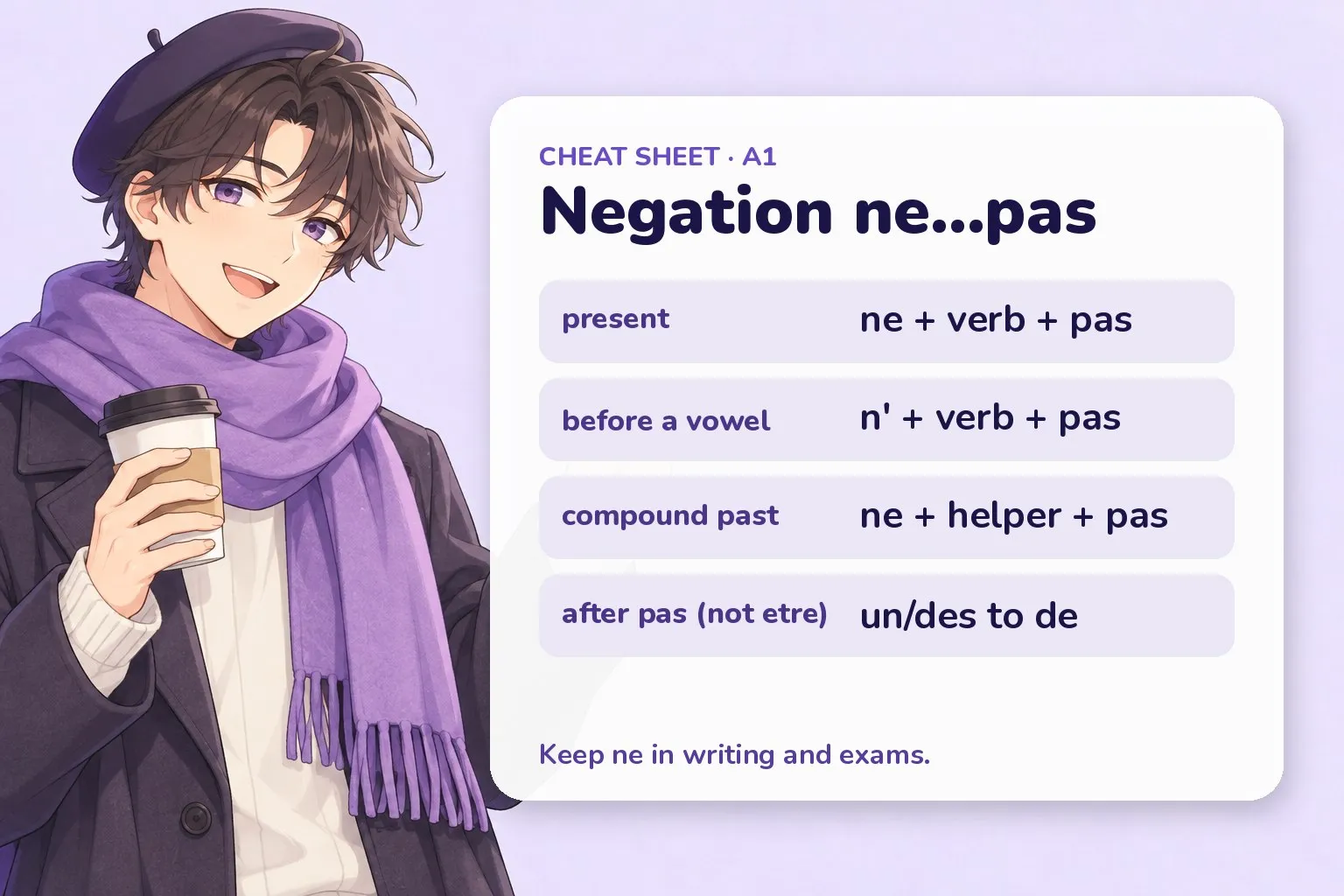
Quick recap before the quiz.
Practice
Negation practice
Try each one, then press Check. No sign-up, nothing is sent anywhere — it all runs in your browser.
Hint: ne before a vowel
Show answer
n' — ne elides to n' before a vowel: Il n'est pas là.
3 Build the past negative: 'I did not eat.'
Show answer
Je n'ai pas mangé — In the passé composé, ne...pas wraps the helper: Je n'ai pas mangé.
4 Match each positive to its negative.
- Je parle.
- Il est là.
- J'ai une voiture.
- C'est un livre.
Show answer
- Je parle. → Je ne parle pas.
- Il est là. → Il n'est pas là.
- J'ai une voiture. → Je n'ai pas de voiture.
- C'est un livre. → Ce n'est pas un livre.
The verb wraps in ne...pas; un/une become de except after être.
Quiz
French negation ne...pas
13 questions · pick an answer and you'll see straight away if it's right.
-
Show answer
ne … pas — Basic negation is ne … pas.
-
Show answer
after the verb — pas follows the verb; ne comes before it.
-
Show answer
Il ne mange pas. — Il ne mange pas.
-
Show answer
n' — ne elides to n': il n'est pas.
-
Show answer
the helper (auxiliary) verb — Around the helper: je n'ai pas mangé.
-
Show answer
Je n'ai pas mangé. — Je n'ai pas mangé — ne...pas around ai.
-
Show answer
pas de voiture — un/une/des/du/de la become de after pas.
-
Show answer
être — être keeps it: ce n'est pas un livre.
-
Show answer
n' — Elle n'aime pas le café — ne elides to n'.
-
Show answer
Je sais pas. — Dropping ne (Je sais pas) is casual speech; keep ne in writing.
-
Show answer
Il ne mange pas de viande. — de after pas: Il ne mange pas de viande.
-
Show answer
never — Swap pas for jamais to mean 'never'.
-
Show answer
ne pas — Je ne parle pas français.
Recap cheat-sheet
| Situation | Pattern | Example |
|---|---|---|
| present verb | ne + verb + pas | je ne parle pas |
| before a vowel | n’ + verb + pas | il n’est pas |
| compound past | ne + helper + pas + participle | je n’ai pas mangé |
| after pas (not être) | un/une/des/du to de | pas de voiture |
| spoken only | drop ne | je sais pas |
Next
- Next grammar point: other negatives (ne…jamais, ne…plus, ne…rien)
- Back to the French grammar section
- New here? Start with Start Learning French Here
All French grammar topics
Every grammar point in order, from your first sentence to advanced structures. Pick one and go straight to it. New lessons go live every day, so topics marked Coming soon fill in over the next weeks.
Grammar path
A1 32 topics · 14 ready
- 01 Definite Articles: le, la, les, l'
- 02 Indefinite Articles: un, une, des
- 03 Partitive Articles: du, de la, des
- 04 Noun Gender in French
- 05 Forming Plurals in French
- 06 Subject Pronouns (je, tu, il, nous, vous)
- 07 The Verb Être (To Be) - Present
- 08 The Verb Avoir (To Have) - Present
- 09 Present Tense: -ER Verbs
- 10 Present Tense: -IR Verbs (finir)
- 11 Present Tense: -RE Verbs (vendre)
- 12 Aller + Near Future (futur proche)
- 13 The Verb Faire (To Do/Make)
- 14 Negation: ne...pas You are here
- 15 Asking Questions (est-ce que, inversion) Coming soon
- 16 Adjective Agreement (Gender & Number) Coming soon
- 17 Position of Adjectives (BAGS) Coming soon
- 18 Possessive Adjectives (mon, ma, mes) Coming soon
- 19 Demonstrative Adjectives (ce, cette, ces) Coming soon
- 20 C'est vs Il/Elle Est Coming soon
- 21 Il Y A (There Is / There Are) Coming soon
- 22 Contractions: au, aux, du, des (à/de + le) Coming soon
- 23 Question Words (qui, que, où, quand, comment) Coming soon
- 24 Vouloir, Pouvoir, Devoir (Present) Coming soon
- 25 Aimer / Préférer + Infinitive (Preferences) Coming soon
- 26 Pronominal (Reflexive) Verbs - Present Coming soon
- 27 The Imperative (Commands) Coming soon
- 28 Venir and Venir De (Recent Past) Coming soon
- 29 Prepositions with Places (à, en, au, aux) Coming soon
- 30 Expressions with Avoir (avoir faim, avoir 20 ans) Coming soon
- 31 Prepositions of Time (à, en, dans, depuis) Coming soon
- 32 Weather & Impersonal Expressions (il fait, il pleut) Coming soon
A2 26 topics
- 33 Passé Composé with Avoir Coming soon
- 34 Passé Composé with Être (+ agreement) Coming soon
- 35 The Imperfect Tense (imparfait) Coming soon
- 36 Passé Composé vs Imparfait Coming soon
- 37 The Simple Future (futur simple) Coming soon
- 38 Direct Object Pronouns (le, la, les) Coming soon
- 39 Indirect Object Pronouns (lui, leur) Coming soon
- 40 The Pronoun Y Coming soon
- 41 The Pronoun En Coming soon
- 42 Comparatives (plus, moins, aussi ... que) Coming soon
- 43 Superlatives (le plus, le moins) Coming soon
- 44 Forming Adverbs in -ment Coming soon
- 45 Depuis, Pendant, Il Y A, Pour (Time) Coming soon
- 46 Partitive & Articles in the Negative (de) Coming soon
- 47 Expressions of Quantity (beaucoup de, trop de) Coming soon
- 48 Pronominal Verbs in Passé Composé Coming soon
- 49 Stressed (Disjunctive) Pronouns (moi, toi, lui) Coming soon
- 50 Possessive Pronouns (le mien, la tienne) Coming soon
- 51 Object Pronoun Placement & Order Coming soon
- 52 Adverb Position in French Coming soon
- 53 Savoir vs Connaître (Two Ways to Know) Coming soon
- 54 Il Faut + Infinitive (Necessity) Coming soon
- 55 Verbs + à / de + Infinitive Coming soon
- 56 Comparing Quantities (plus de ... que) Coming soon
- 57 Adverbs of Frequency (souvent, toujours, jamais) Coming soon
- 58 Quel in Exclamations (Quel beau jour!) Coming soon
B1 24 topics
- 59 The Present Conditional Coming soon
- 60 The Present Subjunctive: Formation Coming soon
- 61 Subjunctive After Will & Necessity (il faut que) Coming soon
- 62 Subjunctive After Emotion & Opinion Coming soon
- 63 The Pluperfect (plus-que-parfait) Coming soon
- 64 The Future Perfect (futur antérieur) Coming soon
- 65 The Past Conditional (conditionnel passé) Coming soon
- 66 Si Clauses (Conditional Sentences) Coming soon
- 67 Relative Pronouns: qui, que, où, dont Coming soon
- 68 Order of Double Object Pronouns Coming soon
- 69 The Gérondif (en + -ant) Coming soon
- 70 The Present Participle (-ant) Coming soon
- 71 Reported Speech (discours indirect) Coming soon
- 72 Irregular Comparatives (meilleur, pire, mieux) Coming soon
- 73 Demonstrative Pronouns (celui, celle, ceux) Coming soon
- 74 The Causative Faire (faire faire) Coming soon
- 75 Depuis Que & Time Conjunctions Coming soon
- 76 Être en Train de / Sur le Point de Coming soon
- 77 Varied Negations (ne...jamais/rien/personne/plus) Coming soon
- 78 Y and En with Verbs (penser à / parler de) Coming soon
- 79 The Past Infinitive (après avoir fait) Coming soon
- 80 Tout: Adjective, Pronoun and Adverb Coming soon
- 81 Types of Pronominal Verbs (reflexive, reciprocal, idiomatic) Coming soon
- 82 Expressing Opinion (à mon avis, trouver que) Coming soon
B2 20 topics
- 83 The Past Subjunctive (subjonctif passé) Coming soon
- 84 Subjunctive After Conjunctions (bien que, pour que) Coming soon
- 85 Subjunctive vs Indicative (penser que, espérer) Coming soon
- 86 Sequence of Tenses (concordance des temps) Coming soon
- 87 The Passé Simple (Recognition) Coming soon
- 88 The Passive Voice (voix passive) Coming soon
- 89 Reported Speech in the Past Coming soon
- 90 Compound Relatives (lequel, auquel, duquel) Coming soon
- 91 Past Participle Agreement with Avoir Coming soon
- 92 Participle Agreement: Pronominal Verbs Coming soon
- 93 Expressing Opposition & Concession (bien que, malgré) Coming soon
- 94 Expressing Cause (parce que, puisque, comme, car) Coming soon
- 95 Expressing Consequence (donc, si bien que, tellement) Coming soon
- 96 Expressing Purpose (pour que, afin de, de peur que) Coming soon
- 97 Highlighting: C'est...qui / C'est...que Coming soon
- 98 Indefinite Adjectives (tout, chaque, quelques) Coming soon
- 99 Indefinite Pronouns (quelqu'un, chacun, certains) Coming soon
- 100 Verbs + Preposition + Noun (penser à, dépendre de) Coming soon
- 101 Verbs of Perception + Infinitive (je le vois arriver) Coming soon
- 102 When to Omit the Article Coming soon
C1 14 topics
- 103 The Imperfect Subjunctive (Literary) Coming soon
- 104 The Passé Antérieur (Literary) Coming soon
- 105 Sequence of Tenses with the Subjunctive Coming soon
- 106 The Expletive Ne (ne explétif) Coming soon
- 107 Restriction & Only (ne...que, ne faire que) Coming soon
- 108 Stylistic & Interrogative Inversion Coming soon
- 109 Advanced Logical Connectors (néanmoins, en revanche) Coming soon
- 110 Nominalisation (Formal/Press Style) Coming soon
- 111 Advanced Hypothesis (au cas où, à moins que) Coming soon
- 112 The Pronominal Passive (se + verb) Coming soon
- 113 Subjunctive in Relative Clauses (le seul qui...) Coming soon
- 114 Absolute & Participial Constructions (Le travail terminé) Coming soon
- 115 Registers: Soutenu, Courant, Familier Coming soon
- 116 Proportional & Advanced Comparison (plus...plus) Coming soon