French Present Tense: -IR Verbs (finir)
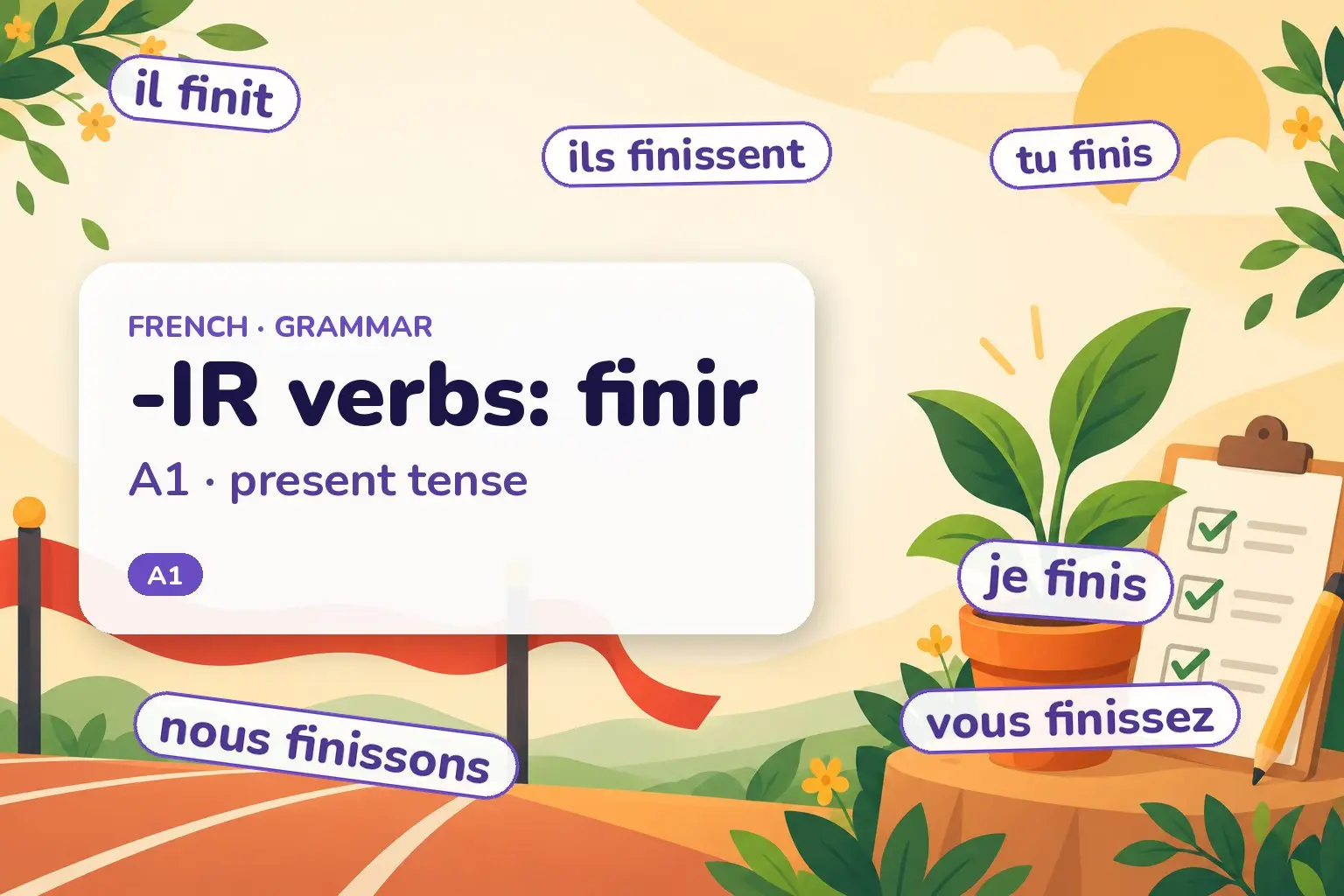
Regular French -IR verbs follow the finir pattern: drop -ir and add -is, -is, -it, -issons, -issez, -issent. So finir ('to finish') gives je finis, tu finis, il finit, nous finissons, vous finissez, ils finissent. The plural forms add an audible -iss-.
Level: A1. After the big -ER group, the next regular family is the -IR verbs built on finir (“to finish”). They are fewer, but very common, and they add one memorable twist: an extra -iss- appears in all three plural forms. Once you hear that -iss-, you have spotted the group.
The rule
A verb is a word for an action or state; its infinitive is the dictionary form (here ending in -ir). To conjugate a regular -IR verb in the present, take two steps:
- Find the stem. Drop the -ir from the infinitive. From finir the stem is fin-.
- Add the present ending for the subject: -is, -is, -it, -issons, -issez, -issent.
So finir becomes je finis, tu finis, il/elle finit, nous finissons, vous finissez, ils/elles finissent. The singular endings are short; the plural endings all carry the sound -iss-, which you actually hear.
The forms (finir, “to finish”)
| Subject | Form | Ending | Said as |
|---|---|---|---|
| je | finis | -is | “fee-NEE” (silent -s) |
| tu | finis | -is | “fee-NEE” (silent -s) |
| il / elle / on | finit | -it | “fee-NEE” (silent -t) |
| nous | finissons | -issons | “fee-nee-SON” |
| vous | finissez | -issez | “fee-nee-SAY” |
| ils / elles | finissent | -issent | “fee-NEES” (the -iss- is heard) |
How to say it
French spelling hides some of these endings; mind the sounds:
| Sound | How to say it |
|---|---|
| -is / -it (singular) | The final -s and -t are silent: finis, finit = “fee-NEE”. Do not pronounce the consonant. |
| -issent | Say the -iss- but drop the final -ent: finissent = “fee-NEES”, never “fee-nee-SONT”. |
| -issons / -issez | “ee-SON” (nasal) and “ee-SAY”: finissons = “fee-nee-SON”, finissez = “fee-nee-SAY”. |
| i | The French i is a tight “ee”, not the English “ih”: finir = “fee-NEER”. |
Example sentences
- Je finis mes devoirs.I finish my homework.
- Tu finis à quelle heure ?What time do you finish?
- Il finit son café.He finishes his coffee.-it is silent: 'fee-NEE'
- Nous finissons le travail.We finish the work.plural -iss- is heard
- Vous finissez tôt aujourd'hui.You finish early today.
- Ils finissent le match.They finish the match.'fee-NEES'
- Je choisis un dessert.I choose a dessert.choisir, same pattern
- Elle grandit vite.She is growing fast.grandir = to grow
- Les enfants grandissent.The children are growing.
- Nous réussissons l'examen.We pass the exam.réussir = to succeed
- Tu obéis à tes parents.You obey your parents.obéir à
- Vous choisissez le menu.You choose the menu.
- Je réfléchis à la question.I'm thinking about the question.réfléchir = to think over
- On finit dans dix minutes.We finish in ten minutes.on takes the il/elle form
- Elles rougissent un peu.They blush a little.
- Le gâteau refroidit.The cake is cooling down.refroidir
- Nous remplissons le formulaire.We fill in the form.remplir = to fill
Common mistakes
- ❌ nous finons → ✅ nous finissons. The plural keeps the -iss-; dropping it is the classic -IR error.
- ❌ ils finent → ✅ ils finissent. Third-person plural is -issent, said “fee-NEES”, not “finn”.
- ❌ je finisse → ✅ je finis. The -isse spelling is the subjunctive; the plain present “I finish” is je finis.
- ❌ je partis for “I leave” → ✅ je pars. partir ends in -ir but is irregular; it does not take -iss-.
- ❌ pronouncing the -s/-t of finis / finit → ✅ keep them silent (“fee-NEE”). Only the plural -iss- is sounded.
A short conversation
A: Tu finis à quelle heure ? — What time do you finish? B: Je finis à six heures. Et après, nous choisissons un film. — I finish at six. And after, we choose a film. A: D’accord, on réfléchit et on décide. — OK, we’ll think it over and decide.
Usage notes
- The present covers “I finish” and “I am finishing”. French has one present tense: je finis is both.
- on = “we” in speech. On finit takes the il/elle ending -it, even though it means “we finish”.
- Many -IR regulars describe change. grandir (grow), vieillir (age), maigrir/grossir (lose/gain weight), rougir (blush), refroidir (cool) — all follow finir.
- Watch the preposition. Some take one: obéir à (to obey), réfléchir à (to think about), réussir à (to succeed in).
Compared with…
- -ER verbs (the parler group) add -e, -es, -e, -ons, -ez, -ent and have no -iss-. If you are unsure which family a verb is in, start by reviewing regular -ER verbs.
- -RE verbs (like vendre) are the third regular family, dropping -re and adding -s, -s, —, -ons, -ez, -ent. They are covered separately in the French grammar section.
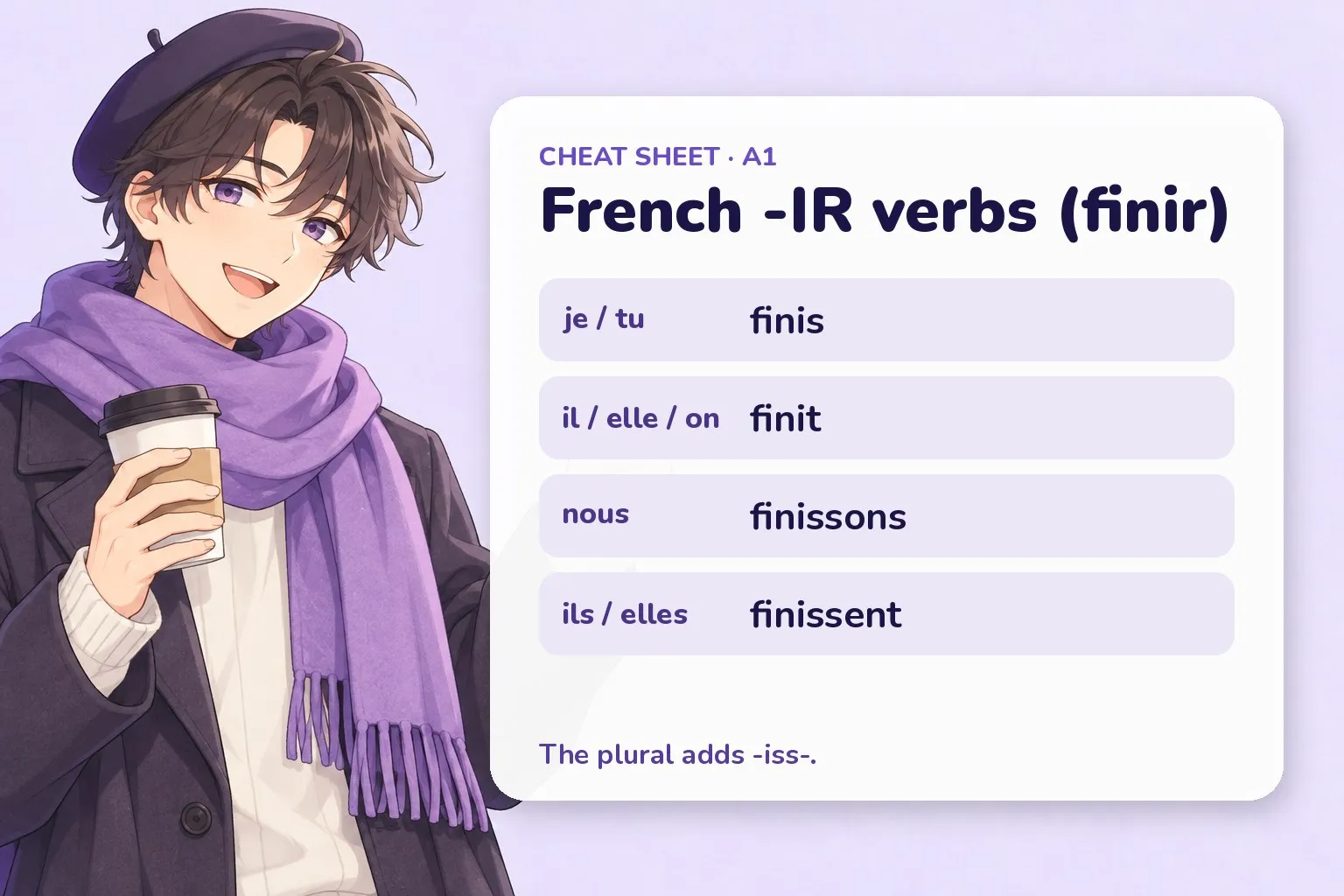
Quick recap before you practise.
Practice
French -IR verbs present practice
Try each one, then press Check. No sign-up, nothing is sent anywhere — it all runs in your browser.
Hint: je form, singular -is
Show answer
choisis — je choisis: stem chois- + -is.
Hint: ils/elles ending, with -iss-
Show answer
grandissent — ils/elles grandissent: plural keeps -iss-.
4 Order the words: 'They finish the match.'
Show answer
Ils finissent le match — Ils finissent le match. The -iss- is heard, the -ent is silent.
5 Match each subject to the ending of a regular -IR verb.
- je
- il / elle / on
- nous
- ils / elles
Show answer
- je → -is
- il / elle / on → -it
- nous → -issons
- ils / elles → -issent
je -is, tu -is, il -it, nous -issons, vous -issez, ils -issent.
Quiz
French -IR verbs present quiz
11 questions · pick an answer and you'll see straight away if it's right.
-
Show answer
drop -ir to get the stem — Drop -ir from the infinitive (finir → fin-).
-
Show answer
-is, -is, -it, -issons, -issez, -issent — Regular -IR verbs take -is, -is, -it, -issons, -issez, -issent.
-
Show answer
finissons — nous → -issons: nous finissons.
-
Show answer
finit — il/elle → -it: il finit (said 'fee-NEE').
-
Show answer
je finis, tu finis, il finit — The singular -is, -is, -it are all silent at the end: 'fee-NEE'.
-
Show answer
'fee-NEES' (the -iss- is heard, -ent silent) — Say the -iss- and drop the -ent: 'fee-NEES'.
-
Show answer
choisir — choisir follows finir: je choisis, nous choisissons. partir/dormir/sortir are irregular.
-
Show answer
réfléchis — je → -is: je réfléchis.
-
Show answer
choisissez — vous → -issez: vous choisissez.
-
Show answer
the plural must keep the -iss-: nous finissons — Regular -IR plurals add -iss-: nous finissons.
-
Show answer
réussissons — nous → -issons: nous réussissons.
Recap cheat-sheet
| Subject | Ending | finir |
|---|---|---|
| je | -is | finis |
| tu | -is | finis |
| il / elle / on | -it | finit |
| nous | -issons | finissons |
| vous | -issez | finissez |
| ils / elles | -issent | finissent |
Next
- Compare the biggest group: regular -ER verbs
- Learn the key irregulars: être in the present and avoir in the present
- Back to the French grammar section
All French grammar topics
Every grammar point in order, from your first sentence to advanced structures. Pick one and go straight to it. New lessons go live every day, so topics marked Coming soon fill in over the next weeks.
Grammar path
A1 32 topics · 12 ready
- 01 Definite Articles: le, la, les, l'
- 02 Indefinite Articles: un, une, des
- 03 Partitive Articles: du, de la, des
- 04 Noun Gender in French
- 05 Forming Plurals in French
- 06 Subject Pronouns (je, tu, il, nous, vous)
- 07 The Verb Être (To Be) - Present
- 08 The Verb Avoir (To Have) - Present
- 09 Present Tense: -ER Verbs
- 10 Present Tense: -IR Verbs (finir) You are here
- 11 Present Tense: -RE Verbs (vendre)
- 12 Aller + Near Future (futur proche)
- 13 The Verb Faire (To Do/Make) Coming soon
- 14 Negation: ne...pas Coming soon
- 15 Asking Questions (est-ce que, inversion) Coming soon
- 16 Adjective Agreement (Gender & Number) Coming soon
- 17 Position of Adjectives (BAGS) Coming soon
- 18 Possessive Adjectives (mon, ma, mes) Coming soon
- 19 Demonstrative Adjectives (ce, cette, ces) Coming soon
- 20 C'est vs Il/Elle Est Coming soon
- 21 Il Y A (There Is / There Are) Coming soon
- 22 Contractions: au, aux, du, des (à/de + le) Coming soon
- 23 Question Words (qui, que, où, quand, comment) Coming soon
- 24 Vouloir, Pouvoir, Devoir (Present) Coming soon
- 25 Aimer / Préférer + Infinitive (Preferences) Coming soon
- 26 Pronominal (Reflexive) Verbs - Present Coming soon
- 27 The Imperative (Commands) Coming soon
- 28 Venir and Venir De (Recent Past) Coming soon
- 29 Prepositions with Places (à, en, au, aux) Coming soon
- 30 Expressions with Avoir (avoir faim, avoir 20 ans) Coming soon
- 31 Prepositions of Time (à, en, dans, depuis) Coming soon
- 32 Weather & Impersonal Expressions (il fait, il pleut) Coming soon
A2 26 topics
- 33 Passé Composé with Avoir Coming soon
- 34 Passé Composé with Être (+ agreement) Coming soon
- 35 The Imperfect Tense (imparfait) Coming soon
- 36 Passé Composé vs Imparfait Coming soon
- 37 The Simple Future (futur simple) Coming soon
- 38 Direct Object Pronouns (le, la, les) Coming soon
- 39 Indirect Object Pronouns (lui, leur) Coming soon
- 40 The Pronoun Y Coming soon
- 41 The Pronoun En Coming soon
- 42 Comparatives (plus, moins, aussi ... que) Coming soon
- 43 Superlatives (le plus, le moins) Coming soon
- 44 Forming Adverbs in -ment Coming soon
- 45 Depuis, Pendant, Il Y A, Pour (Time) Coming soon
- 46 Partitive & Articles in the Negative (de) Coming soon
- 47 Expressions of Quantity (beaucoup de, trop de) Coming soon
- 48 Pronominal Verbs in Passé Composé Coming soon
- 49 Stressed (Disjunctive) Pronouns (moi, toi, lui) Coming soon
- 50 Possessive Pronouns (le mien, la tienne) Coming soon
- 51 Object Pronoun Placement & Order Coming soon
- 52 Adverb Position in French Coming soon
- 53 Savoir vs Connaître (Two Ways to Know) Coming soon
- 54 Il Faut + Infinitive (Necessity) Coming soon
- 55 Verbs + à / de + Infinitive Coming soon
- 56 Comparing Quantities (plus de ... que) Coming soon
- 57 Adverbs of Frequency (souvent, toujours, jamais) Coming soon
- 58 Quel in Exclamations (Quel beau jour!) Coming soon
B1 24 topics
- 59 The Present Conditional Coming soon
- 60 The Present Subjunctive: Formation Coming soon
- 61 Subjunctive After Will & Necessity (il faut que) Coming soon
- 62 Subjunctive After Emotion & Opinion Coming soon
- 63 The Pluperfect (plus-que-parfait) Coming soon
- 64 The Future Perfect (futur antérieur) Coming soon
- 65 The Past Conditional (conditionnel passé) Coming soon
- 66 Si Clauses (Conditional Sentences) Coming soon
- 67 Relative Pronouns: qui, que, où, dont Coming soon
- 68 Order of Double Object Pronouns Coming soon
- 69 The Gérondif (en + -ant) Coming soon
- 70 The Present Participle (-ant) Coming soon
- 71 Reported Speech (discours indirect) Coming soon
- 72 Irregular Comparatives (meilleur, pire, mieux) Coming soon
- 73 Demonstrative Pronouns (celui, celle, ceux) Coming soon
- 74 The Causative Faire (faire faire) Coming soon
- 75 Depuis Que & Time Conjunctions Coming soon
- 76 Être en Train de / Sur le Point de Coming soon
- 77 Varied Negations (ne...jamais/rien/personne/plus) Coming soon
- 78 Y and En with Verbs (penser à / parler de) Coming soon
- 79 The Past Infinitive (après avoir fait) Coming soon
- 80 Tout: Adjective, Pronoun and Adverb Coming soon
- 81 Types of Pronominal Verbs (reflexive, reciprocal, idiomatic) Coming soon
- 82 Expressing Opinion (à mon avis, trouver que) Coming soon
B2 20 topics
- 83 The Past Subjunctive (subjonctif passé) Coming soon
- 84 Subjunctive After Conjunctions (bien que, pour que) Coming soon
- 85 Subjunctive vs Indicative (penser que, espérer) Coming soon
- 86 Sequence of Tenses (concordance des temps) Coming soon
- 87 The Passé Simple (Recognition) Coming soon
- 88 The Passive Voice (voix passive) Coming soon
- 89 Reported Speech in the Past Coming soon
- 90 Compound Relatives (lequel, auquel, duquel) Coming soon
- 91 Past Participle Agreement with Avoir Coming soon
- 92 Participle Agreement: Pronominal Verbs Coming soon
- 93 Expressing Opposition & Concession (bien que, malgré) Coming soon
- 94 Expressing Cause (parce que, puisque, comme, car) Coming soon
- 95 Expressing Consequence (donc, si bien que, tellement) Coming soon
- 96 Expressing Purpose (pour que, afin de, de peur que) Coming soon
- 97 Highlighting: C'est...qui / C'est...que Coming soon
- 98 Indefinite Adjectives (tout, chaque, quelques) Coming soon
- 99 Indefinite Pronouns (quelqu'un, chacun, certains) Coming soon
- 100 Verbs + Preposition + Noun (penser à, dépendre de) Coming soon
- 101 Verbs of Perception + Infinitive (je le vois arriver) Coming soon
- 102 When to Omit the Article Coming soon
C1 14 topics
- 103 The Imperfect Subjunctive (Literary) Coming soon
- 104 The Passé Antérieur (Literary) Coming soon
- 105 Sequence of Tenses with the Subjunctive Coming soon
- 106 The Expletive Ne (ne explétif) Coming soon
- 107 Restriction & Only (ne...que, ne faire que) Coming soon
- 108 Stylistic & Interrogative Inversion Coming soon
- 109 Advanced Logical Connectors (néanmoins, en revanche) Coming soon
- 110 Nominalisation (Formal/Press Style) Coming soon
- 111 Advanced Hypothesis (au cas où, à moins que) Coming soon
- 112 The Pronominal Passive (se + verb) Coming soon
- 113 Subjunctive in Relative Clauses (le seul qui...) Coming soon
- 114 Absolute & Participial Constructions (Le travail terminé) Coming soon
- 115 Registers: Soutenu, Courant, Familier Coming soon
- 116 Proportional & Advanced Comparison (plus...plus) Coming soon