Definite Articles: le, la, les, l'
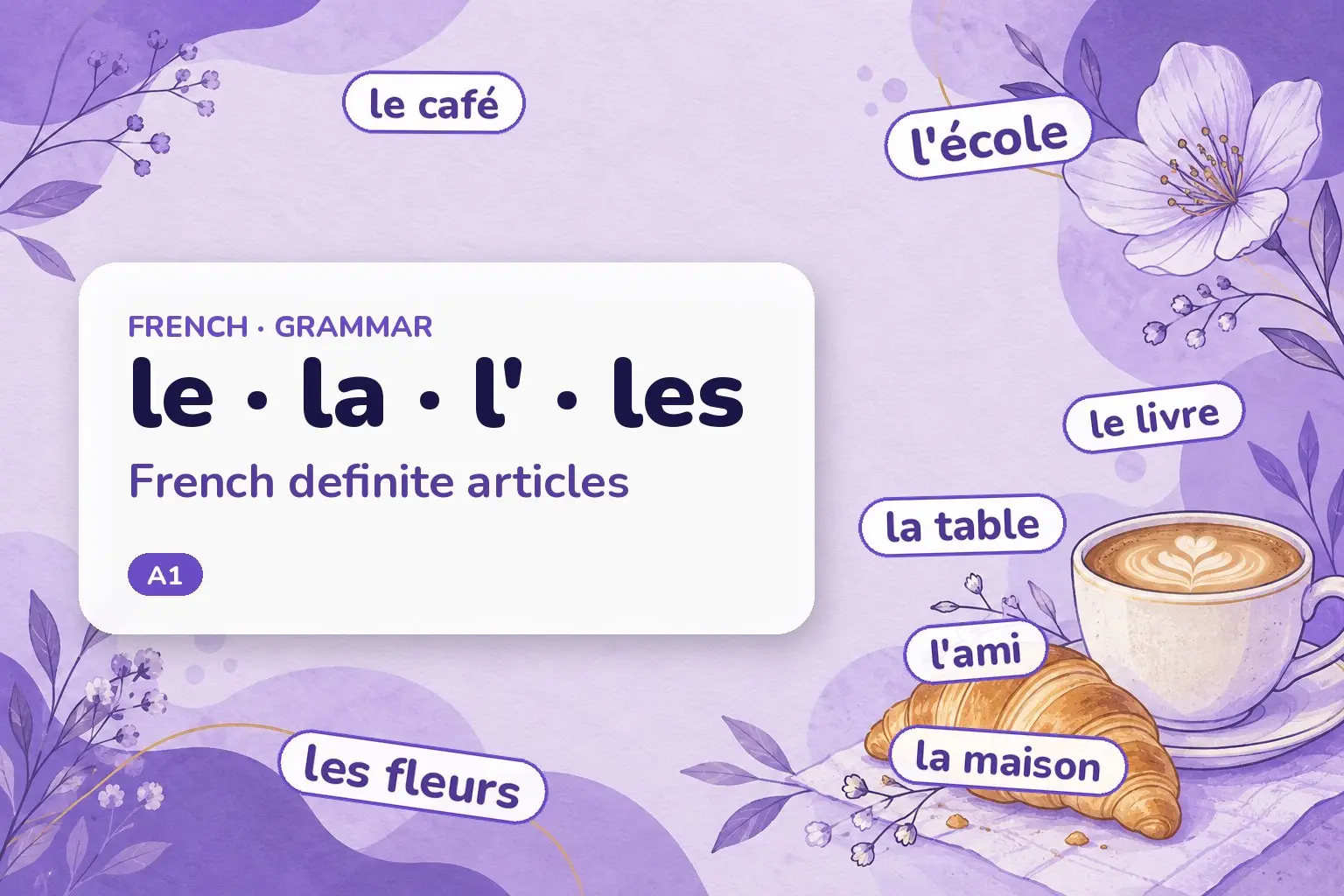
French has four forms of 'the': le (masculine singular), la (feminine singular), les (plural, both genders), and l' before a word starting with a vowel or silent h. So you say le livre, la table, les livres, and l'ami. French also uses the definite article for general statements — 'J'aime le café' means 'I like coffee.'
Level: A1. French has four forms of the definite article — le, la, l’ and les — all meaning “the”. Get the four forms right and your French immediately sounds more natural, because the article appears very often.
The rule
A definite article means “the” — a specific, known thing. In French it agrees with the noun’s gender (masculine/feminine) and number (singular/plural):
- le — masculine singular: le livre (the book).
- la — feminine singular: la table (the table).
- l’ — before a vowel or a mute h, singular: l’ami, l’école, l’homme.
- les — plural, both genders: les livres, les tables.
The change from le/la to l’ before a vowel is called elision. It is the normal rule, with a few fixed exceptions (for example le onze, le huit, and le un when un names the digit itself, as in le un de ce numéro). Words starting with a consonant /j/ sound, such as le yaourt, also keep le/la.
The forms at a glance
| Masculine | Feminine | Before vowel / mute h | Plural | |
|---|---|---|---|---|
| “the” | le livre | la table | l’ami, l’école | les livres / les tables |
Example sentences
Each sentence was written for this lesson (not copied from a third-party corpus).
- Le livre est sur la table. — The book is on the table.
- La maison est grande. — The house is big.
- **L’**ami de Marie est ici. — Marie’s friend is here.
- **L’**école est fermée. — The school is closed.
- Les enfants sont à la maison. — The children are at home.
- Le chat dort. — The cat is sleeping.
- La voiture est rouge. — The car is red.
- **L’**homme parle français. — The man speaks French. (mute h)
- Les fleurs sont belles. — The flowers are beautiful.
- J’aime le café. — I like coffee. (general statement)
- Les chiens aiment courir. — Dogs like to run. (general)
- La liberté est importante. — Freedom is important. (abstract idea)
Common mistakes
- ❌ le école → ✅ l’école. Elide le/la to l’ before a vowel.
- ❌ la ami → ✅ l’ami.
- ❌ le hôtel → ✅ l’hôtel. The h in hôtel is mute, so elision applies.
- ❌ I like coffee = J’aime café → ✅ J’aime le café. French needs the article for general statements.
- ❌ la livre → ✅ le livre. Livre (book) is masculine; match the gender.
A handful of words begin with an aspirated h and block elision: le héros (the hero), le haricot (the bean) — not l’héros. A few special words starting with a written vowel also block it, notably le onze; and yaourt starts with a /j/ consonant sound, so it is le yaourt.
Compared with…
- Indefinite articles (un, une, des) — “a / some”, for things not yet specified.
- Partitive articles (du, de la, de l’, des) — “some” of an uncountable thing (e.g. de l’eau).
- Contractions au (à + le), aux (à + les), du (de + le) and des (de + les). Note des can also be a plural indefinite/partitive article.
These are listed in the French grammar section.
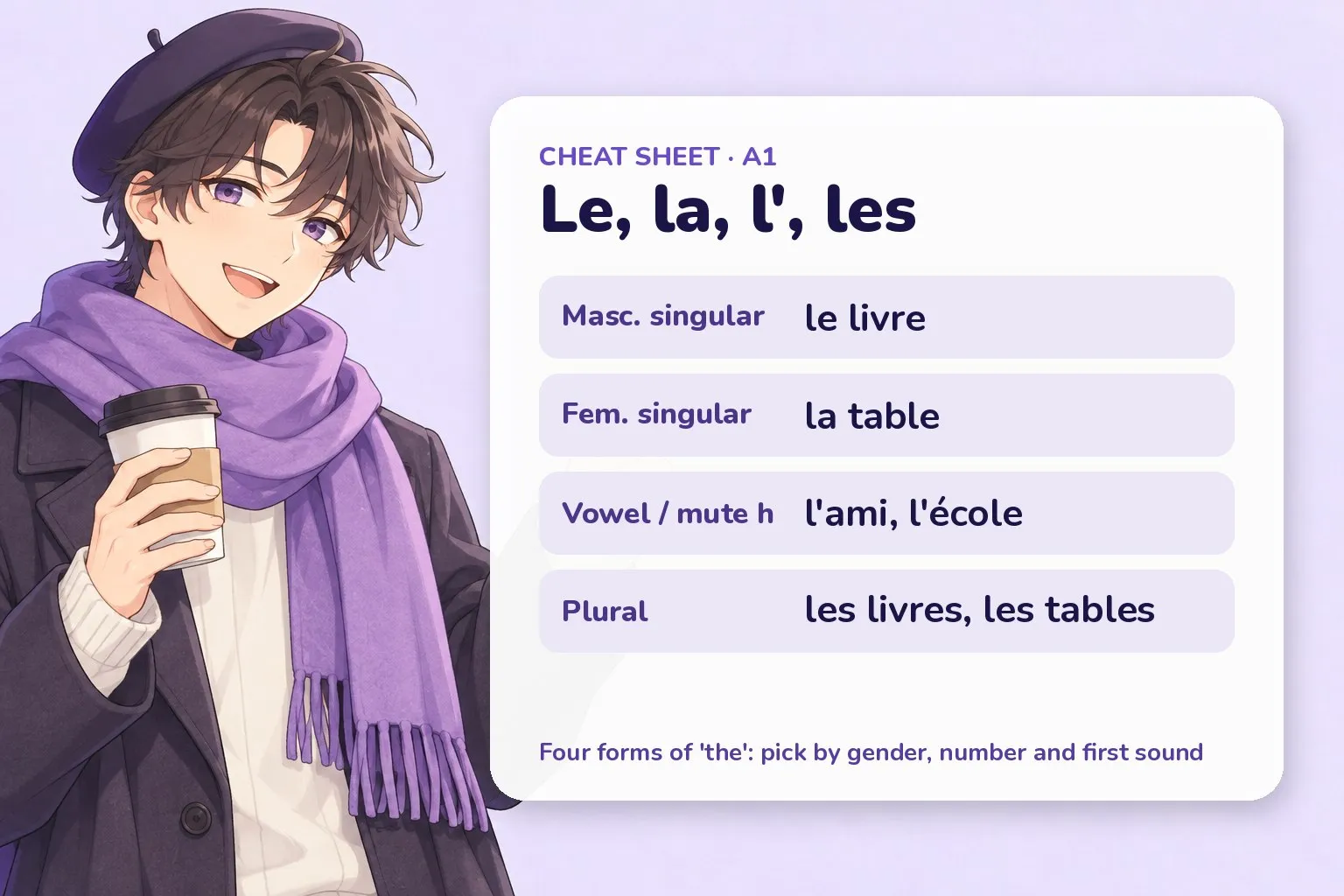
Quick recap before the quiz.
Mini quiz
- ___ livre (masculine)
- ___ école (feminine, vowel)
- ___ enfants (plural)
- J’aime ___ chocolat. (general)
- ___ voiture (feminine)
Answers
- le — masculine singular.
- l’ — elision before a vowel (l’école).
- les — plural.
- le — definite article for a general statement.
- la — feminine singular.
Sources & licensing
- Article forms cross-checked with Wiktionary (CC BY-SA 4.0).
- This topic sits at beginner level (A1) in common course sequencing; the CEFR and DELF frameworks are used as general references, not as a topic-by-topic level ruling.
- Example sentences were written for this lesson; no third-party sentences were copied.
Next
- Back to the French grammar section
- New here? Start with Start Learning French Here
Sources
- French articles (le, la, les) — Wiktionary (CC BY-SA 4.0) (as of October 2026)
- DELF/DALF level descriptors — France Éducation International (as of October 2026)
- CEFR level descriptions (A1) — Council of Europe (as of October 2026)