French Present Tense: Regular -ER Verbs
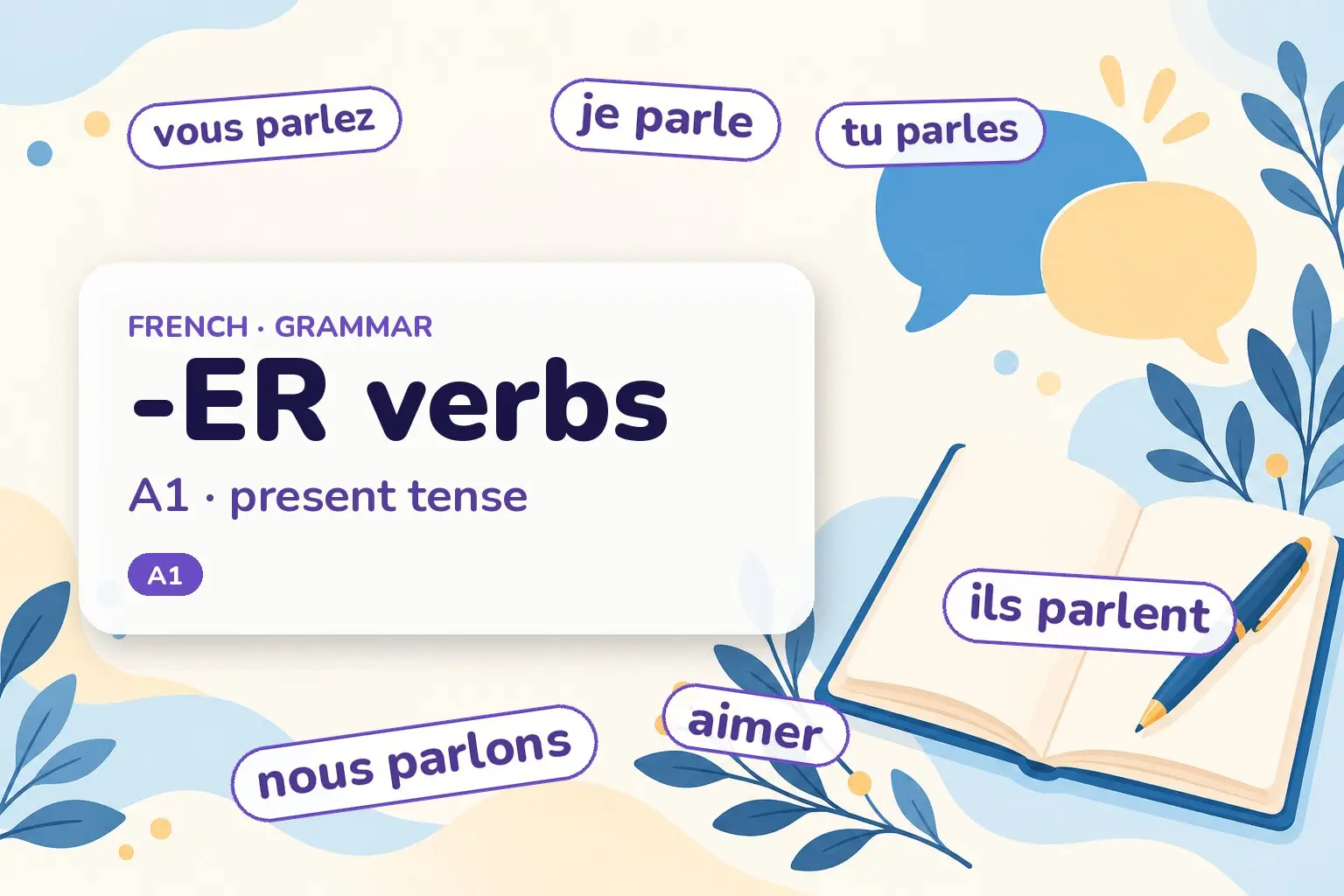
Regular French -ER verbs follow one pattern: drop -er and add -e, -es, -e, -ons, -ez, -ent. So parler ('to speak') gives je parle, tu parles, il parle, nous parlons, vous parlez, ils parlent. The -e, -es and -ent endings are all silent.
Level: A1. Most French verbs end in -er (parler, aimer, habiter), and they nearly all conjugate the same way in the present tense. Learn this one set of endings and you can speak about thousands of everyday actions. The twist for English speakers is in the sound, not the spelling: three of the six endings are completely silent.
The rule
A verb is a word for an action or a state (to speak, to live). Its infinitive is the basic, unconjugated form — the one in the dictionary. For regular -ER verbs, you build the present tense in two steps:
- Find the stem. Take the infinitive and drop the -er ending. From parler (to speak) the stem is parl-.
- Add the present ending that matches the subject: -e, -es, -e, -ons, -ez, -ent.
So parler becomes je parle, tu parles, il/elle parle, nous parlons, vous parlez, ils/elles parlent. The endings never change from verb to verb in this group — only the stem does.
The forms (parler, “to speak”)
| Subject | Form | Ending | Said as |
|---|---|---|---|
| je | parle | -e | “parl” (silent -e) |
| tu | parles | -es | “parl” (silent -es) |
| il / elle / on | parle | -e | “parl” (silent -e) |
| nous | parlons | -ons | “par-LON” (nasal) |
| vous | parlez | -ez | “par-LAY” |
| ils / elles | parlent | -ent | “parl” (silent -ent) |
How to say it
French spelling and sound part ways here; watch these:
| Sound | How to say it |
|---|---|
| -e / -es / -ent | All silent after the stem: parle, parles, parlent = “parl”. Never pronounce the -ent as a syllable. |
| -ons | Nasal “on”: parlons = “par-LON”, mangeons = “ man-ZHON”. |
| -ez | Like “ay”: parlez = “par-LAY”, aimez = “ay-MAY”. |
| Liaison | Before a vowel, nous and vous link with a “z”: nous aimons = “noo-za-MON”, vous habitez = “voo-za-bee-TAY”. |
Example sentences
- Je parle français.I speak French.
- Tu parles trop vite.You speak too fast.
- Il habite à Paris.He lives in Paris.
- Nous habitons en France.We live in France.liaison: nous_habitons
- Vous travaillez beaucoup.You work a lot.
- Ils regardent la télé.They watch TV.-ent is silent
- J'aime le café.I like coffee.je → j' before a vowel
- Elle chante bien.She sings well.
- Nous mangeons à midi.We eat at noon.manger keeps the e: mangeons
- Vous écoutez de la musique.You listen to music.liaison: vous_écoutez
- Je cherche la gare.I'm looking for the station.
- Tu aimes voyager.You like to travel.
- On commence à huit heures.We start at eight o'clock.on takes the il/elle form
- Ils jouent au foot.They play football.
- Elle étudie l'anglais.She studies English.
- Nous commençons le travail.We're starting the work.commencer → commençons (ç)
- Je préfère le thé.I prefer tea.préférer → préfère (accent change)
- Vous dansez très bien.You dance very well.
Common mistakes
- ❌ je parl → ✅ je parle. Even though it is silent, you must still write the -e ending.
- ❌ ils parlentent / pronouncing the -ent → ✅ ils parlent (said “parl”). The -ent ending is silent; it is never a spoken syllable.
- ❌ nous mangons → ✅ nous mangeons. Keep the -e- after g so the sound stays soft (“zh”), not a hard “g”.
- ❌ nous commencons → ✅ nous commençons. The cedilla (ç) keeps the soft “s” sound before -ons.
- ❌ je aime → ✅ j’aime. Before a vowel, je drops its -e and becomes j’.
- ❌ je vais treated as regular → ✅ aller is irregular. It ends in -er but does not follow this pattern.
A short conversation
A: Tu parles anglais ? — Do you speak English? B: Oui, je parle anglais et un peu d’espagnol. Et vous ? — Yes, I speak English and a little Spanish. And you? A: Nous parlons français à la maison. — We speak French at home.
Usage notes
- on = “we” in everyday speech. In conversation, on usually means “we” and takes the il/elle ending: on mange = “we eat”. The ending is the singular -e, even though the meaning is plural.
- je → j’ before a vowel or silent h. je aime is wrong; it must be j’aime, j’habite, j’écoute.
- Spelling-change verbs still use the normal endings. manger, commencer, préférer, acheter keep the -e, -es, -e, -ons, -ez, -ent endings; only the stem’s spelling shifts to protect the sound.
- The present tense covers English “I speak” and “I am speaking”. French has one present form: je parle is both “I speak” and “I am speaking”.
Compared with…
- -IR verbs (like finir, to finish) use a different set of endings (je finis, nous finissons), with an added -iss- in the plural. They are a separate regular group, covered in the French grammar section.
- -RE verbs (like vendre, to sell) drop -re and add -s, -s, —, -ons, -ez, -ent (je vends, il vend, nous vendons). They are the third regular family; see the French grammar section.
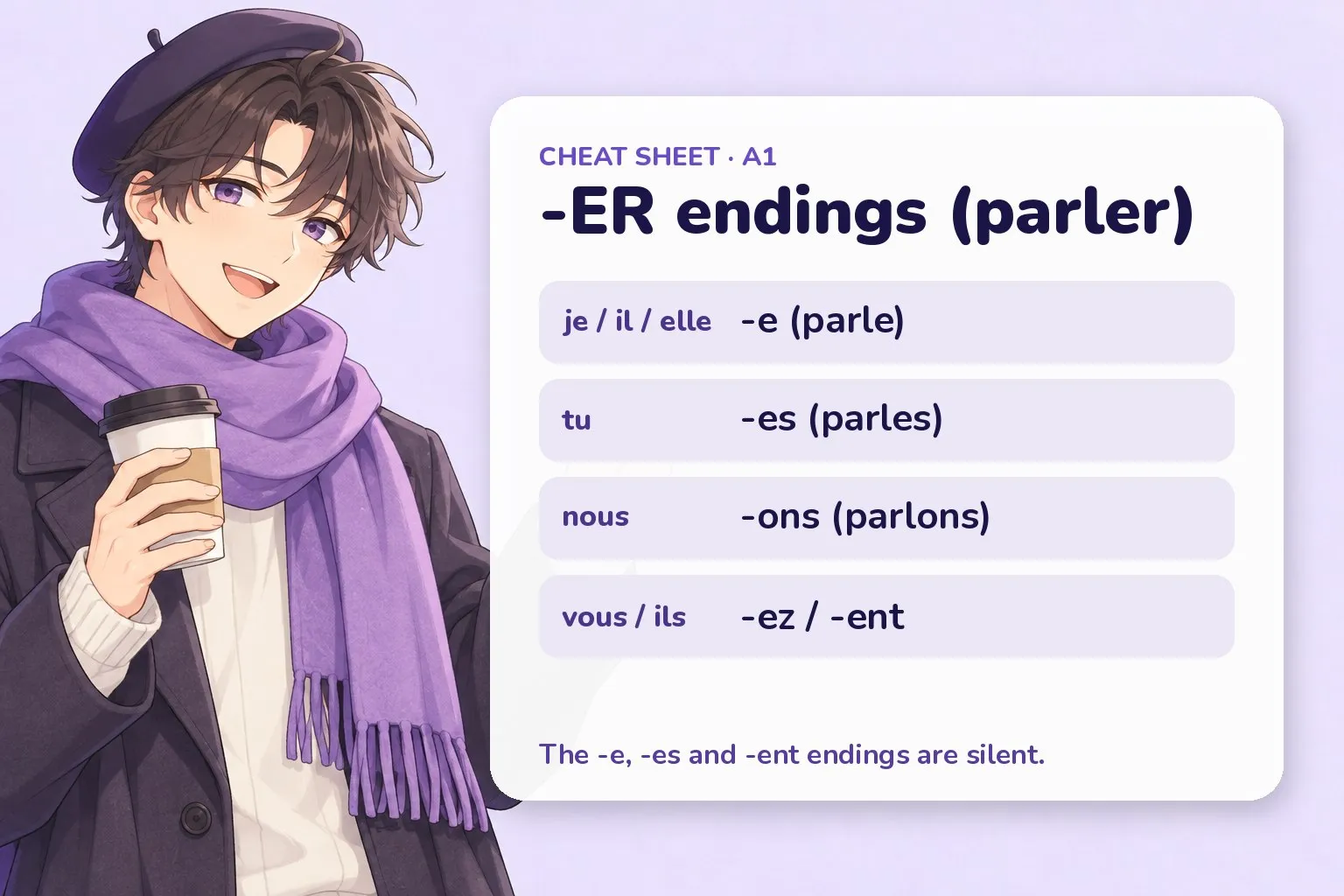
Quick recap before you practise.
Practice
French -ER verbs present practice
Try each one, then press Check. No sign-up, nothing is sent anywhere — it all runs in your browser.
Hint: je form of aimer, elided to j'
Show answer
aime — je + aimer → j'aime (the stem aim- + -e).
Hint: vous ending
Show answer
habitez — vous takes -ez: vous habitez.
4 Order the words: 'They watch TV.'
Show answer
Ils regardent la télé — Ils regardent la télé. The -ent ending is silent.
5 Match each subject to the ending of a regular -ER verb.
- je
- nous
- vous
- ils / elles
Show answer
- je → -e
- nous → -ons
- vous → -ez
- ils / elles → -ent
je -e, tu -es, il -e, nous -ons, vous -ez, ils -ent.
Quiz
French -ER verbs present quiz
12 questions · pick an answer and you'll see straight away if it's right.
-
Show answer
drop -er to get the stem — Drop -er from the infinitive to find the stem (parler → parl-).
-
Show answer
-e, -es, -e, -ons, -ez, -ent — Regular -ER verbs take -e, -es, -e, -ons, -ez, -ent.
-
Show answer
parlons — nous → -ons: nous parlons.
-
Show answer
regardent — ils → -ent: ils regardent (said 'regard').
-
Show answer
je parle, tu parles, ils parlent — The -e, -es and -ent endings are all silent, so je parle / tu parles / ils parlent sound the same.
-
Show answer
it is silent — The -ent ending is silent; ils parlent is said 'parl'.
-
Show answer
j' — je aime → j'aime; je drops its -e before a vowel or silent h.
-
Show answer
to keep the soft 's' sound before -ons — The cedilla keeps c soft (s) before o: commençons.
-
Show answer
the il/elle ending -e — on takes the il/elle form: on mange.
-
Show answer
aller — aller ('to go') ends in -er but is irregular: je vais, tu vas…
-
Show answer
travaillez — vous → -ez: vous travaillez.
-
Show answer
chante — il/elle/on → -e: elle chante.
Recap cheat-sheet
| Subject | Ending | parler |
|---|---|---|
| je | -e | parle |
| tu | -es | parles |
| il / elle / on | -e | parle |
| nous | -ons | parlons |
| vous | -ez | parlez |
| ils / elles | -ent | parlent |
Next
- Review the pronouns that drive the endings: French Subject Pronouns
- Learn the key irregular verb pair: être in the present and avoir in the present
- Back to the French grammar section
All French grammar topics
Every grammar point in order, from your first sentence to advanced structures. Pick one and go straight to it. New lessons go live every day, so topics marked Coming soon fill in over the next weeks.
Grammar path
A1 32 topics · 12 ready
- 01 Definite Articles: le, la, les, l'
- 02 Indefinite Articles: un, une, des
- 03 Partitive Articles: du, de la, des
- 04 Noun Gender in French
- 05 Forming Plurals in French
- 06 Subject Pronouns (je, tu, il, nous, vous)
- 07 The Verb Être (To Be) - Present
- 08 The Verb Avoir (To Have) - Present
- 09 Present Tense: -ER Verbs You are here
- 10 Present Tense: -IR Verbs (finir)
- 11 Present Tense: -RE Verbs (vendre)
- 12 Aller + Near Future (futur proche)
- 13 The Verb Faire (To Do/Make) Coming soon
- 14 Negation: ne...pas Coming soon
- 15 Asking Questions (est-ce que, inversion) Coming soon
- 16 Adjective Agreement (Gender & Number) Coming soon
- 17 Position of Adjectives (BAGS) Coming soon
- 18 Possessive Adjectives (mon, ma, mes) Coming soon
- 19 Demonstrative Adjectives (ce, cette, ces) Coming soon
- 20 C'est vs Il/Elle Est Coming soon
- 21 Il Y A (There Is / There Are) Coming soon
- 22 Contractions: au, aux, du, des (à/de + le) Coming soon
- 23 Question Words (qui, que, où, quand, comment) Coming soon
- 24 Vouloir, Pouvoir, Devoir (Present) Coming soon
- 25 Aimer / Préférer + Infinitive (Preferences) Coming soon
- 26 Pronominal (Reflexive) Verbs - Present Coming soon
- 27 The Imperative (Commands) Coming soon
- 28 Venir and Venir De (Recent Past) Coming soon
- 29 Prepositions with Places (à, en, au, aux) Coming soon
- 30 Expressions with Avoir (avoir faim, avoir 20 ans) Coming soon
- 31 Prepositions of Time (à, en, dans, depuis) Coming soon
- 32 Weather & Impersonal Expressions (il fait, il pleut) Coming soon
A2 26 topics
- 33 Passé Composé with Avoir Coming soon
- 34 Passé Composé with Être (+ agreement) Coming soon
- 35 The Imperfect Tense (imparfait) Coming soon
- 36 Passé Composé vs Imparfait Coming soon
- 37 The Simple Future (futur simple) Coming soon
- 38 Direct Object Pronouns (le, la, les) Coming soon
- 39 Indirect Object Pronouns (lui, leur) Coming soon
- 40 The Pronoun Y Coming soon
- 41 The Pronoun En Coming soon
- 42 Comparatives (plus, moins, aussi ... que) Coming soon
- 43 Superlatives (le plus, le moins) Coming soon
- 44 Forming Adverbs in -ment Coming soon
- 45 Depuis, Pendant, Il Y A, Pour (Time) Coming soon
- 46 Partitive & Articles in the Negative (de) Coming soon
- 47 Expressions of Quantity (beaucoup de, trop de) Coming soon
- 48 Pronominal Verbs in Passé Composé Coming soon
- 49 Stressed (Disjunctive) Pronouns (moi, toi, lui) Coming soon
- 50 Possessive Pronouns (le mien, la tienne) Coming soon
- 51 Object Pronoun Placement & Order Coming soon
- 52 Adverb Position in French Coming soon
- 53 Savoir vs Connaître (Two Ways to Know) Coming soon
- 54 Il Faut + Infinitive (Necessity) Coming soon
- 55 Verbs + à / de + Infinitive Coming soon
- 56 Comparing Quantities (plus de ... que) Coming soon
- 57 Adverbs of Frequency (souvent, toujours, jamais) Coming soon
- 58 Quel in Exclamations (Quel beau jour!) Coming soon
B1 24 topics
- 59 The Present Conditional Coming soon
- 60 The Present Subjunctive: Formation Coming soon
- 61 Subjunctive After Will & Necessity (il faut que) Coming soon
- 62 Subjunctive After Emotion & Opinion Coming soon
- 63 The Pluperfect (plus-que-parfait) Coming soon
- 64 The Future Perfect (futur antérieur) Coming soon
- 65 The Past Conditional (conditionnel passé) Coming soon
- 66 Si Clauses (Conditional Sentences) Coming soon
- 67 Relative Pronouns: qui, que, où, dont Coming soon
- 68 Order of Double Object Pronouns Coming soon
- 69 The Gérondif (en + -ant) Coming soon
- 70 The Present Participle (-ant) Coming soon
- 71 Reported Speech (discours indirect) Coming soon
- 72 Irregular Comparatives (meilleur, pire, mieux) Coming soon
- 73 Demonstrative Pronouns (celui, celle, ceux) Coming soon
- 74 The Causative Faire (faire faire) Coming soon
- 75 Depuis Que & Time Conjunctions Coming soon
- 76 Être en Train de / Sur le Point de Coming soon
- 77 Varied Negations (ne...jamais/rien/personne/plus) Coming soon
- 78 Y and En with Verbs (penser à / parler de) Coming soon
- 79 The Past Infinitive (après avoir fait) Coming soon
- 80 Tout: Adjective, Pronoun and Adverb Coming soon
- 81 Types of Pronominal Verbs (reflexive, reciprocal, idiomatic) Coming soon
- 82 Expressing Opinion (à mon avis, trouver que) Coming soon
B2 20 topics
- 83 The Past Subjunctive (subjonctif passé) Coming soon
- 84 Subjunctive After Conjunctions (bien que, pour que) Coming soon
- 85 Subjunctive vs Indicative (penser que, espérer) Coming soon
- 86 Sequence of Tenses (concordance des temps) Coming soon
- 87 The Passé Simple (Recognition) Coming soon
- 88 The Passive Voice (voix passive) Coming soon
- 89 Reported Speech in the Past Coming soon
- 90 Compound Relatives (lequel, auquel, duquel) Coming soon
- 91 Past Participle Agreement with Avoir Coming soon
- 92 Participle Agreement: Pronominal Verbs Coming soon
- 93 Expressing Opposition & Concession (bien que, malgré) Coming soon
- 94 Expressing Cause (parce que, puisque, comme, car) Coming soon
- 95 Expressing Consequence (donc, si bien que, tellement) Coming soon
- 96 Expressing Purpose (pour que, afin de, de peur que) Coming soon
- 97 Highlighting: C'est...qui / C'est...que Coming soon
- 98 Indefinite Adjectives (tout, chaque, quelques) Coming soon
- 99 Indefinite Pronouns (quelqu'un, chacun, certains) Coming soon
- 100 Verbs + Preposition + Noun (penser à, dépendre de) Coming soon
- 101 Verbs of Perception + Infinitive (je le vois arriver) Coming soon
- 102 When to Omit the Article Coming soon
C1 14 topics
- 103 The Imperfect Subjunctive (Literary) Coming soon
- 104 The Passé Antérieur (Literary) Coming soon
- 105 Sequence of Tenses with the Subjunctive Coming soon
- 106 The Expletive Ne (ne explétif) Coming soon
- 107 Restriction & Only (ne...que, ne faire que) Coming soon
- 108 Stylistic & Interrogative Inversion Coming soon
- 109 Advanced Logical Connectors (néanmoins, en revanche) Coming soon
- 110 Nominalisation (Formal/Press Style) Coming soon
- 111 Advanced Hypothesis (au cas où, à moins que) Coming soon
- 112 The Pronominal Passive (se + verb) Coming soon
- 113 Subjunctive in Relative Clauses (le seul qui...) Coming soon
- 114 Absolute & Participial Constructions (Le travail terminé) Coming soon
- 115 Registers: Soutenu, Courant, Familier Coming soon
- 116 Proportional & Advanced Comparison (plus...plus) Coming soon