Forming Plurals in French (le pluriel)
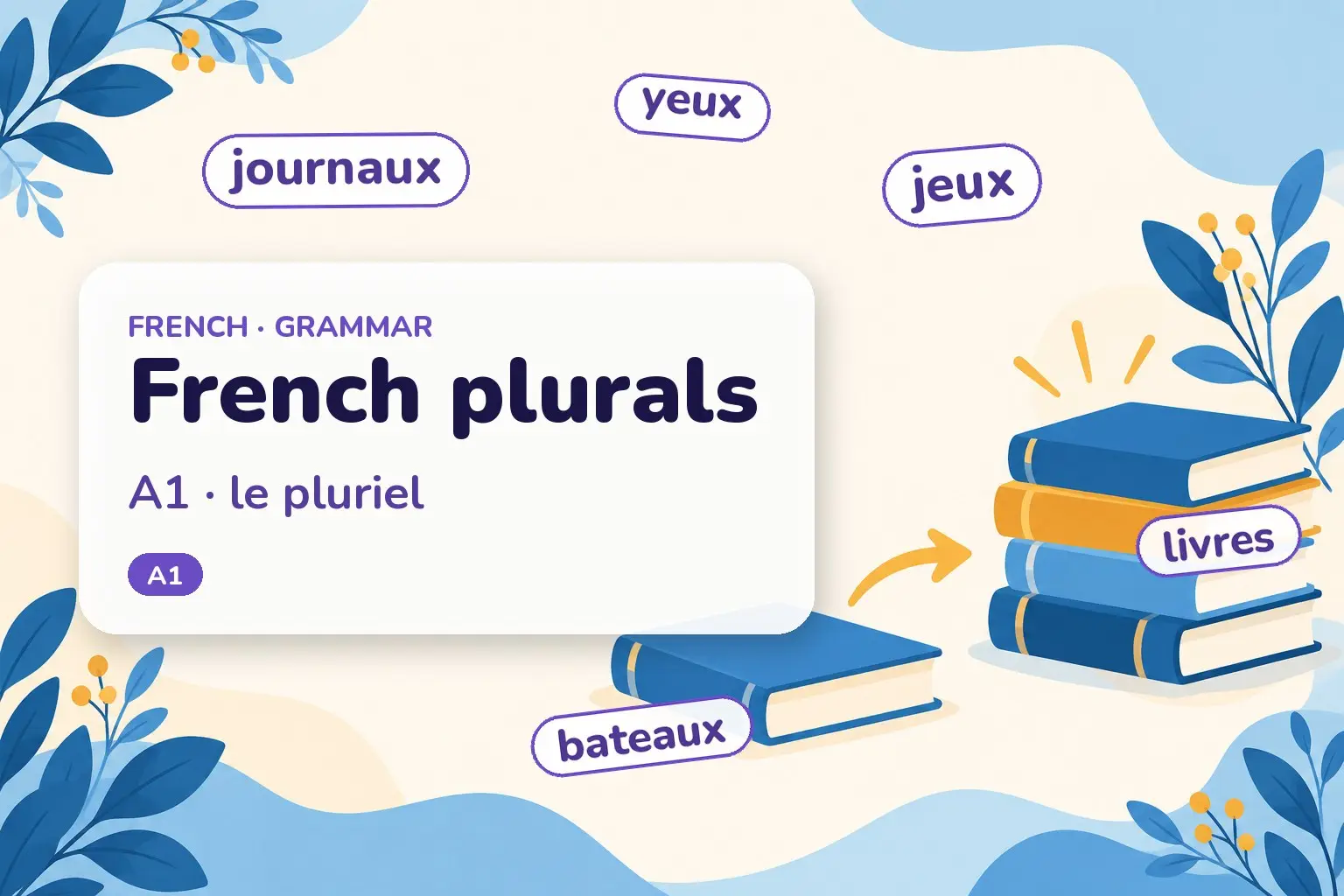
Most French nouns form the plural by adding a silent -s: un livre, des livres. Words ending in -eau or -eu take -x instead (un bateau, des bateaux), words ending in -al become -aux (un journal, des journaux), and words already ending in -s, -x or -z do not change.
Level: A1. Making a French noun plural is mostly simple — add an -s you will never hear. The real skill is spotting the handful of endings that behave differently and remembering that the plural is signalled by the article, not the noun’s sound.
The rule
A noun names a person, place or thing; its plural form means “more than one”. The default rule is the same idea as English: add -s to the singular. The twist is that this -s is silent — un livre (a book) and des livres (some books) sound identical. You know it is plural from the word in front of it (the article), which changes: le / la become les, and un / une become des.
Four endings do something other than plain -s:
- Nouns ending in -s, -x or -z do not change at all: un fils → des fils (sons), une voix → des voix (voices).
- Nouns ending in -eau and most in -eu add -x, not -s: un bateau → des bateaux (boats), un jeu → des jeux (games).
- Nouns ending in -al usually change to -aux: un journal → des journaux (newspapers).
- A small, learnable set of -ou and -ail nouns take irregular plurals (below).
Plural endings at a glance
| Singular ending | Plural | Example (sing. → pl.) | Meaning |
|---|---|---|---|
| most nouns | + s | un livre → des livres | book(s) |
| -s, -x, -z | no change | une voix → des voix | voice(s) |
| -eau | + x | un gâteau → des gâteaux | cake(s) |
| -eu | + x | un jeu → des jeux | game(s) |
| -al | -aux | un animal → des animaux | animal(s) |
| -ail (mostly) | + s | un détail → des détails | detail(s) |
The small exception lists
A few groups look like they should follow a rule but do not. They are short enough to memorise:
- -eu that take -s: un pneu → des pneus (tyres), un bleu → des bleus (bruises).
- -al that take -s: un bal → des bals (dances), un festival → des festivals, un carnaval → des carnavals.
- -ou that take -x (seven words): bijou (jewel), caillou (pebble), chou (cabbage), genou (knee), hibou (owl), joujou (toy), pou (louse): des bijoux, des genoux, des choux.
- -ail that take -aux: above all un travail → des travaux (works), un vitrail → des vitraux (stained-glass windows).
How to say it
French plurals are almost all about the ears, because the written ending is silent:
- The plural -s and -x are not pronounced: livres, bateaux and journaux end on the same sound as their singulars.
- Liaison: before a word starting with a vowel, that silent -s comes alive as a /z/: les amis sounds like “lez-ami”, des enfants like “dez-enfants”.
- The article carries the number: le [luh] → les [lay]; un [uh(n)] → des [day]. Hearing les or des is your cue that the noun is plural.
Example sentences
- J'ai deux livres.I have two books.regular + s (silent)
- Les chats dorment.The cats are sleeping.plural heard from les, not chats
- Elle achète des gâteaux.She is buying some cakes.-eau takes -x
- Les enfants aiment les jeux.The children like games.-eu takes -x
- Je lis les journaux le matin.I read the newspapers in the morning.-al becomes -aux
- Il y a beaucoup d'animaux au zoo.There are many animals at the zoo.animal → animaux
- Ses yeux sont bleus.His eyes are blue.irregular: oeil → yeux
- Nous avons des voix différentes.We have different voices.-x stays the same
- Les fils de mon voisin sont grands.My neighbour's sons are tall.-s does not change
- Elle porte deux bijoux.She is wearing two pieces of jewellery.bijou → bijoux
- Mes genoux me font mal.My knees hurt.genou → genoux
- Il y a des travaux dans la rue.There are works (roadworks) in the street.travail → travaux
- Les festivals d'été sont populaires.Summer festivals are popular.festival → festivals (keeps -s)
- J'achète trois choux.I'm buying three cabbages.chou → choux
- Les bateaux rentrent au port.The boats are returning to port.bateau → bateaux
- Ce sont de beaux tableaux.These are beautiful paintings.tableau → tableaux
Common mistakes
- ❌ saying the -s out loud (“deux livress”) → ✅ the plural -s is silent: deux livres sounds like livre.
- ❌ des journals → ✅ des journaux. Nouns in -al take -aux, not -s.
- ❌ des bateaus → ✅ des bateaux. Nouns in -eau add -x.
- ❌ des voixs or des fils-s → ✅ des voix, des fils. Words already ending in -s, -x or -z do not change.
- ❌ des oeils → ✅ des yeux. This plural is irregular and must be learned.
- ❌ forgetting the article change, e.g. “le livres” → ✅ les livres. The article must go plural too.
A short conversation
A: Tu as des animaux à la maison ? — Do you have any pets (animals) at home? B: Oui, j’ai deux chats et des poissons. — Yes, I have two cats and some fish. A: Et ces beaux tableaux, ce sont les tiens ? — And these lovely paintings, are they yours? B: Oui, je peins pendant les week-ends. — Yes, I paint at the weekends.
Usage notes
- Family names do not take -s: les Martin (the Martins), not les Martins.
- Compound nouns vary (des grands-parents, des arcs-en-ciel); treat each as its own item at this level.
- Some nouns are used mainly in the plural: les vacances (holidays), les gens (people).
- Adjectives agree too: when the noun goes plural, its adjectives usually add -s as well: des livres intéressants. That is covered on the adjective-agreement page.
Compared with…
- Definite and indefinite articles are how you actually hear a plural, since the noun ending is silent. Review how le / la become les and un / une become des on Definite Articles in French (le, la, les).
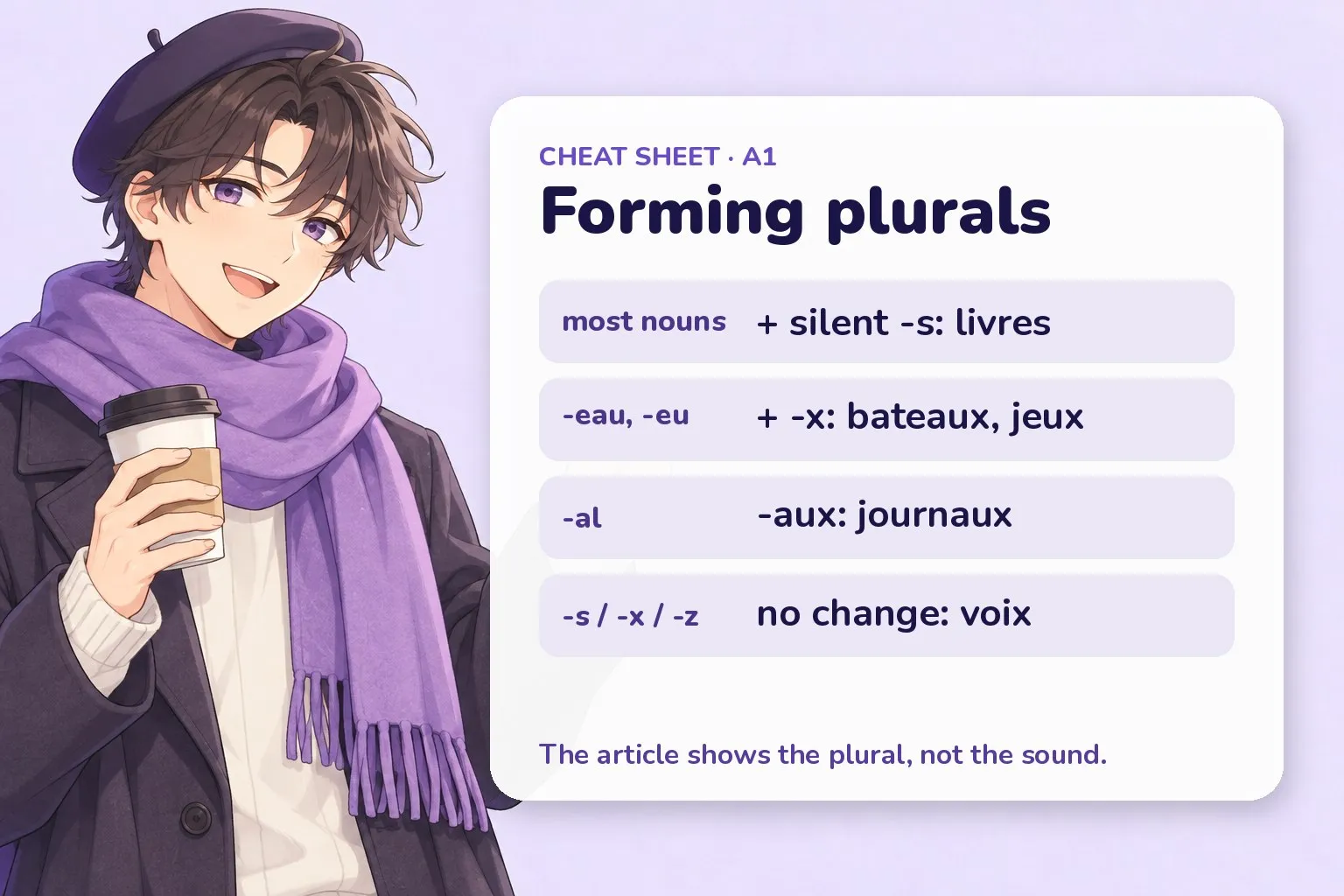
Quick recap before you practise.
Practice
French plurals practice
Try each one, then press Check. No sign-up, nothing is sent anywhere — it all runs in your browser.
Hint: -al becomes -aux
Show answer
journaux — Most -al nouns take -aux: des journaux.
4 Put the words in order: 'the children like games'.
Show answer
les enfants aiment les jeux — Les enfants aiment les jeux — -eu takes -x in jeux.
5 Match each singular to its plural.
- un animal
- un oeil
- un bijou
- un fils
Show answer
- un animal → des animaux
- un oeil → des yeux
- un bijou → des bijoux
- un fils → des fils
-al → -aux, oeil → yeux (irregular), bijou → bijoux (exception), -s invariable.
Quiz
French plurals quiz
12 questions · pick an answer and you'll see straight away if it's right.
-
Show answer
add a silent -s — The default is a silent -s: un livre → des livres.
-
Show answer
des gâteaux — -eau adds -x: des gâteaux.
-
Show answer
des journaux — -al becomes -aux: des journaux.
-
Show answer
un nez — Nouns ending in -z (like nez) do not change: des nez.
-
Show answer
des yeux — oeil → yeux is irregular and must be learned.
-
Show answer
the ending is silent, so the article shows the number — The -s/-x is silent; les and des carry the plural.
-
Show answer
des jeux — Most -eu nouns add -x: des jeux.
-
Show answer
des animaux — animal → animaux (-al to -aux).
-
Show answer
/z/ (liaison) — Liaison turns the -s into /z/: les amis sounds like lez-ami.
-
Show answer
un festival — festival is an exception: des festivals, not festivaux.
-
Show answer
des voix — Nouns ending in -x are invariable: des voix.
-
Show answer
bijoux — bijou is in the -ou group that takes -x: des bijoux.
Recap cheat-sheet
| Ending | Plural rule | Example |
|---|---|---|
| most nouns | + silent -s | des livres |
| -s / -x / -z | no change | des voix |
| -eau, -eu | + -x | des bateaux, des jeux |
| -al | -aux | des journaux |
| -ou (7 words) | + -x | des bijoux |
| oeil | irregular | des yeux |
Next
- Hear the plural through the article: Definite Articles in French (le, la, les)
- Build on gender first: Noun Gender in French
- Back to the French grammar section
All French grammar topics
Every grammar point in order, from your first sentence to advanced structures. Pick one and go straight to it. New lessons go live every day, so topics marked Coming soon fill in over the next weeks.
Grammar path
A1 32 topics · 12 ready
- 01 Definite Articles: le, la, les, l'
- 02 Indefinite Articles: un, une, des
- 03 Partitive Articles: du, de la, des
- 04 Noun Gender in French
- 05 Forming Plurals in French You are here
- 06 Subject Pronouns (je, tu, il, nous, vous)
- 07 The Verb Être (To Be) - Present
- 08 The Verb Avoir (To Have) - Present
- 09 Present Tense: -ER Verbs
- 10 Present Tense: -IR Verbs (finir)
- 11 Present Tense: -RE Verbs (vendre)
- 12 Aller + Near Future (futur proche)
- 13 The Verb Faire (To Do/Make) Coming soon
- 14 Negation: ne...pas Coming soon
- 15 Asking Questions (est-ce que, inversion) Coming soon
- 16 Adjective Agreement (Gender & Number) Coming soon
- 17 Position of Adjectives (BAGS) Coming soon
- 18 Possessive Adjectives (mon, ma, mes) Coming soon
- 19 Demonstrative Adjectives (ce, cette, ces) Coming soon
- 20 C'est vs Il/Elle Est Coming soon
- 21 Il Y A (There Is / There Are) Coming soon
- 22 Contractions: au, aux, du, des (à/de + le) Coming soon
- 23 Question Words (qui, que, où, quand, comment) Coming soon
- 24 Vouloir, Pouvoir, Devoir (Present) Coming soon
- 25 Aimer / Préférer + Infinitive (Preferences) Coming soon
- 26 Pronominal (Reflexive) Verbs - Present Coming soon
- 27 The Imperative (Commands) Coming soon
- 28 Venir and Venir De (Recent Past) Coming soon
- 29 Prepositions with Places (à, en, au, aux) Coming soon
- 30 Expressions with Avoir (avoir faim, avoir 20 ans) Coming soon
- 31 Prepositions of Time (à, en, dans, depuis) Coming soon
- 32 Weather & Impersonal Expressions (il fait, il pleut) Coming soon
A2 26 topics
- 33 Passé Composé with Avoir Coming soon
- 34 Passé Composé with Être (+ agreement) Coming soon
- 35 The Imperfect Tense (imparfait) Coming soon
- 36 Passé Composé vs Imparfait Coming soon
- 37 The Simple Future (futur simple) Coming soon
- 38 Direct Object Pronouns (le, la, les) Coming soon
- 39 Indirect Object Pronouns (lui, leur) Coming soon
- 40 The Pronoun Y Coming soon
- 41 The Pronoun En Coming soon
- 42 Comparatives (plus, moins, aussi ... que) Coming soon
- 43 Superlatives (le plus, le moins) Coming soon
- 44 Forming Adverbs in -ment Coming soon
- 45 Depuis, Pendant, Il Y A, Pour (Time) Coming soon
- 46 Partitive & Articles in the Negative (de) Coming soon
- 47 Expressions of Quantity (beaucoup de, trop de) Coming soon
- 48 Pronominal Verbs in Passé Composé Coming soon
- 49 Stressed (Disjunctive) Pronouns (moi, toi, lui) Coming soon
- 50 Possessive Pronouns (le mien, la tienne) Coming soon
- 51 Object Pronoun Placement & Order Coming soon
- 52 Adverb Position in French Coming soon
- 53 Savoir vs Connaître (Two Ways to Know) Coming soon
- 54 Il Faut + Infinitive (Necessity) Coming soon
- 55 Verbs + à / de + Infinitive Coming soon
- 56 Comparing Quantities (plus de ... que) Coming soon
- 57 Adverbs of Frequency (souvent, toujours, jamais) Coming soon
- 58 Quel in Exclamations (Quel beau jour!) Coming soon
B1 24 topics
- 59 The Present Conditional Coming soon
- 60 The Present Subjunctive: Formation Coming soon
- 61 Subjunctive After Will & Necessity (il faut que) Coming soon
- 62 Subjunctive After Emotion & Opinion Coming soon
- 63 The Pluperfect (plus-que-parfait) Coming soon
- 64 The Future Perfect (futur antérieur) Coming soon
- 65 The Past Conditional (conditionnel passé) Coming soon
- 66 Si Clauses (Conditional Sentences) Coming soon
- 67 Relative Pronouns: qui, que, où, dont Coming soon
- 68 Order of Double Object Pronouns Coming soon
- 69 The Gérondif (en + -ant) Coming soon
- 70 The Present Participle (-ant) Coming soon
- 71 Reported Speech (discours indirect) Coming soon
- 72 Irregular Comparatives (meilleur, pire, mieux) Coming soon
- 73 Demonstrative Pronouns (celui, celle, ceux) Coming soon
- 74 The Causative Faire (faire faire) Coming soon
- 75 Depuis Que & Time Conjunctions Coming soon
- 76 Être en Train de / Sur le Point de Coming soon
- 77 Varied Negations (ne...jamais/rien/personne/plus) Coming soon
- 78 Y and En with Verbs (penser à / parler de) Coming soon
- 79 The Past Infinitive (après avoir fait) Coming soon
- 80 Tout: Adjective, Pronoun and Adverb Coming soon
- 81 Types of Pronominal Verbs (reflexive, reciprocal, idiomatic) Coming soon
- 82 Expressing Opinion (à mon avis, trouver que) Coming soon
B2 20 topics
- 83 The Past Subjunctive (subjonctif passé) Coming soon
- 84 Subjunctive After Conjunctions (bien que, pour que) Coming soon
- 85 Subjunctive vs Indicative (penser que, espérer) Coming soon
- 86 Sequence of Tenses (concordance des temps) Coming soon
- 87 The Passé Simple (Recognition) Coming soon
- 88 The Passive Voice (voix passive) Coming soon
- 89 Reported Speech in the Past Coming soon
- 90 Compound Relatives (lequel, auquel, duquel) Coming soon
- 91 Past Participle Agreement with Avoir Coming soon
- 92 Participle Agreement: Pronominal Verbs Coming soon
- 93 Expressing Opposition & Concession (bien que, malgré) Coming soon
- 94 Expressing Cause (parce que, puisque, comme, car) Coming soon
- 95 Expressing Consequence (donc, si bien que, tellement) Coming soon
- 96 Expressing Purpose (pour que, afin de, de peur que) Coming soon
- 97 Highlighting: C'est...qui / C'est...que Coming soon
- 98 Indefinite Adjectives (tout, chaque, quelques) Coming soon
- 99 Indefinite Pronouns (quelqu'un, chacun, certains) Coming soon
- 100 Verbs + Preposition + Noun (penser à, dépendre de) Coming soon
- 101 Verbs of Perception + Infinitive (je le vois arriver) Coming soon
- 102 When to Omit the Article Coming soon
C1 14 topics
- 103 The Imperfect Subjunctive (Literary) Coming soon
- 104 The Passé Antérieur (Literary) Coming soon
- 105 Sequence of Tenses with the Subjunctive Coming soon
- 106 The Expletive Ne (ne explétif) Coming soon
- 107 Restriction & Only (ne...que, ne faire que) Coming soon
- 108 Stylistic & Interrogative Inversion Coming soon
- 109 Advanced Logical Connectors (néanmoins, en revanche) Coming soon
- 110 Nominalisation (Formal/Press Style) Coming soon
- 111 Advanced Hypothesis (au cas où, à moins que) Coming soon
- 112 The Pronominal Passive (se + verb) Coming soon
- 113 Subjunctive in Relative Clauses (le seul qui...) Coming soon
- 114 Absolute & Participial Constructions (Le travail terminé) Coming soon
- 115 Registers: Soutenu, Courant, Familier Coming soon
- 116 Proportional & Advanced Comparison (plus...plus) Coming soon