The Verb Avoir (To Have) - Present
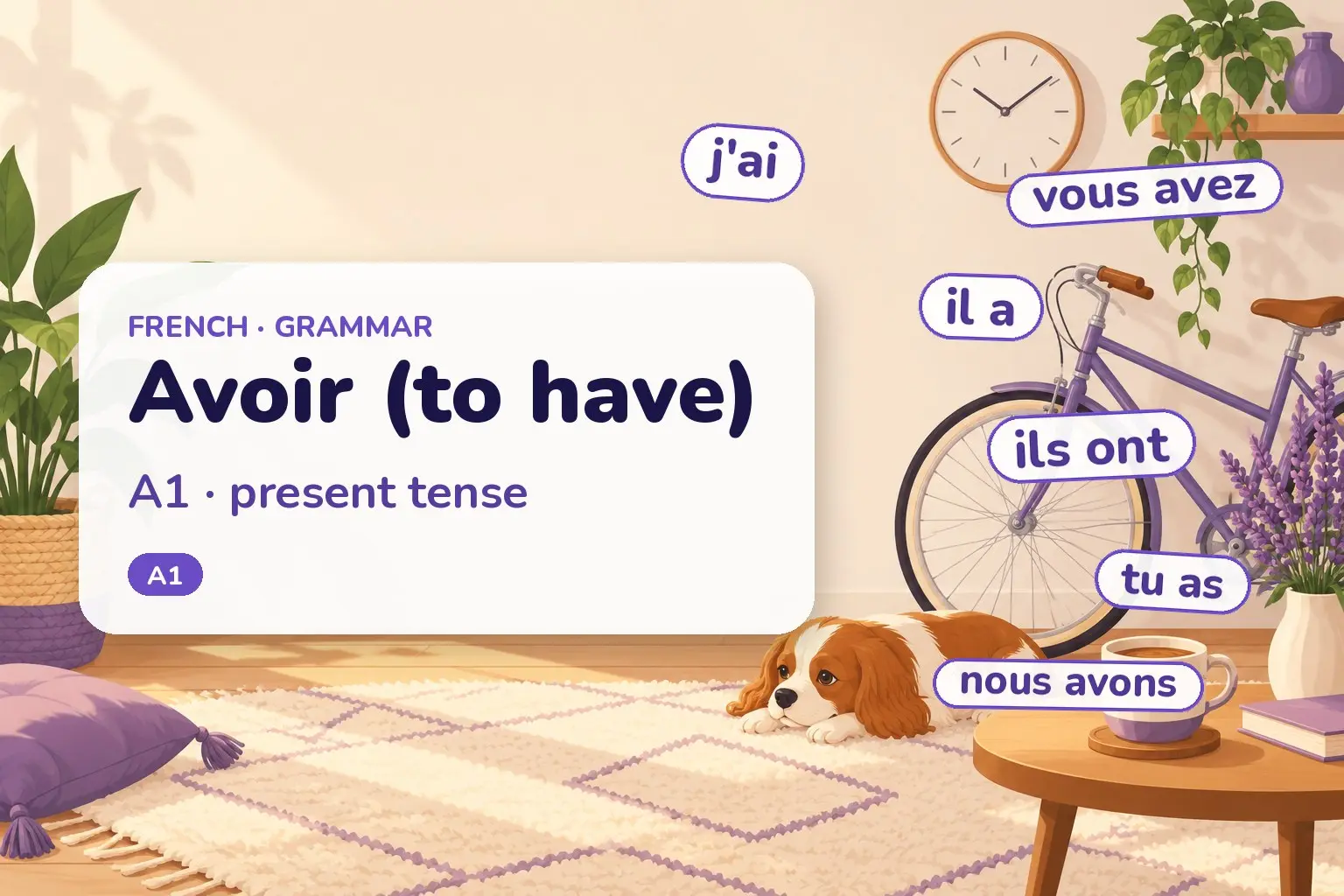
Avoir means to have and is irregular: j'ai, tu as, il/elle a, nous avons, vous avez, ils/elles ont. French also uses it where English uses to be: J'ai vingt ans (I am 20), J'ai faim (I am hungry).
Level: A1. Avoir means to have, and it is one of the two verbs French leans on most (the other is être). You use it for what you own, your age, and a whole set of feelings — and later it becomes the helper verb for the past tense. It is irregular, so you learn its six present forms by heart.
The rule
A verb is a word for an action or a state; avoir is the verb for having. The set of forms you use for each subject is the conjugation. Because avoir is irregular, the forms do not follow a regular stem-plus-ending pattern — you memorise them:
- j’ai — I have
- tu as — you have (one person, informal)
- il / elle / on a — he / she / one has
- nous avons — we have
- vous avez — you have (polite, or plural)
- ils / elles ont — they have
Two things trip up English speakers. First, je shortens to j’ before a vowel, so “I have” is j’ai, never je ai. Second, French uses avoir for many states where English uses to be: age (j’ai vingt ans, “I am twenty”), hunger (j’ai faim, “I am hungry”), and more. Translate these as a set, not word by word.
Avoir also builds the extremely common phrase il y a (“there is” / “there are”), and later it is the helper verb in the passé composé (j’ai mangé, “I ate”) — but that comes after you are solid on the present.
Forms
| Subject | avoir | Meaning |
|---|---|---|
| je (j’) | ai | I have |
| tu | as | you have (informal sg) |
| il / elle / on | a | he / she / one has |
| nous | avons | we have |
| vous | avez | you have (polite / pl) |
| ils / elles | ont | they have |
How to say it
French spelling hides most of these endings. A few sounds need care:
| Form | How to say it |
|---|---|
| j’ai | One syllable, “zhay”: the vowel is like the e in “they”. |
| as / a | Both sound the same, a short “ah”: tu as ≈ “tu ah”, il a ≈ “eel ah”. The spelling differs, the sound does not. |
| avons | “a-VOH(n)”: the final -ons is a nasal vowel, not a hard n. |
| avez | “a-VAY”: the -ez ending sounds like “ay”. |
| ont | Nasal “oh(n)”, final -t silent. Compare ils ont (“eel-z oh(n)”, with a z-link) and ils sont (“eel soh(n)”) — same rhythm, different start. |
Example sentences
- J'ai un chien.I have a dog.possession
- Tu as une voiture ?Do you have a car?tu as, informal
- Il a deux frères.He has two brothers.
- Elle a les yeux bleus.She has blue eyes.
- Nous avons un appartement à Lyon.We have an apartment in Lyon.
- Vous avez l'heure ?Do you have the time?polite you
- Ils ont trois enfants.They have three children.
- J'ai vingt ans.I am twenty (years old).age uses avoir
- Quel âge as-tu ?How old are you?lit. what age do you have
- J'ai faim.I am hungry.lit. I have hunger
- Elle a soif.She is thirsty.
- Nous avons froid.We are cold.
- Il a chaud.He is hot.
- J'ai peur des araignées.I am afraid of spiders.
- On a sommeil.We are sleepy.on = we, takes a
- J'ai besoin d'aide.I need help.avoir besoin de = to need
- Tu as envie d'un café ?Do you feel like a coffee?avoir envie de = to fancy
- Il y a un problème.There is a problem.il y a = there is/are
- Il y a des livres sur la table.There are books on the table.
- Je n'ai pas de temps.I do not have time.negative: pas de, not pas un
- Vous avez raison.You are right.avoir raison = to be right
Common mistakes
- ❌ Je suis vingt ans → ✅ J’ai vingt ans. Age uses avoir, not être.
- ❌ Je suis faim → ✅ J’ai faim. Hunger, thirst, fear and feeling hot or cold all use avoir.
- ❌ Je ai un chien → ✅ J’ai un chien. Je must shorten to j’ before the vowel.
- ❌ Il ont deux frères → ✅ Ils ont deux frères. A plural subject (ils) takes ont; a single il takes a.
- ❌ Je n’ai pas un temps → ✅ Je n’ai pas de temps. After a negative, un/une/des usually becomes de.
- ❌ Nous ont un appartement → ✅ Nous avons un appartement. Ont is for ils/elles; nous takes avons.
A short conversation
— Tu as quel âge ? — J’ai dix-huit ans. Et toi ? — Moi, j’ai vingt ans. On a faim, non ? Il y a un café là-bas. — Bonne idée, j’ai envie d’un chocolat chaud.
Usage notes
- Possession is the core use. Avoir says what you own or what belongs to you: j’ai un vélo (I have a bike), elle a un chat (she has a cat).
- Many feelings use avoir, not être. Learn these as fixed expressions: avoir faim (to be hungry), avoir soif (thirsty), avoir chaud/froid (hot/cold), avoir peur (afraid), avoir sommeil (sleepy), avoir raison/tort (right/wrong), avoir besoin de (to need), avoir envie de (to feel like).
- The negative changes the article. With ne … pas, a following un/une/des usually becomes de: J’ai un stylo → Je n’ai pas de stylo. Before a vowel, ne becomes n’: Je n’ai pas….
- On a is everyday “we have”. In speech, on replaces nous and takes the il/elle form: On a un chien means “We have a dog”, even though it looks singular.
- Il y a never changes for number. “There is a book” and “there are books” are both il y a: il y a un livre, il y a des livres.
Compared with…
- Être (to be): je suis, tu es, il est, nous sommes, vous êtes, ils sont. Use être for identity, origin and description, but avoir for age and bodily states: Je suis étudiant (I am a student) but J’ai faim (I am hungry). The classic error is je suis vingt ans; it must be j’ai vingt ans. Review it on The Verb Être — Present.
- C’est vs il est. To point something out, French uses c’est (c’est un chien), which is built on être, not avoir — keep the two helper verbs separate.
- Before you start, make sure you know the French subject pronouns je, tu, il… that go with each form of avoir.
Practice
Avoir practice
Try each one, then press Check. No sign-up, nothing is sent anywhere — it all runs in your browser.
Hint: the nous form of avoir
Show answer
avons — nous avons — nous takes avons.
3 Build: 'I am twenty years old.' (use avoir)
Show answer
J'ai vingt ans — Age uses avoir: J'ai vingt ans.
4 Match each subject to its form of avoir.
- j'
- tu
- vous
- ils
Show answer
- j' → ai
- tu → as
- vous → avez
- ils → ont
j'ai, tu as, vous avez, ils ont.
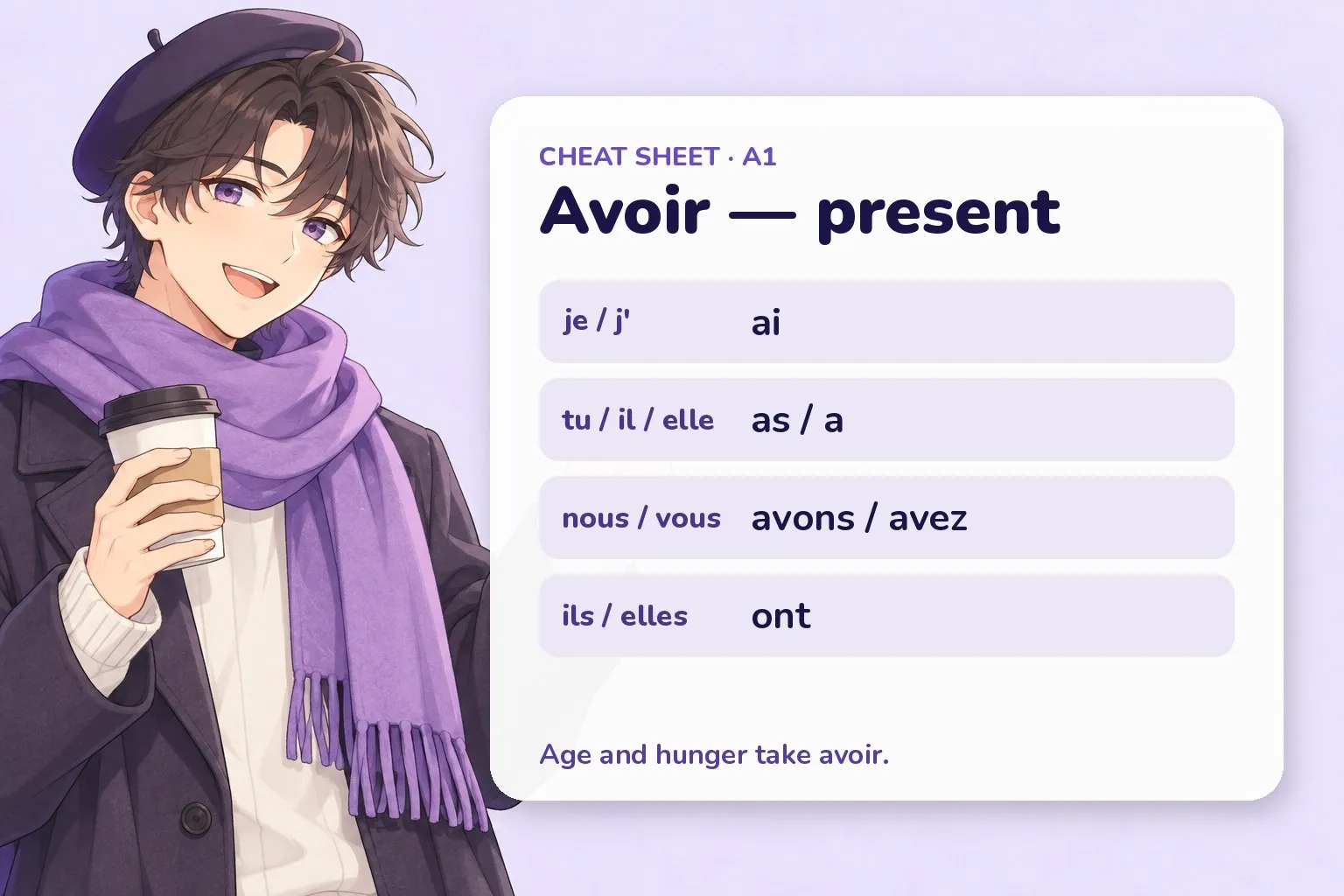
Quick recap before you practise.
Quiz
The verb avoir
14 questions · pick an answer and you'll see straight away if it's right.
-
Show answer
ai — j'ai (je shortens to j').
-
Show answer
as — tu as.
-
Show answer
a — il/elle/on a.
-
Show answer
avons — nous avons.
-
Show answer
avez — vous avez.
-
Show answer
ont — ils/elles ont.
-
Show answer
J'ai vingt ans. — Age uses avoir: J'ai vingt ans.
-
Show answer
Elle a soif. — avoir soif = to be thirsty.
-
Show answer
ai — j'ai un chien.
-
Show answer
Je n'ai pas de stylo. — After a negative, un becomes de: Je n'ai pas de stylo.
-
Show answer
there is / there are — il y a = there is / there are, and never changes for number.
-
Show answer
ont — A plural subject takes ont: ils ont trois enfants.
-
Show answer
a — a with no accent is the verb; à with the grave accent is 'to/at'.
-
Show answer
we are hungry — on = we in speech and takes the form a; avoir faim = to be hungry.
Recap cheat-sheet
| Subject | avoir | Note |
|---|---|---|
| je (j’) | ai | j’ before the vowel |
| tu | as | sounds like il a |
| il / elle / on | a | on = everyday ‘we’ |
| nous | avons | we |
| vous | avez | polite / plural |
| ils / elles | ont | ils ont has a z-liaison |
Next
- Next grammar point: see the French grammar section for what follows
- Compare with The Verb Être — Present
- New here? Start with Start Learning French Here
All French grammar topics
Every grammar point in order, from your first sentence to advanced structures. Pick one and go straight to it. New lessons go live every day, so topics marked Coming soon fill in over the next weeks.
Grammar path
A1 32 topics · 12 ready
- 01 Definite Articles: le, la, les, l'
- 02 Indefinite Articles: un, une, des
- 03 Partitive Articles: du, de la, des
- 04 Noun Gender in French
- 05 Forming Plurals in French
- 06 Subject Pronouns (je, tu, il, nous, vous)
- 07 The Verb Être (To Be) - Present
- 08 The Verb Avoir (To Have) - Present You are here
- 09 Present Tense: -ER Verbs
- 10 Present Tense: -IR Verbs (finir)
- 11 Present Tense: -RE Verbs (vendre)
- 12 Aller + Near Future (futur proche)
- 13 The Verb Faire (To Do/Make) Coming soon
- 14 Negation: ne...pas Coming soon
- 15 Asking Questions (est-ce que, inversion) Coming soon
- 16 Adjective Agreement (Gender & Number) Coming soon
- 17 Position of Adjectives (BAGS) Coming soon
- 18 Possessive Adjectives (mon, ma, mes) Coming soon
- 19 Demonstrative Adjectives (ce, cette, ces) Coming soon
- 20 C'est vs Il/Elle Est Coming soon
- 21 Il Y A (There Is / There Are) Coming soon
- 22 Contractions: au, aux, du, des (à/de + le) Coming soon
- 23 Question Words (qui, que, où, quand, comment) Coming soon
- 24 Vouloir, Pouvoir, Devoir (Present) Coming soon
- 25 Aimer / Préférer + Infinitive (Preferences) Coming soon
- 26 Pronominal (Reflexive) Verbs - Present Coming soon
- 27 The Imperative (Commands) Coming soon
- 28 Venir and Venir De (Recent Past) Coming soon
- 29 Prepositions with Places (à, en, au, aux) Coming soon
- 30 Expressions with Avoir (avoir faim, avoir 20 ans) Coming soon
- 31 Prepositions of Time (à, en, dans, depuis) Coming soon
- 32 Weather & Impersonal Expressions (il fait, il pleut) Coming soon
A2 26 topics
- 33 Passé Composé with Avoir Coming soon
- 34 Passé Composé with Être (+ agreement) Coming soon
- 35 The Imperfect Tense (imparfait) Coming soon
- 36 Passé Composé vs Imparfait Coming soon
- 37 The Simple Future (futur simple) Coming soon
- 38 Direct Object Pronouns (le, la, les) Coming soon
- 39 Indirect Object Pronouns (lui, leur) Coming soon
- 40 The Pronoun Y Coming soon
- 41 The Pronoun En Coming soon
- 42 Comparatives (plus, moins, aussi ... que) Coming soon
- 43 Superlatives (le plus, le moins) Coming soon
- 44 Forming Adverbs in -ment Coming soon
- 45 Depuis, Pendant, Il Y A, Pour (Time) Coming soon
- 46 Partitive & Articles in the Negative (de) Coming soon
- 47 Expressions of Quantity (beaucoup de, trop de) Coming soon
- 48 Pronominal Verbs in Passé Composé Coming soon
- 49 Stressed (Disjunctive) Pronouns (moi, toi, lui) Coming soon
- 50 Possessive Pronouns (le mien, la tienne) Coming soon
- 51 Object Pronoun Placement & Order Coming soon
- 52 Adverb Position in French Coming soon
- 53 Savoir vs Connaître (Two Ways to Know) Coming soon
- 54 Il Faut + Infinitive (Necessity) Coming soon
- 55 Verbs + à / de + Infinitive Coming soon
- 56 Comparing Quantities (plus de ... que) Coming soon
- 57 Adverbs of Frequency (souvent, toujours, jamais) Coming soon
- 58 Quel in Exclamations (Quel beau jour!) Coming soon
B1 24 topics
- 59 The Present Conditional Coming soon
- 60 The Present Subjunctive: Formation Coming soon
- 61 Subjunctive After Will & Necessity (il faut que) Coming soon
- 62 Subjunctive After Emotion & Opinion Coming soon
- 63 The Pluperfect (plus-que-parfait) Coming soon
- 64 The Future Perfect (futur antérieur) Coming soon
- 65 The Past Conditional (conditionnel passé) Coming soon
- 66 Si Clauses (Conditional Sentences) Coming soon
- 67 Relative Pronouns: qui, que, où, dont Coming soon
- 68 Order of Double Object Pronouns Coming soon
- 69 The Gérondif (en + -ant) Coming soon
- 70 The Present Participle (-ant) Coming soon
- 71 Reported Speech (discours indirect) Coming soon
- 72 Irregular Comparatives (meilleur, pire, mieux) Coming soon
- 73 Demonstrative Pronouns (celui, celle, ceux) Coming soon
- 74 The Causative Faire (faire faire) Coming soon
- 75 Depuis Que & Time Conjunctions Coming soon
- 76 Être en Train de / Sur le Point de Coming soon
- 77 Varied Negations (ne...jamais/rien/personne/plus) Coming soon
- 78 Y and En with Verbs (penser à / parler de) Coming soon
- 79 The Past Infinitive (après avoir fait) Coming soon
- 80 Tout: Adjective, Pronoun and Adverb Coming soon
- 81 Types of Pronominal Verbs (reflexive, reciprocal, idiomatic) Coming soon
- 82 Expressing Opinion (à mon avis, trouver que) Coming soon
B2 20 topics
- 83 The Past Subjunctive (subjonctif passé) Coming soon
- 84 Subjunctive After Conjunctions (bien que, pour que) Coming soon
- 85 Subjunctive vs Indicative (penser que, espérer) Coming soon
- 86 Sequence of Tenses (concordance des temps) Coming soon
- 87 The Passé Simple (Recognition) Coming soon
- 88 The Passive Voice (voix passive) Coming soon
- 89 Reported Speech in the Past Coming soon
- 90 Compound Relatives (lequel, auquel, duquel) Coming soon
- 91 Past Participle Agreement with Avoir Coming soon
- 92 Participle Agreement: Pronominal Verbs Coming soon
- 93 Expressing Opposition & Concession (bien que, malgré) Coming soon
- 94 Expressing Cause (parce que, puisque, comme, car) Coming soon
- 95 Expressing Consequence (donc, si bien que, tellement) Coming soon
- 96 Expressing Purpose (pour que, afin de, de peur que) Coming soon
- 97 Highlighting: C'est...qui / C'est...que Coming soon
- 98 Indefinite Adjectives (tout, chaque, quelques) Coming soon
- 99 Indefinite Pronouns (quelqu'un, chacun, certains) Coming soon
- 100 Verbs + Preposition + Noun (penser à, dépendre de) Coming soon
- 101 Verbs of Perception + Infinitive (je le vois arriver) Coming soon
- 102 When to Omit the Article Coming soon
C1 14 topics
- 103 The Imperfect Subjunctive (Literary) Coming soon
- 104 The Passé Antérieur (Literary) Coming soon
- 105 Sequence of Tenses with the Subjunctive Coming soon
- 106 The Expletive Ne (ne explétif) Coming soon
- 107 Restriction & Only (ne...que, ne faire que) Coming soon
- 108 Stylistic & Interrogative Inversion Coming soon
- 109 Advanced Logical Connectors (néanmoins, en revanche) Coming soon
- 110 Nominalisation (Formal/Press Style) Coming soon
- 111 Advanced Hypothesis (au cas où, à moins que) Coming soon
- 112 The Pronominal Passive (se + verb) Coming soon
- 113 Subjunctive in Relative Clauses (le seul qui...) Coming soon
- 114 Absolute & Participial Constructions (Le travail terminé) Coming soon
- 115 Registers: Soutenu, Courant, Familier Coming soon
- 116 Proportional & Advanced Comparison (plus...plus) Coming soon