The French Verb Faire (To Do / Make)
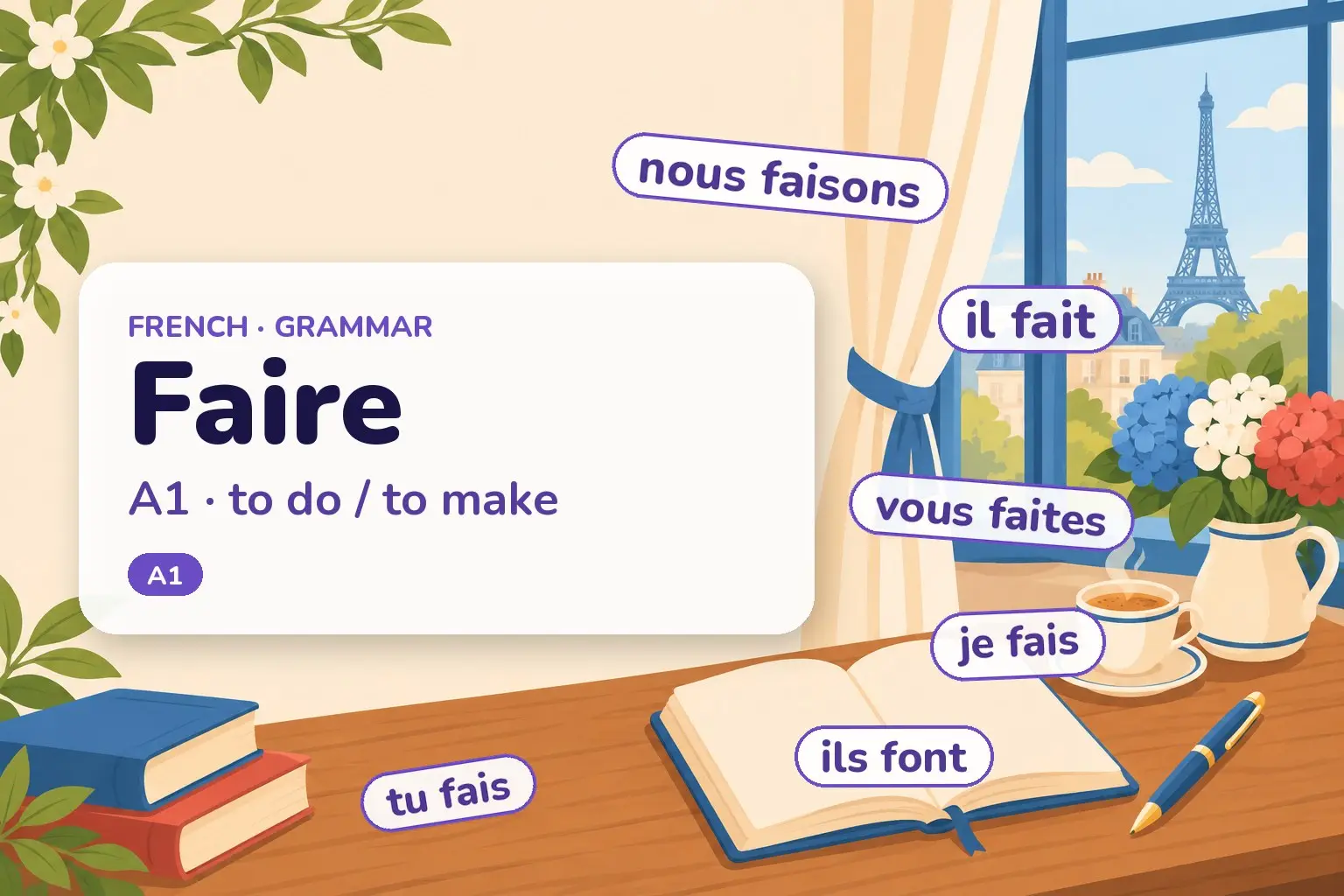
Faire means to do or to make and is irregular: je fais, tu fais, il/elle fait, nous faisons, vous faites, ils/elles font. It also drives set phrases for weather (il fait beau) and activities (faire du sport, faire les courses).
Level: A1. Faire means to do or to make, and it is one of the busiest verbs in French. Beyond those two meanings it powers a long list of fixed phrases — the weather, sports, chores and homework — so you meet it every day. It is irregular, and two of its forms catch almost everyone out.
The rule
A verb is a word for an action or a state; the set of forms it takes for each subject is its conjugation. Faire belongs to the irregular verbs, so you cannot build it from a tidy stem-plus-ending rule — you learn the six present forms directly.
Most of them look regular enough: je fais, tu fais, il fait. The trouble is the last two. Vous faites does not follow the usual -ez ending (it is faites, not faisez), and ils font is a short, one-syllable form, not fontent. These two are shared with only a handful of other verbs (dire → vous dites, être → vous êtes), so fixing them early pays off.
Faire also works like a container for set expressions. Where English picks a specific verb — “to go shopping”, “to cook”, “to pay attention”, “it is sunny” — French very often reaches for faire instead: faire les courses, faire la cuisine, faire attention, il fait beau.
Forms
| Subject | faire | Meaning |
|---|---|---|
| je | fais | I do / make |
| tu | fais | you do / make (informal sg) |
| il / elle / on | fait | he / she / one does / makes |
| nous | faisons | we do / make |
| vous | faites | you do / make (polite / pl) |
| ils / elles | font | they do / make |
How to say it
French spelling hides a few of these sounds; three are worth care:
| Form | How to say it |
|---|---|
| fais / fait | Both say “feh” (like the e in “bed”); the final -s and -t are silent, so je fais and il fait sound almost the same. |
| faisons | The ai here is a mute “e”, so it is “fuh-ZON” — roughly fe-zon, never “fay-zon”. This is the form learners mispronounce most. |
| faites | Say “fet”, one syllable, the final -es silent — like the English word “fet(ch)” without the ch. |
| font | A nasal “foh(n)”, the -t silent: ils font ≈ “eel foh(n)”. |
Example sentences
- Je fais mes devoirs.I am doing my homework.faire for homework
- Tu fais du sport ?Do you do sport / exercise?faire du + activity
- Il fait la cuisine ce soir.He is cooking this evening.faire la cuisine = to cook
- Elle fait les courses au marché.She does the grocery shopping at the market.
- Nous faisons une promenade.We are taking a walk.nous faisons, the tricky form
- Vous faites attention ?Are you paying attention / being careful?vous faites, not faisez
- Ils font la vaisselle après le dîner.They do the dishes after dinner.ils font, not fontent
- Quel temps fait-il aujourd'hui ?What is the weather like today?weather uses faire
- Il fait beau à Paris.The weather is nice in Paris.il fait beau
- Il fait froid en hiver.It is cold in winter.
- Je fais du vélo le week-end.I cycle at the weekend.faire du vélo
- On fait le ménage le samedi.We do the housework on Saturdays.on = we, takes fait
- Que fais-tu ce soir ?What are you doing tonight?
- Les enfants font leurs devoirs.The children are doing their homework.
- Nous faisons de la musique ensemble.We make music together.
- Vous faites un gâteau ?Are you making a cake?
- Elle fait de la natation deux fois par semaine.She swims twice a week.faire de la + activity
- Je ne fais rien aujourd'hui.I am not doing anything today.negative: ne … rien
Common mistakes
- ❌ Vous faisez attention → ✅ Vous faites attention. Faire does not take the regular -ez; the form is faites.
- ❌ Ils fontent la cuisine → ✅ Ils font la cuisine. Ils/elles font is already the full form — nothing is added.
- ❌ Nous faitons → ✅ Nous faisons. The nous form keeps the fais- spelling, said “fe-zon”.
- ❌ Il fais du sport → ✅ Il fait du sport. Fais is for je/tu; il/elle/on takes fait.
- ❌ Je fai mes devoirs → ✅ Je fais mes devoirs. The je form keeps the final -s.
- ❌ Il est beau for “the weather is nice” → ✅ Il fait beau. Weather uses faire, not être.
A short conversation
— Qu’est-ce que tu fais ce week-end ? — Je fais du vélo samedi, et nous faisons les courses dimanche. Et vous ? — Nous ne faisons rien ! Les enfants font leurs devoirs, c’est tout.
Usage notes
- Faire = “do” and “make”. French does not split the two the way English does: faire un gâteau (make a cake), faire une erreur (make a mistake), faire le travail (do the work) all use the one verb.
- Activities take faire + a partitive. To talk about a sport or hobby you practise, use faire du / de la / de l’: faire du tennis, faire de la danse, faire de l’escalade. The little word after faire matches the gender of the activity.
- Weather is impersonal. Il fait beau has no real “it”; the il is a dummy subject, the same il as in il pleut (it is raining).
- The negative wraps the verb. Put ne … pas (or ne … rien, “nothing”) around faire: Je ne fais pas la cuisine, Elle ne fait rien.
Compared with…
- Faire causatif (faire + another verb) means to have something done by someone else, not to do it yourself: Je fais réparer ma voiture (I am having my car repaired), Elle fait couper ses cheveux (She is getting her hair cut). Same conjugation, different job — you will meet it beyond A1 in the French grammar section.
- Être and avoir cover states and possession, while faire covers doing and making. Compare il est médecin (he is a doctor) with il fait de la médecine (he studies / practises medicine). Review the verb être and the verb avoir.
- Make sure you know the French subject pronouns je, tu, il… before you drill faire.
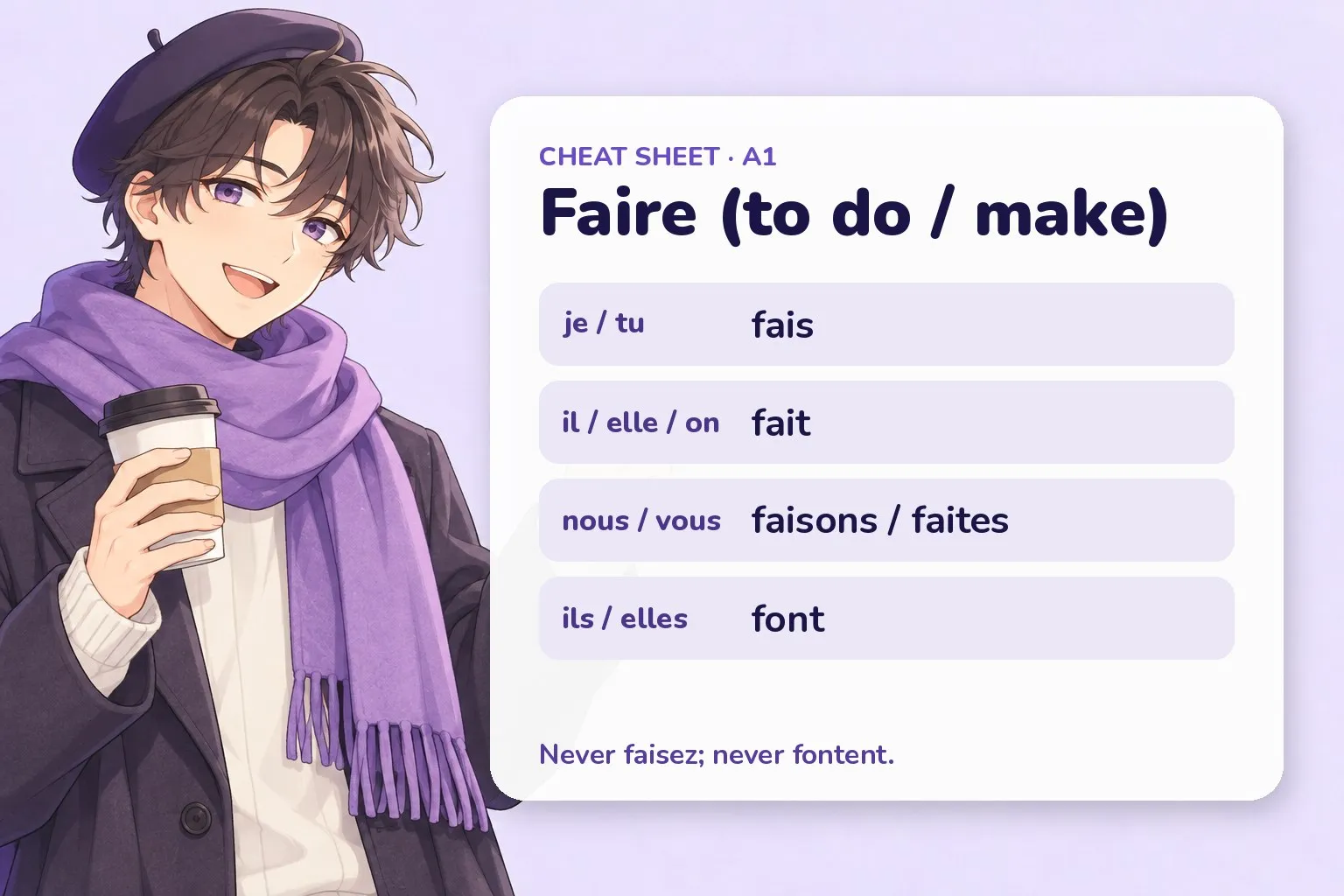
Quick recap before the quiz.
Practice
Faire practice
Try each one, then press Check. No sign-up, nothing is sent anywhere — it all runs in your browser.
Hint: the nous form of faire, said fe-zon
Show answer
faisons — nous faisons les courses — nous takes faisons.
3 Build: 'They are doing the dishes.'
Show answer
Ils font la vaisselle — Ils font la vaisselle — ils/elles takes font.
4 Match each subject to its form of faire.
- je
- il
- nous
- vous
Show answer
- je → fais
- il → fait
- nous → faisons
- vous → faites
je fais, il fait, nous faisons, vous faites.
Hint: one short syllable
Show answer
font — ils font leurs devoirs — font, never fontent.
Quiz
The verb faire
13 questions · pick an answer and you'll see straight away if it's right.
-
Show answer
fais — je fais (with a silent -s).
-
Show answer
fais — tu fais.
-
Show answer
fait — il/elle/on fait.
-
Show answer
faisons — nous faisons, said fe-zon.
-
Show answer
faites — vous faites — an irregular form, never faisez.
-
Show answer
font — ils/elles font.
-
Show answer
Il fait la cuisine. — il fait la cuisine — faire for cooking.
-
Show answer
Quel temps fait-il aujourd'hui ? — Weather questions use faire: Quel temps fait-il ?
-
Show answer
fais — je fais du sport.
-
Show answer
Ils faisont la vaisselle. — It should be ils font la vaisselle, not faisont.
-
Show answer
faire + du/de la introduces an activity — Activities take faire + du / de la / de l': faire du tennis.
-
Show answer
I am having my car repaired — faire + another verb (causative) = to have something done by someone else.
-
Show answer
fais — Je ne fais rien — ne … rien wraps the verb.
Recap cheat-sheet
| Subject | faire | Note |
|---|---|---|
| je / tu | fais | silent final -s |
| il / elle / on | fait | on = everyday ‘we’ |
| nous | faisons | said fe-zon |
| vous | faites | never faisez |
| ils / elles | font | never fontent |
Next
- Next grammar point: review the verb avoir
- Back to the French grammar section
- New here? Start with Start Learning French Here
All French grammar topics
Every grammar point in order, from your first sentence to advanced structures. Pick one and go straight to it. New lessons go live every day, so topics marked Coming soon fill in over the next weeks.
Grammar path
A1 32 topics · 13 ready
- 01 Definite Articles: le, la, les, l'
- 02 Indefinite Articles: un, une, des
- 03 Partitive Articles: du, de la, des
- 04 Noun Gender in French
- 05 Forming Plurals in French
- 06 Subject Pronouns (je, tu, il, nous, vous)
- 07 The Verb Être (To Be) - Present
- 08 The Verb Avoir (To Have) - Present
- 09 Present Tense: -ER Verbs
- 10 Present Tense: -IR Verbs (finir)
- 11 Present Tense: -RE Verbs (vendre)
- 12 Aller + Near Future (futur proche)
- 13 The Verb Faire (To Do/Make) You are here
- 14 Negation: ne...pas Coming soon
- 15 Asking Questions (est-ce que, inversion) Coming soon
- 16 Adjective Agreement (Gender & Number) Coming soon
- 17 Position of Adjectives (BAGS) Coming soon
- 18 Possessive Adjectives (mon, ma, mes) Coming soon
- 19 Demonstrative Adjectives (ce, cette, ces) Coming soon
- 20 C'est vs Il/Elle Est Coming soon
- 21 Il Y A (There Is / There Are) Coming soon
- 22 Contractions: au, aux, du, des (à/de + le) Coming soon
- 23 Question Words (qui, que, où, quand, comment) Coming soon
- 24 Vouloir, Pouvoir, Devoir (Present) Coming soon
- 25 Aimer / Préférer + Infinitive (Preferences) Coming soon
- 26 Pronominal (Reflexive) Verbs - Present Coming soon
- 27 The Imperative (Commands) Coming soon
- 28 Venir and Venir De (Recent Past) Coming soon
- 29 Prepositions with Places (à, en, au, aux) Coming soon
- 30 Expressions with Avoir (avoir faim, avoir 20 ans) Coming soon
- 31 Prepositions of Time (à, en, dans, depuis) Coming soon
- 32 Weather & Impersonal Expressions (il fait, il pleut) Coming soon
A2 26 topics
- 33 Passé Composé with Avoir Coming soon
- 34 Passé Composé with Être (+ agreement) Coming soon
- 35 The Imperfect Tense (imparfait) Coming soon
- 36 Passé Composé vs Imparfait Coming soon
- 37 The Simple Future (futur simple) Coming soon
- 38 Direct Object Pronouns (le, la, les) Coming soon
- 39 Indirect Object Pronouns (lui, leur) Coming soon
- 40 The Pronoun Y Coming soon
- 41 The Pronoun En Coming soon
- 42 Comparatives (plus, moins, aussi ... que) Coming soon
- 43 Superlatives (le plus, le moins) Coming soon
- 44 Forming Adverbs in -ment Coming soon
- 45 Depuis, Pendant, Il Y A, Pour (Time) Coming soon
- 46 Partitive & Articles in the Negative (de) Coming soon
- 47 Expressions of Quantity (beaucoup de, trop de) Coming soon
- 48 Pronominal Verbs in Passé Composé Coming soon
- 49 Stressed (Disjunctive) Pronouns (moi, toi, lui) Coming soon
- 50 Possessive Pronouns (le mien, la tienne) Coming soon
- 51 Object Pronoun Placement & Order Coming soon
- 52 Adverb Position in French Coming soon
- 53 Savoir vs Connaître (Two Ways to Know) Coming soon
- 54 Il Faut + Infinitive (Necessity) Coming soon
- 55 Verbs + à / de + Infinitive Coming soon
- 56 Comparing Quantities (plus de ... que) Coming soon
- 57 Adverbs of Frequency (souvent, toujours, jamais) Coming soon
- 58 Quel in Exclamations (Quel beau jour!) Coming soon
B1 24 topics
- 59 The Present Conditional Coming soon
- 60 The Present Subjunctive: Formation Coming soon
- 61 Subjunctive After Will & Necessity (il faut que) Coming soon
- 62 Subjunctive After Emotion & Opinion Coming soon
- 63 The Pluperfect (plus-que-parfait) Coming soon
- 64 The Future Perfect (futur antérieur) Coming soon
- 65 The Past Conditional (conditionnel passé) Coming soon
- 66 Si Clauses (Conditional Sentences) Coming soon
- 67 Relative Pronouns: qui, que, où, dont Coming soon
- 68 Order of Double Object Pronouns Coming soon
- 69 The Gérondif (en + -ant) Coming soon
- 70 The Present Participle (-ant) Coming soon
- 71 Reported Speech (discours indirect) Coming soon
- 72 Irregular Comparatives (meilleur, pire, mieux) Coming soon
- 73 Demonstrative Pronouns (celui, celle, ceux) Coming soon
- 74 The Causative Faire (faire faire) Coming soon
- 75 Depuis Que & Time Conjunctions Coming soon
- 76 Être en Train de / Sur le Point de Coming soon
- 77 Varied Negations (ne...jamais/rien/personne/plus) Coming soon
- 78 Y and En with Verbs (penser à / parler de) Coming soon
- 79 The Past Infinitive (après avoir fait) Coming soon
- 80 Tout: Adjective, Pronoun and Adverb Coming soon
- 81 Types of Pronominal Verbs (reflexive, reciprocal, idiomatic) Coming soon
- 82 Expressing Opinion (à mon avis, trouver que) Coming soon
B2 20 topics
- 83 The Past Subjunctive (subjonctif passé) Coming soon
- 84 Subjunctive After Conjunctions (bien que, pour que) Coming soon
- 85 Subjunctive vs Indicative (penser que, espérer) Coming soon
- 86 Sequence of Tenses (concordance des temps) Coming soon
- 87 The Passé Simple (Recognition) Coming soon
- 88 The Passive Voice (voix passive) Coming soon
- 89 Reported Speech in the Past Coming soon
- 90 Compound Relatives (lequel, auquel, duquel) Coming soon
- 91 Past Participle Agreement with Avoir Coming soon
- 92 Participle Agreement: Pronominal Verbs Coming soon
- 93 Expressing Opposition & Concession (bien que, malgré) Coming soon
- 94 Expressing Cause (parce que, puisque, comme, car) Coming soon
- 95 Expressing Consequence (donc, si bien que, tellement) Coming soon
- 96 Expressing Purpose (pour que, afin de, de peur que) Coming soon
- 97 Highlighting: C'est...qui / C'est...que Coming soon
- 98 Indefinite Adjectives (tout, chaque, quelques) Coming soon
- 99 Indefinite Pronouns (quelqu'un, chacun, certains) Coming soon
- 100 Verbs + Preposition + Noun (penser à, dépendre de) Coming soon
- 101 Verbs of Perception + Infinitive (je le vois arriver) Coming soon
- 102 When to Omit the Article Coming soon
C1 14 topics
- 103 The Imperfect Subjunctive (Literary) Coming soon
- 104 The Passé Antérieur (Literary) Coming soon
- 105 Sequence of Tenses with the Subjunctive Coming soon
- 106 The Expletive Ne (ne explétif) Coming soon
- 107 Restriction & Only (ne...que, ne faire que) Coming soon
- 108 Stylistic & Interrogative Inversion Coming soon
- 109 Advanced Logical Connectors (néanmoins, en revanche) Coming soon
- 110 Nominalisation (Formal/Press Style) Coming soon
- 111 Advanced Hypothesis (au cas où, à moins que) Coming soon
- 112 The Pronominal Passive (se + verb) Coming soon
- 113 Subjunctive in Relative Clauses (le seul qui...) Coming soon
- 114 Absolute & Participial Constructions (Le travail terminé) Coming soon
- 115 Registers: Soutenu, Courant, Familier Coming soon
- 116 Proportional & Advanced Comparison (plus...plus) Coming soon