French Adjective Agreement: Gender and Number
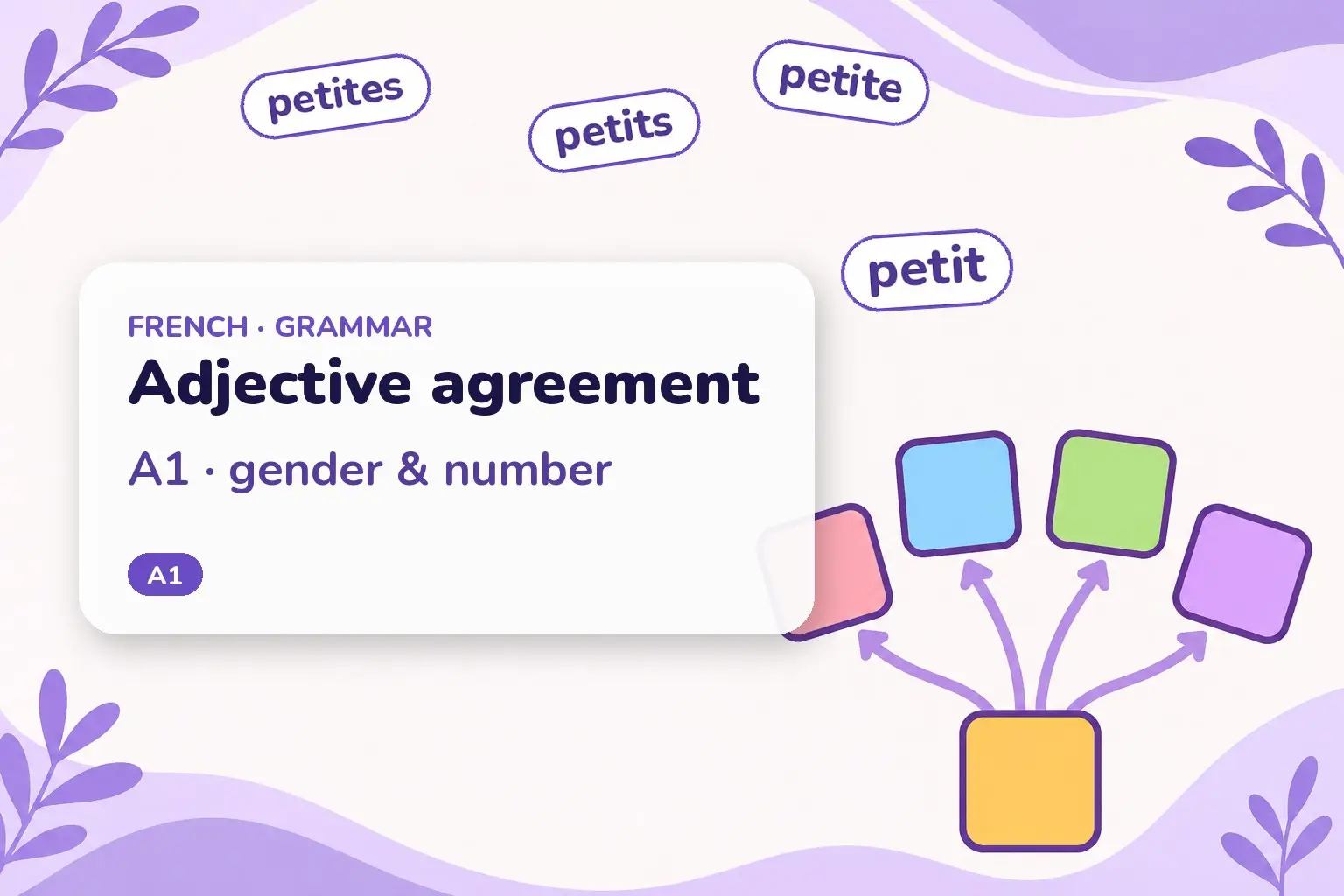
A French adjective changes to match its noun in gender and number: add -e for feminine and -s for plural. Un petit chat, une petite table, des petits chats, des petites tables — four forms from one base word.
Level: A1. In French an adjective — a describing word like petit (“small”) — is not fixed. It changes its ending to agree with the noun it describes, in both gender (masculine or feminine) and number (singular or plural). So one base word, petit, gives you four written forms: petit, petite, petits, petites. This page shows the regular rule and the handful of irregular patterns worth memorising.
The rule
Gender is whether a noun is treated as masculine or feminine; number is whether it is singular or plural. A French adjective copies both from its noun. Start from the masculine singular — the form you find in a dictionary — and build the others:
- Feminine: add -e. grand → grande, petit → petite.
- Plural: add -s. grand → grands, grande → grandes.
- Feminine plural: add both, giving -es. petite → petites.
Two base shapes need no change. If the adjective already ends in an unaccented -e, the feminine is identical: rouge (“red”) is rouge for both genders. If the masculine already ends in -s or -x, the masculine plural adds nothing: un gros sac → des gros sacs.
Most of these endings are silent in speech, so agreement is mainly a writing skill — but the feminine -e often makes a hidden consonant sound: petit ends in a silent “t,” while petite makes the “t” heard.
The regular paradigm
| Base (m sg) | Feminine | Masc plural | Fem plural |
|---|---|---|---|
| petit | petite | petits | petites |
| grand | grande | grands | grandes |
| vert (green) | verte | verts | vertes |
| joli (pretty) | jolie | jolis | jolies |
| rouge | rouge | rouges | rouges |
| gros | grosse | gros | grosses |
The irregular feminines
Several endings change their shape, not just add -e. Learn them as sets:
| Masculine ending | Feminine | Example |
|---|---|---|
| -eux | -euse | heureux → heureuse (happy) |
| -f | -ve | sportif → sportive (sporty) |
| -er | -ère | cher → chère (dear) |
| -el | -elle | naturel → naturelle (natural) |
| -on | -onne | bon → bonne (good) |
| -en | -enne | ancien → ancienne (former/old) |
A few very common adjectives are simply irregular and must be learned whole: beau / belle (beautiful), nouveau / nouvelle (new), vieux / vieille (old), blanc / blanche (white), long / longue (long).
Example sentences
- un petit chata small catmasculine singular, base form
- une petite tablea small tablefeminine: + e
- des petits chatssmall catsmasculine plural: + s
- des petites tablessmall tablesfeminine plural: + es
- une voiture vertea green car
- des yeux vertsgreen eyes
- une jolie maisona pretty house
- un pull rougea red jumperrouge: no change for gender
- une robe rougea red dress
- une femme heureusea happy woman-eux → -euse
- une fille sportivea sporty girl-f → -ve
- ma chère amiemy dear friend (f)-er → -ère
- une bonne idéea good ideabon → bonne
- une belle journéea beautiful dayirregular: beau → belle
- la chemise blanchethe white shirtblanc → blanche
- Les enfants sont contents.The children are happy.agrees with the plural subject
- Elles sont grandes.They (f) are tall.feminine plural after être
- un gros sac, des gros sacsa big bag, big bags-s/-x: no extra -s in the plural
Common mistakes
- ❌ une maison blanc → ✅ une maison blanche. Maison is feminine, so the adjective takes the feminine form.
- ❌ des chats noir → ✅ des chats noirs. A plural noun needs the plural -s on the adjective too.
- ❌ une fille heureux → ✅ une fille heureuse. The ending -eux becomes -euse, not a plain -euxe.
- ❌ une rouge voiture → ✅ une voiture rouge. Agreement is correct here; most short adjectives also come after the noun (that is a separate rule).
- ❌ elles sont grand → ✅ elles sont grandes. After être, the adjective agrees with the subject: feminine plural.
A short conversation
— Tu aimes la nouvelle voiture ? — Do you like the new car? — Oui, elle est belle et rapide. — Yes, it’s beautiful and fast. — Et les sièges ? — And the seats? — Ils sont confortables et blancs. — They’re comfortable and white.
Usage notes
- The base form is masculine singular. Dictionaries list grand, heureux, beau; build the other three forms from there.
- -e already there? No second -e: jeune (“young”), rouge, facile (“easy”) look the same for masculine and feminine.
- Colour words can be invariable. Colours from nouns, like orange and marron (“chestnut/brown”), usually do not agree: des chaussures marron.
- Agreement reaches across the verb. With être, sembler (“to seem”) and similar verbs, the adjective still matches the subject: la soupe est chaude, les soupes sont chaudes.
Compared with adjective position
Agreement decides the ending; a separate rule decides the place. Most French adjectives follow the noun — une voiture rouge — while a small set of short, common ones (petit, grand, beau, bon, nouveau, vieux, joli) come before it: une petite voiture. Position does not change agreement: the adjective still matches gender and number wherever it sits. First make sure you know noun gender and how to form the plural of nouns, since the adjective copies both; then see how describing words behave after the verb être.
Quick recap before you practise.
Practice
Adjective agreement practice
Try each one, then press Check. No sign-up, nothing is sent anywhere — it all runs in your browser.
Hint: masculine plural
Show answer
noirs — Plural masculine adds -s: des chats noirs.
3 Build: 'a green car' (voiture is feminine)
Show answer
une voiture verte — une voiture verte — feminine -e, and the colour follows the noun.
4 Match each masculine ending to its feminine.
- -eux
- -f
- -er
- -on
Show answer
- -eux → -euse
- -f → -ve
- -er → -ère
- -on → -onne
heureux→heureuse, sportif→sportive, cher→chère, bon→bonne.
Quiz
French adjective agreement
12 questions · pick an answer and you'll see straight away if it's right.
-
Show answer
gender and number — It matches its noun in gender and number.
-
Show answer
grande — Add -e: grand → grande.
-
Show answer
petits — Add -s: petit → petits.
-
Show answer
does not change — rouge stays rouge for both genders.
-
Show answer
gros — A masculine adjective ending in -s or -x adds no plural -s: gros.
-
Show answer
heureuse — -eux becomes -euse: heureuse.
-
Show answer
sportive — -f becomes -ve: sportive.
-
Show answer
chère — -er becomes -ère: chère.
-
Show answer
une maison blanche — blanc → blanche for a feminine noun.
-
Show answer
the subject — la soupe est chaude; les soupes sont chaudes.
-
Show answer
contents — A mixed group takes the masculine plural: contents.
-
Show answer
the plural needs -s: noirs — The adjective must take the plural -s: des chats noirs.
Recap cheat-sheet
| Form | Add | Example |
|---|---|---|
| Feminine | -e | petit → petite |
| Plural | -s | petit → petits |
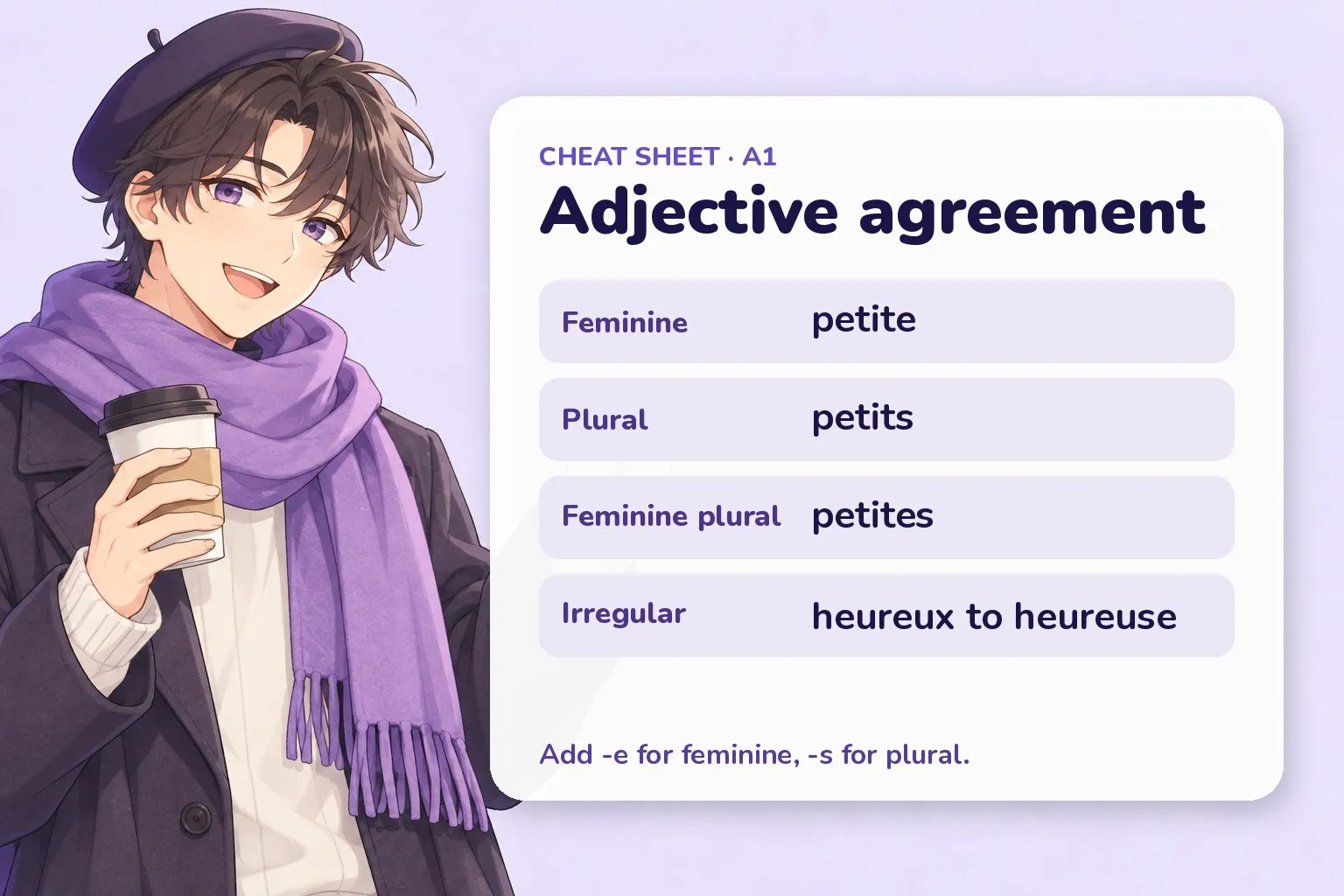
| Feminine plural | -es | petite → petites |
| Already -e | nothing | rouge → rouge |
| Masc -s / -x | no plural -s | gros → gros |
Next
- Next, learn where adjectives sit in the verb être descriptions
- Back to the French grammar section
- New here? Start with Start Learning French Here
All French grammar topics
Every grammar point in order, from your first sentence to advanced structures. Pick one and go straight to it. New lessons go live every day, so topics marked Coming soon fill in over the next weeks.
Grammar path
A1 32 topics · 21 ready
- 01 Definite Articles: le, la, les, l'
- 02 Indefinite Articles: un, une, des
- 03 Partitive Articles: du, de la, des
- 04 Noun Gender in French
- 05 Forming Plurals in French
- 06 Subject Pronouns (je, tu, il, nous, vous)
- 07 The Verb Être (To Be) - Present
- 08 The Verb Avoir (To Have) - Present
- 09 Present Tense: -ER Verbs
- 10 Present Tense: -IR Verbs (finir)
- 11 Present Tense: -RE Verbs (vendre)
- 12 Aller + Near Future (futur proche)
- 13 The Verb Faire (To Do/Make)
- 14 Negation: ne...pas
- 15 Asking Questions (est-ce que, inversion)
- 16 Adjective Agreement (Gender & Number) You are here
- 17 Position of Adjectives (BAGS)
- 18 Possessive Adjectives (mon, ma, mes)
- 19 Demonstrative Adjectives (ce, cette, ces)
- 20 C'est vs Il/Elle Est
- 21 Il Y A (There Is / There Are)
- 22 Contractions: au, aux, du, des (à/de + le) Coming soon
- 23 Question Words (qui, que, où, quand, comment) Coming soon
- 24 Vouloir, Pouvoir, Devoir (Present) Coming soon
- 25 Aimer / Préférer + Infinitive (Preferences) Coming soon
- 26 Pronominal (Reflexive) Verbs - Present Coming soon
- 27 The Imperative (Commands) Coming soon
- 28 Venir and Venir De (Recent Past) Coming soon
- 29 Prepositions with Places (à, en, au, aux) Coming soon
- 30 Expressions with Avoir (avoir faim, avoir 20 ans) Coming soon
- 31 Prepositions of Time (à, en, dans, depuis) Coming soon
- 32 Weather & Impersonal Expressions (il fait, il pleut) Coming soon
A2 26 topics
- 33 Passé Composé with Avoir Coming soon
- 34 Passé Composé with Être (+ agreement) Coming soon
- 35 The Imperfect Tense (imparfait) Coming soon
- 36 Passé Composé vs Imparfait Coming soon
- 37 The Simple Future (futur simple) Coming soon
- 38 Direct Object Pronouns (le, la, les) Coming soon
- 39 Indirect Object Pronouns (lui, leur) Coming soon
- 40 The Pronoun Y Coming soon
- 41 The Pronoun En Coming soon
- 42 Comparatives (plus, moins, aussi ... que) Coming soon
- 43 Superlatives (le plus, le moins) Coming soon
- 44 Forming Adverbs in -ment Coming soon
- 45 Depuis, Pendant, Il Y A, Pour (Time) Coming soon
- 46 Partitive & Articles in the Negative (de) Coming soon
- 47 Expressions of Quantity (beaucoup de, trop de) Coming soon
- 48 Pronominal Verbs in Passé Composé Coming soon
- 49 Stressed (Disjunctive) Pronouns (moi, toi, lui) Coming soon
- 50 Possessive Pronouns (le mien, la tienne) Coming soon
- 51 Object Pronoun Placement & Order Coming soon
- 52 Adverb Position in French Coming soon
- 53 Savoir vs Connaître (Two Ways to Know) Coming soon
- 54 Il Faut + Infinitive (Necessity) Coming soon
- 55 Verbs + à / de + Infinitive Coming soon
- 56 Comparing Quantities (plus de ... que) Coming soon
- 57 Adverbs of Frequency (souvent, toujours, jamais) Coming soon
- 58 Quel in Exclamations (Quel beau jour!) Coming soon
B1 24 topics
- 59 The Present Conditional Coming soon
- 60 The Present Subjunctive: Formation Coming soon
- 61 Subjunctive After Will & Necessity (il faut que) Coming soon
- 62 Subjunctive After Emotion & Opinion Coming soon
- 63 The Pluperfect (plus-que-parfait) Coming soon
- 64 The Future Perfect (futur antérieur) Coming soon
- 65 The Past Conditional (conditionnel passé) Coming soon
- 66 Si Clauses (Conditional Sentences) Coming soon
- 67 Relative Pronouns: qui, que, où, dont Coming soon
- 68 Order of Double Object Pronouns Coming soon
- 69 The Gérondif (en + -ant) Coming soon
- 70 The Present Participle (-ant) Coming soon
- 71 Reported Speech (discours indirect) Coming soon
- 72 Irregular Comparatives (meilleur, pire, mieux) Coming soon
- 73 Demonstrative Pronouns (celui, celle, ceux) Coming soon
- 74 The Causative Faire (faire faire) Coming soon
- 75 Depuis Que & Time Conjunctions Coming soon
- 76 Être en Train de / Sur le Point de Coming soon
- 77 Varied Negations (ne...jamais/rien/personne/plus) Coming soon
- 78 Y and En with Verbs (penser à / parler de) Coming soon
- 79 The Past Infinitive (après avoir fait) Coming soon
- 80 Tout: Adjective, Pronoun and Adverb Coming soon
- 81 Types of Pronominal Verbs (reflexive, reciprocal, idiomatic) Coming soon
- 82 Expressing Opinion (à mon avis, trouver que) Coming soon
B2 20 topics
- 83 The Past Subjunctive (subjonctif passé) Coming soon
- 84 Subjunctive After Conjunctions (bien que, pour que) Coming soon
- 85 Subjunctive vs Indicative (penser que, espérer) Coming soon
- 86 Sequence of Tenses (concordance des temps) Coming soon
- 87 The Passé Simple (Recognition) Coming soon
- 88 The Passive Voice (voix passive) Coming soon
- 89 Reported Speech in the Past Coming soon
- 90 Compound Relatives (lequel, auquel, duquel) Coming soon
- 91 Past Participle Agreement with Avoir Coming soon
- 92 Participle Agreement: Pronominal Verbs Coming soon
- 93 Expressing Opposition & Concession (bien que, malgré) Coming soon
- 94 Expressing Cause (parce que, puisque, comme, car) Coming soon
- 95 Expressing Consequence (donc, si bien que, tellement) Coming soon
- 96 Expressing Purpose (pour que, afin de, de peur que) Coming soon
- 97 Highlighting: C'est...qui / C'est...que Coming soon
- 98 Indefinite Adjectives (tout, chaque, quelques) Coming soon
- 99 Indefinite Pronouns (quelqu'un, chacun, certains) Coming soon
- 100 Verbs + Preposition + Noun (penser à, dépendre de) Coming soon
- 101 Verbs of Perception + Infinitive (je le vois arriver) Coming soon
- 102 When to Omit the Article Coming soon
C1 14 topics
- 103 The Imperfect Subjunctive (Literary) Coming soon
- 104 The Passé Antérieur (Literary) Coming soon
- 105 Sequence of Tenses with the Subjunctive Coming soon
- 106 The Expletive Ne (ne explétif) Coming soon
- 107 Restriction & Only (ne...que, ne faire que) Coming soon
- 108 Stylistic & Interrogative Inversion Coming soon
- 109 Advanced Logical Connectors (néanmoins, en revanche) Coming soon
- 110 Nominalisation (Formal/Press Style) Coming soon
- 111 Advanced Hypothesis (au cas où, à moins que) Coming soon
- 112 The Pronominal Passive (se + verb) Coming soon
- 113 Subjunctive in Relative Clauses (le seul qui...) Coming soon
- 114 Absolute & Participial Constructions (Le travail terminé) Coming soon
- 115 Registers: Soutenu, Courant, Familier Coming soon
- 116 Proportional & Advanced Comparison (plus...plus) Coming soon