French Demonstrative Adjectives (ce, cette, ces)
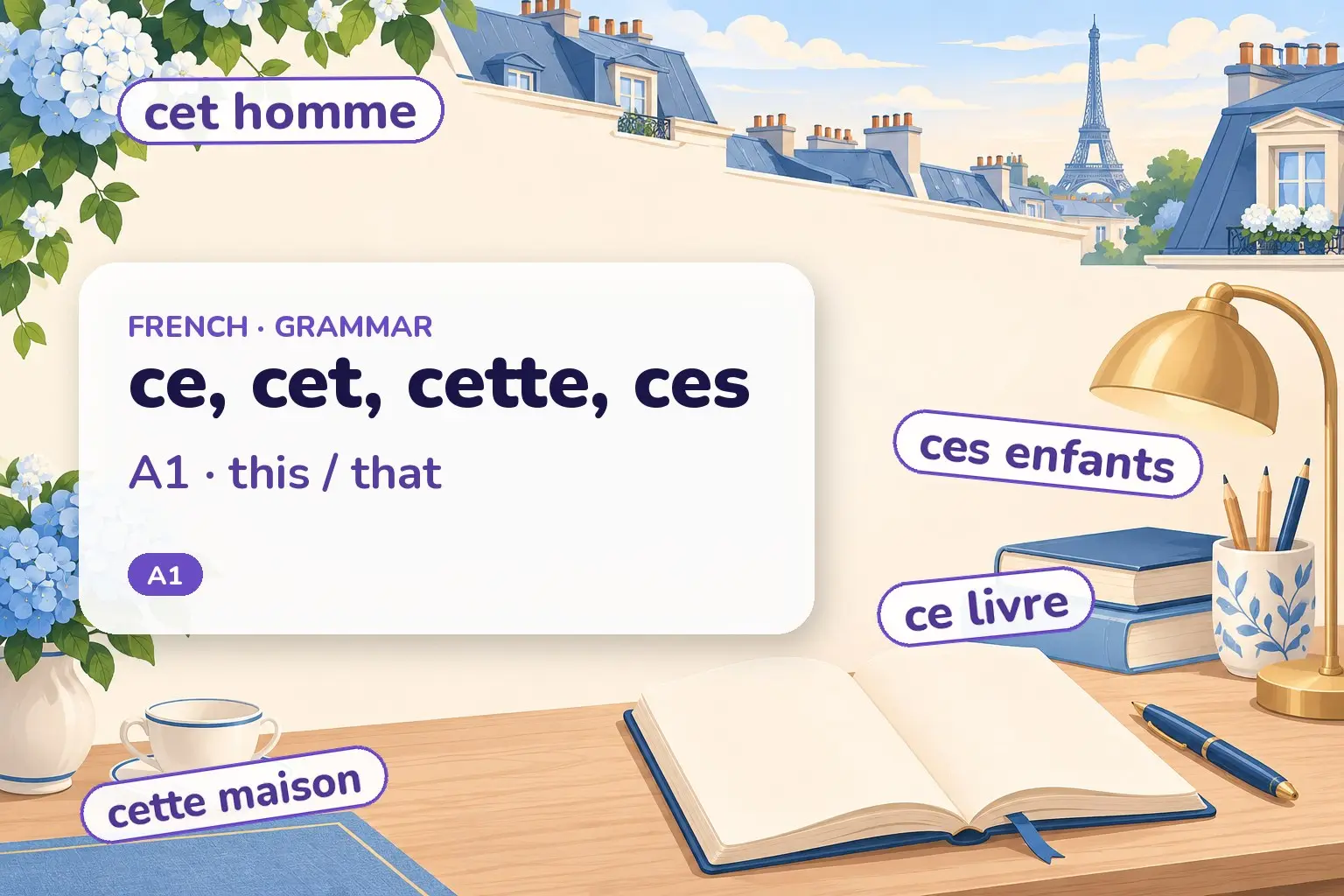
French demonstrative adjectives mean 'this' or 'that' and agree with the noun: ce (masculine), cette (feminine), ces (plural). Before a masculine noun starting with a vowel or mute h, use cet: cet homme. For contrast add -ci (here) or -là (there).
Level: A1. A demonstrative adjective points something out — this book, that house, these children. In French it sits where le or la would go, and it agrees with the noun in gender and number. “This / that book” is ce livre; “this / that house” is cette maison.
The rule
A demonstrative adjective replaces the article in front of a noun and matches it in gender and number. There are four forms:
- ce — before a masculine singular noun starting with a consonant: ce livre (this book), ce garçon (this boy).
- cet — before a masculine singular noun starting with a vowel or a mute h: cet homme (this man), cet arbre (this tree), cet hôtel (this hotel).
- cette — before any feminine singular noun: cette maison (this house), cette femme (this woman), cette école (this school).
- ces — before any plural noun, masculine or feminine: ces livres, ces maisons, ces enfants.
The extra form cet exists only for sound: ce homme would clash two awkward sounds, so French uses cet to glide into the vowel.
The forms
| Consonant start | Vowel / mute-h start | |
|---|---|---|
| masculine singular | ce (ce livre) | cet (cet homme) |
| feminine singular | cette (cette maison) | cette (cette école) |
| plural (all) | ces (ces livres) | ces (ces amis) |
Notice that the feminine cette does not change before a vowel, and the plural ces never changes at all.
This vs that: -ci and -là
To force the difference between this (near) and that (far), attach -ci (here) or -là (there) to the noun with a hyphen:
- ce livre-ci — this book (here)
- ce livre-là — that book (there)
- cette maison-là — that house (over there)
In everyday French, -là is far more common than -ci, and is often used even for things that are close.
Example sentences
Each example was written for this lesson.
- Ce livre est intéressant.This book is interesting.livre m, consonant → ce
- Ce garçon est petit.This boy is small.garçon m → ce
- Cet homme est grand.This man is tall.homme m + mute h → cet
- Cet arbre est vieux.This tree is old.arbre m + vowel → cet
- Cet hôtel est cher.This hotel is expensive.hôtel m + mute h → cet
- Cette maison est belle.This house is beautiful.maison f → cette
- Cette femme parle français.This woman speaks French.femme f → cette
- Cette école est grande.This school is big.école f + vowel → still cette
- Ces livres sont lourds.These books are heavy.plural → ces
- Ces enfants jouent dans le parc.These children are playing in the park.plural → ces
- Ces amies sont gentilles.These (female) friends are kind.feminine plural → ces
- Je préfère ce café.I prefer this coffee.café m → ce
- Regarde cette voiture !Look at this car!voiture f → cette
- Qui est cet étudiant ?Who is this student?étudiant m + vowel → cet
- Ce film-ci est meilleur que ce film-là.This film is better than that film.-ci vs -là for contrast
- Je veux cette robe-là.I want that dress.-là marks 'that one'
- Ces fleurs sentent bon.These flowers smell good.plural → ces
Common mistakes
- ❌ ce homme → ✅ cet homme. Before a masculine noun starting with a vowel or mute h, use cet.
- ❌ cet maison → ✅ cette maison. cet is masculine only; a feminine noun takes cette, even before a vowel (cette école).
- ❌ cette livre → ✅ ce livre. livre is masculine, so the masculine ce is correct.
- ❌ ce livres → ✅ ces livres. Any plural noun takes ces.
- ❌ writing cet for a feminine vowel noun: cet amie → ✅ cette amie. Gender wins: amie is feminine.
A short conversation
— Tu aimes ce tableau ? — Oui, mais je préfère cette photo et ces dessins. — Et cet artiste, tu le connais ? — Bien sûr ! Ce peintre-là est très célèbre.
Here ce goes with masculine tableau and peintre, cette with feminine photo, ces with the plural dessins, and cet with vowel-initial artiste.
Usage notes
- It fills the article slot. You use one word, not two: say ce livre, never ce le livre. The demonstrative replaces le/la/les.
- Mute h vs aspirated h. cet appears before a mute h (cet homme, cet hôtel) but not before an aspirated h (ce héros, ce hibou), where the h blocks the link. A dictionary marks which is which.
- -ci and -là need a hyphen. Attach them to the noun: cette fois-ci (this time), ces jours-là (those days).
- Gender first. Because ce vs cette depends entirely on gender, this builds on noun gender in French; if you are unsure of a noun’s gender, learn it with its article from the definite articles le, la, les.
Compared with…
- Possessive adjectives (mon, ma, mes) fill the same slot before the noun but show ownership, not pointing: mon livre (my book) vs ce livre (this book). See French possessive adjectives.
- Demonstrative pronouns (celui, celle, ceux, celles) replace the whole noun instead of sitting before it: Je préfère celui-ci (I prefer this one). A demonstrative adjective needs its noun; a demonstrative pronoun (celui, celle) stands alone instead.
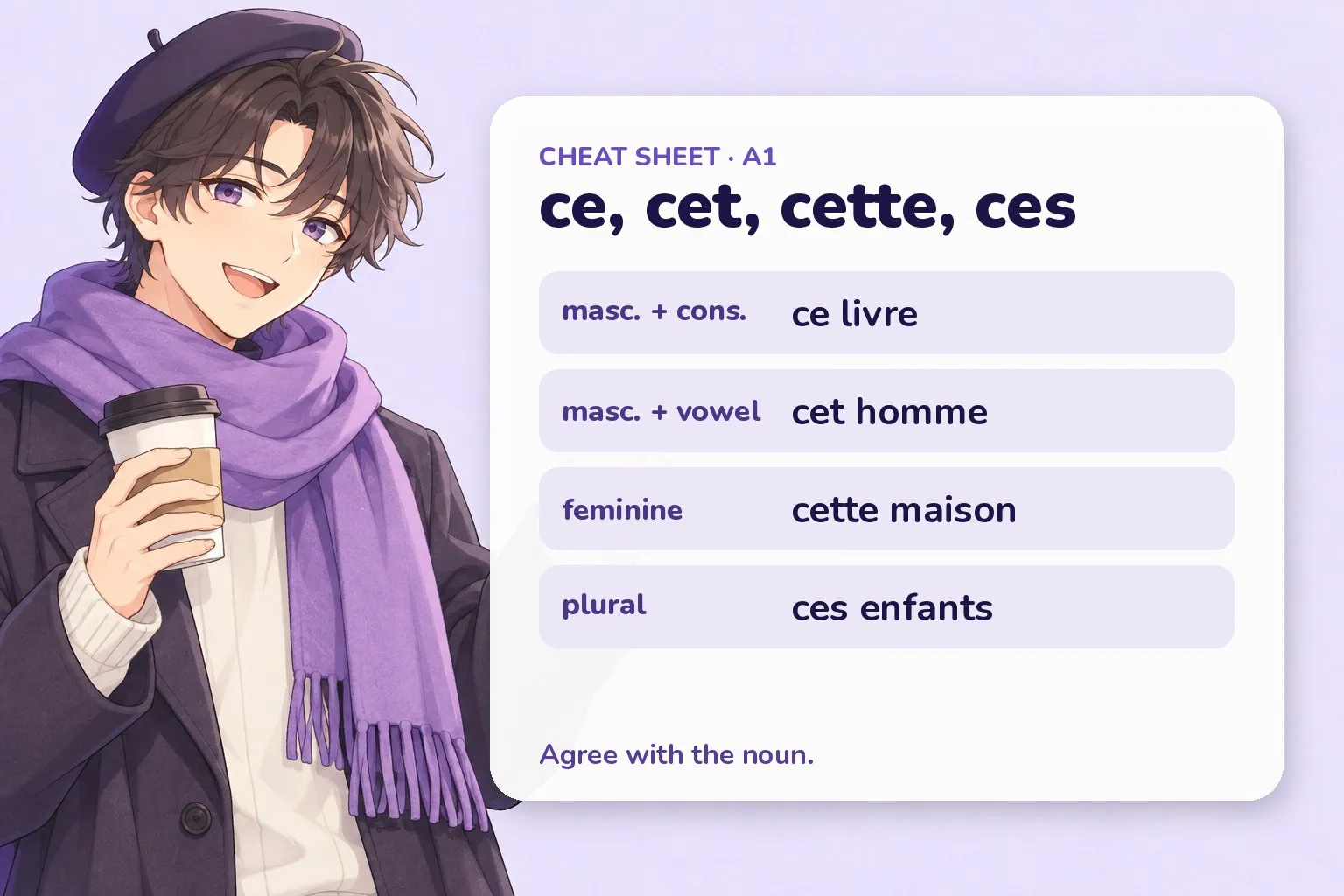
Quick recap before you practise.
Practice
French demonstrative adjectives practice
Try each one, then press Check. No sign-up, nothing is sent anywhere — it all runs in your browser.
Hint: masculine + vowel/mute h
Show answer
cet — Before a masculine vowel-initial noun use cet: cet homme.
4 Match each noun to its demonstrative.
- livre (m, consonant)
- arbre (m, vowel)
- école (f)
- enfants (plural)
Show answer
- livre (m, consonant) → ce
- arbre (m, vowel) → cet
- école (f) → cette
- enfants (plural) → ces
ce = masc consonant, cet = masc vowel, cette = feminine, ces = plural.
5 Order the words: 'I want that dress.'
Show answer
Je veux cette robe-là — cette agrees with feminine robe; -là marks 'that one'.
Quiz
French demonstrative adjectives quiz
11 questions · pick an answer and you'll see straight away if it's right.
-
Show answer
gender and number — It matches the noun in both gender and number: ce/cette/ces.
-
Show answer
ce livre — Masculine singular with a consonant start takes ce: ce livre.
-
Show answer
cet — cet glides into the vowel: cet homme, cet arbre.
-
Show answer
cette maison — Feminine singular takes cette: cette maison.
-
Show answer
ces — ces works for all plurals, masculine or feminine.
-
Show answer
cette école — Feminine stays cette even before a vowel: cette école.
-
Show answer
add -ci (here) and -là (there) — Attach -ci and -là: ce livre-ci vs ce livre-là.
-
Show answer
for sound, before a masculine vowel/mute-h noun — cet replaces ce before a masculine vowel-initial or mute-h noun, for smoother sound.
-
Show answer
no — ce covers both unless you add -ci/-là — ce livre is both; -ci/-là mark the contrast when you need it.
-
Show answer
ce garçon est petit — ce garçon (masc singular consonant) is right; the others mismatch gender or number.
-
Show answer
cet — Masculine + vowel takes cet: cet étudiant.
Recap cheat-sheet
| Noun | Form | Example |
|---|---|---|
| masc. + consonant | ce | ce livre |
| masc. + vowel / mute h | cet | cet homme |
| feminine | cette | cette maison |
| any plural | ces | ces enfants |
| contrast | -ci / -là | ce livre-ci / -là |
Next
- Revisit noun gender in French
- Compare French possessive adjectives
- Back to the French grammar section
- New here? Start with Start Learning French Here
All French grammar topics
Every grammar point in order, from your first sentence to advanced structures. Pick one and go straight to it. New lessons go live every day, so topics marked Coming soon fill in over the next weeks.
Grammar path
A1 32 topics · 21 ready
- 01 Definite Articles: le, la, les, l'
- 02 Indefinite Articles: un, une, des
- 03 Partitive Articles: du, de la, des
- 04 Noun Gender in French
- 05 Forming Plurals in French
- 06 Subject Pronouns (je, tu, il, nous, vous)
- 07 The Verb Être (To Be) - Present
- 08 The Verb Avoir (To Have) - Present
- 09 Present Tense: -ER Verbs
- 10 Present Tense: -IR Verbs (finir)
- 11 Present Tense: -RE Verbs (vendre)
- 12 Aller + Near Future (futur proche)
- 13 The Verb Faire (To Do/Make)
- 14 Negation: ne...pas
- 15 Asking Questions (est-ce que, inversion)
- 16 Adjective Agreement (Gender & Number)
- 17 Position of Adjectives (BAGS)
- 18 Possessive Adjectives (mon, ma, mes)
- 19 Demonstrative Adjectives (ce, cette, ces) You are here
- 20 C'est vs Il/Elle Est
- 21 Il Y A (There Is / There Are)
- 22 Contractions: au, aux, du, des (à/de + le) Coming soon
- 23 Question Words (qui, que, où, quand, comment) Coming soon
- 24 Vouloir, Pouvoir, Devoir (Present) Coming soon
- 25 Aimer / Préférer + Infinitive (Preferences) Coming soon
- 26 Pronominal (Reflexive) Verbs - Present Coming soon
- 27 The Imperative (Commands) Coming soon
- 28 Venir and Venir De (Recent Past) Coming soon
- 29 Prepositions with Places (à, en, au, aux) Coming soon
- 30 Expressions with Avoir (avoir faim, avoir 20 ans) Coming soon
- 31 Prepositions of Time (à, en, dans, depuis) Coming soon
- 32 Weather & Impersonal Expressions (il fait, il pleut) Coming soon
A2 26 topics
- 33 Passé Composé with Avoir Coming soon
- 34 Passé Composé with Être (+ agreement) Coming soon
- 35 The Imperfect Tense (imparfait) Coming soon
- 36 Passé Composé vs Imparfait Coming soon
- 37 The Simple Future (futur simple) Coming soon
- 38 Direct Object Pronouns (le, la, les) Coming soon
- 39 Indirect Object Pronouns (lui, leur) Coming soon
- 40 The Pronoun Y Coming soon
- 41 The Pronoun En Coming soon
- 42 Comparatives (plus, moins, aussi ... que) Coming soon
- 43 Superlatives (le plus, le moins) Coming soon
- 44 Forming Adverbs in -ment Coming soon
- 45 Depuis, Pendant, Il Y A, Pour (Time) Coming soon
- 46 Partitive & Articles in the Negative (de) Coming soon
- 47 Expressions of Quantity (beaucoup de, trop de) Coming soon
- 48 Pronominal Verbs in Passé Composé Coming soon
- 49 Stressed (Disjunctive) Pronouns (moi, toi, lui) Coming soon
- 50 Possessive Pronouns (le mien, la tienne) Coming soon
- 51 Object Pronoun Placement & Order Coming soon
- 52 Adverb Position in French Coming soon
- 53 Savoir vs Connaître (Two Ways to Know) Coming soon
- 54 Il Faut + Infinitive (Necessity) Coming soon
- 55 Verbs + à / de + Infinitive Coming soon
- 56 Comparing Quantities (plus de ... que) Coming soon
- 57 Adverbs of Frequency (souvent, toujours, jamais) Coming soon
- 58 Quel in Exclamations (Quel beau jour!) Coming soon
B1 24 topics
- 59 The Present Conditional Coming soon
- 60 The Present Subjunctive: Formation Coming soon
- 61 Subjunctive After Will & Necessity (il faut que) Coming soon
- 62 Subjunctive After Emotion & Opinion Coming soon
- 63 The Pluperfect (plus-que-parfait) Coming soon
- 64 The Future Perfect (futur antérieur) Coming soon
- 65 The Past Conditional (conditionnel passé) Coming soon
- 66 Si Clauses (Conditional Sentences) Coming soon
- 67 Relative Pronouns: qui, que, où, dont Coming soon
- 68 Order of Double Object Pronouns Coming soon
- 69 The Gérondif (en + -ant) Coming soon
- 70 The Present Participle (-ant) Coming soon
- 71 Reported Speech (discours indirect) Coming soon
- 72 Irregular Comparatives (meilleur, pire, mieux) Coming soon
- 73 Demonstrative Pronouns (celui, celle, ceux) Coming soon
- 74 The Causative Faire (faire faire) Coming soon
- 75 Depuis Que & Time Conjunctions Coming soon
- 76 Être en Train de / Sur le Point de Coming soon
- 77 Varied Negations (ne...jamais/rien/personne/plus) Coming soon
- 78 Y and En with Verbs (penser à / parler de) Coming soon
- 79 The Past Infinitive (après avoir fait) Coming soon
- 80 Tout: Adjective, Pronoun and Adverb Coming soon
- 81 Types of Pronominal Verbs (reflexive, reciprocal, idiomatic) Coming soon
- 82 Expressing Opinion (à mon avis, trouver que) Coming soon
B2 20 topics
- 83 The Past Subjunctive (subjonctif passé) Coming soon
- 84 Subjunctive After Conjunctions (bien que, pour que) Coming soon
- 85 Subjunctive vs Indicative (penser que, espérer) Coming soon
- 86 Sequence of Tenses (concordance des temps) Coming soon
- 87 The Passé Simple (Recognition) Coming soon
- 88 The Passive Voice (voix passive) Coming soon
- 89 Reported Speech in the Past Coming soon
- 90 Compound Relatives (lequel, auquel, duquel) Coming soon
- 91 Past Participle Agreement with Avoir Coming soon
- 92 Participle Agreement: Pronominal Verbs Coming soon
- 93 Expressing Opposition & Concession (bien que, malgré) Coming soon
- 94 Expressing Cause (parce que, puisque, comme, car) Coming soon
- 95 Expressing Consequence (donc, si bien que, tellement) Coming soon
- 96 Expressing Purpose (pour que, afin de, de peur que) Coming soon
- 97 Highlighting: C'est...qui / C'est...que Coming soon
- 98 Indefinite Adjectives (tout, chaque, quelques) Coming soon
- 99 Indefinite Pronouns (quelqu'un, chacun, certains) Coming soon
- 100 Verbs + Preposition + Noun (penser à, dépendre de) Coming soon
- 101 Verbs of Perception + Infinitive (je le vois arriver) Coming soon
- 102 When to Omit the Article Coming soon
C1 14 topics
- 103 The Imperfect Subjunctive (Literary) Coming soon
- 104 The Passé Antérieur (Literary) Coming soon
- 105 Sequence of Tenses with the Subjunctive Coming soon
- 106 The Expletive Ne (ne explétif) Coming soon
- 107 Restriction & Only (ne...que, ne faire que) Coming soon
- 108 Stylistic & Interrogative Inversion Coming soon
- 109 Advanced Logical Connectors (néanmoins, en revanche) Coming soon
- 110 Nominalisation (Formal/Press Style) Coming soon
- 111 Advanced Hypothesis (au cas où, à moins que) Coming soon
- 112 The Pronominal Passive (se + verb) Coming soon
- 113 Subjunctive in Relative Clauses (le seul qui...) Coming soon
- 114 Absolute & Participial Constructions (Le travail terminé) Coming soon
- 115 Registers: Soutenu, Courant, Familier Coming soon
- 116 Proportional & Advanced Comparison (plus...plus) Coming soon